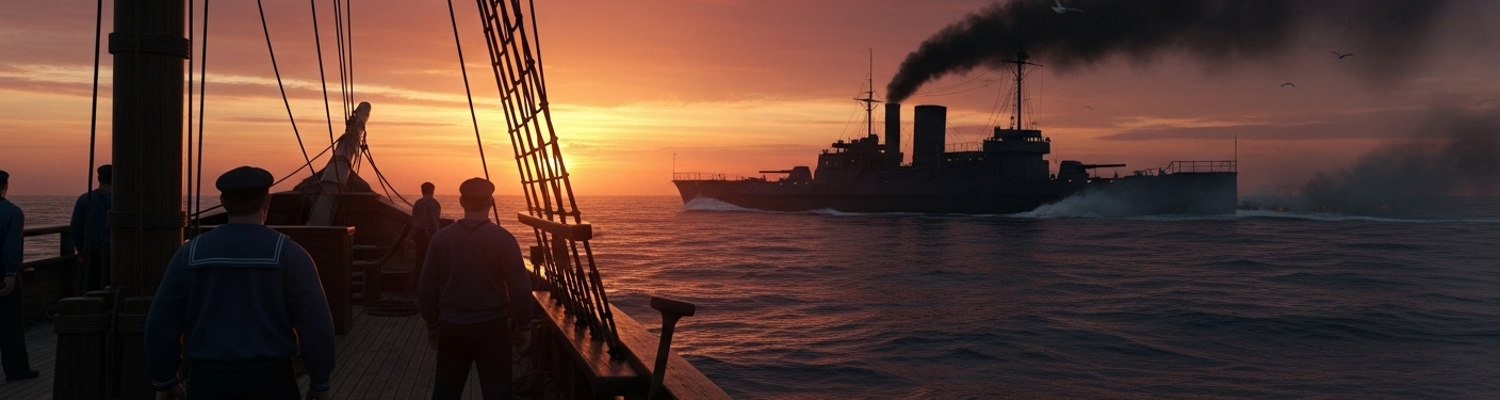

The Forging of a New Reality
The United States Navy emerged from the War of 1812 with a justified confidence. Its heavy frigates, like USS Constitution, had bested their British counterparts in single-ship duels, proving the value of superior ship handling, gunnery, and robust wooden construction. For the next two decades, this model defined American naval power. The ship-of-the-line, with its tiers of solid-shot cannon, remained the ultimate arbiter of sea control. Naval doctrine, solidified over centuries of combat under sail, was predicated on the resilience of oak hulls and the grim arithmetic of exchanging broadsides until one crew or ship could take no more. This established order was about to be rendered entirely obsolete. A French artillery general, Henri-Joseph Paixhans, had published his 1822 treatise, Nouvelle force maritime et artillerie. In it, he theorized a weapon that would shatter the age of wood and sail. The advent of a naval gun capable of firing a large, flat-trajectory explosive shell was not merely an improvement in ordnance. It was a technological rupture that invalidated centuries of warship design and tactical belief, confronting the US Navy with a stark, brutal warning: adapt or face annihilation on a scale previously unknown. The era of the exploding shell had begun, and with it, a revolution that would coat the seas in fire and forge the ironclad.
A New Kind of Fire
The US Navy formally acknowledged the threat and potential of the new ordnance in the early 1840s. While French experiments had been ongoing since the 1820s, it was the clear and present danger that spurred action. Following promising evaluations of the weapon’s capacity to demolish wooden structures, the Navy contracted for its own Paixhans-type guns in 1841. These weapons, produced by foundries like West Point and Cyrus Alger’s South Boston Iron Works, were designated as 8-inch and 10-inch shell guns. The US Navy equipped several vessels with 8-inch guns, weighing between 63 and 55 cwt (hundredweight), starting in 1845. A heavier 10-inch shell gun of 86 cwt followed. By the mid-1840s, these weapons were part of the armament on ships as significant as the USS Constitution and the new steam frigates USS Mississippi and USS Susquehanna.
The technical departure from traditional cannon was profound. A standard 32-pounder solid shot cannon of the era was designed to batter and punch through a wooden hull, creating a shower of lethal wooden splinters and, with enough punishment, compromising the ship’s structural integrity. Its effect was cumulative. The Paixhans gun operated on a principle of catastrophic, immediate destruction. The 8-inch gun fired a hollow, cast-iron sphere weighing roughly 52 pounds, filled with a black powder bursting charge. The 10-inch gun threw an even larger projectile. These guns were 'chambered,' with a conical area for the propellant charge, a design borrowed from mortars, which allowed them to be lighter than a solid-shot gun of the same caliber. Fired with a reduced propellant charge, the shell had a lower velocity than solid shot, but enough energy to pierce the side of a wooden warship. Once through the hull, a time fuze, a simple powder train in a wooden or metal tube ignited by the gun’s discharge, would detonate the main charge inside the ship.
The effect was devastating. Where solid shot punched holes, the exploding shell created a localized blast of fire and shrapnel within the confines of a packed gun deck. The blast could dismount enemy cannons, kill or maim entire gun crews, and tear apart the ship’s internal structure. Worse still was the incendiary effect. The explosion of the black powder charge acted as a massive ignition source, instantly setting fire to the ship’s dry timbers, rigging, and stored powder cartridges. A single well-placed shell could start a blaze that, on a wooden ship at sea, was often uncontrollable and spelled the vessel’s doom.
The Battle of Sinop in November 1853 provided a terrifying, real-world demonstration. A Russian fleet under Admiral Pavel Nakhimov, armed with modern Paixhans guns, annihilated an Ottoman Turkish squadron of wooden frigates and corvettes. The Russians lost no ships. The Ottomans lost seven frigates, two corvettes, and three thousand men. The ships were not just sunk; they were burned to the waterline by explosive shells. The world's navies, including the US Navy, received the message with chilling clarity. The age of tough, resilient wooden warships that could absorb immense punishment was over. Now, any ship of the line could be crippled or destroyed by a few hits.
The End of the Old Rules
The existence of the shell gun forced a complete and panicked re-evaluation of naval tactics. The established doctrine of close-range broadside engagements, the 'Fighting Instructions' that had governed naval battles for over a century, became a recipe for mass suicide. To bring a ship-of-the-line yardarm-to-yardarm with an enemy now meant exposing its vast, vulnerable wooden side to a weapon that could set it aflame from stem to stern. The tactical calculus shifted from attrition to sudden, decisive destruction.
This existential threat altered strategic planning for the US Navy, a service whose very identity was built on the prowess of its wooden fleet. Officers like Commodore Matthew C. Perry, a key figure in naval modernization and an advocate for steam power and improved ordnance, were at the forefront of this shift. Perry’s own command, the steam frigate USS Mississippi, carried ten Paixhans guns during his mission to Japan, a clear signal of the weapon’s importance.
The new reality dictated that engagements must begin at longer ranges. The objective was no longer to close for a decisive slugging match but to land a crippling explosive shell on the enemy before he could do the same. This placed a new premium on gunnery accuracy and range, spurring the work of innovators like John A. Dahlgren, whose scientific approach to ordnance would lead to his own famously powerful and safe cannon designs. It also signaled a change in fleet composition. The gradual replacement of numerous smaller guns with a few, larger-caliber shell guns began.
This tactical re-evaluation also diminished the role of the boarding action, a staple of naval combat for centuries. Closing to board an enemy vessel was hazardous enough in the age of sail and solid shot. Attempting to do so against a ship armed with shell guns meant potentially grappling with a vessel that was a raging inferno, its magazines moments from detonating. The focus of combat shifted decisively from the cutlass and pike to the artillery duel.
The primary failure of this era was one of imagination and institutional inertia. While the US Navy adopted the guns, it was slow to grasp the full tactical and strategic consequences. It continued to build large, wooden-hulled steam frigates through the 1850s, such as the impressive Merrimack-class. These ships were powerful and fast, but they were ultimately flammable targets in a world now dominated by the explosive shell. They were magnificent failures, obsolete on the drawing board.
The Inevitable Iron Coffin
The direct and unavoidable lineage of the exploding shell leads to the ironclad warship. If thick oak walls could be splintered and set ablaze, then ships needed a new skin impervious to this threat. The logic was inescapable, and its first official manifestation in the United States was a design far ahead of its time: the Stevens Battery. Proposed in 1841 by Robert L. Stevens and his brother Edwin, and authorized by Congress in 1842, this vessel was conceived from the outset as a 'shot- and shell-proof' armored steamer. Their initial tests proved that 4.5 inches of iron plating could defeat cannon fire, validating the concept. The original design called for a 250-foot, semi-submersible ironclad with sloped armor, propelled by steam screws to an estimated 18 knots.
However, the Stevens Battery became a case study in developmental failure. Plagued by funding disputes, changing requirements from the Navy, and endless delays, the ship languished in its Hoboken, New Jersey, drydock for decades. It underwent several redesigns, each one larger and more complex, as the power of artillery grew, creating a vicious cycle where the armor was never quite enough for the newest gun. It represented a failure of procurement and political will, not of engineering vision.
While the Stevens Battery rusted, the operational proof of the shell gun’s dominance arrived with the American Civil War. The Confederate Navy, lacking the resources to build a conventional fleet, turned to ironclads out of necessity. The conversion of the captured and burnt hull of the USS Merrimack into the ironclad ram CSS Virginia was a direct response to the Union’s wooden blockade. The Virginia’s mission was simple: to use its iron armor to shrug off the shells of the Union’s wooden frigates and systematically destroy them.
On March 8, 1862, the Virginia did exactly that, destroying the USS Cumberland and the USS Congress at Hampton Roads with terrifying ease. The solid shot from the Union warships bounced harmlessly off its iron casemate. Meanwhile, the Virginia's shell guns tore through the wooden hulls of the Union ships, turning their gun decks into slaughterhouses of fire, splinters, and shrapnel. The USS Cumberland went down with its flags flying, but it went down. The USS Congress, set ablaze and helpless, was forced to surrender. It was the bloody confirmation of everything Paixhans had predicted.
The Union’s immediate, desperate response was the commissioning of its own ironclad, the USS Monitor. Designed by John Ericsson, the Monitor was a radical vessel built for one purpose: to fight and defeat the Virginia. The resulting duel between the two ironclads on March 9, 1862, famously ended in a tactical draw, but it was a strategic watershed. It proved that only an armored ship could fight another armored ship. The wooden warship, the foundation of naval power for centuries, had been rendered a helpless liability. The exploding shell had created a problem that only iron and steam could solve, and in doing so, it had revolutionized naval warfare forever.