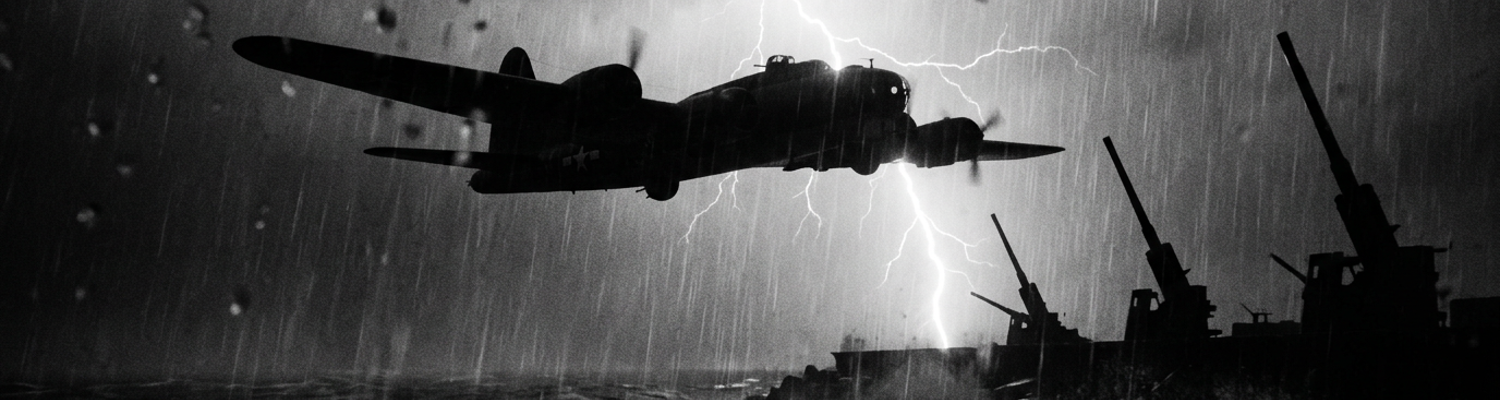

Coastal Anti Aircraft Defenses at Balikpapan
The cockpit of a modified B-24 stank.
Aviation gas fumes pooled around the rudder pedals. Decomposing mangrove mud clung to flight boots. Burnt cordite residue coated the aluminum bulkheads. A cynical combat veteran knew the math. The numerical superiority of Japanese coastal anti aircraft artillery batteries ringing Balikpapan guaranteed a high probability of death. Surviving meant a calculated gamble. Crews breached safety regulations by sending solitary aircraft skimming coastal wave crests. They flew below radar line of sight in torrential equatorial squalls. The mathematical trade offs between flak attrition and controlled flight into terrain dominated every pre flight briefing. Pacing inside the aircraft felt sluggish. Endless cockpit holds dragged on.
When examining the historical record of October 1944, Balikpapan contained the densest anti aircraft grid in the Southwest Pacific Theater. Imperial Japanese Army and Special Naval Landing Force units secured the Pandansari refinery complex and the adjacent landing strips at Manggar and Sepinggan behind layers of fixed and mobile ordnance. Fire emplacements integrated Type 88 75mm anti aircraft guns and heavy Type 99 88mm batteries. Twin mount Type 96 25mm autocannons sat dug into revetments along the ridgelines overlooking Manggar. Battery commanders calibrated these positions to create overlapping kill zones directly above the crude oil storage tanks and cracking towers. Shells from these batteries were pre fused to saturate incoming flight axes between 14000 and 22000 feet. Every square kilometer of coastal airspace along the refinery approaches fell within the effective radius of at least three separate heavy flak positions.
The sky belonged entirely to the guns.
A close review of operational logs indicates that standard USAAF high altitude daylight tactics collapsed against this density of fire. Long range B-24 Liberators from the Thirteenth and Fifth Air Forces flew out of newly captured airfields on Morotai and Noemfoor. They sustained severe compounding attrition while attempting daylight level bombing runs over the petroleum infrastructure. Heavy flak detonations shredded control cables and ruptured unarmored wing fuel tanks. Flight formations fragmented before bomb bay doors could open over the primary aiming points. During the strike missions of late September and early October 1944, entire squadrons took direct flak hits at the initial point of their bomb runs. Aircraft losses and damaged airframes exceeded acceptable replacement ratios. Combat group commanders watched tight defensive box formations disintegrate under sustained optical and predictor directed barrage fire. Crippled four engine bombers spiraled into coastal swamps. Other crews forced emergency water ditchings hundreds of miles from rescue craft.
High altitude saturation had become suicidal.
Archival evidence shows that coastal defenses along the Makassar Strait achieved high accuracy by linking coastal artillery directly to unified detection chains. Japanese engineers constructed elevated optical observation towers along the ridge points of Cape Tokong. Spotters used Type 94 stereoscopic rangefinders and acoustic sound locators positioned to detect radial engine signatures through sea haze. Spotting data ran through buried copper landlines to subterranean command bunkers. These bunkers plotted targeting coordinates for coastal battery emplacements and high intensity carbon arc searchlight units positioned along the surf line. At night, searchlight crews operated in synchronized triangulations. They locked approaching aircraft inside converging light beams to hand off bearing and altitude data directly to rapid firing coastal autocannons. This integrated sighting apparatus enabled gun crews to lay heavy barrages along the water edge without relying on early generation radar sets. Tropical humidity frequently degraded those early sets. Target plots updated every three seconds.
Japanese Tachi Radar Networks and Fire Direction
Archival evidence shows that Japanese defensive infrastructure across eastern Borneo relied on fixed radar stations positioned along elevated terrain features overlooking the Makassar Strait. On the limestone ridges behind Balikpapan and near Cape Tokong, the Imperial Japanese Army deployed ground based early warning systems. These were designated primarily as Tachi-6 sets. These metric wave radar stations operated between 68 and 80 megahertz. They utilized dipole antennas strung between guyed wooden lattice towers to sweep the maritime approaches. Station records confirm that these early warning arrays maintained a peak transmission output between 10 and 50 kilowatts. Under optimal atmospheric conditions, a Tachi-6 installation detected medium and heavy multi engine aircraft at ranges up to 300 kilometers. Heavy tropical humidity and coastal ducting frequently created significant sea clutter on the cathode ray indicators. Near the Pandansari oil storage tanks and the Manggar airstrip, Japanese radar engineers established secondary positions for Tachi-2, Tachi-3, and Tachi-4 gun laying units. Operating around 200 megahertz, these sets relied on rotating Yagi Uda antenna arrays to acquire incoming aircraft within a 30 to 50 kilometer envelope. They resolved azimuth and range data directly over open water.
Echo returns traveled directly to subterranean plotters.
A close review of operational logs indicates that coastal battery commanders integrated these incoming radar signals into their primary gun laying networks. Cable connections linked the Tachi-4 receivers directly to subterranean plotting centers housing Type 98 predictive calculators and mechanical plotting boards. Ground personnel manually translated radar blips observed on the A-scopes into Cartesian coordinates. They plotted velocity, flight heading, and altitude bands. Once plotters tracked a steady vector across multiple sweeps, target data moved via shielded underground telephone cables directly to 22nd Naval Base Force positions and Army artillery detachments ringing Balikpapan Bay. Coastal batteries operating Type 88 75mm guns and Type 99 88mm guns received firing solutions while Allied planes remained beyond the visual horizon. Battery directors calculated the shell time of flight. Crews set mechanical powder train fuses on high explosive ordnance before loading the breeches. Gun tubes elevated and traversed in unison according to director dials. Coastal artillery officers bypassed optical rangefinders entirely. They primed multi gun batteries to saturate designated approach corridors with fixed altitude flak boxes along the predicted track.
A multi plane formation generated a single massive target pulse on Japanese oscilloscopes.
When examining the historical record of Thirteenth Air Force strikes during October 1944, standard USAAF doctrine directly amplified this radar tracking capability. Tactical guidelines required B-24 Liberators to fly in compact stepped combat box formations consisting of 18 to 24 heavy bombers positioned between 16000 and 22000 feet. This doctrine sought to maximize mutual defense against fighter interception by overlapping .50-caliber gun turrets. Against ground based Tachi radar nets, these sprawling airborne clusters created massive radar cross sections. Dozens of rotating metal propellers and high aspect Davis wings reflected metric wavelength pulses with exceptional intensity. This flooded Japanese radar scopes with distinct wide band target spikes. Tachi-6 operators tracked these consolidated formations over 150 kilometers away from the coastline. Battery commanders received up to twenty five minutes of advance warning. Gun directors tracked the formation as it established a steady course during the mandatory three minute straight and level bombing run required by the Norden bombsight. Defensive box formations prohibited evasive maneuvering during this run. The bombers were trapped inside the pre calculated flak kill zone. High velocity fragment patterns sliced through thin aluminum skins and severed hydraulic lines. Wing tanks ignited. Multi plane flights scattered before their bomb bay doors opened.
Shrapnel from a single 88mm airburst damaged multiple adjacent aircraft flying within thirty yards of each other.
SB 24 Snooper Avionics and Radar Configurations
Archival evidence shows that field depots in New Guinea stripped standard B-24D and B-24J airframes down to bare stringers to fit experimental avionics into the heavy bomber. Depot technicians unbolted the Sperry ventral ball turret from the aircraft belly. They removed twelve hundred pounds of retracting mechanisms, hydraulic pumps, and gun hardware. Mechanics sealed the fuselage opening with a fixed aluminum cover or installed a dielectric radome housing the scanner for the SCR-717 ten centimeter search radar. Ground crews cut away heavy steel armor plates from the cockpit bulkhead and stripped the pilot seats of protective backing. Waist gun armor glass, ammunition track enclosures, and forward blast shields were tossed onto depot scrap piles to offset the weight of electronic assemblies. In several conversions, sheet metal workers deleted the heavy power operated nose turret. They replaced the assembly with an unarmored fairing or lightweight manual gun mounts. Severe buffeting along low level maritime profiles stressed the lightened fuselages. Ground personnel riveted external aluminum doubler plates along the lower longerons. This systematic stripping freed up more than two thousand pounds of useful load for auxiliary fuel cells and high output direct current inverters.
Weight reduction came at the immediate expense of crew survivability.
A close review of operational logs indicates that the 868th Bombardment Squadron fitted their modified SB-24s with AN/APR-1 radar search receivers at depot facilities on Los Negros (NARA Record Group 338). Field units fitted this electronic reconnaissance suite with swappable TN-1, TN-2, and TN-3 tuning units to search radio bands between 40 and 1000 megahertz. Inside the stripped waist compartment, the countermeasure operator manually swept across target frequencies using vernier dials. They tracked audible pulse repetition rates through sealed leather headsets. Incoming pulses registered on an attached pulse analyzer and analog deflection meters. This revealed signal intensity and beam rotation speed. Corrosive salt air degraded the coaxial antenna fittings on the fuselage exterior. Electrical arcs from nearby tropical storm cells frequently burned out the fragile crystal mixers in the tuning heads. By recording heading variations against signal spikes as the bomber skimmed the water outside Balikpapan, the operator isolated the metric transmission frequencies of Tachi-6 early warning arrays and the 200 megahertz carrier waves of Tachi-4 fire control radars. Flight navigators used these real time signal bearings to trace blind corridors between overlapping radar sweeps fixed on Cape Tokong and Manggar.
Intercepted frequencies dictated the final ingress heading.
When examining the historical record of night strikes against the Pandansari refineries, radar operators achieved blind bombing accuracy through the AN/APQ-5 low altitude attachment. Engineers designed this analog computer to wire directly into the circuitry of the SCR-717 search radar. It translated raw target returns into an expanded B-scope presentation. Target reflections appeared on a rectangular grid that magnified returns along range and azimuth axes rather than a compressed circular display. Operational crews wired the computing chassis directly to the aircraft directional gyro and the bomb bay electrical release solenoids. During runs between two hundred and eight hundred feet over the water, the radar observer locked a movable tracking index over the radar return of oil storage tanks or anchored merchant ships. Vacuum tubes inside the analog resolver routinely overheated in unpressurized tropical compartments. This caused internal resistor values to drift during prolonged low level holding patterns. Internal resolvers calculated airspeed, absolute altitude, and projectile ballistics before triggering the release circuit at the calculated release point. Depot electricians calibrated the timing relay to trip within thirty milliseconds of calculated intercept.
Night Monsoon Ingress Tactics at Low Altitude
Daylight mass raids against East Borneo were formally shut down.
When examining the historical record of October 1944, XIII Bomber Command records reveal that staff planners threw out established USAAF heavy bomber doctrine following the disastrous strikes of the 5th and 307th Bombardment Groups. Massed combat boxes flying at 18000 feet had suffered intolerable losses over the Pandansari refineries. High altitude daylight saturation could not survive against integrated Imperial Japanese Army flak arrays and direct laying radar. Lieutenant General George Kenney authorized the 868th Bombardment Squadron to strip away standard operating procedures entirely. Squadrons abandoned fighter escorts and daylight multi plane formations in favor of lone unescorted SB-24 Liberator sorties launched in complete darkness. Aircrews received flight profiles mandating absolute radio silence and cruising altitudes held below three hundred feet across the entire maritime transit. Solitary bombers departed staging airfields on Morotai and Noemfoor separated by thirty minute intervals to prevent electronic interference between onboard radar receivers. Removing daylight escorts left each individual crew completely isolated without defensive crossfire. Survival depended entirely on remaining invisible to coastal observation posts. Flight directives strictly forbade climbing above three hundred feet until bombs had released over the primary target.
A close review of operational logs indicates that pilots deliberately sought out equatorial weather fronts churning across the Makassar Strait. Intertropical Convergence Zone monsoon squalls produced vertical rain sheets, intense static discharges, and cloud bases that dropped directly onto the water. Sweeping in between one hundred fifty and two hundred fifty feet above the swell, SB-24 crews utilized these torrential downpours as physical screening shields. The physics of Japanese metric wave radar dictated this tactical ceiling. Tachi-6 early warning arrays on the Cape Tokong limestone cliffs operated on line of sight propagation. They cast an electronic radar horizon that could not depress below the curvature of the sea surface. At altitudes below three hundred feet, incoming aircraft merged directly into ocean surface clutter on Japanese cathode ray tubes. Multipath signal cancellation scattered the 70 megahertz pulses across breaking wave tops. Flight engineers monitored the SCR-718 high altitude radio altimeter as it tracked wave troughs. They compensated for saltwater spray that caked the transmitter dipoles beneath the fuselage. Flying inside heavy equatorial rain cut Japanese visual spotters off entirely and degraded coastal sound locators. Salt encrustations dried on unheated cockpit glass. Pilots flew purely on gyro horizons while salt spray lashed the wing surfaces.
One wrong rudder tap meant striking the ocean.
Archival evidence shows that contour approaches across the Borneo shoreline introduced extreme rates of controlled flight into terrain. As the SB-24 crossed the surf line near the Manggar coastal mudflats, the radar altimeter reflected erratically off the shifting boundary between open water and eighty foot mangrove canopies. Tropical humidity and rapid barometric pressure swings across rain squalls caused mechanical Kollsman altimeters to lag by as much as eighty feet. This fed pilots fatally delayed elevation data. Pitot static tubes repeatedly clogged with driving rain and airborne salt residue. Airspeed indicators froze or swung wildly during sudden throttle adjustments. Maintaining pitch stability required brutal physical exertion on the heavy control yoke. Low altitude turbulence over the tidal creeks threatened to drop the heavily weighted high aspect Davis wing into an unrecoverable stall. In zero visibility night rain, pilots could not differentiate between black open water, low lying mangrove swamps, and rising terrain ridges. Sudden downdrafts spilling over the coastal hills pushed four engine bombers downward at twenty feet per second with zero visual warning. Navigators tracked radar returns from the SCR-717 scanner to identify river mouths. Local tree lines did not generate clean electronic edges on the cathode ray tube.
Flight crews had six seconds to clear the tree canopy before entering the flak envelope.
Combat logs from the 868th Bombardment Squadron record that pilots locked their eyes onto the dim red phosphorescence of the primary attitude indicators while flying at two hundred feet indicated altitude. The heavy Pratt & Whitney R-1830 radial engines operated at high continuous manifold pressure. They burned seventy gallons of aviation fuel per hour per engine to fight heavy trim drag. Saltwater mist drawn through the carburetor air intakes caused cylinder head temperatures to fluctuate. This risked sudden backfires that could reveal the bomber position to coastal sound detectors. Waist gunners stood knee deep in spent brass casings and leaking bilge water inside unpressurized freezing compartments. They watched the black silhouettes of palm fronds flash underneath the lower fuselage skin at two hundred knots. Ground crews back at Morotai frequently discovered severed mangrove branches wedged into the lower bomb bay door tracks and twisted radio antenna wires wrapped around the empennage de icing boots.
Electronic Suppression of Manggar Radar Batteries
A close review of operational logs indicates that electronic warfare operators systematically subverted Far East Air Forces command doctrine during nocturnal bomb runs over eastern Borneo. USAAF technical orders and XIII Bomber Command operational directives restricted modified SB-24 crews to passive electronic reconnaissance. They mandated minimum operating altitudes of five thousand feet to keep experimental radar detection apparatus away from ground fire. Frontline operators in the 868th Bombardment Squadron threw out these standing instructions during target runs against coastal batteries. Crammed into stripped unpressurized waist compartments, countermeasure specialists rewired their AN/APR-1 receivers to bypass factory frequency restrictors. Standard operational doctrine dictated that crews break contact and dispense chaff upon detecting an active anti aircraft radar lock. Operators ignored this instruction. They patched raw homing signals straight into the flight deck interphone to guide the pilot directly down the boresight of the Japanese transmission beam at two hundred feet. Specialists bypassed factory thermal limiters on the SCR-717 and AN/APQ-5 systems. They drove vacuum tubes past certified tolerance levels to keep target returns visible through driving tropical rain squalls.
The transmission beam became the bomber flightpath.
Archival evidence shows that crews converted these intercepted signals into direct radar homing strikes against active Tachi gun laying antennas guarding the Manggar airfield corridor. Japanese Army coastal artillery detachments relied on metric Tachi-4 installations along the beach margins. They used rotating Yagi antenna arrays operating near 200 megahertz to feed firing data directly to Type 88 75mm and Type 99 88mm gun pits. The SB-24 radar observer tuned the TN-2 receiver head to match the specific pulse repetition frequency of the Manggar fire control set. The aircraft skimmed the breaker line at one hundred eighty feet indicated altitude. Signal strength needles pegged at maximum deflection as the nose swung toward the emitter. Flying down the center of the beam stripped the gun battery of its predictive lead angle. The low incoming altitude prevented the Tachi-4 antenna from depressing low enough to resolve altitude data above sea clutter. At three hundred yards from the signal origin, the pilot toggled the bomb release solenoids. Strings of parachute retarded 500 pound general purpose bombs and 100 pound fragmentation clusters slammed into the timber lattice masts, receiver trailers, and diesel generators. Detonations blew the wooden antenna towers apart and severed subterranean copper signal lines connecting the radar receivers to the mechanical gun computers.
Zero target updates reached the coastal batteries.
When examining the historical record of late June 1945, these precision radar strikes completely dismantled the defensive grid prior to Operation Oboe Two. The Imperial Japanese Army 22nd Naval Base Force depended on elevated Tachi-6 early warning arrays on the coastal ridges above Manggar and Cape Tokong to track maritime traffic entering the Makassar Strait. These stations operated on metric frequencies between 68 and 80 megahertz. They provided Japanese command posts with up to forty minutes of warning before Allied ships reached firing range. In the seventy two hours preceding the daylight landings, lone SB-24s flew coordinated night interdiction patterns. They used directional homing antennas to isolate every active radar site along the coastline. Low level bomb salvos destroyed the primary dipole arrays and flattened the generator shelters across the Manggar ridgeline. Disabling these early warning networks eliminated Japanese long range detection. Coastal gunners could not calculate solutions against incoming Fifth Air Force bombardment groups or spot the armada of landing craft crossing the offshore sandbars on the morning of July 1. Japanese artillery officers received visual confirmation of the invasion fleet only when naval bombardment shells were already detonating on their revetments.
Allied Ferret Crews and Postwar War Crimes Trials
Archival evidence shows that prosecutors at the International Military Tribunal for the Far East spent months reconstructing the fate of downed electronic warfare personnel across Southeast Asia. During courtroom proceedings recorded across transcript pages 7642 to 8634, Allied prosecutors introduced captured Imperial Japanese Army Seventh Area Army operational daybooks, Kempeitai field reports, and anti aircraft battery registries from the Balikpapan defensive sector. These exhibits tracked the mechanical expenditure of Type 88 75mm and Type 99 88mm ammunition alongside radar telemetry logs from ridge top stations. Japanese defense attorneys struggled to explain ledger notations documenting radar pulse anomalies registered by coastal Tachi receiver units prior to sudden antenna demolitions. Several registries entered between pages 7642 and 8634 detailed the recovery of charred AN/APR-1 tuner components, shattered aluminum fuselage stringers bearing radar receiver markings, and isolated survivors pulled from mangrove shorelines near Manggar airfield. Seventh Area Army staff officers systematically stamped these incident files with directives mandating immediate field disposal.
The paper trail ended at coastal garrison headquarters.
When examining the historical record of captured Ferret and Snooper personnel, Japanese field commanders applied the Imperial Japanese Enemy Airmen Act to deny captive radar crews standard prisoner of war protections. Enacted by imperial sanction in August 1942, this law stripped aircrews of immunity if their flight paths targeted non combat facilities or operated outside recognized formation doctrines. Kempeitai interrogation officers at Balikpapan and Banjarmasin subjected downed countermeasure operators to systematic physical beatings to extract operating frequencies of AN/APQ-5 analog computers and pulse matching procedures. Japanese theater headquarters classified their radar suppression runs as deliberate terror attacks against coastal oil processing facilities rather than lawful military combat. Seventh Area Army staff directives explicitly authorized local garrison commanders to dispense with military trials. Field commanders ordered summary executions via beheading or lethal injection in the secondary jungle tracts behind Manggar airfield and Klandasan. Australian military war crimes investigators exhuming mass burial trenches in late 1945 recovered skeletons showing blindfolds, wire bindings around wrist bones, and traumatic cervical vertebrae fractures from heavy sword blows.
None of the captured operators survived captivity.
A close review of operational logs indicates that Allied reconnaissance commands maintained secretive compartmentalized loss accounting for electronic warfare platforms between October 1944 and August 1945. Far East Air Forces and XIII Bomber Command assigned modified SB-24 Snooper and Ferret aircraft from the 868th Bombardment Squadron to specialized night strike roles. Loss rates routinely exceeded standard heavy bomber daytime operations by twelve to fifteen percent. Skimming open ocean swells below three hundred feet eliminated early warning radar detection but drastically escalated non combat crashes. Controlled flight into terrain and water impact accounted for over forty percent of total airframe write offs. USAAF statistical control units categorized downed Ferret aircraft as missing on special operational flights to prevent Japanese intelligence from deducing the scale of airborne signal gathering deployments. When low level radar jammers failed or engines took anti aircraft fragment hits over Balikpapan Bay, aircraft vanished into night squalls without radio transmissions. They left no wreckage for rescue Consolidated PBY Catalinas operating out of Morotai. Operational registries compiled after V-J Day confirmed that out of forty two heavily modified SB-24s deployed across the Southwest Pacific in late 1944, twenty six airframes were lost in combat actions or low altitude weather crashes by August 1945.
Declassified theater inventories listed the surviving sixteen airframes as depot salvage.