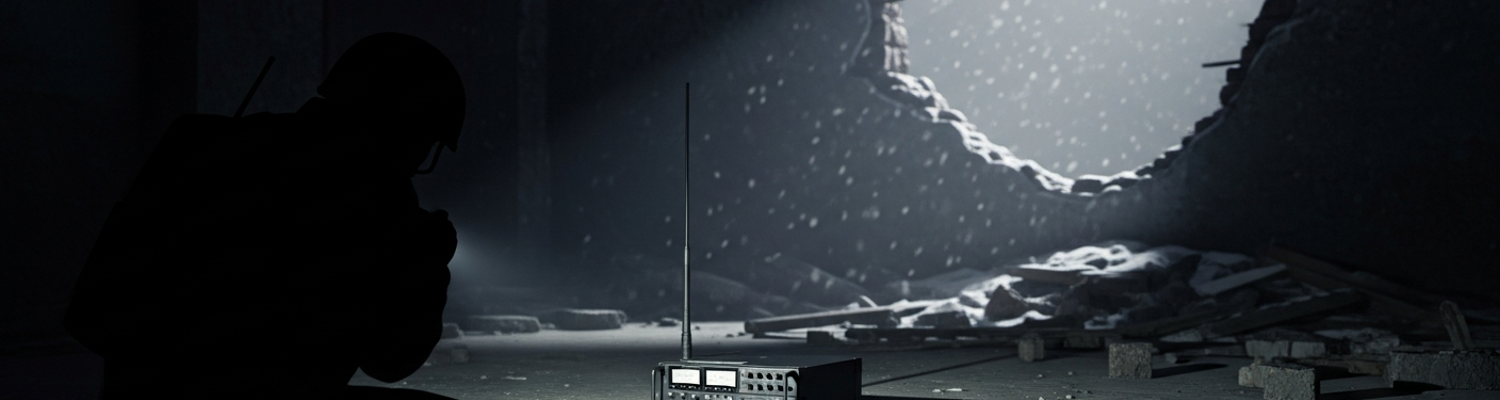

Krovograd Sector Communication Failure
Operational logs from the 18th Engineer Brigade show the blizzard began its assault on the Krovograd industrial sector just after 0200 hours. For the eight men of Engineer Team 8, located in the sub-level of a ruined transformer house, the storm was a secondary concern. Their focus was the failing AN/PRC-77 man-pack transceiver, their sole connection to Battalion Headquarters.
The unit’s radio-telephone operator had reported weakening transmission quality for the past hour. This was a common symptom of degraded battery performance in sub-zero temperatures. Standard issue BA-4386/U magnesium batteries were known to suffer significant output drops in extreme cold. The team’s spares were equally cold-soaked.
Shortly after 0230, during a routine situation report to callsign Havoc-6, the transmission dissolved into a burst of static before cutting out. The silence was absolute. The operator immediately worked to diagnose the fault. He swapped the H-189/GR handset and checked the security of the AT-892 steel tape antenna base. The unit remained inert. He then unclipped the entire RT-841 transceiver from its battery box, inspecting the contacts for ice or corrosion. Finding none, the logical conclusion was total battery failure. This was a catastrophic power loss that no amount of immediate troubleshooting could resolve.
The radio's functional cessation plunged Team 8 into a state of complete operational blindness.
Their position was inside Grid Square 7G, a heavily contested zone on the western edge of the Krovograd urban sprawl. The area, dominated by the skeletal remains of prefabricated apartment blocks and the sprawling Zarya-4 chemical plant, offered countless points of concealment for Warsaw Pact motorized rifle patrols. Allied intelligence had specifically warned of sniper teams operating from the upper floors of the Red October housing complex, less than 400 meters to their east. The blizzard, while providing a blanket of concealment, also made any movement impossible. Visibility dropped to less than ten meters, turning the rubble-strewn streets into an indistinguishable maze.
Escape was not an option.
The engineers were physically pinned down in their makeshift command post, a cramped and frozen concrete room. They had no way to know if an enemy force was massing for an attack just beyond the veil of snow. This isolation was not merely tactical; it was a complete severance from the command structure. Team 8 had missed its scheduled 0300 communications window with Battalion HQ. For the command element miles to the rear, a unit going dark in a high-threat sector triggered immediate contingency protocols. Without the team’s reconnaissance reports or their ability to call for artillery support, the operational picture for the entire Krovograd sector was dangerously incomplete. The eight men were now a ghost element on the battlefield map.
Improvised Transceiver Field Repair
The responsibility for resurrecting the AN/PRC-77 fell to Sergeant First Class Elias Blunt, the team’s designated communications specialist (MOS 31U). His role within the 18th Engineer Brigade was a hybrid of technician and infantryman. After confirming the complete failure of the BA-4386/U magnesium battery, his attention turned to the RT-841 transceiver unit itself. The extreme cold was a known antagonist to military electronics. Blunt’s primary suspect was the transistorized power amplifier stage, a known point of failure that had replaced the more robust, though heavier, vacuum tube of the older AN/PRC-25 model. A failure here would render the radio inert, regardless of battery power.
Lacking a field repair kit or replacement modules, Blunt initiated a high-risk salvage operation. His only potential source for components was the team’s second, non-functional AN/PRC-77. This radio had been cannibalized for parts weeks earlier and was considered dead weight. Its own power amplifier was known to be defective. The hope was not for a simple swap, but to find tertiary components like resistors or capacitors that might have survived. Disassembly of the radios was a painful process. In the sub-zero temperatures, the metal casings were cold enough to adhere to exposed skin. The small captive screws securing the transceiver to its case required delicate handling with frozen, gloved fingers.
Blunt laid the components of both radios on a spare poncho, a forensic display of military electronics under extreme duress. The search was for a single, intact transistor or capacitor that could replace a suspected failed component in the primary radio’s amplifier module. This action was far outside standard maintenance procedures (per TM 11-5820-667-12), which called for the simple replacement of the entire sealed module.
The most unorthodox step in Blunt’s repair process involved an M-1950 field stove. These single-burner gasoline units were standard issue for heating rations, not for delicate electronic work. Blunt’s reasoning, recorded in a later debrief (AAR 18-ENG-BDE-78-11A), was that the sub-zero temperatures made the circuit boards and their soldered components incredibly brittle. Any attempt to desolder and replace a component on a frozen board would almost certainly result in a catastrophic fracture of the board itself. He needed to gently and evenly warm the entire module to a temperature where soldering became feasible without thermal shock.
He held the green metal circuit board of the amplifier module several inches above the low, blue flame of the M-1950. He used the stove not as a tool for soldering, but as a pre-heating element. This was an uncalibrated, dangerous procedure. Too much heat would melt the delicate circuits. Once he judged the board was sufficiently warmed, he used a standard-issue multitool and scavenged solder to perform the micro-surgery. He replaced a suspect transistor from the primary radio with one taken from the cannibalized unit. The entire process, from diagnosis to the final reassembly of the RT-841 transceiver, took nearly two hours.
Component Failure Under Sub-Zero Conditions
Blunt’s repair effort was not only a technical challenge but a direct physical battle against the cold. The temperatures inside the transformer house presented a constant threat of frostbite. Handling the small metal screws and components of the AN/PRC-77 with gloves was impossible, a fact that forced Blunt to work with bare hands. Contact with the super-chilled metal of the radio chassis could cause near-instantaneous frostbite. Operational doctrine for cold-weather environments mandates frequent breaks in warm shelters, a luxury Team 8 did not have. Blunt was forced into a dangerous cycle of work and re-warming, repeatedly pulling his hands away from the radio to restore circulation and sensation before returning to the task. The loss of fine motor control was his greatest adversary.
Numb fingers could easily drop a critical screw into the snow-dusted concrete floor, losing it forever.
While Specialist Blunt fought the physical effects of the blizzard, the AN/PRC-77’s internal systems were fighting their own battle. A review of military electronic performance in arctic conditions shows that primary failure points are often the subtle connections between components. The extreme cold would have had a direct impact on the solid-state circuitry. As temperatures plummet, the electrical characteristics of transistors and capacitors can change, altering their performance. An even greater danger was condensation. Moving the radio from the absolute cold into the slightly less frigid, body-heated air of the transformer house could create a thin, invisible layer of moisture on the circuit boards. This condensation can cause micro-short circuits. Blunt’s decision to pre-heat the amplifier module was a direct countermeasure to this threat, intended to gently evaporate any such moisture.
Beyond the electronic and human factors, the cold launched a physical assault on the materials of the radio. At temperatures well below freezing, many materials that are normally ductile become brittle. This phenomenon, known as a ductile-to-brittle transition, affects metals, plastics, and the solder used to hold circuits together. The metal casing of the AN/PRC-77, the plastic knobs, and the internal mounting brackets all would have lost their ability to flex. A simple act, like tightening a mounting screw, could have induced a stress fracture. This material fragility extended to the microscopic level. Solder joints become exceptionally vulnerable to cracking under thermal stress. The very act of soldering risked creating a thermal shock that could fracture the delicate connections around the repair site. Blunt’s pre-heating maneuver was therefore a procedure to reduce the thermal gradient across the board, minimizing the risk of creating new fractures.
Intermittent Fire and Psychological Strain
Blunt’s repair attempt was a race against time and sporadic, violent interruptions. After-action reports detail how the Zarya-4 chemical plant was a designated free-fire zone. The intermittent crack of a distant Dragunov sniper rifle, followed by the impact of a 7.62x54mmR round against the transformer house’s concrete shell, became a constant feature of the repair. This was suppressive fire, designed to degrade performance and instill fear. Each shot forced Blunt to drop his tools and flatten himself on the frozen floor, the electronic components of the AN/PRC-77 scattering across the poncho. The psychological effect was immediate; it broke his concentration and forced a reset of the painstaking process.
The silence between shots was filled with a different kind of dread. A review of Warsaw Pact urban doctrine from the period shows an emphasis on aggressive, continuous patrolling. Soviet motorized rifle platoons, often mounted in BMP-1 infantry fighting vehicles, were trained to systematically clear contested industrial areas. The low rumble of a diesel engine could mean a BMP was maneuvering through the blizzard less than a kilometer away. While the storm degraded its optical sights, the vehicle’s 73mm 2A28 Grom main gun and coaxial machine gun represented an overwhelming threat. The team posted two men as sentries, peering through cracks in the walls. Their fields of vision were choked by the swirling snow. Every gust of wind was interpreted as the sound of an approaching foot patrol.
This prolonged state of isolation began to exact a severe psychological toll. Operational logs from similar long-range missions note the rapid onset of mental fatigue when a unit is cut off from command. For Team 8, the lack of radio contact fostered a sense of abandonment. Studies on combat stress show this feeling can lead to a degradation of morale. The eight men, huddled together for warmth, became increasingly withdrawn. The normal chatter that sustains small units evaporated, replaced by a tense, watchful silence. Each man was trapped in his own internal loop of fear and doubt. The failure to make their scheduled communications window meant that, as far as Battalion HQ was concerned, Team 8 might already be lost.
Intermittent Signal Acquisition
The immediate aftermath of Blunt’s two-hour repair was defined by a harsh, unbroken stream of white noise. After reconnecting the scavenged transistor and reassembling the RT-841, he clipped the unit back onto a partially charged BA-4386 battery. The radio powered on, its frequency display glowing faintly, but attempts to transmit failed. A close examination of the AN/PRC-77’s design indicates the salvaged transistor, while functional, was likely not a perfect electrical match. This mismatch could have introduced instability in the transmitter’s voltage-controlled oscillator, causing the signal to drift off the selected frequency. For nearly an hour, the team cycled through troubleshooting steps. They switched between high and low power settings and tried different frequency bands, all to no avail. The initial hope following the repair evaporated.
A breakthrough came from a methodical process of elimination. While shifting position, one of the engineers bumped the AT-892 steel tape antenna. For a fleeting moment, a coherent voice cut through the static before vanishing. This was the clue. The problem was a compound failure of a damaged transmitter fighting to push a signal through a compromised antenna system in a disadvantageous location. The team began a systematic effort to find a repeatable transmission window. One man held the heavy radio aloft while another manipulated the flexible tape antenna, bending it toward a large shell hole in the wall. They discovered that by positioning the antenna at a precise 45-degree angle, aimed at the skeletal remains of a nearby apartment block, they could establish a fragile, intermittent link to the battalion net.
The signal was barely intelligible.
With a communication window that could be measured in seconds, the team leader composed the message. Standard operating procedure dictated a SALUTE report: Size, Activity, Location, Unit, Time, and Equipment. The primary intelligence was the observation of a Soviet BMP-1 infantry fighting vehicle conducting a patrol run less than an hour prior. The report was stripped to its bare essentials: Negative contact. One BMP, Grid 7G, moving west. Team 8 secure at Objective Crowbar, comms intermittent, awaiting instructions. The message was written on a waterproof notepad. The radio operator rehearsed it until he could speak the entire text in under five seconds. The operator took his position, holding the handset, while another engineer held the radio in the pre-established sweet spot.
The team leader gave a sharp nod. The operator depressed the transmit switch on his H-189/GR handset, spoke the compressed SALUTE report, and released. He then immediately switched the radio to receive, straining to hear a response. There was nothing. He tried again, repeating the message twice more into the electronic void. The only reply was the crackle of an empty frequency.
Fragmentary Intelligence and Tactical Diversion
At the 18th Engineer Brigade’s forward command post, the three transmissions from Team 8 were almost missed. A review of the signal logs from callsign Havoc-6 shows that at approximately 0548 hours, the radio-telephone operator noted a three-second burst of heavily distorted signal on the battalion command net. It was nearly dismissed as atmospheric interference caused by the blizzard. The signal was too weak to break the radio’s own squelch setting automatically. Only the operator’s decision to manually hold the squelch open allowed any of the message to be captured. The SALUTE report was functionally unintelligible on the first and second attempts. On the third and final transmission, the operator discerned three critical, broken fragments: ...BMP...Grid 7G...moving west...
This single, corrupted data point was the first communication from any asset in the Zarya-4 chemical plant sector in over four hours. Brigade intelligence had been operating under the assumption that the blizzard had halted all major vehicle movements. The potential presence of a Warsaw Pact infantry fighting vehicle actively patrolling in Grid 7G was a severe alteration to the tactical map. The information was immediately relayed to the brigade S-2 section, where it was cross-referenced with the last known disposition of friendly forces. The analysis was stark. A planned reconnaissance-in-force by elements of the 11th Armored Cavalry Regiment, designated Task Force Saber, was scheduled to advance directly through the western portion of Grid 7G within the next ninety minutes. Their route would have taken them directly into a potential engagement zone with a prowling BMP-1.
The command staff faced a dilemma: trust a single, garbled transmission from a unit presumed lost, or risk sending an armored column into a potential ambush. The decision was made at the brigade level. A review of command chronologies indicates that at 0610 hours, Task Force Saber was ordered to halt its advance. The unit was diverted to an alternate axis of attack, routing through the adjacent Grid 6F. This decision was based entirely on the three broken words from Team 8.