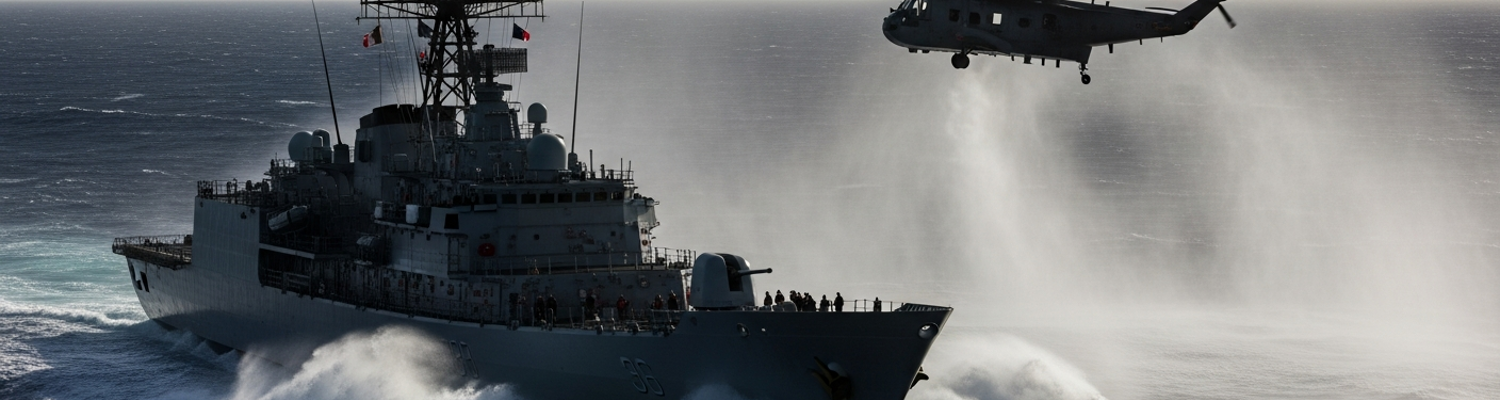

1976 Mediterranean Naval Posture
The Ionian Sea in late autumn was an expanse of slate-gray chop, its surface torn by a frigid, moisture-laden wind. A corrosive salt film coated every vertical surface of the American warships on patrol, eating at paint and exposed steel. Below decks, the oil-scented heat of engine rooms offered a sharp contrast to the biting cold on weather decks where watchstanders hunched against the spray. This was the physical environment of the Mediterranean in November 1976, an arena defined by mechanical wear and human endurance.
A close review of operational logs from the period indicates a sharp escalation in friction between the U.S. Sixth Fleet and the Soviet 5th Operational Squadron, the Eskadra. The primary American naval presence, centered around a carrier task group, found itself under near-constant surveillance. Archival evidence points to a specific pattern of harassment in the waters south of Crete. Soviet Kashin-class destroyers and Kresta II-class cruisers would conduct aggressive maneuvering, sometimes closing to within a few thousand yards of American carriers during flight operations. These actions were designed to test reaction times and gather electronic intelligence.
The American response was a heightened state of alert. Crews operated on a watch schedule that maximized readiness at the expense of rest. Onboard destroyers and frigates acting as the carrier’s defensive screen, electronic warfare technicians monitored a continuous stream of Soviet radar emissions, cataloging frequencies and signal patterns from platforms like the Tu-16 Badger and the Il-38 May.
Every radar contact was a potential threat.
Into this tense theater sailed the hospital ship USS Sanctuary (AH-17). Its mission was far more complex than providing humanitarian aid. The ship was a testbed for a new and unproven doctrine in naval medicine, a direct result of analyses on the vulnerability of large, slow, and unarmed support vessels to modern anti-ship weaponry. Planners within the Sixth Fleet determined that a single hospital ship would be an easily neutralized target. The operational concept assigned to the Sanctuary was one of distributed casualty care. Instead of waiting for casualties to be brought back to its advanced facilities, the ship was tasked with forward-deploying its surgical teams directly to the decks of smaller combatants via helicopter. These teams, consisting of a surgeon, an anesthesiologist, and two corpsmen, were drilled to be inserted onto the fantail of a frigate or destroyer to stabilize critically wounded sailors at the point of injury. SH-3 Sea King helicopters from Helicopter Combat Support Squadron 6 (HC-6) were attached to the Sanctuary, their crews practicing landings on pitching decks in all weather conditions, carrying specialized medical pallets instead of their usual cargo.
These new procedures were put into practice during a series of intense, fleet-level exercises held in late 1976 under the designation Swift Mend. The scenario for Swift Mend was stark: a coordinated, multi-axis simulated missile attack on a carrier task group by Soviet forces. The exercise simulated a saturation strike involving waves of AS-4 air-launched missiles from Tu-22M Backfire bombers and volleys of SS-N-12 cruise missiles from surface combatants and submarines. The primary objective was not to test the fleet’s air defenses but to evaluate its ability to absorb the damage and continue functioning. For the USS Sanctuary and its medical teams, Swift Mend was the definitive examination of their new role. A declassified after-action report (NARA Record Group 330) details a specific exercise event on November 28th, 1976. The Knox-class frigate USS Pharris (FF-1094) was declared hit by two simulated missiles. On the Pharris, smoke pots were ignited to create an atmosphere of chaos and zero-visibility, while umpires tagged specific crewmembers with cards detailing realistic battlefield injuries: shrapnel wounds, severe burns, and compound fractures. The exercise then hinged on a single metric: the time elapsed from the simulated impact on the Pharris to the moment a notional casualty was under surgical care.
Swarm Attack Simulation Parameters
The conceptual underpinnings of the high-speed small craft swarm attack, as envisioned by Soviet naval doctrine, were rooted in an acceptance of asymmetric exchange. Planners acknowledged that a single high-value NATO warship possessed defensive capabilities far superior to any individual Soviet missile boat. The solution was not to build a comparable vessel, but to deploy a multitude of inexpensive, expendable platforms designed to attack in a coordinated, overwhelming mass. A review of Soviet tactical literature from the period reveals a focus on three core design principles: speed, numbers, and multi-axis assault vectors. Fast attack craft like the Osa- and Komar-class boats, capable of speeds exceeding 40 knots, were engineered to minimize the defender’s reaction time. Their operational doctrine dictated that they would use coastal geography, darkness, or electronic jamming to mask their final approach, emerging as a dispersed group from multiple directions simultaneously. This approach was designed to deny the target vessel the ability to concentrate its defensive firepower on a single threat axis. The entire philosophy rested on a calculation: the loss of several low-cost missile boats was an acceptable price for inflicting a mission-kill on a vastly more expensive and strategically significant enemy combatant.
This was a mathematical equation of attrition.
The tactical objective of this doctrine was the complete saturation of a warship’s layered defensive systems. In 1976, a Knox-class frigate like the USS Pharris relied on a sequence of systems to defeat incoming threats. Long-range detection would come from the AN/SPS-40 air-search radar, which would then pass targeting data to the Mk 92 fire control system. The Mk 92, an Americanized version of a Dutch design approved for service in 1975, was a capable system for its era but possessed a finite number of channels. It could only track and guide weapons against a limited number of targets at once. Its primary interceptor was the RIM-7 Sea Sparrow missile, a weapon adapted from an air-to-air role that was effective but had limitations, including a minimum effective range and a slow response time from its launcher. For threats that leaked through the missile envelope, the final layer of defense was the Phalanx Close-In Weapon System (CIWS), a 20mm Gatling gun capable of firing 3,000 to 4,500 rounds per minute. The Phalanx, however, was a last-ditch weapon with an effective range of only about a mile, and its limited magazine could be depleted quickly when engaging multiple targets. A swarm attack was designed specifically to exploit these limitations by presenting the Mk 92 system with more targets than it could process and by launching so many missiles that the Sea Sparrow and Phalanx systems would be exhausted or bypassed.
For the Swift Mend exercise, these principles were translated into a specific and grueling threat scenario for the crew of the USS Pharris. Exercise controllers did not use live boats but instead injected a precise series of simulated electronic contacts directly into the frigate’s combat systems. Archival data from the exercise specifies a simulated attack by a dozen Turya-class fast-attack craft. These notional vessels, based on a Soviet hydrofoil-equipped torpedo boat design, were programmed with a top speed of 45 knots. The simulation parameters dictated their attack profile. Emerging from the radar shadow of a small, uninhabited islet several nautical miles from the frigate’s position, they would execute a coordinated, high-speed pincer movement. Within a five-minute window, the Pharris's radar consoles were flooded with the twelve distinct surface contacts. Each of which then launched two simulated SS-N-2 Styx anti-ship missiles, for a total of twenty-four inbound threats. The after-action report for the Pharris indicates that its Mk 92 system was overwhelmed within the first 90 seconds, failing to achieve a fire control lock on eight of the twenty-four missile tracks. The simulated hits that followed were the direct, calculated outcome of the scenario’s design.
Communications Severance Incident
The link to fleet command vanished. At 14:32 Zulu on November 28th, 1976, during the height of the Swift Mend exercise, every active communications circuit aboard the USS Sanctuary (AH-17) went dead simultaneously. The ship’s primary means of long-range communication, a rack-mounted AN/URC-32 high-frequency transceiver, lost its ability to send or receive radioteletype traffic from the exercise controllers at Naval Communication Area Master Station, Mediterranean (NAVCAMS MED). A review of the ship’s radio logs indicates that the Radioman on watch attempted to re-establish contact on alternate HF frequencies in the 8 MHz and 12 MHz bands. He was met with an impenetrable wall of static. Within seconds, the watch officer in the Combat Information Center reported a similar failure on the line-of-sight UHF channels used for tactical voice communication. The AN/WRC-1 radios, the workhorse for fleet common circuits, were likewise rendered useless. This was not a cascading equipment failure. The abrupt and total nature of the outage pointed to a deliberate, external action.
Every channel was noise.
An analysis of the electronic environment conducted by the ship’s technicians revealed a sophisticated and overwhelming jamming effort. The ship’s AN/SLQ-32(V)1 electronic warfare suite, a relatively simple receiver designed to provide warning of missile guidance radars, was not built for detailed signals analysis. However, its spectrum analyzer display showed a classic Soviet-style broadband barrage jamming signature across the entire military UHF band from 225 to 400 MHz. Simultaneously, the HF bands were being saturated with a swept-tone jamming technique, a powerful, oscillating signal designed to disrupt both voice and data transmissions over long distances. Soviet doctrine for Radioelectronic Combat (REC) specifically detailed these methods to isolate enemy command and control nodes. Intelligence assessments from the period noted the frequent presence of Soviet intelligence-gathering trawlers and long-range Il-38 maritime patrol aircraft in the exercise area. While no specific platform was identified as the source, the power and scope of the interference were consistent with a dedicated electronic attack platform operating in close proximity. The jamming was not subtle; it was a blunt instrument intended to completely sever the ship from any outside communication.
The immediate operational effect was the complete isolation of the USS Sanctuary. At the moment communications were lost, the hospital ship was operating under exercise conditions at coordinates 34°N, 26°E, south of Crete, believing it was part of a controlled simulation. A surgical team aboard an SH-3 Sea King helicopter was already in the air, en route to the damaged USS Pharris several miles away. With the loss of all radio links, the Sanctuary’s command team could neither recall the helicopter nor receive updates on its status. They were blind. The ship was now cut off from the stream of exercise data that dictated its mission, unable to receive tasking for other simulated casualties or report its own status. Per standard procedure for loss of communications, the ship’s captain assumed a real-world threat posture, placing the vessel at a higher state of alert and ordering the crew to operate on their last valid instructions. The Swift Mend exercise, for the crew of the Sanctuary, had ceased to be a simulation. They were now alone in a contested sea, their unique medical capability effectively neutralized without the communications needed to direct it.
Shipboard Systems Catastrophic Failures
The cascade of failures aboard the USS Pharris (FF-1094) began with the system designed as its last line of defense. As the simulated missile swarm saturated the frigate’s fire control channels, the ship’s single Phalanx Close-In Weapon System (CIWS) mount failed to respond. A frantic investigation by the fire control technicians in the Combat Information Center revealed a complete loss of power to the Block 0 mount’s independent search and track radar. Analysis of maintenance logs after the exercise traced the fault to a specific component: a solid-state power inverter (part number 78-A-4591) responsible for converting the ship’s 440-volt AC electrical supply to the precise direct current required by the radar’s electronics. The unit had burned out. This single-point failure rendered the entire automated weapon system inert, forcing the frigate’s crew to fall back on manually operated .50-caliber machine guns and M60 machine guns mounted on the bridge wings. This was a near-hopeless response to sea-skimming targets approaching at transonic speeds. The gun crews, blinded by smoke and the chaos of the simulation, could not acquire the notional targets.
The failures were not isolated.
While the Pharris grappled with its defensive systems, the surgical team dispatched from the USS Sanctuary faced its own mechanical breakdown. Minutes after the SH-3 helicopter landed on the frigate’s fantail and the team moved their equipment to the designated casualty collection point in the ship’s mess decks, the primary operating room lights went dark. A ship-wide power fluctuation, a direct consequence of battle damage simulated by exercise umpires, had tripped the circuit. When the team switched to their battery-powered backup lighting, they were confronted with a second, more insidious failure. The portable field autoclave, a compact steam sterilizer essential for ensuring surgical instruments were free of contaminants, failed to complete its pressure cycle. A critical gasket on the main pressure chamber door, weakened by months of continuous use and the corrosive salt-air environment, had failed. The unit could not reach the temperature and pressure required for sterilization. This left the surgeon with an impossible choice: proceed with emergency procedures using potentially unsterile instruments, or do nothing.
A close review of Sixth Fleet logistical records from late 1976 provides the context for these seemingly disconnected events. The U.S. Navy was contending with the fiscal hangover of the Vietnam War, a period marked by significant budget reductions and a corresponding decrease in the procurement of spare parts. Ships assigned to forward-deployed fleets like the Sixth Fleet were kept on station for extended periods, often deferring scheduled maintenance to maintain operational presence. The result was a fleet-wide condition of advanced material decay. The specific power inverter for the Phalanx CIWS and the high-pressure gasket for the field autoclave were not unique problems. They were emblematic of a systemic shortage. Requisition forms from both the Pharris and the Sanctuary show that both components had been on backorder for months, listed as critical-priority but unavailable in the theater supply system. The Navy was running its machinery at a pace its logistical chain could no longer support. The Swift Mend exercise was simply the trigger that exposed the deep, underlying vulnerability.
Chief Medical Officer’s Pivotal Moment
The five-minute window for the Chief Medical Officer of the USS Sanctuary began at precisely 14:32 Zulu. This was not a formal countdown but an operational reality imposed by physics and failing machinery. At that moment, the ship-wide communications blackout coincided with the last known position of the airborne SH-3 Sea King helicopter, callsign Angel 1. The CMO, a Commander in the Navy’s Medical Corps, knew from pre-exercise briefings that the helicopter had a finite fuel supply, sufficient for its transit to the USS Pharris, a 30-minute on-station time for casualty stabilization, and the return flight. Any deviation meant ditching in the Ionian Sea. The window was therefore defined by the point of no return for the helicopter crew. A close review of exercise flight plans indicates this threshold would be crossed in approximately five minutes from the loss of contact. Standard operating procedure for a communications failure dictated that the ship and its assets were to maintain their last ordered actions. For the helicopter, this meant proceeding with its mission to the Pharris. For the CMO, it meant waiting for contact to be restored. The confluence of a total jamming environment and the helicopter’s precarious fuel state rendered that doctrine obsolete.
Inside the Sanctuary’s main triage ward on the third deck, the CMO’s immediate assessment was an exercise in filtering chaos. The space was a bedlam of simulated emergency. Klaxons blared, echoing the ship-wide general quarters alarm triggered by the communications loss. Runners dispatched by the bridge arrived with contradictory messages. One claimed the jamming was a pre-planned exercise event, another that it was an unscheduled escalation. Corpsmen, drilled for mass casualty scenarios, stood ready at their stations, but the flow of information that was supposed to direct them had ceased. The CMO’s focus narrowed to two critical data points: the dead static from the AN/WRC-1 radio speaker mounted on the bulkhead, and the large plexiglass status board showing Angel 1 as EN ROUTE to the Pharris. His evaluation was not of simulated patients, but of a cascading systems failure. The primary system, communications, was gone. The secondary system, the dispersed surgical team, was now an isolated and unaccountable unit. His assessment concluded that the greatest immediate risk was not to the notional casualties on the Pharris, but to the very real lives of the four-man surgical and flight crew in the helicopter. They were a deployed medical asset operating under his authority, and they were flying blind toward a situation of unknown stability.
This doctrinal void forced the CMO to become the sole command authority for the medical mission. On a hospital ship, command is bifurcated; a line officer commands the ship itself, while the senior medical officer commands the hospital and its functions. That division of responsibility had never anticipated a scenario where the medical commander would have to make a tactical decision with life-or-death consequences completely independent of the ship’s captain and the fleet’s operational commander. The loss of centralized guidance was absolute. The CMO stood before the silent radio, recognizing that no orders would be coming from the task group commander, and the ship’s captain had no authority to direct the deployed medical team. The Swift Mend exercise was designed to test a new medical doctrine, but it had inadvertently uncovered a catastrophic gap in that doctrine: it presumed a functioning chain of command. The CMO was trained in medicine and medical administration, not in air control or search and rescue. Yet the logic of the situation was inescapable. Waiting was a decision in itself, a decision to let the helicopter crew proceed toward a potentially non-existent or compromised landing zone. Acting required him to override standing orders and assume an authority he technically did not possess. His decision to order a second helicopter readied for a potential search and rescue mission, a direct contradiction of exercise rules, marked the moment the CMO transitioned from a medical administrator to a de facto tactical commander.
Radical Damage Control Triage
On the mess decks of the USS Pharris, the surgical team from the Sanctuary confronted a complete inversion of their mission. The space was a chaotic, dimly lit tableau of a mass casualty incident, the air thick with artificial smoke and the shouts of damage control parties. The team’s leader, a Lieutenant Commander surgeon, received the report from the frigate’s Damage Control Assistant: the portable field autoclave had failed. A critical gasket had blown, rendering the steam sterilizer an inert box of steel. This single mechanical failure instantly vaporized the core assumption of their training. They were not a mobile stabilization point for a larger hospital; they were now the only hospital, and its doors were about to close.
They possessed exactly one sterile surgical kit.
The surgeon, recognizing the catastrophic failure of doctrine, improvised a new triage protocol on the spot. A review of after-action reports indicates he abandoned the established categories entirely. He created a single, brutal classification for the wounded sailors laid out on the deck: Mechanically Salvageable. This new standard inverted the logic of conventional triage. A sailor with a sucking chest wound, normally an Immediate priority, was passed over. The procedure to place a chest tube and monitor the patient was too time-intensive. Another with a severe abdominal shrapnel wound and protruding viscera, also an Immediate case, was given a dose of morphine and re-categorized as Expectant. The multi-hour exploratory laparotomy required to save him was a logistical impossibility. The surgeon directed his two corpsmen to ignore these complex cases and identify only those who could be saved by a single, rapid, and resource-light intervention. He was hunting for specific mechanical problems he could fix: catastrophic limb hemorrhage from a major vessel. His triage was no longer about the severity of the injury, but the simplicity of the solution.
The allocation of medical resources became a function of the surgeon’s time. With the helicopter that brought them now a question mark and the Sanctuary an unreachable abstraction, the team’s most precious and non-renewable asset was the window of sterility for their single surgical tray. Every other limited resource, from IV bags of Ringer’s lactate to units of whole blood, was secondary. The Lieutenant Commander’s actions, as documented by exercise umpires, reflected this new reality. He selected his first patient: a young sailor with a simulated arterial bleed from the right femoral artery. This was a problem he could solve. He bypassed the standard procedure of establishing general anesthesia, instead directing the anesthesiologist to use a local nerve block. He worked with brutal efficiency, exposing the artery, applying clamps, and ligating the vessel in under twelve minutes. He had not restored the patient to full health; he had simply stopped the primary fatal process. One life was notionally saved, but the clock was ticking, and the instruments were now contaminated. He had spent his one sterile intervention.
This sequence of decisions represented a fundamental challenge to the naval medical doctrine being tested. The entire Swift Mend concept was predicated on forward teams acting as a temporary bridge, performing initial stabilization before a rapid CASEVAC to the superior facilities aboard the USS Sanctuary. The teams were never designed or equipped for definitive surgical care. By performing a vessel ligation, the surgeon had crossed from stabilization to definitive intervention. He was making decisions that belonged in a fully staffed operating room, not on the floor of a frigate’s mess deck under emergency lighting. The exercise umpires observing the scene noted this doctrinal breach. According to the exercise parameters, the surgeon’s choice to ignore other Immediate casualties constituted a failure to adhere to triage protocols. But the medical team was no longer playing the game. Faced with a scenario where the rules had led to a state of total failure, the surgeon chose to operate on a different set of principles. His final recorded action of the five-minute window was to order a corpsman to fetch a Kelly clamp from the frigate’s own sickbay, a non-sterile instrument, to be used on the next bleeding patient. The choice was clear: certain death from exsanguination versus a high probability of survival with a near-certainty of massive infection.
Modern Naval Medicine Implications
The after-action reports from the Swift Mend exercise forced a fundamental revision of post-Cold War medical doctrine within the Navy's Bureau of Medicine and Surgery. Analysis revealed the core concept of helicopter-borne surgical teams was critically flawed, not in its medical ambition, but in its logistical assumptions. The doctrine’s architects had envisioned a seamless network of evacuation and communication, a vision shattered by the simulated jamming and the cascading equipment failures on the USS Pharris. The failure of the single portable autoclave aboard the frigate became a specific, recurring point of analysis in subsequent doctrinal papers. It demonstrated that a forward-deployed team, no matter how skilled, was rendered ineffective by the failure of a single, low-cost piece of support equipment.
Post-1976 planning shifted away from concentrating capability on a few large hospital ships. Instead, it focused on a new principle: enhancing the self-sufficiency of individual combatants. This led directly to requirements for expanded sickbay facilities on newer ship classes like the Oliver Hazard Perry and Arleigh Burke destroyers, and the stockpiling of multiple, redundant sterile surgical kits and portable equipment. The goal was no longer to bring the patient to the hospital, but to make every ship a potential point of initial, definitive care.
The events of November 28, 1976, provided a stark lesson on the nature of contemporary asymmetric warfare. The Soviet-style swarm attack simulation demonstrated that a saturation of a ship’s defenses was also an attack on its medical capacity. The electronic warfare component was even more prescient. The successful jamming of the USS Sanctuary proved that an adversary could neutralize a high-value medical asset without firing a shot. By severing communications, the enemy could isolate the hospital ship from the fleet, sow chaos, and prevent the coordinated dispatch of medical aid. This specific tactic, isolating medical command and control, is now a core component of modern naval wargaming. Planners now assume that any adversary will actively target medical networks with electronic and cyber-attacks, attempting to replicate the information vacuum that enveloped the Sanctuary’s Chief Medical Officer. Medical readiness in a swarm defense environment is not just about bandages and surgeons; it is about hardened, redundant, and jam-resistant communication pathways.
The most profound lesson of the Swift Mend exercise was the illusion of centralized control in modern naval combat. The entire pre-exercise doctrine was built on the assumption that a flag-level officer, supported by a robust staff, would direct medical assets across the battlespace. The total communications blackout proved this to be a dangerous fantasy. It created multiple, isolated pockets of chaos where established protocols were useless. On the Sanctuary, the Chief Medical Officer was forced to make a tactical decision about a helicopter’s fuel state, a task far outside his medical training. Aboard the Pharris, the surgeon’s decision to abandon standard triage protocols and invent a new system of mechanical salvageability was a direct response to the failure of the logistics chain. He acted not as a doctor in a system, but as the sole authority in a collapsed environment. These events forced a painful re-evaluation within the Naval War College. Subsequent curriculum changes incorporated command and control failure scenarios, designed to stress the decision-making abilities of junior officers and force them to act decisively with incomplete or contradictory information. The lessons learned in the Ionian Sea in 1976 are now codified in the training manuals for every surface warfare officer and naval medical professional.