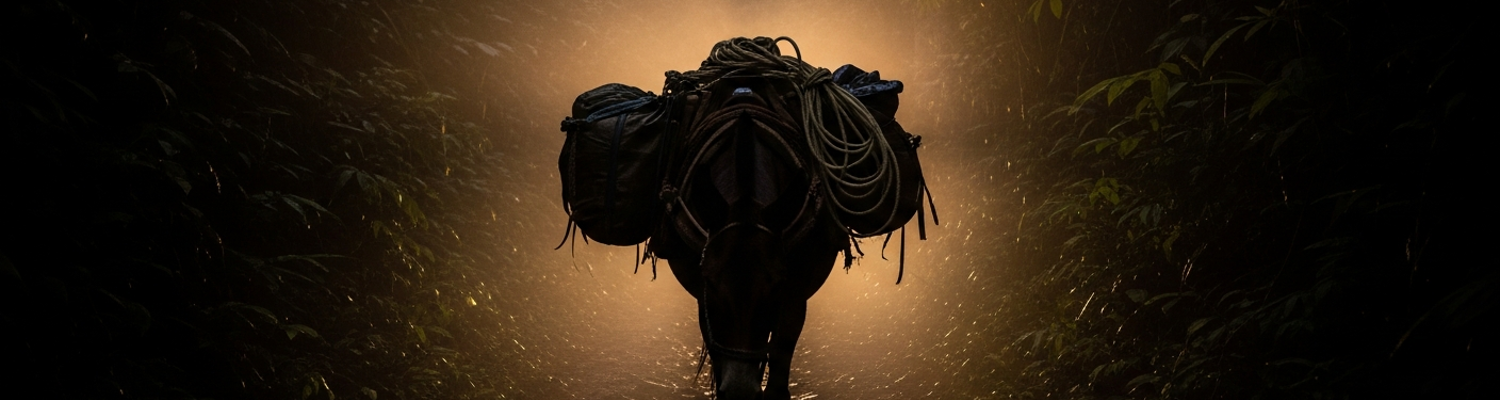

The United States Army’s campaign in the Philippines, initiated after the Spanish-American War, immediately confronted a logistical reality that invalidated its standard doctrine. The archipelago's geography presented a formidable barrier to conventional military transport. Wheeled wagons, the workhorses of the American West and the Civil War, proved entirely useless against the combination of dense jungle, steep volcanic mountain ranges, and waterlogged rice paddies. The tropical climate, with its debilitating heat and torrential monsoon seasons, transformed the few existing dirt tracks into impassable quagmires. American forces, arriving with an organizational structure geared for conventional warfare on open ground, found their supply lines strained and their operational tempo dictated not by the enemy, but by the terrain itself. This failure of traditional logistics forced a swift and pragmatic adaptation. The solution was the pack mule, a hardy and sure-footed animal whose utility was deeply ingrained in the Army’s institutional memory from decades of campaigning in the American Southwest. These animals became the absolute backbone of supply, enabling expeditionary columns to penetrate deep into insurgent-held territory, far from any established road or rail line. Reliance on pack transport was a strategic necessity that shaped the character and conduct of the entire war.
The Unforgiving Terrain
Operations across Luzon, Samar, and other islands demanded that troops navigate narrow, winding trails often no wider than a carabao track. Soldiers and animals had to ford swollen rivers and ascend steep mountain ranges like the Cordillera Central, where no wagon could possibly travel. During the rainy season, which could halt major operations for months, these paths dissolved into rivers of viscous mud that could pull a mule down. Major General Elwell S. Otis, the initial commander of U.S. forces, faced the immense challenge of supplying an army dispersed across hundreds of islands and isolated garrisons. This deployment was necessary to counter the guerrilla strategy adopted by Filipino forces under Emilio Aguinaldo. While the U.S. Navy controlled the sea lanes for strategic movement between islands, the final, critical delivery of supplies to frontline troops fell to the Quartermaster Department’s pack trains. The ability of aggressive commanders like Major General Henry W. Lawton to conduct rapid, mobile operations depended entirely on the mule trains that doggedly followed his columns. Lawton, applying tactics he had perfected during the Apache Wars, led flying columns to pursue insurgent forces. This strategy was only possible because of the accompanying pack mules carrying rations, ammunition, and medical supplies.
The Mule as a Weapons Platform
Pack mules carried far more than subsistence. They transported the Army’s decisive firepower, allowing American units to bring crew-served weapons into the most remote jungle clearings. Weapons like the M1895 Colt-Browning machine gun and light artillery were specifically designed or adapted for animal transport. The M1895, weighing approximately 40 pounds without its water jacket, was manageable for a single mule. Its heavy tripod, at over 56 pounds, and boxes of 250-round fabric belts, weighing about 21 pounds each, could be distributed among other animals in the train. A critical asset was the Vickers QF 2.95-inch Mountain Gun. The Army purchased a dozen of these guns in 1899 specifically for the Philippine campaign. The entire weapon system could be disassembled into four primary loads for mule transport: the gun barrel (236 lbs), the cradle, the trail, and the wheels with their axle. Each component was meticulously strapped to a specially selected, powerful mule. Additional animals carried the fixed ammunition, with shells weighing between 12.5 and 18 pounds. The ability to deploy artillery in remote mountain engagements, where Filipino forces felt secure, provided American troops with a significant tactical advantage. This firepower on hoof gave infantry patrols the confidence to operate far from their garrisons.
Anatomy of a Pack Train
The organization of these logistical units was a specialized science. A standard U.S. Army pack train was a formal unit, typically comprising 50 mules, a civilian packmaster, an assistant packmaster, a blacksmith, a cook, and ten civilian packers, often called cargadores. Many of these men were seasoned veterans of the American frontier, their skills with knots and animal handling commanding high wages and respect. Each packer was responsible for a 'string' of five mules. The lead mule wore a bell, and the other four were tied nose-to-tail behind it. The key piece of equipment was the Aparejo pack saddle. Developed in the 1850s and perfected by General George Crook's forces, the Aparejo was a large, padded leather envelope stuffed with hay or grass. Unlike the rigid wooden frames of other pack saddles, the Aparejo could be molded to a mule's back, providing a wide, cushioned surface that distributed weight evenly. This design was ideal for carrying heavy, awkward, and unbalanced loads like machine gun tripods or artillery components. A skilled packer could balance a load of up to 250 pounds on an Aparejo, a feat that required constant adjustment and a deep understanding of both the equipment and the animal.
The War Against Disease and Forage
Maintaining the health of these vital animals in the tropical environment was a constant, desperate struggle. The Philippines harbored a host of diseases to which American livestock had no immunity. The most devastating was Surra, a parasitic disease caused by Trypanosoma evansi and spread by biting flies. The disease was almost always fatal for horses and mules, causing intermittent fever, progressive emaciation, severe anemia, and edema until the animal collapsed. An outbreak of Surra could effectively destroy a unit’s logistical capacity overnight, stranding troops in the field. The Army’s veterinary services, still in their infancy, had no effective treatment and could only recommend the immediate destruction of infected animals and attempts to quarantine the herd. Rinderpest, a viral plague, also posed a significant threat. Beyond disease, securing adequate and safe forage was a major challenge. The Army had to ship thousands of tons of hay and grain from the United States, a monumental logistical effort. When local forage was used, it was often with disastrous results, as unfamiliar grasses could cause sickness like the dreaded 'bamboo colic'. The daily grind of navigating treacherous trails resulted in endless injuries, from broken legs to severe saddle sores, that stretched the limited veterinary personnel to their limits.
Logistics Dictating Strategy
The availability, or lack thereof, of pack transport directly shaped operational planning and execution. Commanders had to tailor their campaigns to the realities of a mule-based supply line. The friction between the aggressive, mobile warfare advocated by General Lawton and the more cautious, administrative approach of his superior, General Otis, was a defining dynamic of the war's early phase. Lawton, nicknamed the 'General of the Night', understood from his frontier service that defeating a guerrilla force required relentless pursuit. His ability to 'cut loose' from established bases was a direct result of his masterful use of pack trains, a lesson he applied with great success in the Philippines until his death in combat in 1899. His campaigns demonstrated that mobility was the key to victory, and that mobility was carried on the backs of mules.
Later in the war, this logistical capability enabled controversial but effective strategies. In late 1901, Brigadier General J. Franklin Bell’s campaign to pacify Batangas province relied on severing Filipino guerrillas from their civilian support base. Bell established 'zones of protection' to concentrate the population and then sent mobile columns, sustained entirely by pack trains, to sweep the countryside, destroying crops and supplies. This scorched-earth strategy was logistically underpinned by the pack mule, which allowed American patrols to operate independently for extended periods, methodically dismantling the insurgency's support network. The humble mule was not just a beast of burden; it was a core component of American counter-insurgency strategy in the Philippines.