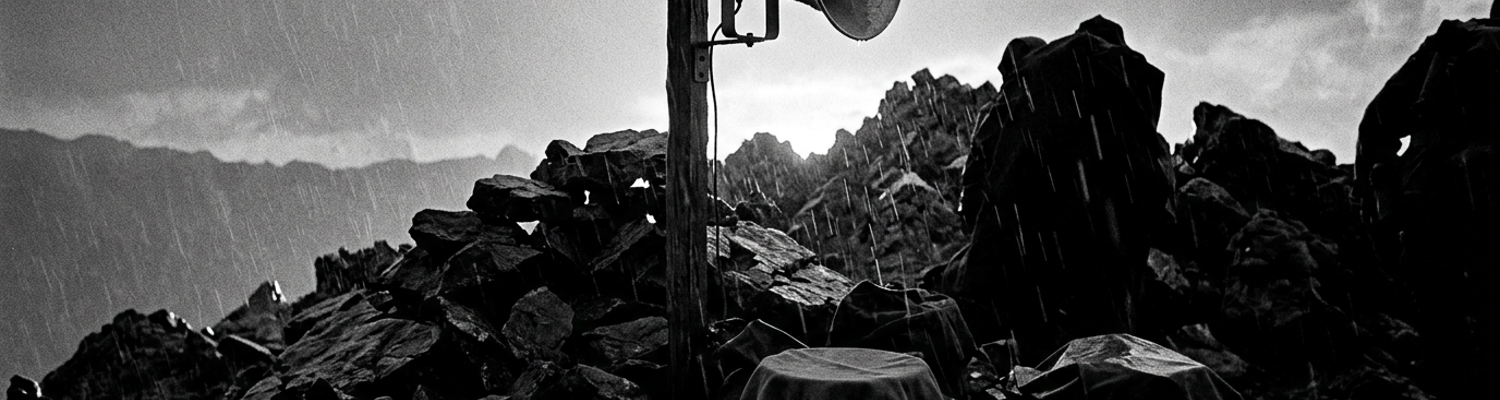

Psychological Warfare Doctrine Versus Himalayan Geography
United States Office of War Information directives mandated standard deployment procedures for tactical psychological warfare teams. Planners in Washington drafted these operational manuals based on European road networks. The doctrine assumed field personnel would deploy mounted public address equipment from the tailgates of three-quarter-ton trucks. Broadcasters were supposed to drive along established transit routes and project acoustic surrender appeals directly into enemy perimeter lines. Troops ascending the eastern approaches to the Salween River found neither roads nor flat firing lines. Allied personnel faced the vertical escarpments of the Gaoligong mountain range. Elevation leaped from 2,500 feet at the river crossing points to above 11,000 feet at the Tatangtzu and Mamien passes. The terrain consisted of narrow mule tracks cut through rain-soaked clay. Pack animals routinely collapsed on these cliff ledges.
Standard military transport did not exist here.
Archival evidence shows that standard OWI field distribution manuals assumed psychological warfare units would operate alongside stable rear-echelon printing plants. These facilities were expected to house motor-driven Multilith 1250 offset presses. Quartermasters allocated stocks of dry twenty-pound bond paper and heavy chemical developer baths for these units. That equipment required smooth electrical current and dry shelter to function. Continuous monsoonal cloudbursts saturated the region west of the Salween throughout May 1944. Paper supplies transported in canvas bags turned to mush before reaching forward staging depots at Baoshan and Yunnan-yi. Lithographic inks separated under high humidity. Mechanical public address systems suffered severe breakdowns during transit. Vacuum tubes inside early military amplifiers featured thin glass envelopes and fragile filaments. These components shattered from the violent jarring of pack mules stumbling down boulder-strewn ravines. Gasoline-powered 110-volt generators built for flatbed trucks proved impossible to haul intact through muddy mountain gullies. Technicians stripped heavy steel cowlings and transported engine blocks on bamboo pack frames.
The equipment reached the front broken or ruined.
A close review of operational logs indicates that American Y-Force liaison officers attached to the Chinese Expeditionary Force ran into immediate tactical friction. General Wei Lihuang directed roughly 72,000 men of the 11th and 20th Army Groups against fortified positions held by the Japanese 56th Division. Combat revolved around close-quarters assaults on timbered bunker complexes atop summits like Songshan. Y-Force psychological warfare specialists arrived with standardized scripts promising honorable captivity and warm meals. Chinese division commanders regarded these appeals as completely detached from conditions on the ground. The Japanese garrison defended interconnected pillboxes to the last man. Field officers refused to pause planned 75mm pack howitzer preparations to let American teams drag speaker horns to forward parapets.
Liaison detachments quickly found their equipment repurposed by force.
Subordinate commanders within the Chinese 71st Army repeatedly requisitioned the pack mules assigned to Y-Force sound units. Chinese quartermasters dumped battery charging crates into the mud to load pack saddles with 81mm mortar rounds and dry rice sacks. American technical officers insisted on priority access to ridg