
Puteaux Origins and Paris Depot Rehabilitation
Entrenched German Spandau MG08 machine-gun crews accounted for roughly eighty percent of all Allied infantry casualties during frontal assaults across the Western Front. They mowed down advancing assault waves from fortified concrete pillboxes. General John J. Pershing discovered that his infantry divisions possessed no organic direct-fire weapons capable of reducing these fortified positions at ranges beyond rifle grenade reach when the American Expeditionary Forces arrived in France in 1917. American heavy ordnance bureaus had failed to design a mobile direct-fire gun for trench fighting. They failed to mass-produce one. Field commanders had to purchase French equipment directly. The Atelier de Construction de Puteaux originally designed the piece for close infantry support. General Headquarters signed supply contracts (NARA Record Group 120) with the French Ministry of Armament to acquire the Canon d'Infanterie de 37 modele 1916 TRP.
The weapon weighed one hundred and eight pounds stripped of its wheels.
The tripod mount added another eighty-six pounds. It threw a one-pound high-explosive projectile out to twelve hundred meters with flat trajectory accuracy. Two gunners lay flat in the mud. They could fire twenty-five shells per minute straight into a machine-gun embrasure. A close review of operational logs indicates that the gun entered American infantry service long before ordnance corps logistics could properly support its delicate mechanisms. Infantry regiments assigned the weapon to their newly formed headquarters company 37mm platoons. Gun teams hauled the barrel and split-trail carriage across cratered ground by hand. They also used pack mules. Mud and chalk grit in sectors along the Aisne and the Marne ruined moving parts within weeks of front-line duty. Continuous rain accelerated this mechanical failure.
Three years of attrition production strained the manufacturing facilities at Puteaux.
Factory managers relaxed fabrication standards to accelerate contract deliveries. Assemblies with uneven metallurgy and soft steel arrived directly in American divisional sectors. Weapons jammed after fewer than fifty continuous rounds. Archival evidence shows French military ordnance depots situated around Paris received damaged and defective pieces. Saint-Denis and the repair workshops at the Caserne de Reuilly handled the bulk of this volume. These depots operated as full-scale remanufacturing centers. Military machinists stripped down battered weapons collected from both French and American combat units. Machinists utilized belt-driven lathes powered by coal generators to mill the raw bar stock. Mechanics faced recurring failures inside the hydraulic-spring recoil cylinder.
The thin internal seals of the cylinder degraded under sustained rapid firing.
This degradation permitted the mixture of glycerin and distilled water to vent out along the piston rod. The internal counter-recoil springs absorbed the full kinetic shock of the one-pound projectile without constant hydraulic resistance. They suffered rapid fatigue and metal snapping. Depot workers re-machined the internal cylinder walls to tighter finishes. Technicians installed heavier vulcanized packing rings. Machinists adjusted fluid viscosity to prevent cylinder blowouts under sustained rapid fire. Depot technicians spent equal labor rectifying the weapon's eccentric-screw rotating drop-block breech mechanism. Extended firing cycles in the mud had worn down the internal locking surfaces. This wear created dangerous headspace variations between the chamber wall and the base of the brass casing.
Excessive headspace led to ruptured cartridge rims.
It caused failed extractions. Hot propellant gases blew backward into the gunner's eyes. Machinists in Paris turned down raw steel bar stock. This process fabricated oversized replacement breechblocks. They hand-lapped the metal directly into each individual receiver to restore an airtight closure. Technicians verified every refurbished tube on hydraulic proof-rigs. These rigs fired over-pressured test charges at thirty thousand pounds per square inch. Workers then stamped the trunnions and shipped them by rail back to AEF depots at Nevers and Is-sur-Tille.
Deployment into the Aisne Sector Revetments
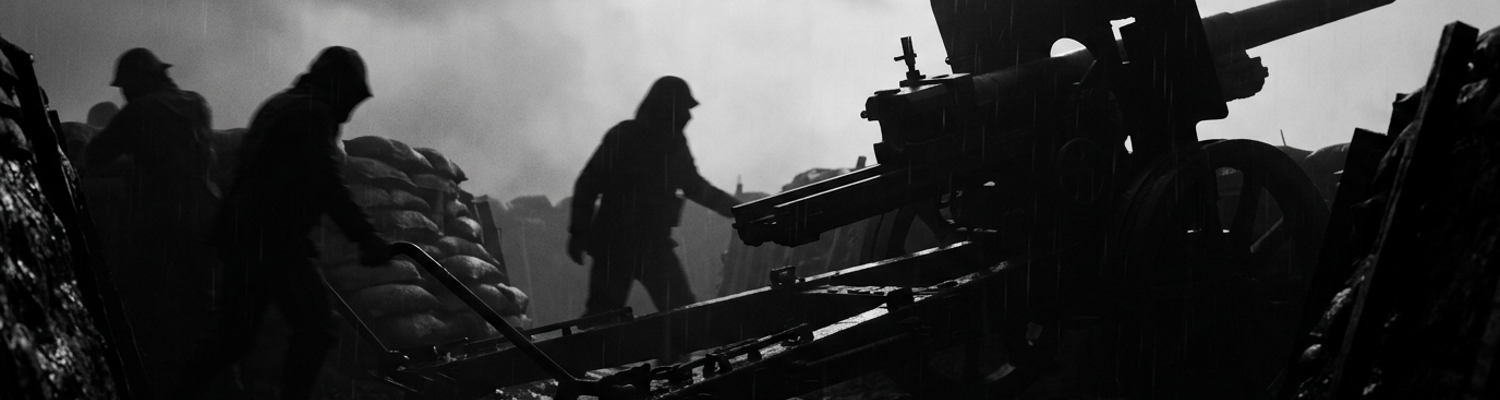
When examining the historical record of the 28th Division in the Aisne sector during late September 1918, operational logs document the mechanical breakdown of hand-transported heavy ordnance under relentless rainfall. Infantry headquarters companies sent their 37mm gun crews into the flooded communication trenches connecting Fismes to the marshy slopes of the Vesle and Aisne rivers. Moving the weapon forward required complete tactical disassembly. Four-man teams tackled the split-trail carriage. This was an eighty-six-pound assembly of folded sheet steel and tubular struts. It featured brass traversing joints that lacked shoulder harnesses.
Two gunners gripped cold metal crossbars.
Relief men steadied the trail spades above deep mud. This mud suctioned boot soles off doughboys' feet. Axles detached from the wooden combat cart wheels lay abandoned miles to the rear in Courlandon (Map Coordinates 14.6-22.1). Horse teams broke their legs in chalk ruts there. Autumn downpours saturated the Aisne soil. Clay coated the exposed elevating screws and clogged the pintle sockets. This turned fine-threaded steel fittings into locked friction blocks before the weapon ever drew sight on an enemy bunker.
Two men carried a bare hundred-and-eight-pound rifled barrel on wooden poles across three miles of saturated crater edges.
Archival evidence shows that physical carrying fatigue induced widespread equipment damage during these night marches. Gun squads from the 110th Infantry Regiment slipped continuously along the slick revetment steps of Trench Constantine (Sector 4). They dropped the French-made barrels onto rock-hard limestone fragments. Such direct impacts warped the thin sheet-metal casing protecting the hydraulic recoil cylinder. The shock broke the delicate mounting lugs of the Model 1916 collimator sight when a tube struck the trench duckboards. Crews had to rely on crude open iron notches filed into the top of the jacket. Ammunition carriers struggled behind. The weight of metal boxes slowed their progress. Each box contained sixteen brass 37mm rounds that clattered loudly in the darkness. Dropped ammunition boxes split along their folded seams. This exposed percussion primers to wet soil and water. The propellant charges became inert within an hour.
A close review of operational logs indicates that combat engineers positioned these guns inside forward listening saps protruding up to eighty meters ahead of the main line near Revillon.
These saps were narrow and unfloored ditches barely three feet wide. Sappers cut them into soft chalk and held them together by decomposing pine revetments and corrugated iron sheeting. Crews dug out wider semicircular weapon pits inside the parapet wall to emplace the M1916. This accommodated the spread of the split trails. Spreading the trails two feet apart destabilized the supporting trench revetments. Sappers had to remove supporting timber posts. This left raw mud overhangs directly above the gun pit. Crews positioned the muzzle low over the forward lip. They used woven burlap sacking coated in mud to mask the silhouette of the tiny gun shield against the open slope.
German observers on the bluffs of the Chemin des Dames detected even the slightest earth disturbance along these forward saps.
They responded with systematic artillery harassment. Batteries of 7.7 cm Feldkanone 96 n.A. and 10.5 cm howitzers dropped contact-fuzed explosive shells directly into the communication approaches every twenty minutes. Concussion waves crushed the timber walls of the listening saps. This showered the exposed 37mm breech assemblies with wet limestone slurry and buried ammunition chests under five feet of dirt. Shrapnel balls shredded the light quarter-inch steel shield of the gun. Flying metal gouged the soft bronze trunnion caps and tore through the exposed canvas water covers protecting the barrel. Gun crews huddled shoulder-to-shoulder in forty-eight-inch dugouts. Sappers excavated these holes directly under the trail spades. They cleared clogged breechblocks with pocket knives as sulfur smoke and dichlorodiethyl sulfide gas settled into the low saps.
Mechanical Attrition in Saturated Saps
When examining the historical record of the 109th Infantry Regiment during their October vigil north of the Vesle River, maintenance sheets show that the chalky silt of the Aisne basin turned into an abrasive liquid paste within forty-eight hours of steady rain. The Aisne basin soil contained high concentrations of calcium carbonate. This mineral composition turned the groundwater into a highly caustic paste. Waterlogged sap walls seeped dissolved limestone directly down into the recessed weapon pits. The M1916 rested on low tripod legs barely eighteen inches above the trench floor. The open breechway and sight bracket operated entirely inside the splash zone of artillery impacts and sliding trench walls. Chalk grit entered the fine screw threads of the Puteaux Model 1916 telescopic sights.
It stripped the soft brass elevation dials.
The internal reticle adjustment gears ground away completely. Liquid slurry penetrated the unsealed objective lenses. Moisture condensed on the internal prism faces. This blinded gunners who wiped the optics with wet wool uniforms only to scratch the exposed glass surfaces into permanent opacity. Archival evidence shows that the weapon's firing mechanism suffered catastrophic mechanical jamming under these identical environmental conditions. The M1916 utilized an internal striker assembly housed directly inside the rotating breechblock. The design relied on a narrow cylindrical channel bored through dense ordnance steel.
Rain mixed with airborne limestone dust washed into the striker channel whenever gunners opened the breech to chamber thirty-seven-millimeter high-explosive shells.
This slurry caked around the firing pin spring. The resulting buildup formed an impenetrable crust that absorbed the kinetic energy delivered by the cocked hammer. Gunners yanked the percussion firing lanyard only to produce soft primer strikes that failed to detonate the percussion cap of the cartridge. Field strips conducted inside the saps exposed the four-millimeter firing pin point to immediate contamination. A soldier dropping the striker into the sap trough meant searching through the opaque white mud for hours. This frequently resulted in lost parts that could not be replaced without cannibalizing another regiment's battery.
A close review of operational logs indicates that the physical deterioration of the crews directly accelerated these mechanical failures.
Detachments from the headquarters companies stood waist-deep in forty-degree stagnant water inside the sap heads for seventy-two consecutive hours without dry footwear. Immersion foot syndrome developed rapidly across every crew. Medical officers documented the progression of necrosis along the metatarsal bones. The cold moisture broke down epidermal layers. Skin sloughed off in sheets. Sensory nerves died. Men became unable to feel their extremities. Crews broke down the gun barrel and recoil assembly using bare hands to service the M1916. Thick issue mittens could not manipulate the tiny retaining pins or the knurled screws on the hydraulic buffer cylinder.
Contact between wet and frostbitten skin and freezing gun metal stripped flesh from gunners' fingertips.
This left bloody smears across the blued steel surfaces that rusted within hours under the acidic and sulfur-laden atmosphere. Numb hands dropped retaining screws into the silt. Logistical records from the 28th Division reveal that standard lubricants made mechanical maintenance virtually impossible in sub-zero nighttime temperatures. Ordnance officers distributed heavy mineral grease and petroleum jelly to protect the split-trail traversing mechanisms from water inundation. This grease solidified into a hard waxy residue that locked the traverse arcs and jammed the elevation gears under plunging overnight temperatures along the Aisne bluffs. Crews attempted to dilute the congealed grease using kerosene or whale oil intended for foot care. The resulting thin emulsion stripped away under the next downpour.
Raw steel was exposed to rapid oxidation.
Medical units evacuated forty percent of the division's 37mm gun crews for advanced gangrene and hypothermia by mid-October (Medical File 44-A). This left understrength two-man teams struggling to clear mud-choked extractors while under relentless counter-battery fire near Revillon.
Signal Collapse Under German Drumfire
When examining the historical record of the 28th Division near Revillon in early October 1918, operational logs document the total destruction of the regiment's forward signal infrastructure under pre-assault German drumfire. Field telephone networks linking the frontline 37mm weapon pits to battalion command posts relied on light twisted-pair outpost wire. This wire was insulated with vulcanized rubber and thin cotton braid. The outpost wire consisted of seven strands of 0.012-inch steel and copper wire. Signal details from the 103rd Field Signal Battalion laid these circuits along the chalk walls of the communication saps. They fastened lines to wooden pickets with friction tape or dropped them directly into the drainage sumps.
German artillery batteries initiated their preparatory bombardments with mixed salvos of 10.5 cm field howitzer rounds and 15 cm heavy high-explosive shells.
Balloon observers stationed along the heights of the Chemin des Dames directed this fire. Concussive ground shock snapped exposed copper-steel strands. Shrapnel cut the suspended wire runs every six to eight feet. Signalmen crawled out under continuous airburst fire to attempt line repairs. They found entire fifty-meter sections of cable pulverized and buried beneath collapsed revetments. Every telephone connection north of the Vesle failed within eighteen minutes of the opening barrage. Archival evidence shows that runner networks collapsed just as quickly as the physical wire lines. Battalion commanders sent foot couriers through the secondary communication trenches toward the forward saps.
German gunners saturated these approach routes with non-persistent diphosgene and concentrated 7.7 cm shrapnel rounds.
Couriers succumbed to blast concussions or lost their way in blown-in trenches. Landmark saps had been flattened into unrecognizable shell craters. Visual signaling also failed without telephone links. Thick clouds of pulverized white limestone dust and sulfur fumes blanked out the valley floor. Autumn river fog compounded the low visibility. This prevented gunners from using trench periscopes to locate shutter-lamp signals or pyrotechnic rockets launched from the regimental observation posts behind Fismes. The forward headquarters companies completely lost the ability to relay range adjustments or assign fire priority targets across their defensive sectors.
A close review of operational logs indicates that the M1916 crews of the 109th and 110th Infantry Regiments fought entirely on their own to engage attacking German infantry.
Gun captains could not coordinate their one-pounder fire with regimental Stokes three-inch trench mortars or supporting French 75mm field artillery batteries without fire direction from battalion headquarters. Forward crews had no warning regarding the exact axis of enemy counterattacks. The isolated units lacked intelligence on the strength of incoming German stormtrooper detachments. Gun teams huddled behind their quarter-inch steel shields inside battered listening saps. They scanned the northern terrain through cracked optical prisms and mud-smeared collimators. German Spandau MG08 crews opened grazing fire from concealed pillboxes three hundred meters away. The 37mm gunners had to estimate ranges by eye and make manual elevation adjustments using damaged traversing wheels.
Muzzle flashes instantly drew direct counter-battery fire from heavy trench mortars.
Archival evidence indicates that isolated gun captains were forced to ration their remaining ammunition chests without knowing when resupply carriers could cross the shelled approaches. Each round fired from the M1916 generated a distinct and sharp report. A bright yellow flash revealed the sap's location to German forward observers on the opposite ridge. German crews targeted the American pit with smoothbore 7.6 cm light Minenwerfer mortars firing fifty-pound high-explosive bombs within ninety seconds of engaging an enemy machine gun. Crews took direct blast hits while frantically trying to unseat stuck cartridge casings from swollen chambers using clearing rods. The isolated detachments had no rear artillery to suppress these mortar nests. Two entire gun squads of the 110th Infantry lay buried beneath their collapsed sandbag parapets by noon on October 5. They had not received a single tactical fire order from their battalion headquarters.
Parapet Overruns and Postwar Obsolescence
When examining the historical record of the 109th Infantry during the German counter-thrust along the northern bank of the Vesle on October 6, 1918, frontline combat logs detail how German assault platoons exploited the blinded listening saps. Stosstruppen from the 200th Infantry Division advanced behind a rolling mortar barrage. They moved along dead ground carved out by dry limestone washouts. Ground-hugging river fog mixed with tear gas masked their movement until the stormtroopers were within thirty yards of the forward American listening posts. American gunners behind the low steel shields of their M1916 pieces had no fields of grazing fire across the obstructed lip of the revetments.
German assault teams bypassed the forward fire sectors entirely.
They swept into the lateral access trenches with Model 24 stick grenades and concentrated bursts from MP 18 submachine guns. German infantry jumping straight down onto the exposed split trails caught gun crews in sap head four sideways. Hand-to-hand trench defense inside the three-foot ditches quickly degenerated into clubbed rifles and trench knives. Archival evidence shows that mechanical failures sealed the destruction of these weapon pits before crews could be overwhelmed by sheer numbers. Gunners cycled the eccentric-screw breechblock with violent and hurried strokes while attempting rapid continuous fire against the incoming assault waves.
The slurry-choked striker channels caused repeated soft strikes on the primer caps of high-explosive rounds.
The accumulated chalk paste inside the chamber prevented hot brass casings from fully contracting when propellant charges did ignite. This stripped the extractor claw clean off the rim and left spent cartridges welded inside the barrel. Gun captains stabbed at the breech openings with brass cleaning rods. These desperate efforts aimed to knock out stuck casings from the muzzle end. German flamethrower detachments closed the remaining distance in seconds. Incendiary fuel jets enveloped the recessed gun pits. The intense heat detonated stacked sixteen-round ammunition chests. This secondary explosion killed the trapped crews beneath their own burning revetment timbers.
A close review of operational logs indicates that the United States Army Ordnance Department recognized the complete operational failure of low-mobility trench guns immediately following the November armistice.
Infantry development boards systematically tested the M1916 against emerging mechanized armor concepts. These interwar weapons evaluations occurred at Aberdeen Proving Ground in 1921. Infantry transport officers concluded that an eighty-six-pound split-trail carriage requiring four exhausted soldiers to haul across broken terrain offered zero tactical utility in fast-moving maneuvers. Rapid developments in motorized infantry doctrine required direct-fire weapons capable of keeping pace with mechanized columns traveling along paved and unpaved roadways. Ordnance designers shifted their resources to mount high-velocity 37mm guns directly into rotating tank turrets. This led directly to the 37mm Gun M5 developed for the M3 Stuart light tank.
Ground infantry units abandoned the tripod-mounted Puteaux system in favor of wheeled and tractor-towed anti-tank guns like the 37mm Gun M3.
The M3 achieved a muzzle velocity of 2,900 feet per second. The M1916 managed barely 1,300 feet per second. This new weapon possessed the high muzzle velocity necessary to penetrate thick face-hardened steel plate. Surplus stocks of the Canon d'Infanterie de 37 modele 1916 TRP were transferred to state National Guard armories during the mid-1920s. They sat locked inside basement supply cages for drill display. The War Department conducted an inventory audit in March 1941 (Ordnance Directive 772). Logistics officers declared the weapon wholly obsolete. The department marked remaining pieces for industrial smelting or training scrap across arsenals in Rock Island and Watervliet.