
Early Shipping Intelligence Anomalies
In the autumn of 1962, the United States Navy commanded the Atlantic. Hundreds of warships, from Forrestal-class supercarriers to Gearing-class destroyers, formed a maritime force of unprecedented power. This armada could project overwhelming force and land entire Marine divisions. The numerical and technological superiority was absolute. The primary adversary was not an enemy fleet, but a pervasive uncertainty.
Beneath this display of raw power, a different conflict was underway.
It was a fight waged with radio receivers and graph paper. A review of operational logs from the Naval Security Group (NSG) and the National Security Agency (NSA) shows the first indications of Operation Anadyr were not grand strategic revelations. They were fragmented, low-grade signals. Early cryptanalysis was a crude, almost artisanal affair. Lacking keys for high-level Soviet military traffic, analysts at listening posts in Florida and Guantanamo Bay focused on more vulnerable transmissions. They targeted Cuban administrative channels and the commercial communications of Soviet-bloc merchant vessels.
The work was painstaking. Analysts used direction-finding equipment to track ships leaving Black Sea ports like Odessa and Sevastopol. They noted adherence to radio silence protocols unusual for commercial shipping. They intercepted bursts of low-level encrypted Morse code. While the content remained locked, the volume and frequency of this traffic analysis pointed to a coordinated, large-scale logistical effort far beyond routine supply runs. Some of the earliest successes came from exploiting poorly implemented Cuban ciphers. When broken, these yielded fragments about port preparations, demands for specialized longshoremen, and the cordoning-off of specific piers at ports like Mariel and La Isabella.
These initial electronic breadcrumbs led intelligence officers to the shipping manifests. Analysts within the Defense Intelligence Agency (DIA) began to notice a pattern of logistical irregularities in the paperwork of ships bound for Cuba. Soviet freighters, such as the Poltava and the Omsk, declared cargoes consisting of agricultural machinery, industrial parts, and paper products. The physical characteristics of these vessels betrayed the declarations. Photo reconnaissance from U-2 overflights and reports from naval patrols showed these ships riding high in the water. This indicated their holds were filled with cargo far less dense than heavy industrial equipment. Observers noted the presence of unusually large hatches and on-deck cranes with heavy-lift capacities unnecessary for offloading tractors. The dimensions of the crates, glimpsed when tarpaulins shifted, were exceptionally long and cylindrical. They matched no known piece of agricultural or industrial hardware in the Soviet inventory. Most telling was the repetition. Dozens of ships, all with similarly deceptive manifests and oversized hatches, were all bound for the same few Cuban ports on a synchronized schedule.
The data did not fit established patterns.
It was initially dismissed. Within the intelligence community in Washington, these disparate points of data failed to overcome a fixed strategic assumption. The consensus view, held firmly within the Central Intelligence Agency and the Pentagon, was that Nikita Khrushchev would never risk placing offensive nuclear weapons just 90 miles from American shores. This analytical filter colored every piece of incoming information. The strange shipping patterns were explained away as components for defensive SA-2 surface-to-air missile batteries. The long crates were interpreted as fuselages for MiG-21 fighters. The heightened secrecy was attributed to Soviet paranoia. DIA analysts who flagged the manifests found their concerns diluted as they moved up the chain of command. Their raw data was condensed into summarized reports that softened the alarming details. The sheer volume of legitimate conventional military and economic aid flowing into Cuba provided perfect cover, allowing these few dozen shipments to be lost in the noise of a much larger Soviet support operation.
Strategic Payload Identification and Nuclear Threat
The intelligence community’s vague unease gained a specific, threatening focus on October 15, 1962. Analysts at the CIA's National Photographic Interpretation Center (NPIC) bent over the grainy images returned by Major Richard Heyser’s U-2 reconnaissance flight from the previous day. What they found scattered across the landscape near San Cristobal in western Cuba was not ambiguous. The analysts identified the distinct shapes of canvas-covered missile transporters, mobile erectors, and fuel tank trailers. These were not components for defensive surface-to-air batteries. Cross-referencing the dimensions and associated equipment with their knowledge of the Soviet arsenal (documented in file series TK-877/USSR), the NPIC team made a positive identification. The objects were Soviet R-12 ballistic missiles, designated by NATO as the SS-4 Sandal. The discovery represented a massive strategic payload deployment. The quantity of equipment indicated this was not a single, token battery but likely an entire regiment, with multiple launch sites under simultaneous, rapid construction.
This was not a conventional threat.
The identification of the R-12 missile system immediately stripped away any lingering hope of a defensive purpose. Intelligence files on the SS-4 were explicit; it was a weapon designed to deliver a nuclear warhead. Analysts calculated that the R-12s being deployed in Cuba could carry a warhead with a yield in the megaton range. With an operational range of over 1,000 nautical miles, these missiles, once operational, would hold a significant portion of the continental United States at risk. A map drawn in the Pentagon’s inner chambers showed a coverage area that included Washington D.C., Dallas, and every city in between. The threat assessment deepened as further U-2 flights revealed more construction. Near Guanajay, analysts spotted larger, more permanent-looking sites. These were assessed to be for the R-14, or SS-5 Skean, an intermediate-range ballistic missile. The R-14 had double the range of the R-12, capable of reaching almost every major population center in the contiguous United States with a 3 to 5-megaton thermonuclear warhead.
The intelligence coming out of NPIC confirmed the Soviet intent to create a comprehensive nuclear strike complex in the Caribbean. Chronological photographic evidence reveals the frantic pace of the Soviet deployment. The October 14 photos showed sites in the early stages of development. At San Cristobal Launch Site 1, photo interpreters could distinguish field-type launchers, missile-ready tents, and oxidizer tank trailers being moved into position. The ground was scarred with the tracks of heavy vehicles. By October 25, just eleven days later, surveillance showed a dramatic escalation. Soviet crews were working around the clock, laying cabling, digging personnel trenches, and applying camouflage netting. The presence of multiple missiles per launcher, eight missiles for four launchers at the San Cristobal sites, indicated a refire capability. Analysts estimated a second volley could be launched within four to six hours of the first. Each new photograph showed the sites moving closer to full operational status.
The Headquarters Bubble and Intelligence Fragmentation
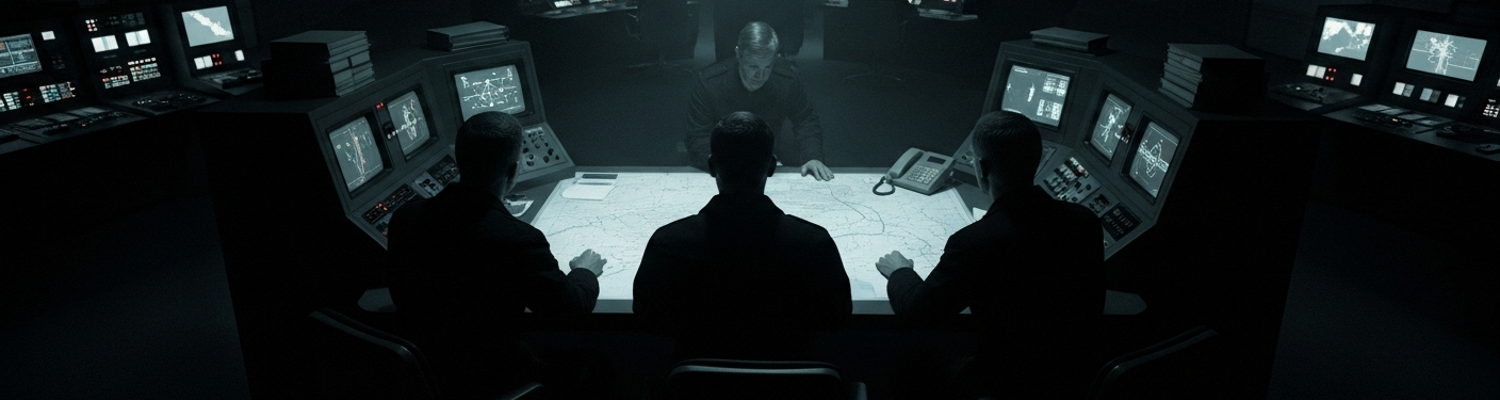
Within the White House Cabinet Room, the Kennedy administration operated inside a condition of strategic isolation. This was the Headquarters Bubble, a state of profound detachment where decisions of global consequence were made by men physically and psychologically separated from the forces they commanded. The Executive Committee of the National Security Council (EXCOMM), a handpicked group of senior advisors, convened for days of intense debate. Their primary connection to the unfolding crisis was through information streams that were delayed and filtered. Communications technology of the era, reliant on encrypted high-frequency radio and teletype, created significant lags. A FLASH precedence message, the highest priority, could take up to three hours to be received, processed, and physically delivered to an action officer. This meant the intelligence EXCOMM deliberated upon was often an outdated snapshot of the tactical situation.
This problem was compounded by severe intelligence fragmentation. In 1962, the American intelligence apparatus was a collection of competing organizations: the CIA, the DIA, the NSA, and the individual service intelligence branches. They guarded their information closely. A Naval Security Group listening post might intercept low-level Soviet submarine communications, a raw piece of signals intelligence (SIGINT). A destroyer on the quarantine line would hold a sonar contact, a purely tactical piece of information. A DIA analyst might have a report on the estimated number of nuclear-tipped torpedoes available to the Soviet submarine fleet. These disparate data points were rarely fused into a single, coherent picture for the decision-makers in Washington.
The result was a distorted mosaic. Archival records show that while the intelligence community correctly identified the presence of offensive missiles through photographic intelligence (PHOTINT), it had significant gaps. Analysts were unaware that the Soviets had already deployed over 100 tactical nuclear weapons to Cuba, including battlefield rockets that would have been used against any American invasion force.
This disconnect created two parallel conflicts: the tactical fight on the quarantine line and the strategic chess match in Washington. On the waters of the Atlantic, Navy destroyer captains operated according to standard procedure, aggressively hunting suspected Soviet submarines. Their doctrine called for dropping practice depth charges to force a submarine to surface for identification, a routine tactical action. To the men in the Headquarters Bubble, each depth charge was a potential trigger for nuclear war. Secretary of Defense Robert McNamara found himself in direct radio communications with naval commanders, attempting to micromanage the blockade from the Pentagon. The commanders at sea, focused on their immediate sensory input of sonar pings and visual contacts, were making decisions based on one set of facts. The leadership in Washington, grappling with fragmented intelligence and the pressure of global thermonuclear war, was operating on another.
Ambiguous Decrypts and Launch Authority
A close examination of National Security Agency logs from October 1962 reveals a contradictory signals intelligence picture regarding the operational status of Soviet missiles in Cuba. While U-2 photography provided proof of the missiles' presence, intercepted radio traffic was supposed to yield insights into their readiness. Instead, it created confusion. SIGINT collection platforms, like the USS Oxford stationed off Havana and RB-47 electronic reconnaissance planes, picked up a flurry of activity. Analysts at Fort Meade listened as Soviet missile crews conducted systems checks, their radio chatter indicating they were moving through pre-launch checklists for the R-12 missiles. At the same time, other intercepts from different sites suggested total disarray. Some units reported they were still awaiting fueling components while others complained of failures in gyroscopic guidance systems. This conflicting information flowed into the intelligence community. The activation of the Spoon Rest target acquisition radars associated with the defensive SA-2 missile sites was a clear indication that Soviet air defenses were coming online, a signal tracked in real-time by the NSA.
The signals intelligence picture was a mess.
This informational chaos was layered upon a fundamental American miscalculation about Soviet nuclear command and control. Within EXCOMM, there was an implicit assumption that the Soviet Union operated with the same rigid, centralized control over its nuclear arsenal as the United States. Policymakers presumed the existence of a Soviet equivalent to Permissive Action Links (PALs), technical safeguards and encrypted codes that physically prevented a warhead from being armed without direct authorization from Moscow.
This assumption was entirely wrong.
Post-crisis analysis of Soviet doctrine (found in declassified KGB files) revealed that the Kremlin had pre-delegated launch authority for its tactical nuclear weapons to the local Soviet commander in Cuba, General Issa Pliyev. In the event of a full-scale American invasion and a breakdown in communications, Pliyev had the authority to use the nearly 100 tactical nuclear warheads secretly deployed to the island. This fact was completely unknown to US intelligence at the time. These weapons included warheads for FROG-3 Luna short-range artillery rockets and IL-28 bombers, which would have been used against any invading American force with catastrophic results.
The combination of ambiguous readiness signals and blindness to the Soviets' delegated launch authority created a dangerous fog of war inside the Headquarters Bubble. The most pointed example occurred on October 27, the day remembered as Black Saturday. When Major Rudolf Anderson’s U-2 reconnaissance plane was shot down over Banes, Cuba, by a Soviet-manned SA-2 missile, the act was interpreted in Washington as a deliberate escalation ordered by Khrushchev. The Joint Chiefs of Staff pushed for immediate retaliatory air strikes. Archival evidence later showed the order to fire was not given by Moscow. The overall Soviet commander, General Pliyev, could not be reached, so his deputies made the decision to fire on their own authority. The men in the White House Cabinet Room were reacting to what they perceived as a direct message from the Kremlin, when they were in fact reacting to the decision of a panicked field commander, a distinction made invisible by the lack of complete intelligence.
Cryptanalytic Teams and Visibility Challenges
National Security Agency operational records from October 1962 show that the agency’s cryptanalytic teams operated under conditions of intense physical and psychological stress. At facilities like Fort Meade in Maryland and within the cramped spaces of Naval Security Group listening posts, analysts worked in secure, windowless rooms. The air was thick with the clatter of teletype machines printing intercepted Morse code and the hum of magnetic tape reels on specialized computers like BOGART, a machine designed for statistical analysis of ciphertext. These were low-level enlisted personnel and civilian specialists, often in their early twenties, performing grueling, round-the-clock shift work. The pressure came from the torrent of raw data arriving from collection platforms like the USS Oxford (AGTR-1) and reconnaissance aircraft. Every burst of radio traffic had to be recorded, cataloged, and analyzed. The knowledge that a single missed or misinterpreted signal could fail to provide a critical warning was a constant burden.
The fundamental challenge for these teams was the inability to provide a clear picture of Soviet intent. Archival analysis shows that at the time of the crisis, the NSA could not decipher the high-level cryptographic systems used by the Soviet government or military. These critical communications were protected by advanced electromechanical cipher machines like the Fialka and, for the most sensitive traffic, by one-time pad systems that were practically unbreakable. As a result, cryptanalysts were forced to work on the periphery. They could read lower-grade Cuban military ciphers and analyze the patterns of Soviet communications without understanding the content. This traffic analysis yielded clues, not answers. Analysts could identify that a Soviet submarine division was in frequent communication with its headquarters, but not whether it was reporting readiness to attack or a mechanical failure. They could detect the activation of Spoon Rest radar systems, confirming the air defense network was operational, but they could not hear the orders being given to the crews.
For the decision-makers in Washington, this information arrived with a significant delay. The communications infrastructure of 1962 meant there was a lag between the moment a signal was intercepted and the moment an analyzed report landed on a desk in the White House. A FLASH-priority message could take hours to be encrypted, transmitted, decrypted, and hand-delivered. This delay was most pronounced in the cat-and-mouse game between U.S. Navy destroyers and Soviet submarines. While analysts at Fort Meade might be piecing together SIGINT that suggested a submarine's general location, the destroyer captain on the quarantine line was operating in real-time, relying solely on his sonar contact. Tactical decisions, like dropping practice depth charges on a Soviet submarine, were made in an information vacuum, disconnected from the high-level diplomatic chess match in Washington.
Incidental Collection of Civilian Communications
Operational logs from the National Security Agency during the 1962 crisis reveal an intelligence collection effort that inadvertently swept up a vast spectrum of local Cuban communications. SIGINT platforms, most notably the specialized collection ship USS Oxford patrolling just outside Cuban territorial waters, were tasked with intercepting military and government transmissions. Its antennas and receivers also pulled in a chaotic jumble of civilian signals. These were the incidental byproducts of an electronic dragnet: the unencrypted chatter of amateur ham radio operators, bleed-over from local commercial radio broadcasts, and fragments of civilian telephone conversations. This collection was not targeted. It was simply part of the raw, unprocessed data hoovered up by round-the-clock surveillance.
Within the intelligence processing pipeline at Fort Meade, this civilian chatter was systematically categorized as the lowest possible priority.
Analysts were under extreme pressure to find the electronic keys to the primary conflict: Soviet missile readiness, the intentions of their submarine fleet, and any indication of launch preparations. The hunt was for telemetry data and encrypted military commands. In this high-stakes environment, the panicked conversations of Cuban citizens were considered intelligence noise. CIA reports also noted the collection of information from Cuban refugees, but this human intelligence was often voluminous and of questionable value, slowing its dissemination. The incidental electronic intercepts of civilians, lacking the hard data of a photograph, were filed away. This information, containing ground-truth observations from the Cuban populace, was effectively lost in a system geared entirely toward deciphering the enemy’s military machine.
Retrospective analysis of these discarded intercepts shows they painted an accurate picture of a nation being converted into a forward Soviet base. Civilian reports spoke of large-scale construction projects in rural areas and the sudden appearance of thousands of Russian-speaking men. There were accounts of entire roads being closed to local traffic for the nighttime movement of long, canvas-covered military convoys. Cuban civilians and militia members were mobilized across the island, preparing for a U.S. invasion they believed was imminent. While Washington’s attention was fixed on the R-12 and R-14 missile sites, the civilian chatter captured a much broader disruption: food shortages, the requisitioning of private vehicles, and a pervasive sense of dread. These disparate reports, coming from different parts of the island, corroborated what the U-2 photos only hinted at. The scale and speed of the Soviet operation and its deep psychological impact on the population remained a fragmented and unappreciated resource, buried under the weight of higher-priority analytical demands.
Ad-Hoc Analysis of Non-Military Channels
A largely unheralded intelligence effort ran parallel to the hunt for Soviet military codes. While the NSA’s primary cryptanalytic assets at Fort Meade were directed against high-grade Soviet traffic, a secondary, improvised effort took shape at the tactical edge. At collection sites like the one in Guantanamo Bay and aboard the USS Oxford, analysts began targeting a different layer of the signal environment. They focused on lightly encrypted or clear-text communications from Cuban civil and commercial entities. This included the dispatch logs of the Cuban national railway, administrative traffic from port authorities, and communications from state-run agricultural collectives.
The work was artisanal. Lacking dedicated decryption keys, teams used pattern analysis and basic frequency-counting techniques to find weaknesses in what were often poorly implemented commercial cipher systems. Their objective was not to find launch orders but to answer more prosaic questions about the internal functioning of the Cuban state. Where were food shipments being diverted? Why were specific roads suddenly closed to all non-military vehicles? This ad-hoc analysis of non-military communications represented a conscious pivot. It was a recognition that the ground truth of the crisis might be found not in Soviet military channels, but in the disrupted daily life of the Cuban populace.
This was intelligence collection at the granular level.
The data harvested from these civilian channels provided a ground-level context absent from high-altitude photography. Decrypted railway manifests showed a wholesale seizure of the island’s rolling stock for military transport. This directly caused a breakdown in the food distribution network to eastern provinces and created demonstrable shortages confirmed by other intelligence sources. Intercepted police and local militia communications painted a picture of rising confusion. These transmissions detailed efforts to manage civilian populations being displaced by the creation of extensive, restricted military zones around the missile sites. Analysts could track the imposition of curfews and the requisitioning of private vehicles. This information created a second, entirely different map of the crisis. One map, used by the Pentagon, showed Soviet missile sites. The other, pieced together from this civilian chatter, showed a society fraying under the pressure of a massive, rapid, and secretive foreign military occupation.
Intelligence Influence on Diplomatic Strategy
A small, influential group within the U.S. government recognized the strategic value of this intelligence on Cuban societal conditions. While much of the raw data was initially sidelined as low-priority by military-focused agencies, analysts at the State Department’s Bureau of Intelligence and Research (INR) began to use it. They combined the SIGINT evidence of civil disruption with refugee debriefings and sparse reporting from the few remaining diplomatic contacts on the island. The resulting analysis argued that the Soviet deployment and the American quarantine were creating an internal crisis for Fidel Castro’s government that was separate from the military threat.
This view, championed by figures like INR director Roger Hilsman, was presented in briefings to key EXCOMM members, including Attorney General Robert Kennedy.
It offered a powerful counter-narrative to the purely military options favored by the Joint Chiefs of Staff. This understanding of the island’s internal fragility directly influenced American diplomatic strategy. The knowledge that the Cuban regime was struggling with food shortages, infrastructure breakdowns, and a terrified population provided a compelling argument for continuing the naval quarantine. This method applied pressure through a slow squeeze rather than resorting to immediate air strikes or an invasion. An invasion, it was argued, might unify a fractured Cuban populace against a common enemy. The quarantine, however, worsened the internal chaos and could potentially create fissures between Castro and his Soviet patrons.
This intelligence gave American negotiators a subtle but significant advantage. It allowed them to proceed with back-channel discussions with the Soviets, armed with the knowledge that their adversary’s Cuban base of operations was becoming increasingly unstable. The final American offer, which included a public pledge not to invade Cuba, was shaped by this understanding. It was a concession designed to give Khrushchev a way out, but it was made with the confidence that the internal pressures on the Cuban regime were already achieving a significant strategic objective. It was a quiet success for ad-hoc intelligence over rigid military doctrine.