
The hydraulic actuators of the LVTP-5's ramp groaned. Instead of the firm sand promised by doctrine, the thirty-ton landing vehicle found only estuarine mud south of Hoi An. Its tracks churned uselessly. Then came the mortars. The crump of incoming rounds joined the engine roar, walking explosions across the water and sand toward the stranded vehicle. For the Marines of Battalion Landing Team 2/26, part of Special Landing Force Alfa, the plan for a combined sea and air assault had just dissolved into the violent conditions of the I Corps Tactical Zone.
This was the intended function of Amphibious Ready Group Alfa, designated Task Group 79.4 by the Seventh Fleet. The group was a self-contained instrument of power projection, a naval task force centered on an amphibious assault ship like the USS Okinawa and its embarked Marine contingent. The ground element, the Special Landing Force (SLF), paired a reinforced Battalion Landing Team (BLT) with a Marine Medium Helicopter Squadron (HMM). SLF Alfa was conceived as a strategic fire brigade, held offshore to conduct rapid search-and-destroy operations against enemy forces identified near the coast.
Operational logs from late 1968 confirm SLF Alfa was built around BLT 2/26 and the helicopters of HMM-362. Their deployment during Operation Valiant Hunt in December 1968 placed them directly onto Barrier Island, a known enemy staging area in Quang Nam Province.
The I Corps Tactical Zone was the most consistently violent operational area in South Vietnam. As the northernmost of the four corps zones, it shared a border with the Demilitarized Zone (DMZ). Its proximity to North Vietnamese supply lines and regular army (NVA) units made it a conventional battlefield. The terrain was a tactical problem set, a hostile mix of sandy coastlines, marshy river deltas, dense jungle, and rugged inland mountains. Units in I Corps regularly faced well-trained, well-equipped NVA regiments employing mortars, artillery, and sophisticated ambush tactics. This environment consistently invalidated the assumptions of American amphibious doctrine. Planners in air-conditioned shipboard compartments could not account for the exact composition of mud in a landing zone or predict the location of pre-sighted NVA 82mm mortars.
The doctrine itself was a multi-layered application of force. Initial mission parameters for SLF Alfa called for a synchronized amphibious and riverine assault capability. An operation would commence with naval gunfire support (NGFS) from destroyers and cruisers offshore, intended to suppress enemy defenses. Simultaneously, the HMM squadron would launch waves of helicopters from the LPH, executing a vertical envelopment to land troops behind enemy positions and cut off their retreat. The surface assault, carried by LVTP-5s and landing craft, would then hit the beachhead, driving the enemy into the blocking positions. Archival records show these operations, with names like Dagger Thrust and Valiant Hunt, were envisioned as swift raids lasting only a few days before the force would re-embark. During Operation Valiant Hunt, BLT 2/26 was tasked with a search and clear operation on Barrier Island, south of Hoi An, from December 15, 1968, to January 5, 1969. The operation resulted in 3 American fatalities and 19 wounded, against 33 enemy killed.
American amphibious doctrine assumed the ability to isolate and overwhelm a defender on a predictable coastline. In the I Corps Tactical Zone, this assumption was consistently broken by entrenched Viet Cong and North Vietnamese Army forces. NVA units, operating as conventional light infantry, applied classic anti-landing doctrine derived from Soviet and Chinese models. After-action reports from operations near the Cua Viet River and on the Batangan Peninsula show NVA units rarely defended the immediate shoreline. They prepared layered defensive belts inland, using coastal dunes and vegetation for concealment. Mortar and recoilless rifle teams were pre-sited on reverse slopes, hidden from naval gunfire, with interlocking fields of fire covering the exits from the beach. Command-detonated mines were sown in the surf zone. Upon landing, Marine units moved off the beach directly into prepared kill zones, taking fire from positions they could not see. The NVA would engage, inflict casualties, and withdraw through prepared trench and tunnel networks before supporting arms could be brought to bear.
Viet Cong guerrilla units employed even more asymmetric methods. They relied on extensive tunnel systems, with entrances concealed in village wells or beneath animal pens, allowing them to strike and vanish. They turned the environment into a weapon, with tripwires connected to grenades in thick undergrowth and punji stake pits concealed by foliage.
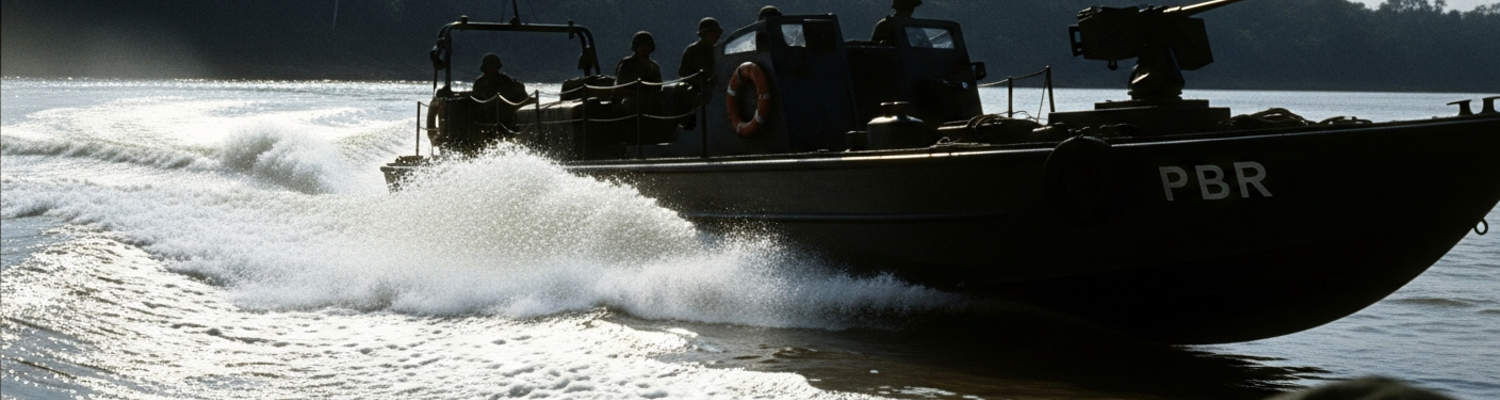
Riverine assaults in the densely populated deltas of rivers like the Song Thu Bon faced their own difficulties. The primary challenge was distinguishing combatants from the civilian population. Viet Cong forces deliberately embedded themselves within local communities, using fishing sampans to transport weapons and using villages as fortified bases. River Assault Divisions, such as RAD-112, employed armored troop carriers and heavily armed Monitors, but these vessels were channeled by the waterways into predictable routes. VC and NVA rocket-propelled grenade (RPG) teams established ambush positions in thick vegetation along the riverbanks, waiting for boats to enter a narrow channel before opening fire. Operational logs from Task Force 116 (Game Warden) and the Mobile Riverine Force reveal a constant threat from swimmers attempting to attach mines to hulls and from ambushes initiated by a single RPG hit designed to disable a lead boat and trap the entire column. The rules of engagement, designed to minimize civilian casualties, restricted the use of suppressive fire into villages or against unidentified watercraft. The Viet Cong exploited this constraint.
The terrain of coastal Quang Nam Province degraded the effectiveness of American mobility and firepower. Rice paddies were tactical obstacles. The thick mud could bog down a 37-ton LVTP-5 amphibious tractor, while the dikes separating the paddies provided cover but also channeled infantry into predictable paths for ambush. Troops burdened with 90 pounds of gear found their movements slowed to a crawl. Mangrove swamps offered a different hostility. The interlocking root systems made movement on foot nearly impossible, while the brackish water caused weapons to malfunction and radio signals to degrade. Fishing villages were rarely neutral territory. A review of operations like Allen Brook and Valiant Hunt shows hamlets were often transformed into fortresses, with trench systems connecting spider holes and bunkers built underneath homes. The LVTP-5, the primary surface assault vehicle, proved mechanically unreliable in extended land operations and vulnerable to mines due to its low-slung fuel tanks. Marines often rode on top of the vehicles, preferring the risk of small arms fire to being trapped inside during a mine strike.
Amphibious assault doctrine hinged on information dominance. Electronic intelligence, or ELINT, gathered by offshore naval vessels, was the primary mechanism for achieving it. Destroyers and specialized surveillance ships assigned to the naval task group would patrol the coast, their receiver suites, like the AN/WLR-1, intended to intercept North Vietnamese military transmissions. Logs show these platforms were tasked with identifying the locations, types, and frequencies of enemy assets, from coastal defense radars to the tactical command nets of NVA mortar platoons. The goal was to build a detailed electronic order of battle, allowing commanders to destroy threats before they could engage landing forces. The technology and the environment conspired against this objective. The AN/WLR-1 was a sensitive but manually intensive system. It required a skilled Cryptologic Technician to be tuned to the right frequency band at the exact moment to catch a fleeting transmission. The system, designed for open-ocean tracking of Soviet warships, struggled against a coastline that reflected, distorted, and scattered radio signals, degrading the accuracy of direction-finding equipment.
The signals environment off the coast of I Corps was a dense, chaotic mix of electromagnetic energy. North Vietnamese and Viet Cong units, equipped largely with Chinese-supplied radios, operated across a wide spectrum of frequencies with often lax discipline. Layered on top of this was the enormous electronic footprint of the American war machine. Task Group 79.4's own ship-to-ship communications, the radio nets of Marine companies ashore, the chatter of helicopter pilots from HMM-362, and the command frequencies for naval gunfire support all saturated the airwaves. An ELINT operator in the cramped signals intelligence van aboard a destroyer had to sift through this wall of noise to find one critical enemy broadcast. Archival evidence shows the sheer volume of friendly, allied, and enemy military transmissions could overwhelm the processing capabilities of both the equipment and the operator.
The problem was magnified by the civilian world. The Vietnamese coast was teeming with non-military radio traffic. Da Nang was a major source of commercial broadcasts and teletype communications. Hundreds of fishing sampans and coastal freighters used their own low-power radios, creating a constant, unpredictable wash of signals. Viet Cong and NVA intelligence units were known to exploit this, intercepting civilian communications for their own purposes. For American ELINT teams, this civilian clutter presented a constant risk of misidentification. A burst of static from a fishing boat’s faulty generator could mimic the characteristics of a coded enemy transmission. The colloquialisms used by local fishermen could be misinterpreted by an analyst as enemy operational traffic, potentially diverting intelligence assets or calling naval gunfire onto a harmless vessel.
The flawed and incomplete ELINT picture translated directly into heightened risk for the Marines of Battalion Landing Team 2/26. The premise of the Special Landing Force was speed and surprise, hitting a beach based on intelligence that pinpointed enemy locations. When that intelligence was unreliable, the doctrine disintegrated. Commanders could not be certain if a landing zone designated as 'cold' by ELINT analysts was truly clear of enemy forces or if it was a sector where NVA radio operators were maintaining strict discipline. This uncertainty forced tactical adjustments that negated the intended speed of amphibious operations. Instead of rapid strikes, landing forces often had to assume the worst-case scenario, moving cautiously off the beach in a slow, methodical advance. This hesitation gave NVA defenders time to reposition forces, prepare ambushes, and withdraw.
Specific intelligence failures during coastal operations in late 1968 demonstrate the direct impact. After-action reports from Operation Valiant Hunt on Barrier Island reveal patterns consistent with significant ELINT shortcomings. On one occasion, a series of high-frequency transmissions logged by an offshore destroyer was misinterpreted as a potential NVA regimental command post. This assessment led to the diversion of a flight of HMM-362 helicopters, tasked with inserting a blocking force, to a position miles from the actual enemy concentration. The target turned out to be the radio net of a civilian fishing cooperative. The diversion allowed a known enemy unit to exfiltrate from the operational area unmolested. In a more lethal failure, the low-power, intermittent radio checks from a pre-sited NVA 82mm mortar platoon concealed inland from the landing zone were completely masked by the high volume of commercial radio traffic from nearby Hoi An. The ELINT summary provided to the BLT 2/26 command element indicated no significant electronic activity in the sector. The initial waves of Marines were therefore caught by surprise when accurate and sustained mortar fire began falling on the beach exits, inflicting casualties within minutes of the assault.
The detonation of a command-detonated mine or the opening salvo from a mortar battery created an instantaneous medical crisis. The overpressure from high explosives could rupture lungs and eardrums, while metal fragments inflicted devastating soft tissue damage and traumatic amputations. In the first moments following an ambush, responsibility fell upon the platoon’s assigned Navy Hospital Corpsman. These enlisted sailors, often no older than the Marines they served, were the first link in a long evacuation chain. A review of I Corps operational logs shows a corpsman’s immediate actions, applying tourniquets and dressing massive wounds under fire, were the determining factor in a casualty’s initial chance of survival. The violence of NVA ambushes, designed to inflict maximum damage in the opening minutes, often resulted in multiple, simultaneous casualties that could overwhelm a single corpsman. An ambush on May 22, 1968, inflicted over 50 casualties on elements of the 1st Battalion, 4th Marines, in the first 20 minutes.
From the battlefield, the wounded were transported to the Battalion Aid Station (BAS). A Marine BAS was a component of the battalion’s support company, typically staffed by a Navy battalion surgeon, a physician’s assistant, and a handful of hospital corpsmen. Its doctrinal role was stabilization, not definitive care; it lacked the capacity for major surgery. A MASCAL (mass casualty) event, defined by any incident that generated more casualties than on-hand medical personnel could manage, would immediately saturate the BAS. Stretchers covered every available surface. Medical personnel, working with limited blood supplies, were forced into triage, prioritizing casualties with the greatest chance of survival. During the battle for Hue City in February 1968, the aid station for the 1st Battalion, 5th Marines was established just one block behind the front line.
The next phase was medical evacuation, or medevac. A request was radioed from the field, and a UH-34 Seahorse or a CH-46 Sea Knight would be dispatched. Average flight time was only 35 minutes. These flights were exceptionally hazardous. NVA and VC forces specifically targeted medevac helicopters. LZs frequently came under intense mortar and machine-gun fire. The Tet Offensive of 1968 saw a dramatic spike in medevac demand, with Air Force assets alone moving over 10,000 patients in February. The number of wounded often exceeded the capacity of available helicopters, leading to delays on the ground as corpsmen fought to keep the critically injured alive.
For the most severe cases, the destination was a larger facility. This could be the 1st Medical Battalion’s hospital at Da Nang or one of the Navy hospital ships anchored offshore, such as the USS Repose (AH-16). These floating hospitals were state-of-the-art medical centers with a capacity for 750 patients, multiple operating rooms, and a staff that included 24 doctors and 30 nurses. A helicopter could land directly on the ship’s deck. Yet even these facilities felt the strain. During the Tet Offensive, the USS Repose took on 1,000 patients in twelve days. The influx was so great that neurosurgery patients were lined up on stretchers in hallways to be triaged. Morgue capacity was exceeded, forcing the temporary use of empty freezer space for the dead.
Amphibious assault doctrine, conceived for sterile shorelines, broke down completely in the populated coastal plains of Quang Nam province. Operations like Valiant Hunt, conducted by BLT 2/26 from December 1968 to January 1969, were not executed in an empty battlespace. They were imposed upon a functioning civilian world. The coastal area south of Da Nang and Hoi An was a dense patchwork of rice paddies, fishing villages, and family compounds. When the LVTP-5s of the landing force moved inland, they rolled through hamlets where daily life was in progress. After-action reports from this period show Marine companies were constantly forced to navigate around non-combatants. Cordon and search operations required Marines to enter homes, inspect belongings, and move civilians into holding areas. This unavoidable contact was a constant source of friction and tactical paralysis. A platoon could not clear a tree line with grenades if it was adjacent to a civilian hut. The presence of civilians degraded the speed and surprise the Special Landing Force concept depended upon.
For the enlisted Marine and Navy Corpsman, the operational environment created a severe moral dilemma. The formal Rules of Engagement (ROE) were designed to limit civilian casualties, but they often stood in opposition to self-preservation. Archival evidence from III Marine Amphibious Force directives shows a complex set of constraints on firepower in populated areas. Yet Viet Cong and NVA forces systematically exploited these rules. They would emplace machine gun positions in occupied homes or initiate ambushes from behind groups of fleeing villagers. This forced 19-year-old infantrymen to make split-second, life-or-death decisions based on ambiguous information. The person in traditional black pajamas might be a farmer or a Viet Cong soldier maneuvering to a flanking position. This constant ambiguity was psychologically corrosive. It created a battlespace where every non-combatant was a potential threat and every engagement carried the risk of a catastrophic collateral damage incident.
The tactical challenges were acute. Operational logs from BLT 2/26 detail numerous instances where combat was initiated within hamlets. Viet Cong fighters, when pressed, would retreat into civilian bunkers or tunnel entrances concealed beneath homes, daring the Marines to use explosives that would inevitably kill the families inside. A platoon leader taking fire from a fortified hut faced a choice: risk his Marines in a direct assault with small arms, or request mortar or naval gunfire support that would obliterate the structure and everyone in it. After-action reports frequently note the enemy’s deliberate use of civilians as human shields to cover their withdrawal. The presence of non-combatants also complicated medical evacuations. Landing zones for medevac helicopters often came under fire from enemy positions intermingled with civilian populations, delaying the evacuation of the wounded.
The aftermath of a firefight in a village involved policing up the bodies of slain non-combatants, treating wounded women and children, and witnessing the destruction of homes.