
Besieged European City Urban Warfare
03:17 ZULU, 14 NOVEMBER 1961. GRID 52°31'N, 13°23'E. A persistent, freezing rain slicked the cobblestone streets of the Friedrichstadt district. It glazed antennas and periscopes with a thin coat of ice. For the tank crews of the U.S. Army’s Berlin Brigade, the weather was a tactical impediment of the highest order. The sub-zero moisture atomized in the air, limiting visibility to mere meters and rendering infrared optics nearly useless. It seeped into the seals of turret hatches and engine compartments, promising mechanical trouble. On the ground, the rain turned soot-stained snowpack into a treacherous slurry, reducing the purchase of steel tank treads and making precise maneuvering a near impossibility. The weather was a sensory deprivation weapon, blinding the defenders of the American sector just as unidentified armored formations began to move in the east.
This weather actively degraded combat effectiveness. It created significant health risks like hypothermia and frostbite for exposed soldiers and impaired the function of electronics not specifically winterized.
The attack came with a suddenness that pointed to a catastrophic intelligence breakdown. Berlin, the capital of spies, had gone deaf and blind. Post-action analysis would later reveal a combination of factors led to the failure. Human intelligence assets in East Berlin, the primary source of information on troop movements, had been systematically compromised or neutralized in the preceding months. A CIA post-mortem indicated that a significant portion of its East German network had been turned, feeding handlers a stream of disinformation that painted a picture of routine winter drills. Signals intelligence, normally a reliable backstop, was hampered by the extreme weather which disrupted collection, while enemy units observed an uncharacteristic level of radio silence. The entire hostile enterprise was a textbook case of operational security, leaving Western forces with no warning of the impending armored push until the low rumble of diesel engines was audible in the streets themselves.
The crews were fighting their own machines.
The M48 Patton tanks of Company F, 40th Armor were powerful but deeply flawed instruments for this specific fight. A close review of operational logs shows their primary liability was the AV-1790 gasoline engine. While powerful, it made the vehicle exceptionally vulnerable to fires; a single well-placed anti-tank rocket could turn the 49-ton vehicle into an inferno. This fact was not lost on the crews. The narrow, canyon-like streets of the old city became kill boxes. Enemy infantry, concealed in the upper floors of buildings, found the tanks’ high profiles to be easy targets. The 90mm main gun lacked the elevation to engage these high-angle threats, and the tank’s turret traverse was too slow for the violent, close-quarters nature of the engagement. The commander’s station was another point of failure. The M1 cupola, while intended to allow the commander to operate the .50-caliber machine gun from under armor, was cramped and its vision blocks were easily obscured by rain and ice. To effectively reload the weapon or clear a jam, the commander had to expose his upper body, making him a magnet for sniper fire. Many commanders were forced to abandon the cupola’s protection, directing their drivers and gunners with the hatch open, fully exposed to the elements and enemy fire. After-action reports documented numerous instances of M48s absorbing multiple RPG hits that, while not penetrating the main armor, caused spalling on the interior and detonated externally stored equipment, creating secondary projectiles and hazards for the exposed infantry they were supposed to be supporting.
Ad Hoc M48 Patton Armor Improvisation
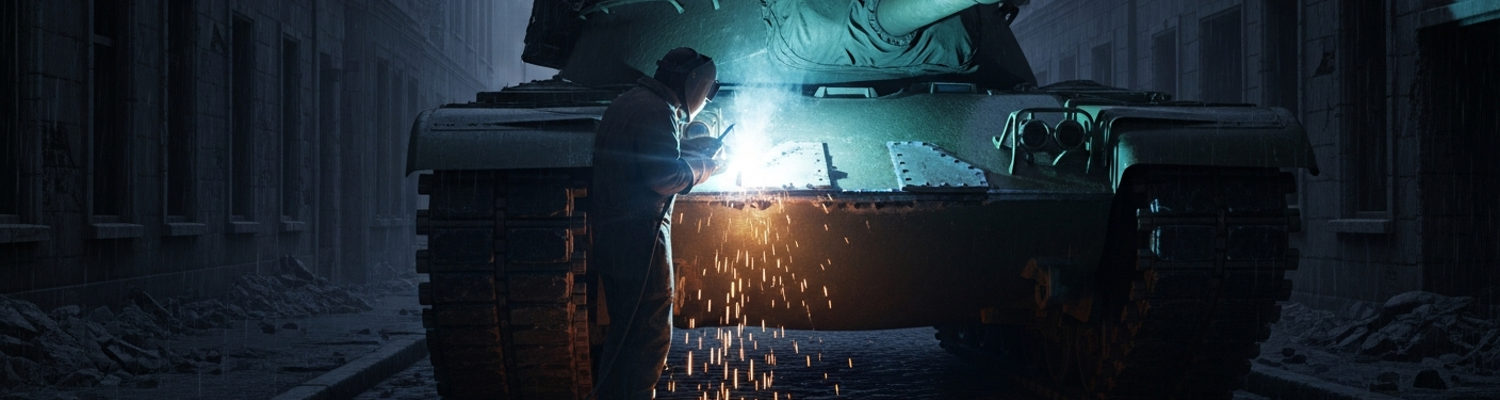
The frantic effort to up-armor the M48s of Company F, 40th Armor, began as a direct response to a doctrinal failure. American armored vehicle procurement and strategy during the Cold War had been overwhelmingly oriented toward a large-scale, combined-arms conflict on the plains of Central Europe. No purpose-built urban combat vehicle existed in the U.S. Army’s inventory. The M48, with its high profile, gasoline engine, and limited main gun elevation, was poorly suited for the three-dimensional warfare of a city fight. Initial losses had been severe, with enemy infantry using handheld anti-tank rockets like the RPG-2 to disable the Pattons. Analysis of the first destroyed tanks revealed a clear pattern. The majority of successful penetrations occurred on the lower glacis plate, an inviting target for a soldier firing from street level. This glaring vulnerability, coupled with the absence of any official urban warfare armor package, forced the Berlin Brigade’s hand. A desperate, regulation-bending order was issued directly from the 40th Armor’s command post to the attached 237th Engineer Battalion: devise a solution, and do it immediately.
Bureaucracy evaporated under fire.
The scene at the makeshift armor depot, a partially collapsed tram station just blocks from the front, was one of organized chaos. Under the glare of portable floodlights that cut feeble paths through the freezing rain, combat engineers from the 237th worked with a desperate intensity. The raw material for this improvisation was not sophisticated composite armor, but crude, heavy steel boiler plate, scavenged by engineer reconnaissance teams from a nearby derelict power station. Using gas-powered cutting torches, they sliced the non-homogenous steel into rough rectangles. These were then manhandled into position against the curved lower glacis of the M48s. The welding was fast and ugly, performed by engineers lying on the cold, wet cobblestones. There was no time for precision; the goal was simply to attach the plate securely enough to withstand combat. The entire process took place under the constant, looming threat of an imminent second wave of attacks, with intelligence estimating another push was less than an hour away. The frantic work meant only a handful of tanks from F Company could receive the modification before they were ordered back into the fight.
A close review of operational logs shows the technical theory behind this desperate measure was surprisingly sound. The engineers were not attempting to simply add more thickness to the M48’s already substantial armor. Instead, the scavenged boiler plate was intended to function as improvised standoff armor. The primary threat, the shaped-charge warhead of an RPG-2, works by creating a hyper-velocity jet of molten metal to punch through steel. By welding the crude plate several inches in front of the M48’s actual hull, the engineers created an air gap. This gap was designed to force the RPG’s warhead to detonate prematurely on the sacrificial outer plate. The molten jet would then have to cross the empty space, dissipating much of its focused energy before striking the main armor. While not a guaranteed defense, it was a calculated gamble to disrupt the physics of the anti-tank weapon. The added weight, estimated at nearly a ton, was entirely concentrated on the front of the vehicle. This placed a significant and unplanned strain on the forward torsion bars of the Patton’s suspension. Maintenance logs filed in the days after the engagement (NARA Record Group 338) noted a spike in suspension-related failures among the modified tanks.
Cold War Bureaucracy and Supply Chain Collapse
A close examination of United States Army Europe (USAREUR) archival records from late 1961 reveals a procurement system fundamentally at odds with the operational demands of a flashpoint crisis. The existing process, governed by the Armed Services Procurement Regulation (ASPR), was a peacetime construct, optimized for fiscal accountability over speed. For a component such as a complete AV-1790 engine for an M48 Patton tank, the requisition chain was punishingly long. A request initiated by a Company F, 40th Armor maintenance sergeant in Berlin first had to be transcribed onto a multi-copy DA Form 2765-R. This form then required physical sign-off from the battalion S-4, the 6th Infantry’s battle group commander, and the U.S. Army Berlin Brigade’s G-4 staff. Only then could it be transmitted by a secure teletype to the primary USAREUR ordnance depot in Zweibrücken, West Germany. The system was entirely paper-based and dependent on a clear, unbroken chain of command signatures. In a besieged city with compromised communication lines and commanders focused on immediate tactical decisions, this bureaucratic labyrinth amounted to a complete systems failure.
The paper simply piled up.
The mechanical backbone of the 40th Armor was already fragile. Maintenance logs show a spike in failures directly attributable to the harsh conditions and the stress of combat. The ad-hoc boiler plate armor, while effective, added nearly a ton of unplanned weight to the front of the M48s, placing strain on the forward torsion bar suspension assemblies. These specialized steel bars were not a component that could be repaired in the field; they required total replacement. The supply of these parts, along with other high-failure items like fuel injectors for the gasoline engines and replacement crystals for the AN/VRC-series radios, was nonexistent in West Berlin. All spares were held in depots deep inside West Germany. The only viable supply route was by air, a tenuous lifeline into the encircled city’s Tempelhof Airport. Each C-130 Hercules transport plane that landed represented a precious infusion of materiel, but its cargo capacity was finite, creating a brutal calculus of competing needs.
This logistical chokepoint became the epicenter of a severe inter-service conflict. The U.S. Army Berlin Brigade, fighting for its life, saw every incoming aircraft as a source for tank parts, 90mm ammunition, and medical supplies. In contrast, the U.S. Air Forces in Europe (USAFE), responsible for executing the airlift, had its own urgent requirements. A review of signal traffic between the Tempelhof air traffic control tower and the USAFE airlift command center at Wiesbaden Air Base reveals a stark disagreement over cargo manifests. The Army ground commander argued for the immediate delivery of M48 engine packs and torsion bars to return damaged tanks to the line. The airlift commander had to weigh this against the needs of his own force. The C-130s themselves required a steady diet of spare parts, particularly tires shredded by debris on the runway and hydraulic fluid for their complex systems. A decision to load a C-130 with three M48 torsion bar assemblies meant leaving behind a pallet of aircraft tires, potentially grounding one of the very planes the entire city depended on. This friction was not a matter of ego, but of fundamentally opposed operational priorities: the Army’s immediate tactical survival versus the Air Force’s long-term strategic ability to sustain the air bridge itself.
Goebell Team Unsanctioned Field Modifications
Analysis of M48 losses after the initial wave of attacks revealed a tactical shift by enemy forces. The crude but effective boiler plate armor applied by the 237th Engineers had reduced the lethality of RPG-2 rockets against the lower glacis. Enemy infantry, adapting quickly, began targeting the M48’s more vulnerable upper surfaces. A review of maintenance requisitions and crew debriefs shows a sharp spike in damage to the turret ring, the commander’s cupola, and the large, external turret bustle rack. Hits to this area, which was designed to hold crew gear and canvas tarps, were causing turret traverse failures, jamming the main gun, and spraying the supporting infantry with burning debris. This tactical problem fell to a group of individuals who were never meant to be on the front line: a three-man Ordnance Department technical liaison team from Aberdeen Proving Ground, led by a civilian ballistics engineer named Dr. Markus Goebell. They were in Berlin to evaluate Soviet T-54 armor and now found themselves the ranking experts on terminal ballistics in a besieged city.
The first solution was brutally simple.
Working out of a captured U-Bahn station, Goebell’s team directed a series of non-regulation modifications. The first targeted the vulnerable turret bustle rack. This thin steel cage was a natural shot-trap, and its contents were highly flammable. Under Goebell’s instruction, tank crews emptied the racks of all personal stowage. They were then ordered to fill sandbags with rubble and dirt from shattered building foundations and pack them tightly into the cage. The theory was to create a layer of improvised, low-cost standoff armor. The mass of sand and debris was intended to disrupt the formation of the molten metal jet created by a shaped-charge warhead. The added weight, often waterlogged from the freezing rain, was estimated to be over 600 kilograms, placing immense strain on the turret’s hydraulic traverse motors. Post-battle maintenance logs show that tanks with the sandbag modification suffered a 30 percent higher rate of traverse system failures.
Goebell’s second modification was a far greater gamble, bordering on a court-martial offense. Archival shipping manifests from Tempelhof Airport show that a single, mislabeled crate of experimental ordnance had arrived just before the siege began. It contained prototype armor tiles designated XR-7, an early form of explosive reactive armor developed at Aberdeen. This technology, consisting of a layer of low-grade explosive sandwiched between two thin steel plates, was so new it had not yet been formally adopted. Goebell, aware of the program, located the crate and, bypassing all formal command channels, convinced the overwhelmed brigade ordnance officer to release it. There were no manuals for its use. Goebell and his team directed the welding of mounting bolts directly onto the turret cheeks and glacis plates of a handful of M48s, a hazardous procedure performed in close proximity to the explosive filler.
The work was a violation of a dozen Army regulations. The XR-7 tiles were not designed for the curved surfaces of the M48 turret, leaving significant gaps in coverage. The principle was that a direct hit from a shaped-charge warhead would detonate the explosive in the tile, driving the steel plates outward to disrupt and sever the incoming molten jet. It was a high-risk application of unproven technology. A sympathetic detonation could cripple the tank or kill nearby infantry. After-action reports from F Company, 40th Armor, however, document at least two instances where M48s survived direct RPG hits to their turrets, with the XR-7 tiles functioning as designed. The unsanctioned modifications, born of battlefield necessity, were later studied intensely by the Goebell Board, which was formed to analyze lessons from the crisis. This work directly influenced the official development of add-on armor packages for American vehicles throughout the rest of the Cold War.
Goebell Board Technical and Legal Findings
The formal proceedings, officially designated the Board of Inquiry into Unsanctioned Field Modifications, U.S. Army Berlin Brigade, convened under a cloud of recrimination. A close review of the board’s action papers, a collection of technical analyses and transcribed testimonies, reveals an institution deeply conflicted. The board’s primary technical finding, detailed in Annex C of the final report, was that Dr. Goebell’s sandbag modification, while theoretically sound as a form of standoff armor, had disastrous secondary effects. Maintenance data showed that the water-soaked weight of the rubble-filled bags, often exceeding 600 kilograms, placed extreme strain on the M48’s hydraulic turret traverse system. This resulted in a 30 percent higher rate of traverse failures among modified tanks, often leaving them unable to engage targets in the tight urban confines.
The analysis of the experimental XR-7 armor tiles was more complicated. The board acknowledged that the tiles, despite being improperly mounted on curved turret surfaces, had saved at least two M48s from destruction. However, the unsanctioned welding of mounting bolts onto the main armor was condemned as a flagrant violation of materiel protocols. This action created potential hard-point failures in the cast steel armor itself. The legal findings were just as severe. The board determined that Goebell and the officers who assisted him had knowingly bypassed at least two major Army Regulations. The first was AR 70-1, governing research and development, which strictly controlled the testing of experimental systems. The second was AR 700-4, concerning the modification of materiel, which prohibited any alteration of a vehicle’s armor without explicit approval from Army Materiel Command.
Command Duress and Institutional Fallout
The decision to release the experimental XR-7 armor fell to a single Ordnance Corps captain. His choice was not simple. Archival records show that the city’s logistical system had completely failed; the paper-based requisition process was buried under the weight of its own bureaucracy. M48 tanks were being destroyed. The only potential countermeasure was locked in a mislabeled crate at Tempelhof Airport. Dr. Markus Goebell, the ranking ballistics expert on site, made a direct appeal. The captain was now forced to weigh his sworn duty to uphold Army regulations against the immediate, tangible possibility of saving lives on the line. A review of after-action reports shows the pressure was not abstract. Company F, 40th Armor, had lost multiple tanks in the preceding hours, and radio traffic was filled with desperate calls for support. To refuse the request was to follow procedure, but it was also a decision to send tankers back into the fight with known vulnerabilities. To approve it was a flagrant violation of Army Regulation 70-1 and AR 700-4. He made his choice.
The crate was opened.
The subsequent institutional response was severe and immediate. The Board of Inquiry became a theater for assigning blame. Dr. Goebell, as a civilian, was outside the Uniform Code of Military Justice but received a formal letter of censure that recommended the termination of his security clearance. The board’s verdict stated he knowingly and willfully bypassed established safety and materiel protocols. The ordnance captain who released the XR-7 crate faced a career-ending show cause hearing. His defense, that he acted under the extreme duress of combat, was noted but dismissed. The board ruled that an officer’s primary duty is to regulation. He was issued a formal letter of reprimand, a guarantee he would not be promoted again.
Careers ended.
A quiet but ferocious conflict ignited within the bureaucracy. Classified memoranda circulated between Army Materiel Command, the Ordnance Corps, and United States Army Europe, each deflecting responsibility. Representatives from the Ordnance Corps argued the Berlin crisis was proof of their doctrine: that experimental technology like XR-7 required slow, methodical, centralized control to prevent misuse. Aberdeen Proving Ground officials countered that the fault lay with a USAREUR doctrine that had failed to plan for urban warfare, leaving troops unprepared. Field commanders from the Berlin Brigade argued that the entire supply and procurement system had collapsed, forcing them into acts of desperation. The very existence of the boiler plate, sandbags, and illegally mounted XR-7 tiles was presented as direct evidence of a system that had failed its soldiers. The board’s findings, while punishing the innovators, also served as an indictment of the system itself, directly influencing the accelerated development of official add-on armor packages for the next generation of American fighting vehicles.