
Parted Span Wires and Rig Deck Failures
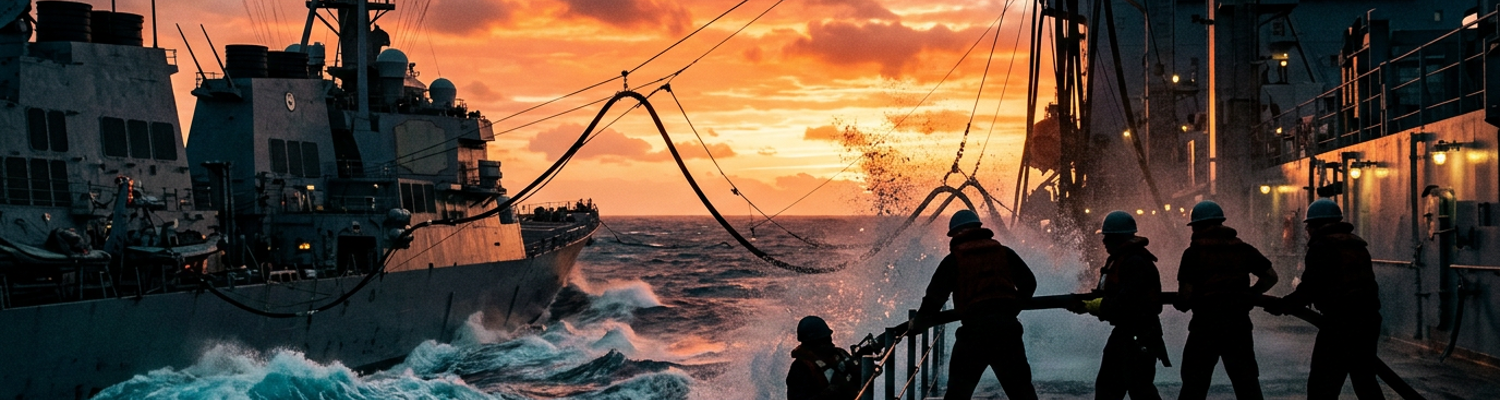
Service Squadron Three fleet oilers faced the massive logistical challenge of transferring millions of gallons of bunker fuel and aviation gasoline to combat ships scattered across rough waters off Formosa. Seventh Fleet aircraft carriers, cruisers, and destroyers burned through fuel at rapid rates while maintaining continuous air patrols and naval blockades around the offshore islands. Keeping these frontline warships combat ready required fleet oilers to maneuver alongside them in open water, establishing physical connections across eighty to one hundred feet of churning sea while both vessels matched speed at twelve to fifteen knots. Rig crews sent across heavy messenger lines, pulled thick steel cables over high lead blocks, and secured tensioned highline span wires capable of supporting two massive six-inch fuel hoses full of liquid. Every replenishment run demanded flawless coordination between bridge helmsmen, winch drivers, and deck hands as thousands of tons of steel hull surged against the ocean currents.
Ocean currents and heavy autumn swells rolling through the shallow Taiwan Strait constantly disrupted this delicate balance by forcing the paired hulls to roll and pitch out of rhythm with each other. Deep wave troughs passed beneath an oiler while an adjacent destroyer rose on a wave crest, expanding the distance between the two mastheads in a matter of seconds. Automatic tensioning winches frequently failed to pay out line quickly enough to relieve the sudden crushing load placed on the three-quarter-inch wire. Tension spiked beyond the rated breaking strength of the steel, snapping highline span wires on Service Squadron Three oilers with sudden explosive force. Parted main wires instantly severed the bridge between the two ships, dropping heavily loaded fuel rigs directly into the sea and leaving hundreds of feet of pressurized steel cable unsupported in midair.
Steel cables whipped across oil-slicked non-skid plating off the Pescadores, creating lethal hazards for deck hands trapped in the open rig stations. Loose jagged ends of the parted cables recoiled toward the oiler at extreme speed, shearing through metal stanchions, tearing away wooden fairleads, and shredding canvas gear bags mounted along the superstructure. Fuel oil escaping from torn hose couplings sprayed over the deck surfaces, mixing with sea spray to turn the rough deck paint into a slick treacherous hazard. Deck crews wearing bulky life vests and steel helmets threw themselves flat against the steel waterways or scrambled behind armored winch housings to avoid being struck by the flailing wire rope. Winch operators slammed emergency levers to kill steam pressure, halting the spinning drums before the wild cable ends could foul the remaining deck machinery or pull bystanders into the machinery guards.
Machinery guards provided temporary cover until rig crews scrambled to their feet to secure the damaged deck stations and clear the tangled wreckage before the drifting vessels collided. Sailors equipped with cable cutters and heavy axes severed the dangling hose saddles, letting damaged fuel lines drop clear into the ocean before they could foul the ship propellers. Chief petty officers directed deck teams to haul in the remaining sections of frayed wire rope by hand, securing the loose ends to deck bitts with heavy manila line. Bridge officers on the oiler broke off the fueling approach, sounding whistle signals to order the receiving warship to sheer away and reset its approach formation. Deck hands dragged fresh spools of wire rope from the hold to rig a replacement span wire across the kingposts, preparing the deck station to take on the next waiting destroyer.
Rough Water Fueling of Screening Destroyers
Destroyers assigned to the carrier screen emerged from dense seasonal fog banks to take their stations along the port side of the oiler. Rig crews stood ready on the open deck as the approaching escort vessels maneuvered within eighty feet, conducting refueling operations at sea speeds of twelve to fourteen knots amidst weather conditions that reduced visibility across the water to less than two hundred yards. Helmsmen on both ships fought heavy cross currents and steering suction, applying constant rudder corrections to keep their hulls parallel in the rolling swells. Gunner mates on the oiler fired line-throwing guns across the narrow gap between the moving ships, sending shot lines over the forecastle of the destroyer to pull across heavy manila messenger lines. Deck hands hauled the replacement span wire across the water, anchoring the terminal fitting into the receiving padeye and hoisting the fuel hoses into position over the churning sea. Sailors bolted the fuel couplings into the receiving trunks and signaled the pump rooms to open the supply valves.
Supply valves opened as pumps deep inside the oiler forced thick bunker fuel through the suspended hoses, starting continuous pumping cycles that ran for twelve hours without interruption. Service Squadron Three vessels fueled six to eight screening destroyers in rapid succession to ensure the combat screen around Formosa never dropped below operational strength. Transferring this volume required pumping tens of thousands of gallons of fuel oil while maintaining steady speeds and constant wire tension against erratic wave action. Engine rooms on the oilers burned extra steam to run both the main propulsion turbines and the high-capacity cargo pumps at maximum output. Crew members rotated through four-hour watches without rest, monitoring pressure gauges on the rig deck and watching for any signs of line failure while salt spray coated their goggles and life jackets. Intense heat radiated off the continuous-duty winch motors, baking the surrounding deck plates as heavy sea spray washed over the machinery.
Machinery vibrations increased as winch drums experienced severe mechanical brake slippage when scorched friction bands failed to hold the surging cable tension. Mechanical winch brake slippage and hydraulic line leaks induced by continuous pumping cycles spread across the rig stations, as high-pressure fluid lines ruptured under the unrelenting shock of waves pushing the hulls apart. Escaping hydraulic oil sprayed in fine mists over the winches and pooled on the wet steel deck, making footing even more treacherous for the line handlers. Span wires paid out abruptly when the winch brakes slipped, allowing the heavy fuel hoses to drop toward the water and threatening to rip the fittings off the deck of the destroyer. Deck officers shouted warnings over the sound of the engines while winch drivers leaned their full weight against manual hand brakes to arrest the runaway drums.
Winch drums slowed as machinists wrapped split rubber gaskets and threaded steel clamps around the weeping pipe joints to keep line pressure steady. Rig crews used wire brushes and sand to scour the spilled hydraulic fluid off the non-skid plating, giving the winch operators firm footing as they manually adjusted the brake linkages. Winch operators tightened the mechanical brake bands with heavy wrenches between destroyer approaches, cooling the hot steel drums with buckets of seawater so the linings could grip the cable. Constant mechanical adjustments allowed the oiler to complete the fuel transfer to the destroyer without parting the highline or dropping the hose saddles into the sea. Deck hands uncoupled the fuel hoses, tripped the pelican hooks to release the span wire, and watched the topped-off destroyer increase speed to return to its patrol station.
Ordnance Bottlenecks Aboard USS Mauna Kea
USS Mauna Kea steamed into the replenishment formation as those topped-off destroyers peeled away, opening its cargo holds to replenish the depleted magazines of the fleet. Gunner mates and deck divisions faced a relentless physical burden, maintaining round-the-clock munitions staging using highline rigs and whip-lines to pull tons of explosives out of deep magazine holds. Hydraulic cargo elevators ran without pause from the bottom of the hull, bringing up pallets of five-inch projectiles, brass powder cases, and heavy aerial bombs into the stifling staging areas. Deck gangs wrestled the explosive cargo across narrow passageways using overhead monorails, hooking wire slings and cargo nets to highline rigs and whip-lines that groaned under the immense weight. Crewmen secured the pallets to rolling skids on the exposed main deck, stacking live ordnance under sodden canvas coverings while salt spray washed over the steel waterways. Heavy seasonal fog banks gradually swept across the formation, hiding the surface of the water and turning the busy staging deck into an isolated platform surrounded by gray mist.
Mist settled thick over the water, creating severe transfer bottlenecks involving five-inch shells and bombs swinging erratically in zero-visibility conditions. Screening destroyers and heavy cruisers maneuvered into station along the port and starboard flanks of the ammunition ship, matching speed at twelve knots while entirely hidden from bridge view by the blinding fog. Highline trolleys suspended heavy pallets of five-inch gun ammunition above the water gap, but the violent rolling of the paired hulls constantly disrupted the tension on the span wires. Opposing wave crests pushed the ship hulls apart and dropped them into troughs out of rhythm, transforming suspended loads of five-inch shells and five-hundred-pound bombs into uncontrolled swinging arcs that plunged toward the sea before jerking violently skyward. Winch operators lost visual tracking of the receiving ships completely, forcing transfer rates to plummet as loads hung suspended over the boiling wake for minutes at a time. Steel padeyes and kingpost fittings creaked under the extreme lateral torque whenever a swinging pallet of bombs threatened to smash directly into the ammunition ship superstructure.
Superstructure impacts were avoided when boatswain mates countered the violent swinging by rigging extra manila taglines to the highline trolleys, giving deck gangs manual leverage over the erratic loads. Line handlers braced their boots against slippery non-skid plating, throwing their collective weight against the hemp ropes to dampen the violent oscillations before the swinging munitions could shear off rig stanchions. Sound-powered telephone talkers stationed along the ship rail shouted cadence counts and wave timings into their chest transmitters, giving winch operators the only sensory data available in the blinding fog. Winch operators responded to these verbal cues by feathering steam controls and mechanical hand brakes, timing each payout of the whip-lines to match the rise and fall of the unseen receiving warship. Improvised hemp snubbers and auxiliary whip-lines guided the volatile pallets down onto the receiving decks during brief moments when the wave crests leveled the hulls. Rig crews on the receiving combatants quickly unhooked the cargo nets, dragged the five-inch shells and bombs into armored ammunition handling rooms, and signaled the ammunition ship to haul back the empty highline trolley for the next run.
Blackout Replenishment for Task Force Carriers
Highline trolleys zipped back across the water while Task Force 77 aircraft carriers USS Lexington and USS Midway moved into replenishment positions. Both attack carriers maintained continuous combat air patrols over the Formosa Strait to deter hostile aircraft and protect the offshore islands, keeping flight decks in a state of unending activity. Jet interceptors burned vast amounts of aviation fuel and required constant replenishment of replacement parts, lubricants, and specialized avionics gear to stay flight-worthy. Bringing supply ships alongside these moving airfields required precise shiphandling, as the carriers could not halt their flight operations during the transfer without sacrificing defensive air coverage. Supply vessels settled into formation along the carrier flanks at speeds between twelve and fifteen knots, cutting through rough autumn swells that threw walls of spray over the forward gun mounts. Fleet commanders ordered complete darkness across the entire formation, imposing strict blackout discipline to ensure that neither coastal radar stations nor surfaced torpedo boats could pinpoint the ships. Deck officers immediately ordered all external illumination extinguished, leaving the steel decks plunged into absolute darkness.
Darkness forced rig crews working along the exposed deck edges to rely on lanterns fitted with dark red lenses for their only permissible light. Sailors aimed these dim red battle lanterns strictly downward against the wet non-skid plating, shielding the glass faces with their hands and canvas flaps so that no stray light leaked outward toward the horizon. Deck hands relied heavily on physical touch and muscle memory in the faint red glow, tracing cold steel cable strands with their palms to check for broken wires. Rig captains checked the heavy shackle pins and pelican hooks by hand, feeling the threaded metal seat firmly into the padeyes without the aid of white work lights. Voice commands were strictly forbidden across the open deck to maintain noise discipline, forcing line handlers to communicate through hand taps on shoulders and muffled whispers transmitted over sound-powered telephone circuits. Working under these dim red glows slowed every mechanical procedure, but it prevented the enemy from detecting the silhouettes of the fleet carriers against the dark ocean surface.
Ocean surfaces concealed the steel highline rigs transferring delicate avionics crates, radar spare parts, and ammunition pallets across the invisible gap between the hulls. Suspended loads swung heavily through the night air as rolling seas caused the oiler and the carrier to heave out of sync. Winch operators on the supply ships could not see the carrier sponsons where the cargo needed to land, relying entirely on sound-powered phone talkers who relayed tension adjustments second by second. Receiving crews on USS Lexington and USS Midway caught each swinging cargo net with long wooden reach poles, guiding the heavy wooden crates onto mattresses and rubber dunnage laid across the deck. Deck hands swiftly unhooked the cargo bridles under the dim glow of their red-lens battle lanterns and dragged the supplies into interior hangar bays, where aviation mechanics waited to install the parts on grounded fighters. Empty highline trolleys then zipped back across the span wire into the darkness to receive the next pallet from the supply ship staging areas.
Supply ship staging areas depended on radar scopes displaying the exact distance between the plunging warships, feeding continuous range updates to the bridge to keep the highline wires from snapping in the dark. Helmsmen on both vessels watched glowing circular screens rather than the black water, using station-keeping radar to adjust rudders by half-degree increments and counteract the dangerous hydrodynamic suction pulling the two hulls together. Bridge talkers called out range markers in single feet over dedicated telephone lines, warning the captain whenever a ship surged too close or drifted beyond safe wire limits. Engine rooms answered constant minor speed corrections on the engine order telegraphs, maintaining an exact twelve-knot pace against unpredictable tidal rips off the Formosa coast. Crews completed the transfer of thousands of gallons of aviation fuel and tons of critical aircraft components without displaying a single flash of white light. Deck divisions tripped the pelican hooks to drop the span wires clear of the water, allowing USS Lexington and USS Midway to increase boiler output and turn into the wind to recover their returning combat air patrols.
Doctrinal Improvisation and Peacetime Safety Waivers
Aircraft from the returning combat air patrols vanished into the overcast sky as fresh columns of destroyers closed in to take on fuel. Service Squadron Three officers faced a relentless physical dilemma, because standard peacetime replenishment doctrine required keeping a wide separation distance of one hundred and forty feet between ships to prevent hull collisions. Heavy autumn wave troughs in the Taiwan Strait repeatedly threw the ships apart, stretching the heavy rubber fueling lines taut and threatening to rip them off their deck flanges. Fleet commanders resolved this crisis by issuing an authorized bypassing of standard naval peacetime separation distances to prevent ruptured transfer hoses. Helmsmen brought the destroyers alongside at an unusually close range of barely seventy feet, steering through churning wake currents with constant rudder adjustments. Fuel hoses hung in deep slack curves across the narrowed gap, absorbing the violent roll of the ships without placing tearing strain on the couplings.
Couplings held firm against the surging pressure, but the compressed distance transferred violent shock loads directly into the supporting steel highlines. Steel strands along the span wires began to unlay and fray under the rapid unequal pitching of the paired hulls. Standard naval procedure required damaged rigging to be struck below and replaced, or dictated that the entire oiler return to port at Subic Bay or Yokosuka for shipyard rerigging. Service Squadron Three could not afford to withdraw a single auxiliary ship from the Taiwan Strait without leaving combat air patrols and escort screens completely out of fuel. Deck officers consequently refused port returns, ordering shipboard repair crews to solve the rigging failures right on the pitching deck.
Deck surfaces became makeshift workshops as shipfitters carried oxyacetylene cutting torches, heavy steel plate, and portable pneumatic drills directly onto the wet non-skid plating to tackle the damaged wires. Machinists cut thick channel iron into fitted backing plates, drilling bolt holes through the metal to create heavy split-collar brackets that matched the diameter of the frayed highlines. Deck gangs secured these pieces around weakening wire sections, completing the on-deck fabrication of makeshift wire clamps and rig stops to repair parting lines without port returns. Riggers bolted the makeshift clamps directly over the frayed cable strands with hardened steel fasteners, tightening each nut with heavy impact wrenches until the metal teeth bit into the wire core. Crewmen welded mechanical rig stops along the guide tracks to prevent traveling trolleys from rolling over the damaged wire sections during cargo runs.
Cargo runs resumed after rig stops halted the highline trolleys several inches short of the patched cable sections, keeping the traveling wheels from catching on the bolted metal brackets. Winch operators engaged their friction drums slowly, testing the reinforced cables under thousands of pounds of deadweight tension before signaling the next waiting warship to pull alongside. Improvised clamps held the parted steel strands tightly in place, preventing the highlines from unraveling completely under the heavy drag of loaded fuel saddles. Bridge officers matched speeds with the next approaching destroyer, passing messenger lines across the narrow gap to resume continuous pumping operations. Black bunker oil flowed through the suspended hoses into the warship bunker tanks, keeping the screening escorts fully fueled on the front lines without losing a single hour of station time.
Logistical Sustenance for Quemoy Convoy Escorts
Station time proved critical as destroyers broke away from the replenishment rigs to escort Republic of China supply convoys heading directly into heavy artillery fire around Quemoy. Continuous at-sea replenishment of naval escorts defending Republic of China supply convoys to Quemoy was the only method that kept American warships screening the transport runs without abandoning the forward perimeter. Seventh Fleet combat vessels accompanied Nationalist transport ships and landing craft to within three nautical miles of the island beaches, turning their guns seaward to block hostile torpedo boats while shore artillery pounded the surf zone. Screening warships could not leave their patrol boxes to enter Formosan ports without breaking convoy schedules, forcing Service Squadron Three auxiliary ships to steam right on the edge of the contested channel to deliver fuel, ammunition, and fresh provisions. Combat escorts consumed immense quantities of bunker fuel while maneuvering aggressively to shield the vulnerable amphibious vessels from shellfire. Rig crews passed heavy fuel hoses and messenger lines to the escorts every forty-eight hours, matching speeds through turbulent rip tides while lookouts scanned the shoreline for artillery muzzle flashes.
Artillery muzzle flashes illuminated the horizon while deck divisions absorbed an immense physical toll working consecutive thirty-six-hour shifts to sustain forward defensive lines around the bombarded archipelago. Sailors stood on vibrating oil-covered steel decks without relief, hauling sodden manila messenger lines, carrying heavy rigging tackle, and wrestling wildly lurching fuel hoses as destroyer after destroyer queued along both flanks of the oilers. Salt spray and raw fuel oil crusted on their faces, causing chemical burns and deep skin blisters around their eyes, necks, and forearms. Exhausted crewmen collapsed against deck bitts or dozed standing up while strapped into heavy canvas safety harnesses, their hands swollen and split open from handling frayed wire rope under constant strain. Ship medics administered salt tablets, taped cracked fingers, and treated sprained wrists directly on the open weather decks so men could stay at their winch controls, because every spare body was needed to catch shot lines and secure hose saddles. Petty officers kept watch over their men on the slick non-skid plating, shouting warnings whenever swinging hose blocks threatened to crush line handlers.
Hose blocks swung back into continuous action when fresh pairs of screening destroyers pulled alongside the replenishment ships to replenish their rapidly draining bunker tanks. Riggers wrestled the heavy rubber lines onto the receiving sponsons, locking the couplings into position with bronze spanner wrenches while green water crashed over the forward gun mounts. Chief boatswain mates monitored the relentless rotation of escorts, rotating sleep-deprived line handlers between line-throwing stations and fuel manifolds to keep crewmen from slipping into the sea from sheer physical collapse. Engineers down in the auxiliary pump rooms ran centrifugal pumps at maximum discharge pressure, driving thousands of gallons of black oil through the suspended lines in record time so the escorts could disengage without delay. Line handlers hauled in the empty messenger lines by hand, stowing the hemp coils on wooden grates while the receiving ships unbolted the fuel fittings and prepared to cast off the highlines. Deck hands knocked loose the pelican hooks with sledgehammers, watching the topped-off escorts sheer away into the chop to resume their protective cordons around the Nationalist transport vessels.