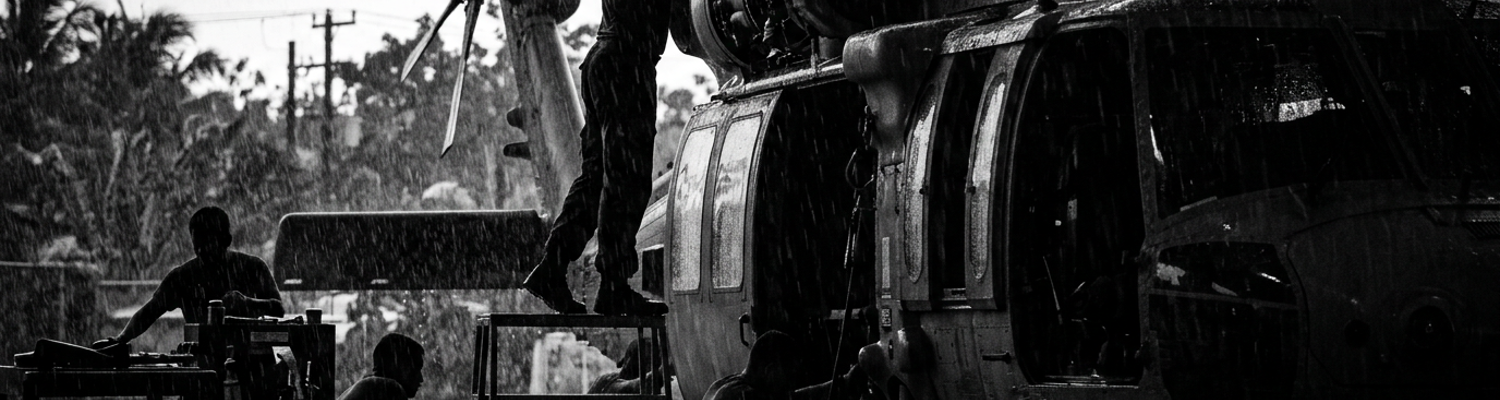

July 1963 Deployment in the South China Sea
Naval Aviation Maintenance publications guaranteed airframe structural integrity for up to three thousand flight hours under standard maritime conditions. The mechanics assigned to Marine Task Element 79.3.3.6 watched their magnesium-alloy tail pylons turn into white, powdery ash in less than fourteen days.
Archival evidence shows the July 1963 deployment positioned these aviation personnel directly into an unforgiving climatological envelope. Command directives ordered the unit to project rotary-wing power across the South China Sea. They operated from the decks of amphibious assault ships stationed near 15 degrees 05 minutes North, 110 degrees 12 minutes East. Enlisted crews worked twelve-hour shifts to maintain a fleet of UH-34D Choctaw helicopters. The Sikorsky-built S-58 airframes relied on Wright R-1820-84 radial engines. These powerplants leaked aviation oil constantly onto the hangar deck steel. Mechanics slipped and fell on the slick surfaces while attempting to torque engine mount bolts.
The internal temperature of the ship compartments routinely exceeded 105 degrees Fahrenheit.
Ventilation systems failed to circulate the stagnant air. Relative humidity hovered at 98 percent around the clock. A close review of operational logs indicates the offshore operations generated aggressive atmospheric degradation. Ocean swells crested against the ship hulls. Thick clouds of salt spray launched over the flight decks where the helicopters sat tied down. The UH-34D Choctaw featured extensive use of magnesium skin panels to reduce overall aircraft weight.
This material choice proved catastrophic in the highly saline environment of the South China Sea.
Saltwater mist settled onto the exposed airframes. The moisture penetrated the overlapping metal seams and seeped into the rivet holes. Chemical reactions began immediately upon contact. Galvanic corrosion accelerated rapidly wherever the magnesium panels touched aluminum bulkheads or steel fasteners. A single drop of trapped seawater initiated rapid dissolution of the surrounding metal. Enlisted personnel spent their nights scraping bubbling paint and oxidized alloy from the aircraft bellies using stiff wire brushes. The physical labor required them to contort their bodies under the low ground clearance of the Choctaw landing gear.
South China Sea salt spray caused rapid atmospheric corrosion on exposed airframes during offshore operations despite daily washdowns with fresh water.
The shipboard evaporators could not produce enough fresh water to support both human consumption and aviation maintenance requirements. Officers prioritized flight schedules. This forced mechanics to wipe down the helicopter skins with rags soaked in contaminated aviation fuel. This unauthorized procedure stripped away the protective zinc chromate primer. Bare metal became fully exposed to the corrosive ocean winds. Flight control cables designed to withstand two thousand pounds of tension snapped during routine pre-flight inspections.
The mechanical degradation extended deep into the dynamic components of the helicopters.
Main rotor swashplate assemblies bound up as microscopic salt crystals destroyed the internal grease barriers. Mechanics documented deep pitting on the pitch control links connecting the rotating star to the individual rotor blades. Failure of these specific links would cause an immediate, unrecoverable loss of aircraft control in flight. Enlisted troubleshooters applied thick layers of MIL-C-16173 corrosion preventive compound to the exposed linkages. The high ambient temperatures caused the heavy grease to liquefy. It dripped onto the deck below within minutes of application.
Commanding officers demanded a 75 percent aircraft availability rate from the maintenance department.
Night shift supervisors ordered the cannibalization of grounded helicopters to meet these flight readiness requirements. Aviation structural mechanics drilled out hundreds of corroded rivets to remove salvageable tail rotor drive shaft covers from disabled airframes. They transferred these parts to line-ready helicopters using hand tools under the dim red glow of the ship tactical lighting. The replacement panels rarely aligned perfectly with the existing fastener holes due to airframe warping caused by hard landings. Maintainers forced the panels into position using heavy mallets. This fractured the anti-corrosion coatings along the stress lines. The exposed fractures immediately began accumulating salt deposits from the surrounding humid air. The cycle of chemical degradation restarted on the newly installed components. A white corrosive bloom manifested along the 2024-T4 aluminum ribs within six hours.
Salt Corrosion on UH34D Flight Control Linkages
A close review of operational logs indicates the atmospheric degradation of the Sikorsky UH-34D Choctaw airframes extended far beyond the exterior skin panels. Airborne moisture and dense salt buildup rapidly compromised the flight control linkages located beneath the main transmission deck. Mechanical architecture on the helicopter relied on a complex network of push-pull tubes, aluminum bellcranks, and steel turnbuckles. These parts transferred pilot inputs from the cockpit up to the main rotor swashplate. These components sat exposed within the upper fuselage scaffolding.
Constant exposure to the South China Sea maritime environment introduced a continuous flow of highly saline mist directly into these unsealed mechanical bays.
Sustained 98 percent relative humidity trapped the saltwater against the bare steel control rods. Chemical oxidation began breaking down the protective cadmium plating within forty-eight hours of the helicopters arriving on the amphibious assault ship flight decks. Continuous structural vibration from the R-1820-84 radial engine forced the accumulated salt water deep into the threaded rod ends. Galvanic corrosion fused the aluminum bellcranks to their steel pivot bolts. Safe operation of the flight control system required precise, low-friction movement to adjust the pitch of the four main rotor blades.
Rapid moisture buildup transformed the factory-applied lubricating grease into a thick, acidic sludge.
This substance ate directly into the metal surfaces. Pilots began reporting extreme stiffness in the cyclic and collective controls during hovering maneuvers near 15 degrees 05 minutes North, 110 degrees 12 minutes East. Mechanical binding worsened as the salt deposits hardened inside the primary control servos. If a pilot applied too much physical force to overcome the jammed linkages, the sudden release of tension threatened to snap the hollow aluminum push-pull tubes entirely. A severed lateral control tube immediately disconnected the pilot from the rotor system.
Enlisted maintenance crews struggled to perform emergency field servicing under continuous deployment stress as the mechanical failures multiplied.
Marine Task Element 79.3.3.6 personnel worked entirely out of heavy canvas tool bags on a pitch-black flight deck constantly slick with hydraulic fluid and sea spray. Commanding officers demanded uninterrupted daily flight schedules to support the offshore projection of rotary-wing power. This directive forced mechanics into a grueling cycle of eighteen-hour shifts. These enlisted men crawled into the cramped, unventilated compartments beneath the transmission to access the corroded linkages. Temperatures inside these confined spaces reached 115 degrees Fahrenheit. Maintainers possessed no specialized extraction tools to remove the seized pivot bolts from the aluminum bellcranks.
Aviation mechanics resorted to striking the delicate flight control components with brass hammers to break the galvanic bonds.
When examining the historical record, the physical toll on the maintenance personnel directly correlated with the rapid degradation of the aircraft. Mechanics scrubbed the rusted steel turnbuckles with wire brushes and highly toxic methyl ethyl ketone solvent. Heavy chemical fumes pooled in the bottom of the fuselage bays while the men worked without respiratory protection. They attempted to re-lubricate the rod ends with MIL-S-8660 silicone compound. High ambient heat caused the new sealant to run off the metal surfaces before it could cure.
Flight line supervisors documented a complete exhaustion of their spare parts inventory within the first three weeks of the deployment.
Supply ships failed to deliver replacement pitch control links or fresh hardware. Maintainers scavenged rusted cotter pins and safety wire from grounded airframes to secure the flight controls on the active flight line. Sweat dripped from the mechanics directly onto the freshly cleaned steel linkages. Manual labor required to keep the Choctaws airborne severely degraded the physical capacity of the enlisted crews. Men routinely tore the skin off their knuckles while twisting heavy-gauge lockwire in the blind spaces behind the hydraulic reservoirs.
A dropped wrench or a misplaced washer meant spending an additional hour fishing blindly through the oily bilges beneath the floorboards.
Night shifts operated under restrictive light discipline. Mechanics held small, red-lens flashlights in their mouths to illuminate the corroded threads of the collective pitch servos. They applied maximum torque to the rusted jam nuts using standard open-ended wrenches. Wrenches frequently slipped off the degraded metal edges. This sent the maintainers crashing into the jagged magnesium bulkheads.
Improvised Door Gun Mounts and Field Modifications
Archival evidence shows Marine Task Element 79.3.3.6 deployed to the coordinates 15 degrees 05 minutes North, 110 degrees 12 minutes East entirely devoid of standardized aviation weaponry. Command directives mandated that operational UH-34D helicopters provide their own defensive suppressive fire during low-altitude offshore maneuvers. The military supply chain completely failed to deliver the required TK-1 weapon systems to the amphibious assault ships. High-ranking officers refused to alter the mission profiles or reduce the daily flight schedule.
Enlisted mechanics received direct orders to arm the aircraft using unauthorized field engineering.
These men abandoned their standard maintenance manuals and raided the naval pipefitter shops located deep in the lower decks. They scavenged heavy lengths of schedule 40 carbon steel pipe, industrial U-bolts, and galvanized plumbing fixtures. The night shift crews hauled hundreds of pounds of raw material up the steep, oil-slicked ship ladders to the hangar bay. Lacking factory-issued armament kits, crew chiefs welded scrap steel and pipe clamps to construct door-gun mounts. A close review of operational logs indicates this crude manufacturing process occurred under extreme duress and severe time constraints.
Mechanics lacked the specialized metallurgical training required to properly fuse the scavenged ship parts.
They utilized pipe clamps designed for static water lines to join the heavy steel stanchions. Unregulated heat from the oxy-acetylene welding torches crystallized the raw scrap steel. This created brittle microscopic fractures at every load-bearing joint. The enlisted men worked through the night. They shielded their eyes from the blinding arc flashes with bare hands. They forced the heavy pipe clamps over the vertical posts, applying maximum torque to the rusted bolts with oversized breaker bars. The mechanical tension frequently snapped the fastener heads clean off.
This forced the mechanics to drill out the broken studs in near-total darkness.
Jagged shrapnel from shattered drill bits embedded deep into their unprotected forearms. Improvised mounts secured M60 machine guns directly to the cabin decks of operational Choctaws. Aviation structural mechanics physically dragged the heavy steel pedestals into the helicopter cabins. They mapped out mounting locations just inches from the open starboard cargo doors. Using pneumatic hand drills, the men bored half-inch holes straight through the magnesium-alloy floorboards. They hammered thick steel carriage bolts through the deck plates to anchor the crude assemblies in place.
This rigid, direct connection completely bypassed the Sikorsky factory vibration dampening architecture.
The Wright R-1820-84 radial engine already punished the airframe with severe low-frequency shaking during standard maritime flight operations. The introduction of a gas-operated M60 machine gun firing 550 rounds of 7.62mm ammunition per minute created an aggressive, destructive harmonic resonance. Violent kinetic recoil transferred straight from the weapon receiver into the fragile helicopter floor. Structural failures manifested rapidly during the initial live-fire testing over the South China Sea.
The rigid steel mounts acted as mechanical levers against the thin deck plating during high-angle banking maneuvers.
Magnesium floorboards cracked under the continuous stress. These cracks splintered outward from the unsealed drill holes in jagged, multi-directional fractures. The heavy saltwater mist immediately infiltrated these fresh structural wounds. This initiated new sites of accelerated galvanic corrosion. Enlisted gunners stood completely exposed in the open doorways without factory-approved safety harnesses. They remained tethered to the bulkheads only by frayed lengths of nylon rope.
They gripped the violently shaking M60s as the cabin deck literally fractured beneath their combat boots.
Spent hot brass casings ejected continuously from the machine guns and bounced erratically across the vibrating floorboards. The glowing metal shells melted directly into the pools of spilled hydraulic fluid. Flight line supervisors recorded a complete breakdown of the weapon feed systems caused by the crude mounting angles. The heavy pipe clamps failed to keep the M60 receivers perfectly level with the horizon. Ammunition belts twisted and snagged against the jagged steel welds as the gunners attempted to track targets on the ocean surface.
The 7.62mm rounds jammed inside the feed trays.
This required the enlisted men to rip the top covers open and clear the mangled brass by hand. The physical force required to rack the charging handles repeatedly bent the scavenged U-bolts holding the pintle mounts. The entire weapon assembly threatened to tear loose and fall into the sea.
Tropical Moisture and Barrel Extension Warping
Archival evidence shows Marine Task Element 79.3.3.6 executed a relentless daily flight schedule that pushed their field-modified weapon systems past factory design limits. Command directives required the UH-34D Choctaws to fly back-to-back offshore patrol routes near 15 degrees 05 minutes North, 110 degrees 12 minutes East. Enlisted gunners fired thousands of 7.62x51mm rounds through their improvised M60 machine guns to suppress targets along the coastline. Continuous cyclic firing generated intense thermal energy within the weapon receivers.
The barrel extension represented a critical mechanical junction on the M60.
This threaded steel collar locked the quick-change barrel directly into the sheet metal receiver assembly. Sustained automatic fire raised the internal temperature of these steel components well above eight hundred degrees Fahrenheit. The South China Sea environment subjected these superheated weapons to a constant 98 percent relative humidity. Thick saltwater mist blew continuously through the open cargo doors during low-altitude banking maneuvers. The saturated ocean air aggressively quenched the superheated steel.
Uneven thermal contraction from the continuous moisture exposure caused the M60 barrel extensions to physically warp.
The gas-operated system required precise headspace tolerances for the bolt to seat correctly within the firing chamber. As the steel collars deformed out of factory alignment, the rotating locking lugs failed to engage the recesses inside the barrel extension. Gunners slamming the charging handles forward found the bolts binding against the warped metal. Firing the weapon in this degraded state caused catastrophic out-of-battery detonations. Brass cartridge casings ruptured instantly upon ignition because the unsupported chamber allowed the explosive force to expand sideways.
High-pressure expanding gases blasted unburned gunpowder and jagged brass fragments backward through the ejection port.
Shrapnel embedded directly into the exposed necks of the enlisted crews operating the guns. Aviation ordnancemen discarded the deformed barrel assemblies into heavy canvas bags. A close review of operational logs indicates the extreme humidity levels accelerated mechanical wear across all moving parts on the field-modified defensive weaponry. The improvised pipe-clamp mounts offered zero environmental shielding for the exposed M60 receivers. Ambient moisture mixed rapidly with the thick carbon fouling generated by the standard ball ammunition.
This chemical combination created a highly abrasive sludge inside the weapon gas cylinders.
The heavy operating rod and gas piston ground through this gritty paste at a rate of 550 cycles per minute. Friction stripped the protective manganese phosphate coatings off the internal steel components within forty-eight hours of deployment to the amphibious assault ships. Bare carbon steel oxidized rapidly in the salt-heavy atmosphere. Rust fused the feed cover hinges solid during the night shifts. Mechanical degradation severely compromised the fire control components of the machine guns.
The abrasive carbon paste wore down the hardened steel sear edges on the trigger mechanisms.
Weapons fired uncontrollably when gunners released the triggers during offshore target tracking. Crew chiefs attempted to halt these runaway machine guns by violently twisting the ammunition belts to snap the metal feed links. The extreme friction also destroyed the feed cam assembly located inside the top cover. The rusted cam lever failed to pull the heavy 100-round belts across the feed tray. Enlisted men resorted to physically dragging the heavy ammunition belts into the receiver with their left hands while holding down the trigger with their right. Sharp brass cartridge bases sliced deep into their bare palms.
Feed Tray Jams During Hot Combat Landings
Archival evidence shows Marine Task Element 79.3.3.6 executed contested zone insertion flights into hostile landing sites near the coordinates 15 degrees 05 minutes North, 110 degrees 12 minutes East. As the UH-34D Choctaws descended toward the tree line, enemy forces directed concentrated 7.62x39mm small arms fire at the unarmored magnesium-alloy airframes. The improvised M60 door guns represented the only suppressive capability available to the enlisted crews. Steep descent angles required to clear the jungle canopy forced the gunners to fire at extreme downward trajectories.
Firing from these awkward positions exacerbated the structural flaws of the scavenged steel pipe mounts.
The heavy 100-round ammunition belts dragged against the sharp edges of the weapon feed trays. Friction overpowered the rusted feed cam assemblies inside the top covers. The M60 feed pawls failed to pull the heavy brass cartridges into the firing chamber. Mangled metal links jammed violently inside the receivers. The sudden cessation of outbound fire left the helicopters completely undefended during the final fifty feet of their approach.
Aircrews and Navy corpsmen repeatedly cleared weapon feed-tray jams while incoming rounds punched holes through the cabin floorboards.
A close review of operational logs indicates the primary crew chiefs frequently sustained shrapnel injuries from the exploding instrument panels. This forced the airborne medical personnel to abandon their trauma kits and man the dead weapons. These enlisted men possessed no formal training on M60 maintenance procedures. They operated strictly on survival instinct within the deafening noise of the Wright R-1820-84 radial engines and the continuous strikes of enemy lead against the fuselage. The immediate threat of being overrun on the ground dictated a rapid, forceful clearing process.
Clearing the malfunction required the corpsmen to physically unlatch the top cover and rip the twisted ammunition belt out of the feed tray.
Internal steel components of the receiver exceeded six hundred degrees Fahrenheit after prolonged cyclic firing. The men grabbed the mangled brass cartridges with their bare hands. Blistering skin peeled off their fingers and stuck directly to the superheated metal feed pawls. Blood mixed with the abrasive carbon sludge coating the weapon bolt. Sensory chaotic combat landings forced personnel to manually cycle hot machine guns under enemy fire.
The Sikorsky S-58 airframes shook violently as the pilots slammed the cyclic controls to evade incoming anti-aircraft artillery.
This severe mechanical vibration disoriented the enlisted men standing in the open cargo doors. Thick smoke from burning jungle vegetation flooded the cabin. Visibility dropped to less than three feet. Rotary-wing downwash kicked up blinding clouds of dirt and debris from the unprepared landing surfaces. The noise of the main rotor blades slapping the heavy tropical air drowned out all internal communications. Gunners could not hear the metallic click of the firing pin striking an empty chamber.
They relied entirely on the sudden lack of physical recoil to identify a weapon failure.
Warped barrel extensions caused the fresh 7.62x51mm rounds to bind against the chamber walls. Enlisted personnel had to grab the heavy charging handle and pull it rearward with their entire body weight to extract the stuck cartridges. The charging handle frequently slipped from their sweaty palms. When examining the historical record, command directives explicitly forbade abandoning a jammed weapon during an active extraction sequence. Desperate personnel punched the charging handles forward with the heels of their hands to force the rotating bolt into battery.
Enemy tracers illuminated the dark cabin interior with bright red flashes.
Crew chiefs braced their boots against the fractured magnesium deck plates to gain leverage. They manually cycled the M60s round by round. They fired single shots into the tree line to suppress the hostile positions. The heavy carbon steel receiver assemblies threatened to tear loose from the improvised pipe mounts under the stress of manual operation. Spent shell casings ejected erratically and bounced off the aluminum bulkheads. Physical exhaustion set in as the gunners kept their fingers pressed tightly against the triggers while fighting the heavy mechanical resistance of the degraded steel components.
The helicopters lifted off the landing zone leaving a trail of leaking aviation oil behind them.