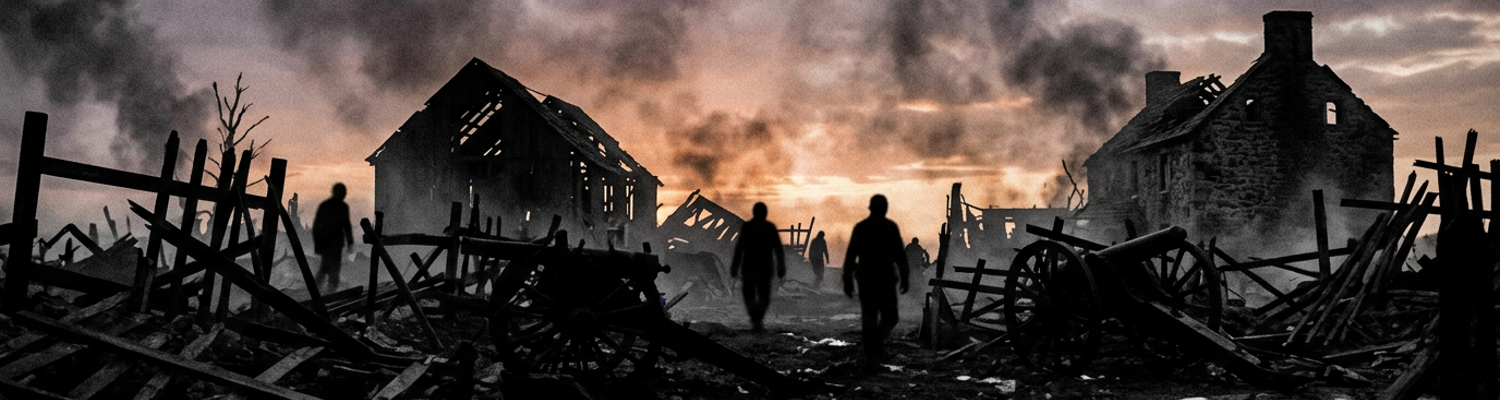

Postwar Romanticism and Urban Slaughter Mechanics
Twenty paces south of the Carter family brick homestead. A Federal pioneer sergeant hammered a notch into an eight-inch white oak headlog. He adjusted its elevation across two timber risers. This left a three-inch firing slit above the red clay parapet. Dirt clung to his entrenching spade. The skirmish horns sounded along the southern horizon. General John Bell Hood committed roughly twenty thousand infantrymen to a frontal advance. They moved against fortified Federal breastworks without coordinated artillery support. The Confederate Army of Tennessee advanced with two full corps abreast. Benjamin F. Cheatham directed his divisions along the Columbia Pike. Alexander P. Stewart drove his brigades toward the railroad cut on the right. Hood launched this massive formation across rolling sod fields at four in the afternoon. Colonel Robert F. Beckham kept his divisional artillery battalions trapped miles behind the rear guard. They sat in stalled wagon trains near Spring Hill. Federal gunners in the Twenty-Third Army Corps held their fire. They waited for the attackers to clear the outer range stakes. They unloaded solid shot and spherical case shot into unprotected infantry ranks advancing over bare ground.
Hood sent his men forward completely stripped of suppression fire.
Postwar Southern romanticism recast this disastrous frontal assault. Writers presented it as a chivalric open-field charge. They ignored the close-range urban slaughter. Writers in the Confederate Veteran and regional memorial associations spent decades portraying the action as a disciplined sweep of banners across open meadows. They presented the defeat as an honorable demonstration of martial character. When examining the historical record, this framework deliberately obscures the butchery. The violence unfolded directly around civilian farm architecture. Combat south of the Carter house quickly devolved into hand-to-hand fighting within fenced yards. Men fought in garden plots and outbuildings. Soldiers fought over the breastworks with axe helves. They swung broken fence rails and iron ramrods. Entrenched Federal infantry shot attacking Confederates directly in the face at a distance of twenty inches. They fired through the slits beneath the Carter headlogs. Defenders inside the yard bayoneted men attempting to climb over the revetment.
Southern memorialists erased the physical mechanics of this defeat.
Assault columns rapidly lost organizational cohesion. They funneled into lethal bottlenecks around domestic agricultural buildings. Charging Confederates overran the exposed forward brigades of George D. Wagner. Fleeing Federal soldiers sprinted toward the main works. They formed a physical screen of running men. This prevented the Federal main line from firing. Those runners scrambled over the parapet. The full weight of Federal small arms fire struck the assault wave. This shattered the command structures of Patrick Cleburne and John C. Brown. Brigades contracted toward the farm structures. They crowded into the narrow lanes separating Fountain Branch Carter brick dwelling, timber smokehouse, and wood-framed cotton gin. Formations disintegrated entirely. Company commanders lost sight of their regiments. Regimental colonels could not locate their brigade standards through the blinding layer of hanging sulfur smoke. Men packed tightly against the exterior walls of the outbuildings. They were unable to advance. They were unable to retreat across the exposed field. Black powder fouling quickly choked weapon actions. This bent iron ramrods and jammed percussion caps inside dirty nipples. Soldiers abandoned their Enfields. They clawed through bloodied mud to scavenge functioning Springfields from fallen comrades.
Federal Defensive Retrenchment and Civilian Architecture
A close review of operational logs indicates that the defensive line at Franklin took form before dawn. Brigadier General Jacob D. Cox reached the southern outskirts of Franklin at roughly daybreak on November 30, 1864. He temporarily commanded the Twenty-Third Army Corps. Major General John M. Schofield had ordered him to secure the high ground south of the town. This protected the army supply wagons while engineers repaired the wagon bridges over the Harpeth River. Cox placed the center of his primary defensive belt across a gentle swale on the nineteen-acre agricultural homestead. Fountain Branch Carter owned this property. The defensive trace bisected the farm property directly. It cut through the south garden, vegetable patches, and outer livestock pens. West of the turnpike, Cox assigned Colonel Silas Strickland third brigade of Thomas H. Ruger division. The 50th Ohio and the 72nd Illinois Infantry regiments deployed across the private yard. East of the pike, Colonel John W. Reilly first brigade of the second division took over the line. The 104th Ohio Infantry aligned its right flank just fifty paces south of the brick dwelling. This trace trapped the civilian farm buildings directly within the primary defensive zone.
Digging began within minutes of line selection.
Union infantrymen from the XXIII Corps constructed earthworks utilizing whatever materials lay within arm reach across the Carter homestead. Regimental officers ordered their men to dismantle hundreds of yards of post-and-rail and zig-zag cedar fencing. These fences enclosed the wheat plots and locust groves. Troops interlocked these heavy split-rails into twin retaining walls. They excavated a deep interior ditch. They shoveled red clay and loam between the timber revetments. The resulting earthen parapet stood four feet high and five feet thick at its crest. Packed soil reinforced its forward face. Working with pioneer axes, fatigue squads felled nearby ash, locust, and white oak trees. These served as heavy exterior headlogs. Carpenters notched short transverse timber blocks into the crest of the revetment beneath these logs. This left a horizontal gap of three to four inches along the timber base. Defenders could rest their rifle muskets in these embrasures. They fired directly at approaching attackers. Their own foreheads, eyes, and shoulders remained shielded from enemy rifle balls. Exterior ditches dug two feet deep and three feet wide in front of the breastworks increased the vertical clearance. Any assault force would have to scale this height.
The tools broke under the frozen ground.
The intersection of the Columbia Turnpike created an inadvertent defensive gap. It formed a deadly funnel directly abutting the Carter house yard. Army supply wagons numbering over eight hundred vehicles required uninterrupted passage through Franklin. They needed to cross the Harpeth River pontoon bridges. Cox left the macadamized turnpike roadbed un-entrenched. Excavating a ditch across the hardened crushed limestone was physically impossible in the available hours. Blocking the turnpike would have choked the retreat of Wagner forward brigades and Schofield ordnance trains. Federal pioneers constructed an offset, discontinuous rail-and-earth traverse twenty paces to the rear of the main parapet. This left an open sixty-foot corridor through the center of the line. The gap exposed the southern edge of the yard. It created a natural spatial bottleneck right against the family farm office, milkhouse, and brick kitchen. Captain Cullen A. Bancroft placed two 3-inch Ordnance rifles of Battery A, 1st Ohio Light Artillery inside this opening. They pointed their muzzles down the macadam turnpike. Two additional guns from the 6th Ohio Light Artillery sat just east of the turnpike near the Carter cotton gin. They sighted their tubes directly across the open road. Cleburne and Brown assault columns hit the works. This road opening drew fleeing Federal skirmishers and advancing Confederates alike into a compact killing pocket between the Carter yard fence and the turnpike ditch.
Scattered wagon ruts guided the attacking brigades directly toward the unbarricaded roadbed.
Archival evidence shows that Strickland line west of the turnpike bent slightly back toward the Carter garden fence. This left the immediate flank of the 72nd Illinois without solid timber revetments at the pike shoulder. A shallow ditch and a row of upright cedar fence rails held together with bent wire covered the opening between the road shoulder and the yard boundary. The position lacked depth. Its fields of fire ended at the crest of the turnpike grade sixty yards to the south.
Springfield Rifle Fouling and Ammunition Depletion
A close review of operational logs indicates that the standard Union combat loadout failed almost immediately under Cleburne assault. Federal infantrymen positioned across the Carter garden entered the works carrying standard leather cartridge boxes. These held forty rounds of .58-caliber paper-wrapped ammunition. The Confederate assault slammed into the exterior breastworks between half-past four and five in the evening. Soldiers in the 104th Ohio and the 72nd Illinois sustained an unbroken cyclic rate of fire exceeding three rounds per minute. Men tore paper cartridges with their teeth. They dumped sixty grains of black powder down the muzzle. They rammed hollow-base Minie balls home. They seated percussion caps onto cones without pause. Within twenty-five minutes of continuous firing, individual cartridge boxes hung empty along the parapet. Regimental quartermasters could not drive reserve ammunition wagons through the jammed lanes behind the Carter buildings. Forward companies exhausted their entire personal ordnance supply before darkness fully fell over the turnpike.
The boxes emptied faster than supply runners could cross the yard.
Sustained firing rapidly degraded the mechanical function of the Model 1861 and Model 1863 Springfield rifle-muskets. Each round burned low-grade black powder. This left a dense gummy deposit of potassium carbonate and unburned carbon lining the inside of the rifled barrel. Barrel temperatures climbed after twenty rounds. This residue hardened into thick slag. It constricted the weapon bore. The .577-inch projectiles could not slide down the lands and grooves. Fouling accumulated equally inside the percussion cone. Escaping sulfur gas baked into the micro-vent of the nipple. This blocked the flash path between the percussion cap and the main powder chamber. Misfires multiplied down the line. Soldiers cocked their lock plates in panic. The repeated forceful striking of hammers against carbon-caked cones placed severe shear stress on internal components. Lock plates fouled with cap copper fragments seized up. Brittle forged-steel mainsprings snapped clean under the rapid mechanical cycling. Dozens of Springfields became completely inert as Confederate troops mounted the exterior ditch.
Hammers dropped onto dead iron.
When examining the historical record, surviving infantrymen in Silas Strickland brigade resorted to desperate field expedients. They needed to keep their weapons firing. Men crawled along the bloodied boards of the Carter yard traverse. They ripped open the cap pouches and cartridge boxes of dead and maimed comrades. They retrieved loose paper rounds and dry percussion caps. Fouled barrels expanded from heat and choked on carbon residue. Standard iron ramrods jammed halfway down the length of the barrel. They were unable to seat the lead bullet against the powder charge without catastrophic resistance. Attempting to discharge an unseated round risked bursting the barrel tube in the firer face. Soldiers grabbed limestone ballast rocks from the Columbia Turnpike. They tore jagged cedar fence pickets from the Carter garden palings. They used them as crude mallets to hammer stuck ramrods down the choked muzzles. Striking the iron rods with raw stones bent the metal shafts. This pinned the tools permanently inside the barrels. Defenders discarded the rifles to fight with bayonets and shovel blades.
Battered weapons littered the interior ditch.
Confederate Breaches at the Carter Outbuildings
Archival evidence shows that the Federal defensive perimeter ruptured along the Columbia Turnpike around five in the afternoon. Elements of John C. Brown division on the west of the pike and Patrick Cleburne division on the east surged across the abandoned outer earthworks of Wagner forward brigades. They collided directly with the main breastworks fronting the Carter estate. Brigadier General George W. Gordon Tennessee brigade advanced on Brown right flank. They mounted the parapet adjacent to the turnpike gap. They drove into the private domestic grounds of the homestead. Granbury Texas brigade from Cleburne command smashed past the outer ditches east of the roadway. They collapsed the flank companies of the 104th Ohio. Disorganized clusters of Confederate infantry poured past the unbarricaded roadbed. They swept directly into the thirty-foot corridor separating Fountain Branch Carter one-story frame farm office from the heavy brick smokehouse. Forward momentum dissolved almost immediately. Regimental commanders lost touch with their flank companies in the smoke. More than four hundred men from Tennessee and Texas units jammed together in the packed dirt yard. They were isolated from any unified operational command.
The advance fractured against masonry and split timber.
A close review of operational logs indicates that the physical footprint of the Carter dependencies dictated the slaughter. The farm office, kitchen, and thick brick walls of the smokehouse stood clustered barely paces apart behind the main brick dwelling. These created rigid spatial boundaries. They compressed the penetrating assault wave. An infantry line advancing two ranks deep contracted violently into an irregular mass five or six files wide. Men collided with one another while attempting to navigate the narrow passage between the smokehouse wall and the adjacent timber outbuildings. This compaction converted the yard into an enclosed killing zone swept by intersecting angles of fire. Federal reserves from Colonel Emerson Opdycke brigade launched an immediate bayonet countercharge from the north edge of the yard. The 125th Ohio and 73rd Illinois advanced without waiting for orders. They leveled massed rifle volleys straight down the corridor between the structures. Surviving riflemen of the 72nd Illinois fired into the western flank of the bottleneck from behind interior garden fence lines. Confederates in the middle of the crush were trapped between the buildings and the rear revetments. They could neither raise their rifle-muskets to return fire nor turn around to flee.
Rounds tore through the alley from three different directions simultaneously.
When examining the historical record, pinned Confederates sought immediate cover inside the surrounding agricultural structures. They needed to avoid annihilation. Scores of infantrymen from Cleburne and Brown divisions kicked through the wooden doors and batten shutters of the Carter farm office, the brick smokehouse, and the detached kitchen. Confederate riflemen used weapon barrels to break open structural joints in the weatherboarding. They knocked brick mortar loose along the wall footings. This created makeshift firing loops just inches above the dirt floors. Marksmen leveled their Enfield rifles across the domestic yard from these protected interior perches. They aimed point-blank into the exposed rear profiles of the Federal soldiers still manning the primary breastworks. Troops from the 50th Ohio and 183rd Ohio found their defensive revetments turned against them. Lead rounds struck the reverse slopes of the parapets from distances under fifteen yards. Defenders holding the front trenches had their backs raked by incoming rifle balls. They crouched low in the ditch mud. They turned 180 degrees to engage the domestic buildings. Opdycke advancing reserves traded shots at point-blank range through the doorframes and window sashes. They filled the interior rooms with blinding sulfur clouds. Combatants fought hand-to-hand across the threshold floorboards.
Muzzle flashes ignited the pine weatherboarding of the farm office as darkness settled over the yard.
Close-Quarters Combat in Domestic Chokepoints
Men killed each other over boundary fences with tools scavenged from wagon beds.
Archival evidence shows that physical space between the Carter farm office, detached kitchen, and brick smokehouse contracted to under twelve feet. This eliminated standard firing distances. Weapons jammed from carbon fouling or dropped empty during the initial breach. Combatants converted firearms into blunt-force impact weapons. Walnut stocks shattered across skull bones and collarbones. Infantrymen swung Model 1853 Enfield and Springfield rifles like clubs. Bayonet sockets buckled under lateral stress against equipment belts and ribs. Triangular steel blades bent into useless arcs. Soldiers drew broad-headed felling axes from abandoned Federal entrenching kits in the packed dirt corridor separating the smokehouse from the garden palings. They hacked into clustered ranks at shoulder height. Discarded iron ramrods became thrusting spears driven into chests and faces at zero range. Men dropped them when barrel heat swelled the rifle tubes. Men wrestled on the ground in three inches of clay mud. They stabbed with pocket knives and gouged eyes. Trapped comrades behind them fired past their ears. Unburned powder grains scorched their coats.
Black powder flash burns coated the faces of soldiers fighting chest to chest.
When examining the historical record, Colonel Emerson Opdycke held his five-regiment reserve brigade two hundred yards north of the Carter house. They positioned astride the Columbia Pike near the Carter cotton gin lane. Opdycke saw George D. Wagner broken division stream rearward with Confederate infantry intermingled on their heels. He ordered an immediate forward charge without awaiting operational instructions from division headquarters. The 125th Ohio, 73rd Illinois, 44th Illinois, 24th Wisconsin, and 36th Illinois advanced in double-quick time. They fixed bayonets on the run. They collided head-on with charging units from George W. Gordon Tennessee brigade and Hiram Granbury Texas regiments inside the Carter garden. The impact drove the disordered Confederate assault wave backward against the interior revetments. Opdycke men fought through the domestic yard step by step. They retook two 3-inch Ordnance rifles belonging to Battery A of the 1st Ohio Light Artillery. Attackers had briefly seized them along the turnpike roadbed. Hand-to-hand fighting centered around the wheel hubs of these cannons. Union infantrymen used sponge-rammers and captured cedar fence posts to batter attacking Confederates off the gun carriages.
The retaken guns were discharged with double-canister straight into the farmyard corridor.
A close review of operational logs indicates that concentrated fire around the Carter perimeter systematically eliminated tactical leadership across both armies within forty minutes. Confederate division commander John C. Brown fell severely wounded near the turnpike ditch. This left his command without centralized direction during the breach. Brigade commanders suffered near-total liquidation along the sixty-yard frontage of the Carter homestead. Brigadier General John Adams died directly astride the Federal earthworks. His horse was shot through the neck and tumbled across the cedar headlog into the interior ditch. Brigadier General Otho F. Strahl was struck by three separate rifle balls while handing loaded Springfields up to his men on the reverse slope. He bled out inside the garden trench. Major General Patrick Cleburne and Brigadier General Hiram Granbury were killed within paces of each other on the eastern shoulder of the pike. This severed the nerve center of Cleburne division. Federal units faced identical command vacuums. Multiple company captains in the 72nd Illinois and 104th Ohio fell dead behind the Carter outbuildings. Squad-level pockets of eight to ten men fought independently without officers, orders, or tactical coordination.
Corporals and privates directed the defense from behind the corpses of their company commanders.
Civilian Entrapment Beneath the Carter Floorboards
Archival evidence shows that twenty-three noncombatants sought shelter in the earth-floored masonry basement beneath the Carter dwelling. Small arms fire swept the yard around half-past four. Fountain Branch Carter was sixty-four years old. He led his immediate kin down the narrow timber cellar stairs alongside neighboring refugees and farm laborers. The group included Carter daughters, his paroled son Moscow, and multiple grandchildren under the age of ten. The family of local woodworker Johann Albert Lotz fled their timber-framed home across the Columbia Pike. They sought the relative protection of Carter brick foundations. Several enslaved and domestic workers crowded into the same twenty-five by forty-foot space. Susanna and Oscar Carter were among them. These civilians packed shoulder to shoulder against the unmortared limestone and rough brick perimeter walls. They remained confined in total darkness for more than five hours. Point-blank musket fire and artillery detonations rocked the structure. Frightened children were muffled with wool shawls to maintain silence. Adults sat on storage bins and food barrels. They expected incoming shells to collapse the overhead floor beams.
Limestone masonry provided the only physical barrier separating the trapped families from continuous small arms volleys.
A close review of operational logs indicates that incoming fire perforated the structural framing of the Carter homestead directly above the civilians. Standard .58-caliber Minie balls weighing roughly five hundred grains penetrated the exterior walls at velocities exceeding nine hundred feet per second. They sheared cleanly through the three-quarter-inch pine weatherboarding and lath plaster. Iron canister balls discharged from the 3-inch Ordnance rifles of Battery A, 1st Ohio Light Artillery struck the southern elevation of the house. They punched five-inch holes through solid weatherboards. They ripped across parlor furniture and gouged the tongue-and-groove heart pine flooring. Small arms rounds deflected downward off interior brickwork and hearthstones. They fractured ceiling joists. This dropped lead fragments into the cellar below. Clouds of pulverized gypsum plaster, shattered brick clay, and carbon residue drifted through the joist gaps. This coated the civilians huddled against the foundation footings. Over one thousand individual bullet strikes and shrapnel scars marked the exterior farm surfaces by sunset. The domestic ceiling turned into an active physical hazard for the noncombatants below.
Lead projectiles repeatedly dropped through the cracked pine flooring.
When examining the historical record, tactical choices in the Confederate left wing sealed the fate of Captain Theodoric Carter within sight of this domestic cellar. He served as an assistant quartermaster and volunteer aide-de-camp to Brigadier General Thomas Benton Smith in William B. Bate division. The twenty-four-year-old captain had no operational mandate to join the assault wave. Carter mounted a horse anyway. He rode at the front of the 20th Tennessee Infantry as the brigade advanced across the undulating fields southwest of the homestead. The formation approached the Federal entrenchments held by the 72nd Illinois. They ran into dense defensive crossfire roughly one hundred and seventy-five yards from his father garden boundary. A Federal rifle bullet struck Carter directly in the head. He dropped from his saddle into the mud of a drainage swale just outside the Union parapet.
He lay incapacitated in the freezing mud while counterattacks swept back and forth across the yard.
Fountain Branch Carter and his daughters emerged with lanterns after midnight. The Federal Twenty-Third Corps evacuated the works toward Nashville. A surviving staff officer from Smith brigade guided them. The family combed the corpse-littered ground southwest of the breastworks. They discovered the captain alive but comatose near the outer defensive ditch. Family members lifted him onto an improvised stretcher. They carried him past the battered outbuildings and laid him on a bed inside his sister Annie room. Army surgeons examined the cranial penetration. They found the lead slug lodged against the skull base. They declared the trauma non-survivable. Tod Carter died in that bedroom on December 2, 1864. This was forty-eight hours after the breach.
Adjutant General Records and Tactical Collapse
Archival evidence shows that field command structures dissolved within two hours of the initial breach at the Carter cotton gin and turnpike ditch. Confederate records documented the death, wounding, or capture of fourteen general officers and sixty-five regimental commanders at Franklin. Major General Patrick Cleburne and Brigadier Generals John Adams, Hiram Granbury, States Rights Gist, and Otho Strahl died in the yard or on the parapet. John C. Carter received fatal wounds within yards of the Carter garden. Seven other generals suffered severe bullet wounds. These included John C. Brown, Francis M. Cockrell, William A. Quarles, and Arthur M. Manigault. Brigadier General George W. Gordon was dragged over the interior revetment into Federal captivity. Regimental leadership suffered identical destruction across Ruger and Reilly fronts. Lieutenant colonels and majors fell alongside their color-bearers. Line regiments fell under the direction of junior lieutenants or second sergeants by nine in the evening. Field clerks tallied the losses near Winstead Hill on the morning of December 1. Entire brigades lacked an officer above the rank of captain.
The administrative structure of the Army of Tennessee collapsed.
When examining the historical record, emergency orders issued by Hood adjutants on December 2 and December 3 exposed the systemic disintegration of the army organizational framework. Adjutant and Inspector General files from December 1864 detailed emergency consolidations of decimated companies into composite regiments. They needed to maintain functional front lines. Surviving riflemen from the 6th, 10th, 15th, 17th, 18th, 24th, and 25th Texas regiments in Patrick Cleburne former division were shattered during the fight along the Carter outbuildings. They were compressed into a single composite battalion barely numbering one hundred and thirty rifles. Company rosters ceased to reflect county-level recruitment origins. Quartermasters merged squads of three or four men into makeshift tactical platoons under surviving officers from unrelated commands. The remnants of four Tennessee brigades across John C. Brown division were thrown together into ad-hoc units. Privates answered roll calls administered by unfamiliar sergeants. Ordnance clerks could not reconcile equipment ledgers. Consolidating regiments mixed Enfield, smoothbore, and scavenged Springfield rifles within identical companies. This created persistent ammunition distribution errors in the supply trains.
Muster rolls recorded company rosters that had dropped from sixty men to seven.
A close review of operational logs indicates that the subsequent march along the frozen macadamized Franklin Pike toward the outskirts of Nashville accelerated the army administrative unraveling. Hood ordered his depleted corps north on December 1 across sleet-covered roads. They marched without shoes, winter overcoats, or food rations. Inspection reports and muster rolls cataloged soaring desertion rates and total supply exhaustion during the subsequent advance to Nashville. Reports compiled between December 4 and December 10 documented widespread physical breakdown. Hundreds of soldiers wrapped their feet in raw cowhide or scraps of wool blankets tied with hemp twine. They left blood on the limestone turnpike through Brentwood. Confederate quartermaster departments possessed no reserve boots or forage. Daily bread rations fell to a half-pound of rough cornmeal per man. Cheatham corps recorded hundreds of men slipping into the cedar glades at night. They wanted to avoid freezing in the rifle pits along the Nashville hills. Provost marshals lacked the mounted personnel or physical supplies required to round up escapees along the Harpeth River corridor. The army dug in along the crests of Montgomery Hill and Overton Knob. Inspection files registered that over two thousand men had abandoned their commands between Franklin and the southern barricades of Nashville. (NARA Record Group 109).