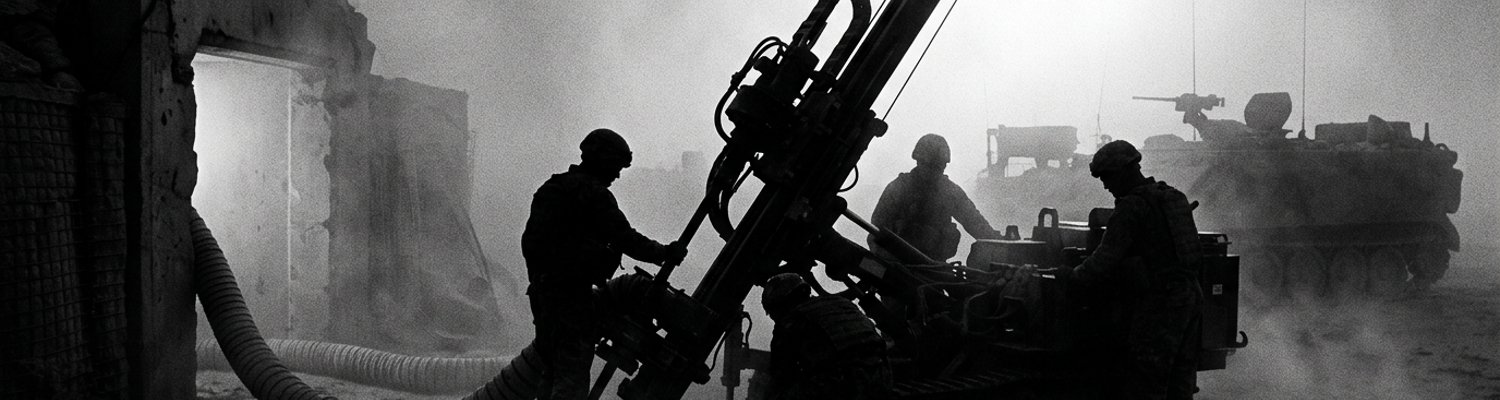

Post-Clearance Collapse and Adit Extraction
Archival evidence shows that during Operation Intrinsic Action in September 1998, combat engineers encountered unmapped subterranean layouts. These were located along the Kuwait-Iraq border escarpments. The Jal az Zor ridge spanned dozens of kilometers. It curved north of Kuwait Bay. Iraqi forces excavated extensive bunker networks here during the 1990 occupation. Poured-concrete command galleries penetrated directly into unstable sedimentary layers. These layers consisted of marl, sandstone, and gravel. The original builders used inadequate shoring.
Surface reconnaissance teams failed to identify these subterranean galleries. Blowing desert sand concealed the sunken access shafts.
Sappers carried twenty-pound satchel charges. They also carried demolition crimpers and AN/PDR-77 detection units. They entered these deep command posts on hands and knees.
Their objective was clearing abandoned Iraqi munitions.
Underground temperatures exceeded 120 degrees Fahrenheit. This heat drained military-grade nickel-cadmium radio batteries rapidly. Tactical communications between tunnel teams and surface safety watches degraded within minutes.
A close review of operational logs indicates a structural failure at Portal Charlie.
Specialist Daniel Vance knelt in the dry wash outside the portal. He scraped caked gypsum from the brass sensor head of an atmospheric testing monitor. Sunlight baked the exposed sandstone ledge. The surface temperature reached 104 degrees. Vance wiped hydraulic fluid from his goggles. He listened to the muffled metallic clanking of field entrenching tools.
The sounds reverberated up through the trench floor.
Inside the portal mouth, a dry-stacked timber beam shifted. Several tons of fractured limestone caprock pressed down.
The roof line failed without an audible crack.
Fine pulverized dolomite filled the narrow corridor. It blinded the clearing detachment. The dust clogged the intake valves of their chemical-biological protective facepieces.
At the surface portal, the platoon sergeant abandoned radio check-ins. He initiated physical headcounts. He marked soldier numbers across the ballistic plates of body armor using yellow grease pencils.
Subterranean extraction required physical force. The crawl space measured under twenty-eight inches in height.
Engineers utilized fifteen-foot tubular nylon vehicle-recovery straps. They hooked these directly into tactical harnesses. They dragged two disabled team members feet-first through the rubble heap. Other soldiers hand-cleared large chunks of shattered aggregate.
Staff Sergeant Marcus Rivas coupled an auxiliary air hose to a mobile diesel compressor. He pumped atmospheric air into the collapsed crawlway. This action displaced localized carbon monoxide concentrations. The gas levels had exceeded three hundred parts per million (NARA Record Group 338).
Mechanical screw jacks from an M9 Armored Combat Earthmover were wedged beneath the sagging overhead slab. They held the fractured portal ceiling rigid. The recovery party completed the extraction.
Vance marked the final engineer accountable on the portal tally board at 1507 hours.
Thermal Casualties and Blackout Triage Protocols
When examining the historical record of the 1st Battalion, 67th Armor Regiment, medical logs establish a systemic environmental crisis. The extraction effort triggered this event across the ridge line.
Late-summer shamal winds descended from the northwest. They crossed the gravel plain. Forty-knot gusts whipped fine silt into zero-visibility squalls by 1520 hours.
Airborne particulates jammed the centrifugal oil filters of two idling M577 tactical command post carriers. They choked the engine intakes on skid-mounted Sullair air compressors.
Conditions inside the unventilated concrete gallery deteriorated faster.
Ambient temperatures in the lower gallery surpassed 122 degrees Fahrenheit. Residual heat from pneumatic breakers drove this number upward. Confined human respiration added to the thermal load. There were no vertical convection shafts.
Every surface radiated heat directly into the cleared access way.
Trapped engineers shed their body armor to squeeze through the twenty-eight-inch collapse zone. They suffered severe bronchial spasms. Airborne limestone slurry coated their upper respiratory tracts.
Forward medical personnel established a triage point sixty meters behind the ridge crest. They constructed a blackout shelter from canvas tarpaulins and two M113A3 armored ambulances.
Tactical command enforced strict blackout protocols. Active radar installations and border observation posts occupied high ground twelve kilometers north.
Flight medics from the 247th Medical Detachment worked without interior white lights. They illuminated their work surfaces exclusively with chemical glow sticks. They used red-filtered lenses muffled inside heavy canvas sleeves.
Extracted sappers arrived unconscious. Core body temperatures measured between 104.8 and 106.2 degrees Fahrenheit. The patients exhibited violent involuntary muscle contractions.
Peripheral veins collapsed throughout their limbs under severe thermal dehydration. This prevented standard intravenous needle sticks.
Medics stabilized the arms of patients against equipment crates. They located femoral and saphenous access points by tactile palpation in total darkness. They pushed three-liter boluses of chilled lactated Ringer solution. They secured the IV tubing with standard olive-drab duct tape. Adhesive medical tape dissolved against sweat-soaked skin.
Medical staff exhausted twenty-four units of crystalline intravenous fluids in ninety minutes.
Patients vomited gray sludge. This mixture consisted of inhaled dolomite dust and stomach bile. Medics executed immediate mechanical clearance using manual foot-pump aspirators. Electrical suction units had burned out their field transformers.
Staff Sergeant Marcus Rivas instructed support personnel to strip the patients naked on canvas litters. Crews saturated patient skin with bulk water drained from ten-gallon vehicle coolers (serial number 44-12998).
The shamal dust storm grounded all UH-60 aeromedical evacuation flights out of Ali Al Salem Air Base. The treatment team sustained stabilized thermal shock victims inside darkened ambulance hulls. They waited for desert surface temperatures to drop after midnight.
Battalion surgeon Captain Andrew Myers manually entered the final arterial blood gas readings onto field casualty cards. He used a red flashlight at 2340 hours.
The mercury on the outer ambulance hull registered ninety-nine degrees.
Structural Integrity Assessments of Desert Escarpments
Structural survey teams re-entered Complex Bravo-Four at 0245 hours. Their objective was mapping the mechanical failure of the subterranean galleries.
First Lieutenant Gregory Vance led a four-man assessment team. They carried dial-indicator crack gauges, ultrasonic thickness scopes, and digital inclinometers.
Inside the primary division-level command gallery, sixty-centimeter-thick poured Portland cement overhead slabs exhibited catastrophic scabbing. Compressive spalling covered the ceiling. High-pressure blast waves from previous penetrations had sheared the bond between aggregate and internal steel reinforcement.
Slabs hung suspended only by deformed thirty-millimeter rebar. The steel sagged eleven inches into the central workspace.
Tensile cracks traversed the entire width of the sixty-foot reinforced ceiling. Three-hundred-pound chunks of shattered aggregate dropped onto destroyed plotting tables and radio racks.
Structural load models indicated extreme stress. The overlying weight of eight meters of unconsolidated caliche and fossiliferous limestone exceeded the remaining shear capacity of the compromised ceiling beams by forty-two percent.
Vance halted all clearance personnel from setting foot beneath the unsupported bays.
He ordered the overhead braced using heavy-duty timber cribbing. Six-ton hydraulic shoring struts were scavenged from maintenance trucks.
Secondary cave-ins posed a continuous lethal threat across the network of narrow saps. These tunnels connected the primary command bunker to auxiliary gun emplacements.
Breaching teams had previously deployed thirty-pound M183 demolition assemblies. They blew open blast-locked steel bulkhead doors inside the access tunnels.
Those interior explosive breaches successfully sheared the six-bolt locking lugs on the heavy steel hatches. The resulting pneumatic overpressure pulverized the soft, unlined walls of the surrounding saps.
Shockwaves traveled hundreds of feet down the three-foot-wide crawlways. They detached brittle gypsum stringers. They pulverized the cohesive clay marl holding the trench walls upright.
Saps that appeared stable during the initial room-clearing sweep began collapsing three to six hours later.
Ground tremors generated by idling M2A2 Bradley infantry fighting vehicles fifty meters away on the ridge road triggered mass slumping. The rock shifted along horizontal bedding planes. This buried two pneumatic air hoses. It crushed a steel rescue stretcher left in Sap Three.
Battalion commanders altered their engineering doctrine before sunrise on September 14.
Captain Robert Holbrook ordered an immediate halt to all high-explosive interior entry breaches across the southern escarpment adits.
Sapper squads shifted exclusively to gasoline-powered diamond-blade chop saws. They used Broco thermal cutting torches and forty-ton Enerpac hydraulic spreader jaws. They forced reinforced steel entryways without transmitting explosive impulse energy into the fractured mountain.
Geophone listening spikes were driven six inches into the tunnel floorboards every twenty meters. These monitored micro-fracture noise and structural slippage inside the escarpment walls.
Internal acoustic pinging exceeded three events per minute. Survey personnel evacuated the lateral saps to wait out localized slope adjustments.
Inspection teams cataloged seven separate interior collapse zones by 0530 hours. Each required thirty-six hours of manual excavation before clearance work could resume.
The final sensor log recorded seven distinct rock falls before dawn.
Munitions Cataloging and Bulk Demolition Demands
Archival evidence shows sharp tactical friction erupting between Brigade Intelligence officers and forward sapper commanders. This occurred at 0615 hours on September 14 over Bunker Complex Delta-Nine.
Tactical exploitation analysts from the 513th Military Intelligence Brigade demanded complete technical cataloging of all captured materiel. They ordered dismounted engineer squads to descend into unmapped storage galleries. The engineers were told to record serial production stamps and document foreign munitions markings.
The company commander of Company B, 317th Engineer Battalion opposed this directive.
He argued that trapped underground heat and shattered overhead caprock made deep entry exceptionally hazardous. Demolition specialists pushed for top-down neutralization using surface-laid bulk C-4 charges. They prepared four-hundred-pound ring mains of M112 explosive blocks. These were rigged directly above the primary entry shafts.
Surface charges promised to collapse the subterranean galleries instantly. This would seal the ordnance under hundreds of tons of pulverized limestone. It would not expose personnel to structural failure or toxic air.
Division headquarters overrode the sapper commander. They ruled that intelligence collection on Soviet-bloc weapons imports held immediate priority over rapid site destruction.
Orders forced clearance teams back into the fractured adits.
Two-man sapper teams re-entered Magazine Bay Two. They carried graphite grease pencils, mechanical inspection mirrors, and canvas log binders.
Stacked wooden ammunition crates held Soviet-manufactured 152-millimeter OF-540 high-explosive artillery projectiles. These sat alongside 122-millimeter 9M22U artillery rockets. Factory stamps indicated manufacture at Soviet State Plant 67 between 1978 and 1984 (NARA Record Group 338).
Trapped ambient heat exceeded 116 degrees Fahrenheit. This caused the cast TNT and hexogen explosive filler inside the projectiles to exude. Oily, toxic nitroaromatic fluids pushed through fractured nose plugs and corroded fuze threads.
Specialist Kevin Brand hand-recorded Cyrillic lot codes. He noted factory batch indicators and propellant burn indices. He knelt inches away from unstable chemical deposits pooled across the concrete floor.
Sapping personnel examined every casing for crystallized picric acid. They looked for exposed tetryl booster pellets that had degraded over eight years of desert storage. The shells were highly vulnerable to detonation from slight friction.
S-2 intelligence requirements demanded that every individual lot number be documented by hand. Disposal personnel could not place any neutralization charges until this was complete.
Clearance teams operated against a strict operational withdrawal timeline set for 0900 hours. The schedule was calculated to extract all forces before surface temperatures hit 110 degrees. Higher heat increased the volatility of deteriorating nitrocellulose propellants.
Staff Sergeant Wayne Calder coordinated egress corridors with 1st Battalion, 67th Armor Regiment. He tracked withdrawal milestones across Phase Line Orange on tactical map sheets.
Clearance details maintained simultaneous work lines. Survey personnel hand-recorded the remaining lot numbers on wooden crates of 120-millimeter mortar bombs. Demolition squads laid thirty-pound M183 demolition charges against four load-bearing support columns.
Engineers laced fifty-grain PETN detonating cord into dual-primed ring circuits. They crimped M7 non-electric blasting caps onto M14 timed fuse igniters adjusted to an eleven-minute delay.
Sapper crews cleared the tunnel mouth at 0848 hours. They left three thousand pounds of unstable munitions wired to four separate firing circuits across the gallery floor.
The last clipboard cleared the portal mouth twelve minutes before blast time.
Subterranean Chemical Defense Shelter Vulnerabilities
Clearance elements from Company B, 317th Engineer Battalion approached Shelter Echo-Seven at 0915 hours.
The structure was a subterranean chemical defense shelter. Yugoslav contractors built it during the late 1980s. Two meters of reinforced concrete caprock and airtight steel bulkhead doors protected the interior. Modular ventilation shafts connected the deep personnel bays directly to Swiss-designed carbon filtration banks.
Surface demolition squads clearing adjacent trenches faced an unforeseen engineering threat.
Topside concussive detonations generated violent ground-shock waves. These waves propagated directly into the enclosed chambers below. The high structural rigidity of the bunker prevented explosive overpressure from venting outward into the surrounding caliche.
Concussive energy from surface cratering charges traveled down mechanical air-intake flues. This threatened to trigger sympathetic explosions of unmapped Iraqi ordnance stacked against the interior walls.
Sappers discovered eighty wooden crates of 82-millimeter high-explosive mortar bombs. These were stored alongside 120-millimeter artillery propellants directly beneath the shelter air intake.
A topside satchel charge detonating above the intake shaft would shatter the brittle concrete intake baffles. It would generate internal overpressures exceeding seventy pounds per square inch.
Mechanical impact fuzes on the stacked mortar bombs were destabilized by years of desert heat. They risked instantaneous sympathetic detonation under localized concussive stress.
A secondary explosion inside the sealed shelter would blow out the subterranean bulkheads. It would destroy adjacent adits and collapse the escarpment face above.
Captain Robert Holbrook issued an emergency stop-work order across Phase Line White at 0940 hours. He grounded all topside explosive breaches within one hundred meters of any identified chemical redoubt. Interior sapper teams had to confirm munition stability by hand.
During the post-assault lull, clearing teams verified collective-protection seals. They checked if toxic compounds had filled the living quarters.
Corporal Hector Silva and Specialist Daniel Vance entered Echo-Seven at 1005 hours. They wore M40 protective masks and butyl rubber gloves to conduct atmospheric verification.
Warped steel airlock frames had compromised the overpressure seals. The inner compartments were stagnant and fouled by combustion gases.
Silva carried an M256A1 chemical agent detector kit. He pulled cardboard tickets from their vapor-resistant foil pouches to begin testing the still air.
Working under red-filtered field lanterns, he crushed the small glass ampoules embedded in the ticket between thumb and forefinger. He soaked the enzyme-treated paper test pads with specialized liquid substrates.
The ticket sampled the subterranean atmosphere for fifteen minutes. It screened for blister agents such as sulfur mustard, blood agents such as hydrogen cyanide, and nerve agents including tabun and sarin.
Clearance teams executed four consecutive M256A1 ticket tests across the command bay, barracks quarters, and air scrubber room. They declared the atmosphere free of persistent chemical vapors at 1045 hours.
Silva recorded the negative findings on standard DA Form 1594 log sheets clipped to his body armor.
Technicians used an MX210 multigas monitor to check secondary atmospheric criteria. They logged ambient interior heat at 108 degrees Fahrenheit and available oxygen at 19.4 percent. They opened the emergency escape hatch to surface air.
The enzyme test spot on the ticket retained its unreacted color.
Equipment Attrition in Confined Subterranean Galleries
Equipment failure reports inundated Company A, 317th Engineer Battalion at bunker complex Echo-Seven by 1115 hours.
Engineers pushed through forty meters of lateral crawlways. Fine particulate talc dust hung suspended in the stagnant subterranean air. Earlier breaching detonations and collapsed marlstone ceiling layers had ground this material into airborne powder.
Standard-issue C2A1 particulate canisters screwed into M40 protective masks began failing within twenty-five minutes of continuous wear.
The ultra-fine calcium carbonate dust penetrated the outer paper pre-filter wrap. It packed tightly into the pleated high-efficiency particulate air media and activated charcoal beds.
Sapping personnel experienced immediate inhalation resistance. Differential breathing pressures spiked to over 4.5 inches of water gauge. Soldiers unscrewed canisters to clear obstructions or endure partial suffocation.
Portable squirrel-cage squad ventilation blowers suffered mechanical seizure. These were set up to draw air through twenty-foot collapsible vinyl ducts.
The abrasive talc dust migrated past standard rubber dust seals into the unsealed permanent-split capacitor motor bearings. It converted internal grease into grinding paste. It tripped the thermal overload switches on three consecutive Model GP-250 air blowers by 1145 hours.
The subterranean layout inflicted an equally rapid toll on electro-optical systems and tactical electronics inside the deep command complex.
Sapper reconnaissance teams descended into the third subterranean tier. Six meters of dense, heavily rebar-reinforced poured concrete caused massive electromagnetic attenuation.
Squad-level communication collapsed completely.
AN/PRC-148 and AN/PRC-126 tactical VHF and UHF intra-squad transceivers experienced instantaneous signal loss. They dropped line-of-sight propagation as soon as patrol leaders turned two successive ninety-degree blast-trap corners.
Radio operators attempted to boost transmission output from one-half watt to five watts. They melted internal amplifier circuits. They burned through BA-5590 lithium sulfur dioxide battery blocks in less than forty minutes instead of their standard twelve-hour operational threshold.
Radio frequency signal levels dropped below negative 115 dBm within fifteen paces of the reinforced concrete adits. Squad leaders lost all radio contact with topside command nets. Platoon sergeants laid down physical WD-1/TT field wire and connected sound-powered TA-312/PT telephone handsets along tunnel ribs.
Subterranean darkness caused acute power failure across the detachment night vision suites.
Sapping elements clearing Magazine Bay Three operated in absolute zero-lux conditions. The integrated infrared illuminators on their AN/PVS-7B dual-tube night vision goggles ran continuously to resolve unexploded ordnance and structural cracks.
Ambient cavern heat reached 112 degrees Fahrenheit. This combined with the heavy current draw of the Class 1 infrared diodes and microchannel plate image intensifier tubes. The mix triggered rapid internal impedance surges across standard alkaline and lithium AA batteries.
Cells providing thirty hours of green-phosphor amplification died in less than three hours.
Battery voltages plummeted below 2.0 volts. The automatic brightness control circuitry shut down. This blinded clearance personnel in pitch-black corridors strewn with fractured concrete and exposed rebar spikes.
First Lieutenant Gregory Vance pulled forward scout elements back to the second blast door at 1220 hours. Four of six clearing teams suffered simultaneous night-vision blackouts. He issued direct orders to replace primary battery cells after every seventy-five minutes of gallery inspection.
Logistical registers maintained at the ridge staging area recorded the attrition. Ninety-six depleted C2A1 filter canisters, fourteen seized blower impellers, and two hundred twenty-four discarded BA-5800 and alkaline battery pairs were loaded onto rear-echelon supply trucks by 1300 hours.
Maintenance sergeants tagged eight burned-out AN/PRC-126 chassis for depot-level disposal. Internal power amplifier boards had scorched their plastic housings.
Topside armory logs showed replacement battery inventory for the entire engineer company stood at eighteen percent capacity before noon.
Immediate Tactical Revisions for Desert Sapping
Operations officers from the 317th Engineer Battalion and 1st Battalion, 67th Armor Regiment assembled inside a canvas command tent at 1330 hours. They drafted emergency tactical revisions to theater engineer doctrine.
Field reports from complexes Echo-Seven and Bravo-Four proved that traditional subterranean clearing methods were systematically incapacitating forward sappers.
Captain Robert Holbrook and battalion operations planners discarded existing guidelines under Field Manual 5-250. They issued a field directive banning all subterranean penetration deeper than ten meters without continuous mechanical air displacement.
The new standard mandated trailer-mounted Sullair 375 diesel compressors or positive-pressure vane-axial blowers. These had to be positioned at least twenty meters upwind of tunnel mouths.
Engineers snaked twelve-inch reinforced neoprene ducting directly to the forward face of every cleared gallery. They maintained a minimum air displacement rate of fifteen hundred cubic feet per minute.
Clearance teams were forbidden from crossing the portal threshold until topside crews logged fifteen full minutes of forced atmospheric flushing. Crews confirmed oxygen concentrations above nineteen point five percent with calibrated MX210 multigas monitors.
The revised engineering protocol targeted mechanical contamination generated by sappers themselves.
Inside dead-end adits, gasoline-powered chop saws, Broco thermal cutting torches, and secondary detonations created lethal pockets of carbon monoxide and nitrogen dioxide. Natural draft could never vent these gases through fractured caliche caprock.
Holbrook mandated closed-circuit extraction fans operating in an exhaust-induction configuration. Contaminated air was actively sucked from the working face. A secondary blower forced fresh, filtered air into the entry trench.
Mechanics cannibalized flexible duct adapters from M88 recovery vehicles. This prevented fine dolomite dust from entering compressor intakes. They fabricated field expedient pre-filters out of damp burlap and coarse engine wire.
Sapper squads caught entering galleries without verified positive airflow faced immediate relief from subterranean duty.
Medical staff documented that trapped underground heat posed a threat just as severe as atmospheric poison.
Battalion surgeon Captain Andrew Myers coordinated with company commanders at 1415 hours. They instituted rigid fifteen-minute work rotations for all personnel clearing the southern escarpment adits.
Underground ambient temperatures held steady between 114 and 122 degrees Fahrenheit. Ninety percent relative humidity from human perspiration compounded the heat. This triggered core body temperature spikes of one degree Fahrenheit every six minutes of heavy mechanical labor.
Platoon sergeants took command of surface stopwatches. They assigned two-man safety teams to the portal mouths. These teams pulled clearance personnel out of the adits at the nine-hundred-second mark without exception.
Relieved sappers were stripped of their helmets, flak vests, and chemical facepieces inside shaded canvas collection points behind the ridge crest.
Each soldier was placed inside an air-conditioned M577 command carrier for a mandatory forty-five-minute recovery period. They were required to drink two full one-quart canteens of chilled electrolyte solution. Medics logged radial pulses and temporal temperatures on adhesive triage cards (Form 31-A).
Topside timekeepers logged forty-eight distinct fifteen-minute rotations before the sun dropped below the northern escarpment line.