
Intelligence Estimates and Report ORE 18-50
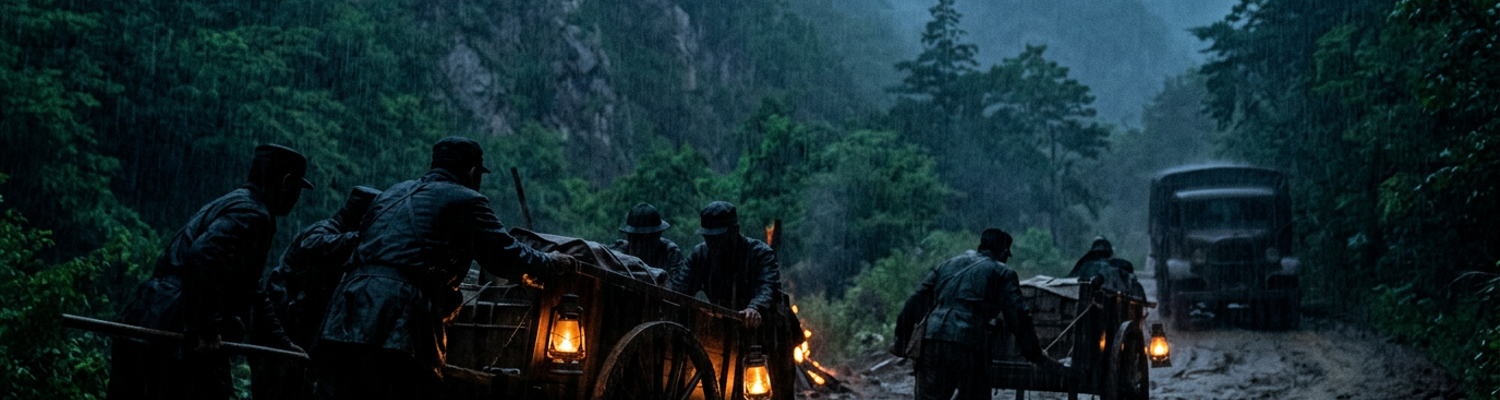
Mud choked the narrow dirt roads winding through the Uijeongbu Gap as relentless summer rainstorms broke across the central Korean peninsula in June 1950. Steep granite hills rose sharply on both sides of the two unpaved corridors that formed the traditional invasion gateway toward Seoul, trapping movement between rocky cliffs and waterlogged rice paddies. Soldiers of the Republic of Korea Army trudged through thick clay and deep drainage ditches along these passes, their leather boots rotting in the sweltering humidity while wooden supply carts bogged down to their axles. Swollen mountain streams repeatedly tore away primitive log bridges, forcing frontline units to carry food sacks and small arms ammunition boxes on their backs over slick footpaths. Officers at the Far East Command in Tokyo viewed these jagged peaks and flooded valleys not as an operational obstacle, but as a natural barrier that would prevent any mechanized force from launching a rapid offensive.
Analysts at the Central Intelligence Agency cataloged the North Korean military buildup on June 19, 1950, when CIA report ORE 18-50 detailed Soviet supplied armor, heavy artillery, and Yak-9 aircraft. Photographic evidence and border surveillance confirmed that North Korean tank regiments possessed medium Soviet built T-34 tanks that far outmatched anything fielded south of the thirty eighth parallel. Analysts fatally concluded that Pyongyang lacked the independent logistical endurance to launch a sustained invasion without overt Red Army backing. Staff officers in Washington believed that North Korea could not manufacture its own munitions, replacement engines, or vehicle fuel, leading them to argue that the regime was incapable of operating far beyond its railheads without direct Soviet participation. Decision makers accepted this assessment, convinced that the northern buildup represented a calculated political bluff rather than preparation for an armored drive down the peninsula.
KMAG planners maintained an intentionally restricted supply posture for South Korean forces based on assumptions that a major mechanized invasion was logistically unviable. American advisers withheld heavy combat gear from the South Korean army, denying them medium tanks, attack bombers, and standard 155 millimeter howitzers to keep the force organized purely as an internal police and border defense group. Ordnance officers enforced rigid limits on frontline ammunition stores, allowing border regiments only two or three days of basic combat loads while locking the remaining shells inside distant supply dumps near Pusan. South Korean infantry regiments stationed near Uijeongbu received light 2.36 inch bazookas along with training ammunition that could not penetrate the thick armor plates of Soviet T-34 tanks. Supply officers rationed vehicle gasoline, rifle cartridges, and mortar rounds so tightly that frontline commanders could not conduct live fire defensive drills or build emergency stockpiles inside their forward bunkers.
Riflemen of the Republic of Korea 7th Division felt the immediate consequences of these supply caps as they manned exposed trenches overlooking the northern highway into Uijeongbu. Artillerymen operated short barreled 105 millimeter howitzers with severely restricted shell allowances, leaving them unable to register defensive target areas along the likely avenues of approach. Truck drivers parked their transport vehicles under sodden tarpaulins across muddy staging areas because local maintenance shops lacked spare fan belts, replacement tires, and fresh battery fluids. Advisers from the American mission repeatedly rejected requests from Korean commanders for antitank minefields, insisting that enemy vehicles would bog down in the flooded paddies long before reaching the defensive line. Guards stood watch in the cold rain across the forward ridges with fewer than fifty rounds in their canvas pouches, watching the dark northern hills while their empty supply bunkers stood bare behind them.
Frontline Munitions Shortages Along the Parallel
Artillery shells from Korean People's Army batteries smashed into those bare bunkers along the border ridges at dawn on June 25, 1950, throwing showers of pulverized rock and wet mud over the defenders. KMAG officers discovered frontline South Korean units had fewer than two days of combat ammunition when the assault forces crossed the thirty eighth parallel. Infantrymen of the 7th Division crouched in waterlogged trenches and returned fire with their M1 Garand rifles, rapidly exhausting their canvas pouches of eight round clips during the first three hours of relentless enemy assaults. South Korean company commanders sent urgent runners back to regimental command posts to request fresh wooden crates of .30 caliber ammunition and 60 millimeter mortar shells, but the local supply sheds contained only empty ration tins and dry packing straw. Liaison officers checked their logistical records against real time expenditure rates and confirmed that forward units possessed only twenty four to thirty six hours of sustained defensive fire before their weapons would fall completely silent.
T-34-85 tanks exploited this critical shortage of defensive fire by rolling straight down the unpaved highway into the Uijeongbu corridor without facing any long range artillery interdiction. South Korean infantry elements were supplied only with obsolete 2.36 inch M9A1 bazookas that failed to pierce the frontal armor of Soviet T-34-85 tanks. Rocket teams crawled through flooded rice paddies under heavy machine gun fire to set up ambush positions less than thirty yards from the road embankments. Gunners shouldered the metal launch tubes, aimed directly at the lower front glacis plates of the lead vehicles, and pulled their magnetic triggers to fire their remaining shaped charge rockets. Explosions from the small 2.36 inch warheads detonated against the thick steel plates, shearing off exterior stowage bins and scorching the green paint, but the heavy sloping metal deflected the blast energy and left the interior crew compartments completely unharmed. North Korean tank crews quickly turned their long 85 millimeter cannon toward the roadside firing signatures, wiping out the exposed rocket positions with high explosive rounds and crushing the forward trenches under wide steel tracks.
Munitions stockpiles stored in rear depots could not reach these collapsing positions to replace the destroyed equipment or replenish the empty ammunition pouches. Severe depot transport bottlenecks prevented available rear area munitions stockpiles from reaching engaged frontline ROK units during the opening twenty four hours. Railroad dispatchers at the main railheads in Pusan and Incheon lacked working steam locomotives and coal supplies, leaving dozens of freight cars loaded with rifle cartridges and 105 millimeter howitzer shells stranded on siding tracks hundreds of miles from the fighting. Military police officers commandeered civilian cargo trucks across Seoul, but these commercial vehicles lacked spare tires, fan belts, and motor oil, causing entire motor columns to break down along the muddy roads. Quartermaster personnel watched the single northbound dirt highway grind to a complete standstill as thousands of panicking civilian refugees, ox carts, and retreating medical units jammed the narrow passes against the few surviving supply trucks. Frontline soldiers along the northern ridges threw away their empty rifles, abandoned their useless bazooka tubes in the mud, and retreated south along the railroad tracks as enemy armor severed the final defensive perimeter around Uijeongbu.
The Five Minute Munitions Transport Breakdown
Artillerymen positioned south of the rail line watched those unarmed infantrymen trudge past their battery pits while waiting for a fresh convoy of high explosive rounds to arrive from the staging yard. Six heavy trucks sat idling in the gravel yard at the Uijeongbu railhead, loaded with wooden crates of 105 millimeter shells and ready to roll north. A five minute breakdown in dispatch coordination halted the departure of these ammunition prime movers during the critical tactical defense of the Uijeongbu Corridor on June 26, 1950. Motor pool officers argued over route clearance authorizations, brandishing conflicting paperwork as rain poured over the canvas hoods of the waiting vehicles. Drivers kept their boots pressed against the clutch pedals while the engines burned gasoline, unable to move forward through the depot gates without signed travel manifests. This localized administrative pause froze the entire logistical line, holding tons of desperately needed munitions motionless on the wet gravel while North Korean tanks ground steadily southward down the valley.
Radio operators huddled inside forward command tents listened to frantic calls from artillery batteries as those enemy tanks rumbled closer down the valley. American military advisers urged the battery commanders to pack their survey gear, limber their guns, and execute an immediate withdrawal toward secondary positions north of Seoul. South Korean battery commanders refused to displace their weapons without direct orders from ROK army headquarters, demanding instead that the dispatch depot rush every available shell truck to the firing line. Conflicting withdrawal and resupply instructions between KMAG advisers and ROK field officers severed radio contact at the exact moment artillery batteries exhausted ready service ammunition. Gun crews fired their final ready rack shells into the rising smoke, leaving their brass breech blocks open and empty as the transmitters went dead. Battery commanders shouted into dead microphones while their loaders stood with empty hands beside silent 105 millimeter barrels, watching the northern road for the supply convoy that had failed to arrive.
Truck drivers finally accelerated their loaded prime movers out of the depot gates five minutes behind schedule, but the delay prevented the vehicles from reaching those silent guns in time. The five minute disruption in transport coordination left gun positions isolated from incoming supply trucks along the narrow Dongducheon corridor. Swarms of civilian refugees, handcarts, and retreating infantry battalions filled the gravel roadbed, completely blocking the path of the heavy military vehicles as they attempted to move northward against the southward movement of soldiers and civilians. Drivers downshifted into first gear, honking vehicle horns and attempting to force their bumper guards through the dense crowd, but the five minute gap had allowed the retreating masses to block the roadway with carts and abandoned equipment completely. Lead vehicles ground to an absolute halt three miles south of the artillery emplacements, unable to advance through the crowded road or turn around on the narrow shoulders between flooded paddies.
Gunners stranded at the empty artillery emplacements heard the distant truck horns stop sounding and realized no fresh ammunition would reach them before enemy armor crested the ridge. Artillerymen unscrewed optical sights from their mounting brackets, picked up sledgehammers to smash the delicate elevation dials, and drove hardened steel wedges into the open breech blocks of their silent cannons. Soviet T-34-85 tanks opened fire with high explosive rounds from eight hundred yards away, splintering the wooden revetments and driving the defenseless crews into roadside drainage ditches. Soldiers climbed down the southern embankment on foot, leaving five disabled 105 millimeter howitzers and stacks of empty shell casings behind in the mud as enemy infantry secured the roadway. The loss of artillery fire support opened the final northern route through the pass, allowing the lead armored units of the Korean People's Army to roll unimpeded toward the southern outskirts of Uijeongbu.
Artillery Abandonment in the Uijeongbu Corridor
Tanks of the Korean People's Army surged down that open southern corridor toward the remaining artillery pits outside Uijeongbu. The sudden breakdown in munitions supply forced the abandonment of the ROK 7th Division remaining 105 millimeter howitzers as ammunition completely ran out. Battery officers inspected their damp revetments and discovered only splintered wooden crates, shredded waterproof liners, and piles of spent brass casings scattered across the mud. Gun crews had fired their last rounds of high explosive shells during the morning defense against enemy infantry charges, leaving the heavy howitzers sitting silent while the stranded supply trucks remained stuck miles to the south. Advisers from the American mission could offer no emergency air drops or alternative ammunition convoys to replenish the empty caissons. Soldiers pulled destruction tools, heavy sledgehammers, and incendiary grenades from storage chests while enemy tank commanders watched their positions through periscopes from less than four hundred yards away.
Crews spiked and abandoned their guns under direct observation from advancing North Korean armor rather than allowing functional artillery pieces to be captured. Gun captains initiated a five minute emergency destruction sequence at 1140 in the morning as enemy machine gun bullets struck the steel gun shields. Gunners used the first two minutes to drive hardened steel wedges into the open breech mechanisms and shatter the panoramic optical sights with iron sledgehammers. Loaders spent the next three minutes pulling safety pins on thermite canisters and dropping the burning chemical charges directly down the rifled barrels to melt the internal steel tubes into warped metal. Soviet T-34-85 tanks fired high explosive shells into the dirt parapets as the final howitzer barrel buckled, showering the artillerymen with pulverized earth and flying rock. Survivors scrambled out of the smoking battery pits on their bellies, crawling through muddy irrigation ditches toward the southern tree line as North Korean tank treads crushed the ruined weapon mounts.
Soldiers of the forward infantry regiments watched those surviving artillerymen stumble back into their defensive lines without field pieces or rifles. The loss of organic division artillery stripped forward infantry regiments of all indirect fire support against massed Soviet supplied armor columns. Infantry officers along the ridge had relied on pre registered howitzer concentrations to break apart enemy troop formations before the tanks reached small arms range. Rifle companies now occupied wet trenches without a single heavy weapon capable of firing beyond the direct line of sight of their frontline foxholes. Spotters on the forward observation knolls lowered their field glasses and folded their coordinate maps, realizing that no barrage could be summoned to target the enemy infantry gathering along the valley floor. North Korean armored commanders recognized the sudden silence of the southern guns and formed their armor into tight wedge formations along the paved roadway.
Tanks of the lead North Korean battalions accelerated in tight columns along the road, using their heavy hull armor to shield truckloads of motorized infantry following close behind. Drivers shifted into higher gears and drove straight over the abandoned roadblocks, crushing log obstacles and barbed wire entanglements under their wide steel treads. South Korean infantrymen fired their rifles and hurled fragmentation grenades from roadside ditches, but the rifle bullets bounced harmlessly off the sloped armor plates. Machine gunners mounted in the tank turrets sprayed the exposed defensive trenches with continuous heavy fire, driving the defenders backward toward the southern outskirts of Uijeongbu. Regimental commanders ordered an immediate withdrawal of their surviving infantry battalions, directing company officers to burn their field tents, abandon their heavy mortars, and fall back toward the southern river crossings on foot.
Strategic Collapse of the Seoul Approach
Riflemen discarded their empty cartridge belts and heavy field packs alongside the smoldering canvas tents as they joined the growing column of retreating soldiers heading south. The destruction and abandonment of the ROK 7th Division artillery collapsed the final organized northern defense guarding the Uijeongbu Gap. Frontline officers had no heavy weapons capable of breaking up the massed enemy formations advancing through the valley without the 105 millimeter howitzers to shell the highway choke points. Exhausted infantrymen broke ranks under relentless mortar fire, wading across flooded rice paddies and climbing over steep granite ridges to escape encirclement. American military advisers abandoned their forward observation posts, loaded their radio sets into surviving jeeps, and drove southward down the crowded dirt highway as organized resistance disintegrated behind them.
North Korean armor exploited the ruptured corridor on June 26, 1950, opening a direct and unhindered mechanized highway toward the South Korean capital. Soviet built T-34-85 tanks rumbled south along the gravel road in tight formation, firing high explosive shells into abandoned defensive trenches and crushing makeshift roadblocks under their wide steel tracks. Motorized infantry units of the Korean People's Army followed immediately behind the lead armor in open topped trucks, dismounting at critical road junctions to clear out isolated groups of South Korean riflemen. Tank gunners sprayed machine gun fire into roadside ditches and forested knolls, preventing the retreating defenders from rallying or setting up secondary blocking positions. South Korean staff officers at the regional command post gathered their remaining maps, burned classified message logs in iron drums, and scrambled into jeeps as enemy tank shells exploded along the outer perimeter wall.
Jeeps carrying those retreating staff officers sped through the northern suburbs of Seoul, spreading news that the defensive perimeter in the Uijeongbu valley had fallen. The operational collapse in Uijeongbu precipitated the rapid evacuation of Seoul and the subsequent emergency demolition of the Han River bridges. Government officials burned administrative records in courtyard bonfires, packed gold bullion into freight cars, and boarded southbound trains to establish a provisional capital at Daejeon. Panicked city residents surged out of residential districts with their belongings piled onto handcarts and bicycles, jamming the major avenues leading toward the southern river crossings. Military police units set up checkpoints at key intersections, attempting to separate military vehicles from the civilian crowds, but the sheer volume of fleeing people overwhelmed all traffic control efforts.
Engineers from the ROK Army watched the uncontrolled human stampede surge onto the Han River bridges as they prepared demolition charges under the steel roadway spans. Detonation teams ignited the primer cords and fired the electric blasting caps during the early morning darkness of June 28 while thousands of retreating troops and civilian families were still crossing the river. Massive explosions tore through the steel trusses of the highway and railway spans, dropping three entire bridge spans into the dark water below. The premature destruction of the river crossings trapped the majority of the remaining South Korean divisions north of the river without heavy weapons, vehicles, or secure escape routes. Disorganized infantry units abandoned their trucks, discarded their equipment along the northern riverbank, and searched for wooden boats or shallow sandbars as North Korean tanks rolled into the northern outskirts of the city.