
Postwar Bureau of Ships Underway Replenishment Doctrine
Boatswain Mate Third Class Ronald Vance used a brass drift to tap a jammed cotter pin through the hinge of a heavy pelican hook on the forward auxiliary sponson. Freezing seawater washed over his leather work gloves. His knuckles went numb. The deck plates shuddered under the strain of a wet towing line. Thirty tons of sudden lateral pull sheared the metal pin in half. The split shank whipped across the plating. It missed his knee by four inches.
The physical limits of manual rigging had been reached.
Archival evidence shows that wartime fueling relied almost entirely on manual close-in methods. These techniques nearly broke the Pacific Fleet during the typhoons of late 1944. Deck gangs routinely hauled wet, salt-caked Manila hemp lines measuring up to five inches in circumference directly across open deck spaces. These organic fiber ropes absorbed seawater. They doubled in weight. The lines sagged deep into the trough between vessels running barely eighty feet apart. Whenever an oiler rolled out of sync with an escorting destroyer, the slack vanished instantly. Deck cleats snapped out of their welds. Crewmen suffered severe injuries. Naval planners answered this hazard by replacing organic fiber with high-tensile three-quarter-inch wire rope rigged as an elevated span wire. This steel cable carried the fuel hose on trolley blocks suspended well above the wave crests. The raw physical forces overwhelmed standard deck winches. Hull forms surged apart in rough water. The unyielding steel wire rope could not stretch like hemp. Winch drums stalled. Tackle severed. Pad-eyes ripped clean out of bulkheads.
The sea itself was now the primary adversary.
Postwar technical panels within the Bureau of Ships determined that combat task forces could no longer retreat to sheltered anchorages like Ulithi Atoll to replenish. Revised fleet directives issued in 1948 established strict operational standards. Support ships had to transfer fuel and stores in Sea State 5 while maintaining continuous formation speeds between twelve and sixteen knots. Running at these speeds made an eighty-foot separation dangerous due to hydrodynamic suction. Adjacent hull displacements pull two ships together into collision. BuShips ordered replenishment distances expanded to a gap of one hundred forty to two hundred feet. Bridging that distance in heavy swells required elevated rig points on kingposts. It required automatic tension-sensing steam winches. Quick-release couplings had to drop a fuel connection within ten seconds during an emergency breakaway.
A close review of operational logs indicates that this mechanical upgrade faced immediate strain from the operational arrival of early carrier-based jet aircraft. Escort carriers of the Commencement Bay class displaced between twenty-four thousand and thirty-six thousand tons. They required higher continuous boiler outputs to generate launch wind over the bow. The new Grumman F9F-2 Panther burned kerosene-based JP-1 fuel at rates exceeding three hundred gallons per hour during low-altitude missions. Liquid stores vanished three times faster than piston-engine Corsairs. Carrier fuel bunkers emptied within forty-eight hours of combat operations off the Korean coast. Fleet oilers could no longer pump through four-inch hoses without leaving strike groups starved for fuel. BuShips mandated seven-inch lines pumping three hundred thousand gallons an hour. The new span-wire systems had to hold more than fifteen tons of dead fuel weight suspended between rolling hulls.
The entire replenishment doctrine depended on mechanical winches holding that suspended steel wire taut against thirty-foot swells.
Mechanical Architecture of the Electric-Hydraulic Winch
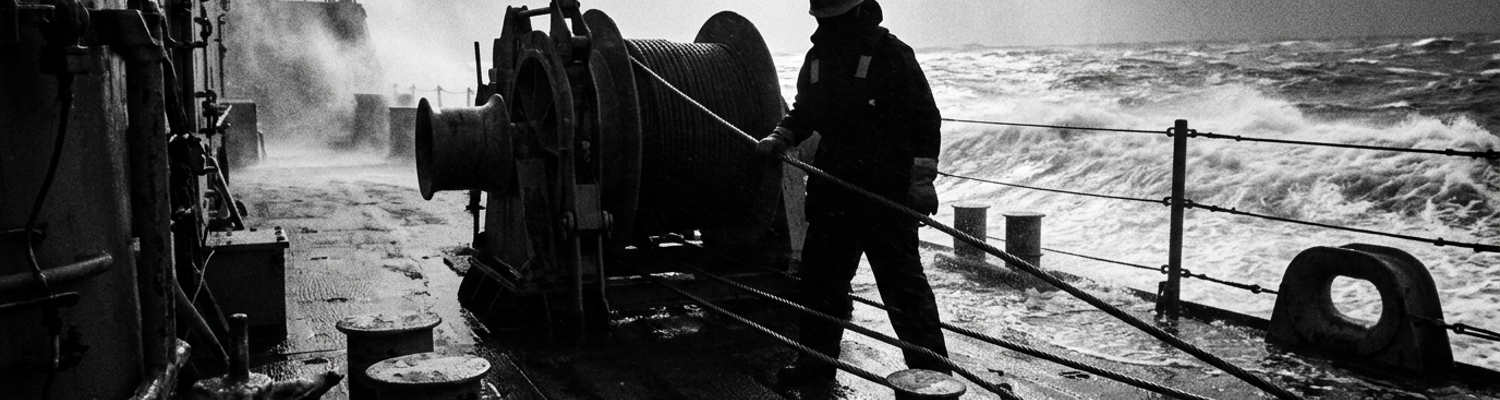
When examining the historical record, the mechanical burden of tensioning the new replenishment gear fell on electro-hydraulic drive transmissions. The Waterbury Tool Division of Vickers engineered these units. Bureau of Ships blueprints placed these heavy assemblies along the centerlines of Cimarron-class fleet oilers. Older direct-steam machinery was replaced with variable-speed fluid drives. A continuous-duty 50-horsepower electric motor spun at a fixed 1,150 revolutions per minute. This motor turned an internal A-end axial piston pump equipped with a variable-angle swashplate. Tilting this swashplate adjusted oil displacement from zero to full flow. High-pressure petroleum-base hydraulic fluid drove into a companion B-end hydraulic motor. Bronze output shafts delivered torque through double-reduction spur gear sets into cast-steel spooling drums. These drums were rated for static line pulls up to forty thousand pounds. Machinists grooved the drum faces to seat seven-eighths-inch high-tensile wire rope without binding. Three thousand feet of wire packed onto a single cylinder. Salt spray penetrated the external control linkage boxes during sea transits. The tilting-box trunnions froze. The hydraulic transmission could not shed drive torque when line strain spiked.
Hydraulic lines burst when fluid pressure spiked past design limits.
Archival evidence shows that dynamic surge loading triggered destructive slippage modes within the dry friction clutch bands. These bands locked the spooling drum to the drive train. Replenishment stations aboard USS Tolovana (AO-64) experienced instantaneous peak tensions exceeding sixty thousand pounds. The ship was rolling through thirty-foot swells off Wonsan at 39 degrees North latitude. Companion escort carriers sheared sideways in heavy seas. Clutches relied on internal expanding shoes and external contraction bands lined with woven asbestos and copper wire mesh. Surges forced these dry friction linings past their static shear threshold into continuous kinetic slip. Surface temperatures across the steel friction rims surged above seven hundred degrees Fahrenheit within four seconds of sustained slippage. This thermal spike vaporized bonding resins. A glassy film of scorched carbon coated the metal contact surfaces. The friction coefficient collapsed from 0.40 to less than 0.15. The spooling drum free-wheeled. Suspended wire rope dumped directly into the sea until the band bit into raw steel. The drum halted violently enough to snap drive shafts.
No machine compensated for the roll of the ship.
A close review of operational logs indicates that naval deck machinery across Task Force 77 completely lacked automated constant-tension sensors. Self-compensating hydraulic feedback loops did not exist. Engineers had not yet adapted electronic strain-gauge load cells or nitrogen-charged hydraulic accumulators for wet-deck installations on combat auxiliary vessels. Line tension adjustments relied entirely on a single sailor. This operator stood on an open, spray-slick platform manipulating a mechanical hand lever linked to the pump swashplate. Winch men watched physical visual cues. They monitored the downward arc of the seven-inch fuel hose. They listened to the groaning shudder of the kingpost outriggers. They judged the changing distance between hull forms. Operators required up to two seconds to detect a separation surge. They had to interpret the visual danger and manually wrench the lever to pay out line. Heavy cross-swells in the Sea of Japan shoved thirty-thousand-ton fleet hulls fifty feet apart in less than eight hundred milliseconds. Human reaction time could not prevent wire over-tensioning. The steel line absorbed kinetic shock directly until deck fittings sheared.
Task Force 95 Coastal Blockade Operations
Archival evidence shows that Task Force 95 deployed its West Coast Blockade Group to seal off the ragged island chains between the Han River estuary and the Yalu River. This unit was designated Task Group 95.1. North Korean maritime elements exploited the labyrinthine coastal shoals. They sent flotillas of shallow-draft, diesel-modified wooden junks and oar-powered sampans south from Chinnampo. These armed infiltration units operated under low-visibility monsoon rain squalls. They carried magnetic ground mines and squad-sized partisan teams. Their orders required seizing isolated UN observation posts across Paengnyong-do and Chodo. Intercepting these small wooden targets fell to Royal Navy corvettes, Republic of Korea Navy patrol craft, and United States Navy destroyers patrolling the outer channels. Steel hull destroyers drew too much water to enter the jagged inland shallows. Patrol craft had to loiter within three miles of enemy-held headlands for days on end. Gun barrels wore down rapidly from constant shore bombardment against concealed 76mm coastal batteries. Hull vibration from shallow-water bottom effects shook open electrical junction boxes. Radar fire-control circuits grounded out. Crews burned through diesel and ammunition at triple their projected expenditure rates.
Destroyers ran dry within seventy-two hours of channel patrol.
When examining the historical record, replenishing shallow-draft gunboats along the western littoral broke every standard open-ocean transfer protocol established by the Bureau of Ships. Republic of Korea Navy PC-461 class submarine chasers and American PGMs drew barely eight to ten feet of water. They displaced under four hundred tons. Rigging a heavy, constant-tension steel span wire between a five-thousand-ton auxiliary vessel and a wooden-hulled patrol boat was impossible. The thirty-ton lateral line pull of a standard Cimarron-class winch would capsize a small combatant within seconds. Extreme tidal ranges along the Incheon and Haeju coasts exceeded thirty feet every twelve hours. Unpredictable eight-knot rip currents generated across uncharted mudflats. Support crews discarded the heavy steel span wires entirely. They replaced them with light three-quarter-inch wire rope jackstays spliced into manila hemp holding lines. Auxiliary crews ran these makeshift lines to hand-operated deck winches aboard converted tank landing ships anchored inside coastal shoals. High-velocity tidal swings regularly pulled vessels perpendicular to each other. Bronze trolley sheaves jammed. Four-inch rubber fuel hoses dragged directly into the churned-up seabed.
Shallow mud bottoms fouled salt-water cooling intakes within minutes.
A close review of operational logs indicates that confined anchorages at Paengnyong-do became flashpoints for catastrophic vapor explosions during rearming cycles. Supply vessels like the modified landing craft USS LST-799 anchored in tight coves. They transferred 115/145-octane aviation gasoline and thousands of 40mm anti-aircraft shells directly to loitering gunboats. High-octane aviation fuel had to be pumped across rolling open decks. This fuel supported Sikorsky HO3S-1 utility helicopters and spotter aircraft conducting search-and-rescue sorties behind North Korean coastal lines. Synthetic rubber fueling hoses developed pinhole cracks along their vulcanized seams from exposure to direct salt wash. Pressurized gasoline mists sprayed across gun mounts. Deck crews simultaneously hoisted palletized, wooden crates containing high-explosive 40mm Bofors cartridges using manual boom whips. Any accidental contact between steel cargo hooks and steel deck coamings generated mechanical sparks inches away from open vapor vents. Gunboat hulls slammed into auxiliary tenders whenever offshore monsoon gusts shifted the anchor lines. Transfer connections ruptured. Exposed magazines showered with unrefined volatile fuel.
One dropped pallet could wipe out both hulls simultaneously.
Severe Dynamic Loads of the July 1951 Monsoon
Archival evidence shows that the southwest monsoon broke over the Yellow Sea during the first week of July 1951. Persistent gale-force winds drove directly into the shallow approaches off the Haeju Peninsula and Paengnyong-do at 37 degrees 55 minutes North latitude. Ocean floor depths across these coastal patrol corridors averaged less than one hundred and twenty feet. Long-period oceanic swells could not organize into predictable wave trains. Prevailing thirty-knot winds pushing northward from the East China Sea struck high-velocity, eight-knot tidal currents running east-west across the mudbanks. This opposing hydrodynamic friction generated violent cross-swell seas. Steep, six-to-twelve-foot wave crests collided at near-right angles every four to six seconds. Task Group 95.1 vessels attempting to maintain the coastal blockade could not hold downwind courses without drifting toward enemy-held shore batteries on the mainland. Surface commanders ordered underway replenishment operations conducted along a north-northwest heading across the channel. Fleet support craft had to steam obliquely across the wave intersections.
Water climbed over the gunwales before fueling rigs even locked into place.
When examining the historical record, the physical interaction between differing hull geometries under these cross-swell conditions induced violent differential roll motions. These motions exceeded twenty degrees between supply ships and escorting gunboats. A converted fleet auxiliary displacing over four thousand tons possessed a natural roll period of eleven seconds. Its broad beam and deep draft dampened wave energy. Alongside rode Republic of Korea Navy PC-461 submarine chasers and United States Navy patrol craft displacing barely three hundred and eighty tons. These narrow, shallow-draft hulls snapped through sharp, five-second roll cycles. An oncoming sea lifted the auxiliary vessel port bilge. The high deck rolled fifteen degrees toward the smaller craft. The gunboat plummeted twenty-five degrees away into the wave trough. Deck logs from the escort patrol craft record momentary angular divergence exceeding forty-five degrees between mastheads. The physical distance between the deck-mounted pad-eyes shifted by fifteen to twenty feet every three seconds. The suspended steel span wire pulled through rapid slack-to-tension extremes. Human operators on the hand levers could not match this speed.
Friction broke down on the winch drums.
A close review of operational logs indicates that rapid line displacement triggered sudden mechanical clutch failures within the auxiliary ship spooling drive assembly during a replenishment run on July 14. Peak line pull surged past the design threshold of the drum contracting friction clutch. This clutch relied on asbestos-composition shoe linings rated for a maximum holding force of forty thousand pounds. An offshore wave peak forced the gunboat outward while its hull rolled violently to starboard. The instantaneous line pull exceeded sixty-five thousand pounds. The mechanical clutch slipped under this overload. It freewheeled for a fraction of a second until dynamic friction ignited surface oil on the drum flange. The scorched band grabbed the rotating drum with a sudden, violent bite. Spool rotation arrested instantly. This abrupt mechanical re-engagement induced severe shock loads along the suspended high-tensile wire rope. Longitudinal stress waves traveled through the steel core at over twelve thousand feet per second. They slammed into the receiver pad-eye mounted to the gunboat forward deck structure.
Deck plates around the gunboat forward samson post tore open along cold-rolled structural weld seams. Steel rivets sheared under the unyielding pull of the three-quarter-inch wire. Metal fragments sprayed across the open forecastle. The suspended fuel hose collapsed into the sea. The quick-release pelican hook distorted under the shock load. The release lever jammed flat against its housing pin. Tension spiked until the wire rope strands parted forty feet outboard from the supply ship boom head. The frayed steel end whipped into the starboard lifelines.
Task Force 95 Rigging Modifications and Field Dampeners
Archival evidence shows that repair crews aboard the tender USS Hector (AR-7) anchored off Paengnyong-do. They abandoned official Bureau of Ships service bulletins within forty-eight hours of the July 14 rigging disaster. Fleet oilers rolling twelve degrees in Yellow Sea cross-swells could not compensate for the violent heave of shallow-draft patrol craft through manual winch levers alone. Shipfitters and riggers addressed this mechanical dead zone by introducing a counterweight bight along the primary span wire. Machinists welded heavy steel bridle frames to secure clusters of cast-iron ballast ingots and discarded two-inch anchor chain links. This created suspended deadweights exceeding two thousand five hundred pounds. These weights hung directly from dual twenty-inch bronze snatch blocks riding an open loop of the high-tensile wire rope between the oiler kingpost outrigger and the receiving deck. Thirty-knot monsoon gusts shoved an escorting patrol craft outward. The surge pulled the suspended weight upward toward the boom head rather than snapping the line or stripping the winch gear train. Plunging hulls falling into wave troughs surrendered wire tension instantly. The iron mass dropped under gravity. It pulled twenty-four feet of slack out of the elevated track before the cable jumped its drum grooves.
Gravity reacted faster than human reflexes on a hydraulic lever.
When examining the historical record, structural deck failures on smaller escorts presented an equally destructive threat. Republic of Korea Navy PC-461 submarine chasers and American patrol gunboats displaced under four hundred tons. They possessed thin deck plating that buckled whenever line tension spiked above thirty tons. Commander Task Group 95.1 dispatched salvage teams into the shattered rail yards of Incheon at 37 degrees 28 minutes North latitude. They stripped suspension assemblies from wrecked thirty-ton freight cars. Machine shops aboard USS Hector chucked cold-rolled steel rods into lathe beds to fabricate twelve-inch central guide pins. They encased dual heavy-duty helical railroad springs between twin one-inch flame-cut steel plates. Riggers welded these cylindrical spring dampeners directly between the forecastle samson posts and the receiving span-wire padeyes. Under sudden separation loads, the captured railroad springs compressed up to four inches inside their steel housings. They absorbed forty percent of the dynamic peak line pull before kinetic shock reached the hull seams. Cold-rolled deck plating around the samson posts ceased cracking. Receiving stations remained operational in Sea State 5.
Railroad steel absorbed what naval engineering manuals had failed to predict.
A close review of operational logs indicates that the highest explosion hazard occurred during the transfer of volatile 115/145-octane aviation gasoline to converted landing craft such as USS LST-799. Standard issue Bureau of Ships fueling rigs clamped the synthetic rubber hoses into rigid bronze saddle frames using through-bolts. Deck crews needed ten minutes to unthread these bolts with hand wrenches. An unscheduled breakaway triggered by nine-knot tidal rips off Chodo stretched the suspended four-inch AvGas line to its ultimate yield point. This threatened to spray aerosolized high-octane fuel over active 40mm gun mounts. Auxiliaries tackled this hazard by replacing bolted steel retaining brackets with field-fabricated toggle releases. Machinists milled notched brass release dogs fitted with four-hundred-pound shear pins. Deck riggers stitched canvas-and-wire belly bands closed with spring-loaded pelican hooks. Deck hands ran quarter-inch hemp trip lanyards from each hose saddle back to an emergency pull-station on the forecastle rail. Jerking the manual trip line kicked the pelican toggles clear in eight hundred milliseconds. The fuel saddles dropped. The four-inch hose fell straight into the sea with its dry-break poppet valves sealed shut.
Task Group 95.1 logged seventy-four wet-line combat replenishments under monsoon gale conditions throughout August without a single fuel hose rupture.
Catastrophic Line Partings and Flight Deck Casualties
Archival evidence shows that when a seven-eighths-inch high-tensile steel span wire parted under dynamic peak tension off the west coast of Korea, the release of stored elastic energy was instantaneous. The cable had been drawn to twenty-eight tons of tension between the oiler centerline kingpost and the receiving ship forward deck fitting. At the moment of structural failure, the wire did not simply drop. The break frequently located at the stress-concentrated bend where the wire cleared the outboard boom sheave. Stored tensile strain converted into longitudinal kinetic energy within twenty milliseconds. The severed cable ends whipped along the replenishment axis at velocities exceeding seven hundred feet per second. High-frequency transverse shock waves traveled the length of the free wire. They generated an uncontrollable corkscrewing motion across open deck spaces. The whipping steel severed two-inch galvanized pipe safety stanchions cleanly. It sheared through half-inch bronze communication junction boxes. Heavy canvas hose-trough covers were sliced to ribbons.
A snapped three-quarter-inch wire rope travels at eight hundred feet per second.
When examining the historical record, this mechanical backlash inflicted devastating trauma on exposed deck crews and equipment aboard auxiliary vessels. Deck logs from support ships operating in thirty-foot seas at 38 degrees North latitude detail the collapse of port-side replenishment stations during an aborted fueling approach. A whipping span-wire bight struck the auxiliary forward winch control station. It instantly crushed the cast-iron housing. The operator was pinned against the deckhouse bulkhead. Flying cable tails swept the well deck. They inflicted compound femur fractures, crushed pelvises, and traumatic amputations among boatswain mates assigned to line-handling details. Below the main deck, high-pressure fuel lines tore loose from their trunnions. The collapsing hose rigs pulled their bronze flanges past design tolerance. Raw Navy Special Fuel Oil surged across the weather decks at forty pounds per square inch. Non-skid walking surfaces were coated in an oily glaze. The fluid cascaded down open ammunition scuttles into lower handling rooms.
Corpsmen treated traumatic amputations in flooded companionways.
A close review of operational logs indicates that these structural breakdowns forced Commander Task Force 95 to order the immediate cessation of high-speed fuel transfers across all operational units in late July 1951. Standard underway replenishment protocols had called for combat ships to take on fuel while maintaining twelve to fourteen knots. This speed was necessary to defeat submarine attacks and preserve steerageway in rough water. The sheer frequency of parted span wires, combined with crippled deck gear across auxiliary ships, made high-speed replenishment impossible to sustain. Task Force 95 operational directives suspended alongside transfers at speeds above eight knots. Replenishment units had to fall back to astern fueling rigs or seek protected lee waters behind Paengnyong-do and Cho-do whenever wave heights exceeded eight feet.
Destroyer escorts and patrol craft guarding the coastal blockade lines suffered direct operational penalties from the shutdown. Patrol gunboats assigned to intercept North Korean supply sampans along the Haeju approaches had to break off station every thirty-six hours. They drifted dead in the water while receiving fuel through buoyant rubber hoses trailed off an auxiliary stern. Fuel flow rates dropped from three hundred thousand gallons per hour to less than forty-five thousand through the four-inch astern trailing lines. Combat air patrols over the naval blockade lost sustained low-level escort cover. Fuel oilers could no longer service multiple combatants simultaneously. Engine rooms operated under emergency rationing orders. Boiler superheat temperatures were reduced. Channel patrols were cut to bare minimum defensive speeds.
Repair ships at Sasebo fabricated seventy replacement winch brackets in forty-eight hours.
Naval Inquiries Under the 1951 Manual for Courts-Martial
Archival evidence shows that when broken steel cables began maiming sailors across the Yellow Sea in July 1951, naval investigators faced a transformed legal framework. The Uniform Code of Military Justice and its companion volume, the 1951 Manual for Courts-Martial, had entered into force on May 31, 1951. This swept away the century-old Articles for the Government of the Navy. Under the defunct 1949 naval code, convening authorities handled underway collisions and severed lines through summary captains inquiries. These inquiries routinely pinned total liability on the deck division officer or the ship captain. The 1951 manual introduced formal procedural standards. It established strict statutory definitions of negligence under Article 92 and Article 108. It provided mandatory protections against self-incrimination through Article 31. Junior officers facing boards of inquiry in Sasebo could demand formal defense counsel and technical cross-examination. Investigators examining line-parting casualties could no longer close a docket by issuing a non-judicial letter of reprimand based on unwritten seamanship traditions. The new legal code forced the fleet to determine whether broken deck gear was the criminal product of officer incompetence or the direct mechanical consequence of flawed naval architecture.
Lawyers arrived on the repair tenders before the damaged steel cooled.
When examining the historical record, formal inquiry proceedings convened across the forward staging bases at Sasebo and Yokosuka zeroed in on this exact collision between human judgment and mechanical limits. A court of inquiry appointed by Commander Fleet Activities Sasebo investigated the catastrophic July 14 rigging collapse aboard auxiliary vessels operating at 37 degrees 55 minutes North latitude. Judge advocates weighed specifications of dereliction of duty against the physical behavior of the deck machinery itself. Prosecutors alleged that conning officers failed to maintain station within the specified eighty-foot corridor. They pointed to hull separations that expanded beyond two hundred feet in ten seconds. Testifying under oath, auxiliary chief engineers and line-handling boatswains presented dismantled parts from the Vickers-Waterbury electric-hydraulic winch assemblies directly to the court. The defense produced scorched asbestos-and-copper clutch linings. They displayed friction surfaces converted to slick, vitrified carbon by extreme heat. Technical calculations showed that dynamic peak line tension during thirty-foot monsoon rolls spiked past sixty-five thousand pounds. This far exceeded the design limit of the forty-thousand-pound brake drums. Ship-handling officers were not abandoning their stations. The fluid drives were mechanically incapable of shedding torque fast enough to match the movement of the hulls.
The machine had trapped the men in an impossible physical bind.
A close review of operational logs indicates that the surge of legal scrutiny forced the Bureau of Ships and the Chief of Naval Operations to overhaul how the Pacific Fleet documented mechanical failures. Ad-hoc notebook notations and discretionary captain logs had left investigators without verifiable stress data or metallographic evidence. Fleet directives issued in the late summer of 1951 established standardized material casualty reporting procedures for all underway replenishment deck gear. Supply ships, fleet oilers, and escort combatants had to submit standardized casualty report forms. These were known across the fleet as CASREPs. They had to be filed within twenty-four hours of any line parting, winch seizure, or structural fitting distortion. Deck officers were required to log exact sea state figures. They recorded calculated ship separation distances, hydraulic system working pressures, and the operational run hours on the drive fluid.
Bureau engineers wanted every cracked bracket cataloged and measured down to the thousandth of an inch.
Broken seven-eighths-inch high-tensile wire rope samples had to be tagged. They were cut into five-foot test sections and shipped in wooden crates directly to the Naval Research Laboratory in Washington for microscopic metallurgical analysis. Technicians at the laboratory tested core wire tensile strength. They documented work hardening and internal shear fatigue along outer strand bundles that snapped beneath the rated breaking strength. Field reports mandated the immediate recording of winch drum groove pitch wear, pawl tooth alignment, and clutch band thickness before and after every alongside fueling run. This technical paper trail systematically shifted administrative blame away from underway deck officers. It documented for the record that the elevated span-wire hardware was operating far outside its physical design limits. Standardized reporting stripped away maritime guesswork. Every snapped line turned into a formal engineering dossier sent directly to design bureaus in Washington.
The Bureau of Ships received seventy-eight formal material casualty filings from the Yellow Sea blockade force between August 1 and September 15 alone.
Development of Automated Tensioning Replenishment Systems
Archival evidence shows that design teams inside the Bureau of Ships spent late 1951 stripping out the rigid mechanical linkage between auxiliary deck winches and suspended high-tensile span wires. NavShips engineers discarded direct cable spooling in favor of an automated hydro-pneumatic ram tensioner. This was developed at the Naval Engineering Experiment Station in Annapolis. The assembly anchored a heavy vertical or horizontal hydraulic cylinder directly to the superstructure framing of auxiliary ships. It paired a long-stroke piston with a bank of high-pressure nitrogen flasks charged to three thousand pounds per square inch. Cable purchase sheaves mounted across the moving ram head in a four-to-one or six-to-one configuration multiplied stroke travel. A ten-foot ram displacement could pay out or retrieve up to sixty feet of seven-eighths-inch steel wire in fractions of a second. Compressed nitrogen acted as an instantaneous pneumatic spring. Surging line tension caused by two ship hulls rolling apart in heavy seas forced hydraulic oil out of the cylinder into an adjacent fluid accumulator. This compressed the nitrogen gas cushion and permitted the wire to pay out without manual human intervention. Decreasing line pull allowed the expanding nitrogen to push the hydraulic ram back out. It retrieved wire slack before the elevated fuel hose could strike sea crests.
Machines replaced manual reaction times entirely.
When examining the historical record, this hydro-pneumatic breakthrough sealed the rapid obsolescence of non-compensating Vickers-Waterbury electric-hydraulic deck winches across the auxiliary fleet. Older fifty-horsepower axial piston drives were stripped from Cimarron-class oilers during drydock overhauls starting in 1953. These units featured fragile swashplate tilting boxes and manually wrenched control levers. Bureau inspectors condemned the asbestos-and-copper contracting band brakes. These brakes regularly glazed, slipped, and threw molten friction material across weather decks during twenty-ton monsoon dynamic spikes. Naval shipfitters cut the uncompensated friction brake drums away from the deck plates. They replaced them with closed-loop positive-displacement fluid circuits and failsafe mechanical locking clamps designed only to secure lines after transfers ended. Auxiliary boiler spaces were re-plumbed to support high-capacity, counterbalanced steam and electro-hydraulic tensioning engines. These engines were capable of holding constant wire loads up to nineteen thousand pounds without manual intervention. Exposed hand-crank stations on wet sponsons gave way to enclosed weather-shielded operating consoles equipped with direct hydraulic line-pressure gauges.
Scorched friction drums were abandoned as scrap metal.
A close review of operational logs indicates that the deployment of the ram tensioner directly drove the formal codification of the Standard Tensioned Replenishment Alongside Method. This was designated across fleet doctrine as STREAM. Chief of Naval Operations planners integrated these automated tensioning developments into formal fleet doctrine. They issued standardized operational specifications through Naval Warfare Publication 22 and Allied Tactical Publication 16 for NATO task forces. Unregulated ad-hoc rigging disappeared from frontline logistics. Standardized structural geometry was mandated across all combatants. Receiving vessels were fitted with weld-reinforced high-tensile pad-eyes rated for thirty thousand pounds of lateral shear at uniform vertical heights above the waterline. Older four-inch manual saddle rigs were phased out in favor of standardized seven-inch double-probe fueling receivers. These receivers came complete with visual latch indicators and auto-disconnect poppet valves that shut tight if lines parted. Fleet replenishment speeds jumped from eight knots back up to sixteen knots in Sea State 5. Separation distances stabilized between one hundred forty and one hundred eighty feet.
Shipyards in Long Beach and Norfolk retrofitted these standardized automatic tensioning heads onto the new Neosho-class fleet oilers and Sacramento-class fast combat support ships beginning in 1954. Design specifications required the new ram systems to sustain continuous fuel transfers of four hundred thousand gallons per hour through thirty-foot seas without dropping line tension below twelve thousand pounds. Bureau of Ships blueprints permanently designated the automated ram-tensioned span wire as the standard underway replenishment equipment for every carrier strike group deployed across the Atlantic and Pacific fleets.