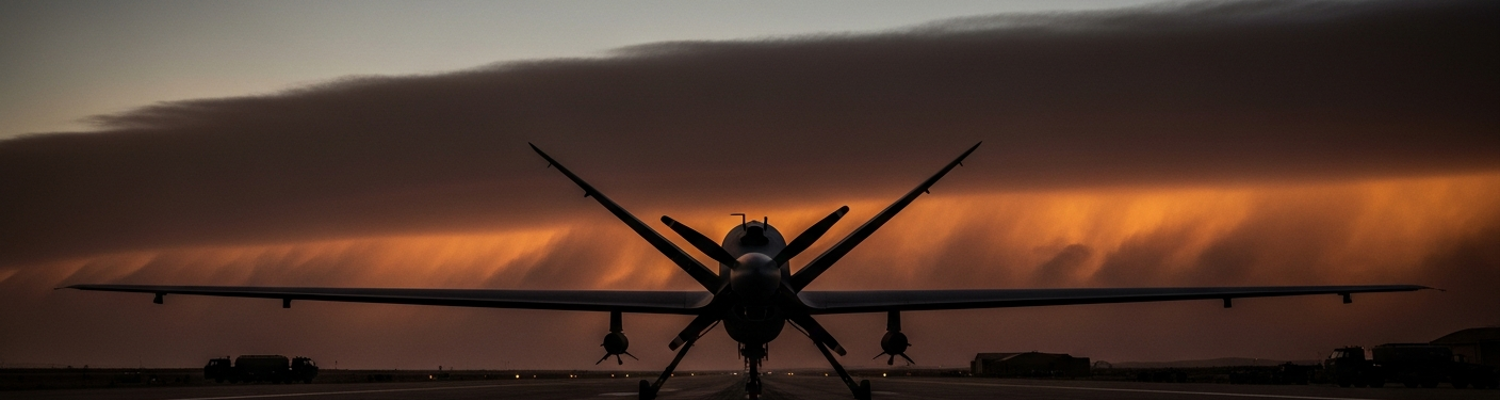

RQ-1 Predator Early Deployments
By the 2001 American campaign launch in Afghanistan, the US Air Force inventory included sixty RQ-1 Predators. Twenty were already lost in action. The high attrition rate drew criticism from Pentagon officials who pointed to flawed operational procedures, with a large number of crashes resulting from equipment failure, operator error, or weather. The aircraft's accident rate was notable; by March 2009, seventy Predators had been lost in crashes.
A review of operational logs shows the RQ-1’s transition from a Balkan reconnaissance asset to a frontline tool in the Global War on Terror was a forced evolution. Following trial runs over Afghanistan in 2000, codenamed “Afghan Eyes,” the Predator was deployed for Operation Enduring Freedom in October 2001. The 11th and 15th Reconnaissance Squadrons, operating from Indian Springs, Nevada, were the primary units tasked with its use. Forward-deployed ground crews and launch-and-recovery elements were established at austere airfields, including Jacobabad and Shamsi in Pakistan, and later Balad Air Base in Iraq. A specific airframe, serial number 03-3119, began combat operations from Balad in July 2005. The operational geography was unforgiving. Extreme temperatures in the Iraqi desert and the high, rugged mountains of Afghanistan presented immediate and severe challenges to the drone’s mechanical systems. Downdrafts in the mountains north of Jalalabad could overwhelm the aircraft’s limited engine power. Fine desert sand infiltrated sensitive electronics and mechanical components. The move into Operation Iraqi Freedom saw Predators operating from bases like Ali Al Salem in Kuwait, flying missions that included striking Iraqi air defense systems, such as a ZSU-23-4 gun, outside Al Amarah in March 2003.
Its primary intelligence gathering mission centered on providing persistent Intelligence, Surveillance, and Reconnaissance (ISR). The mission payload consisted of a nose-mounted camera for the remote pilot and a large, gimbaled sensor turret. This turret, the Versatron Skyball, housed an electro-optical camera for daylight observation and a forward-looking infrared (FLIR) sensor for night operations. Deployed Predators were tasked with identifying enemy movements, monitoring compounds, and tracking individuals over long periods. This pattern of life analysis allowed intelligence analysts to build a detailed picture of enemy activities without risking personnel. The video feed could be transmitted in real-time via a Ku-band satellite data link to ground control stations, often located thousands of miles away in places like Creech Air Force Base, Nevada. This over-the-horizon capability was a central design feature, but the satellite link itself could be a point of failure. System freezes at the ground station could lead to a complete loss of contact with the aircraft. In at least one documented case, a Predator flew its lost link profile for over twelve hours before it was eventually lost because control could not be re-established.
Early performance expectations were misaligned with the aircraft’s operational record. The Predator was developed as an Advanced Concept Technology Demonstration and pushed into service after proving its value over Bosnia. It was expected to be a low-cost, expendable asset suitable for deployment in moderate-risk areas. The realities of combat operations exposed profound frailties. The aircraft’s four-cylinder Rotax 912 engine, a design originally for snowmobiles, was highly susceptible to icing at altitude and overheating in desert conditions. A turbocharged Rotax 914 was later introduced to improve performance, but engine-related failures remained a common cause of crashes. Reports from Afghanistan detailed turbocharger failures due to oil coking, a breakdown of oil at high temperatures that leaves solid residue, and complete engine failures that led to total airframe loss. Electrical failures were another vulnerability; a failed cable could cause a flight control surface to lock in place, rendering the aircraft uncontrollable. These persistent mechanical and electronic failures, combined with a susceptibility to severe weather, ensured that the early Predator fleet was consumed at a rate that strained logistics and the small community of specialized operators and maintainers.
Desert Particulate Vulnerabilities
The air over Iraq and Afghanistan was hostile. A close examination of operational logs from Predator units shows a constant battle against an environment determined to grind the machine down. The fine particulate matter, a talcum-like dust ubiquitous to the region’s arid basins and windswept plains, proved to be a pervasive threat. This was not coarse sand; it was a fine, penetrating powder that infiltrated every seam and joint of the airframe. Maintenance records from forward operating bases like Balad and Shamsi document a dramatic spike in engine-related failures directly attributable to this dust. The Rotax 914 engine, a design never intended for such conditions, was especially vulnerable. Its air intakes, despite field-expedient filters, would become clogged, starving the engine of air and leading to reduced performance and overheating. The dust ingested into the cylinders acted as a grinding compound, accelerating wear on pistons, rings, and bearings. This significantly shortened engine life and increased the frequency of catastrophic failures like cracked crankshafts. This constant abrasion and contamination demanded a punishing maintenance tempo, reducing the operational availability of a fleet already strained by high loss rates.
This abrasive quality was most acutely felt by the Predator’s primary sensor, the Versatron Skyball turret. The turret’s most important component for night operations, its forward-looking infrared (FLIR) sensor, was protected by a lens made of germanium. While ideal for transmitting infrared radiation, germanium is a relatively soft material, highly susceptible to scratching. During takeoffs and landings from austere, often unpaved, airfields, the Predator’s own propeller wash would kick up clouds of fine sand and dust. This created a sandblasting effect that pitted and scoured the delicate surface of the germanium lens. Each microscopic scratch degraded the quality of the image transmitted back to operators thousands of miles away, reducing the sensor’s effective range and its ability to resolve fine details. A heavily abraded lens could render the multi-million dollar system incapable of positively identifying a target or tracking a person of interest. Field maintainers, under pressure to keep the limited number of airframes flying, resorted to desperate measures, attempting to polish the lenses or applying temporary protective films. These were stopgap solutions at best. The only real fix was a costly and time-consuming replacement of the entire sensor ball, a significant logistical burden for units in remote locations.
The aircraft's lines of communication were also under assault. The machine relied on two primary data links: a C-band line-of-sight link for takeoff and landing, and a Ku-band satellite link for over-the-horizon flight. Both could be disrupted by severe weather, but the massive dust storms, or haboobs, common to the region presented a unique set of challenges. These storms, dense with electrostatically charged particles, could cause significant signal attenuation. A Predator flying a mission could lose its satellite link as it entered a dust storm, forcing it into its automated lost link profile where it would circle a pre-programmed point until the connection could be re-established. This not only aborted missions but placed the aircraft at high risk of being lost if the link could not be regained before fuel ran out. Archival accident investigation reports detail multiple instances where lost links in weather were a contributing factor to a crash, turning a temporary disruption into the total loss of an aircraft.
Sensor and Communication Degradation
The operational effectiveness of the Predator was wholly dependent on the quality of the data it could gather and transmit. A review of operational logs from units like the 432nd Air Expeditionary Wing at Creech Air Force Base reveals that the degradation of the primary electro-optical/infrared (EO/IR) sensor was a constant and mission-critical problem. The Versatron Skyball turret was an exquisitely sensitive instrument rendered vulnerable by the very environment it was designed to scrutinize. The sand-blasted germanium lens on the forward-looking infrared sensor did more than just soften the image; it actively worked against the sensor operator. In the high-contrast lighting of the Iraqi and Afghan deserts, a pristine lens already struggled with blooming and washout from the intense sunlight. A pitted lens exacerbated this, scattering light and reducing the subtle distinctions in texture and shadow that an operator relied on to identify threats. At night, the problem inverted. The compromised germanium surface failed to efficiently transmit thermal energy to the IR sensor, effectively lowering its sensitivity. This made distinguishing a warm human body from the residual heat of a sun-baked rock a matter of intense, eye-straining concentration for an operator thousands of miles away. This forced a tactical adaptation. To get a clear enough image for positive identification, pilots had to fly the Predator lower, bringing it within range of small arms and anti-aircraft artillery, negating one of its key survival advantages.
This degradation of vision was compounded by a constriction of its data stream. The Predator’s ability to operate over the horizon was entirely reliant on a Ku-band satellite data link. Archival evidence shows this link, while revolutionary, was a finite resource that was quickly overwhelmed. In the early days of operations over Afghanistan, the handful of Predators in theater had relatively uncontested access to satellite bandwidth. As the number of unmanned systems proliferated, with more Predators, and later, Reapers and Global Hawks all demanding data, the available bandwidth per aircraft diminished sharply. A single Predator system, consisting of the aircraft and its ground control station, was designed to use a dedicated satellite communications suite, often involving a large 20-foot dish. The strain on this architecture forced commanders into a form of digital triage. High-priority missions, such as tracking a high-value individual, might receive a full-quality video feed. Other missions, like routine convoy overwatch or infrastructure surveillance, would have their data streams compressed. This compression introduced visual artifacts, increased latency, and lowered the frame rate, making the operator’s job significantly harder. Flying the aircraft became less intuitive, and the sensor operator’s ability to detect subtle movements or changes on the ground was severely hampered by a pixelated and lagging video feed.
The most catastrophic failure was the complete loss of this digital connection. Data stream interruptions were a frequent and feared occurrence. These lost link events could be triggered by a host of factors inherent to the system’s design and its operational environment. The physical hand-off from the line-of-sight C-band data link used during takeoff and landing to the Ku-band satellite link was a common point of failure. Weather, particularly the dense dust storms of Iraq or the thick cloud layers over Afghan mountains, could sever the connection entirely. Internal equipment malfunctions were another persistent cause; accident investigation board reports detail numerous crashes where a failure in the aircraft’s primary control module or a software freeze at the ground control station led to a permanent lost link. When the link was severed, the Predator was designed to autonomously enter a pre-programmed flight pattern, typically circling a designated point at a safe altitude until the connection could be re-established. This action immediately aborted the mission. For the crew at Creech or another control element, it began a frantic troubleshooting process to restore contact. If they failed before the aircraft exhausted its fuel, the result was the total loss of a multi-million dollar airframe. In some cases, the aircraft simply vanished from all tracking, crashing in remote, unrecoverable locations.
Operational Setbacks and Aborts
The promise of persistent surveillance was consistently broken by the machine’s inherent fragility. A review of operational logs and accident reports from the early campaigns in Afghanistan and Iraq reveals a dramatic spike in mission abort rates, driven largely by the constant failure of critical components. The most common trigger for an aborted sortie was a lost link event, a sudden and total severance of the satellite connection between the aircraft and its pilots at ground stations like Creech Air Force Base. This digital umbilical cord could be cut by anything from internal avionics malfunctions to the dense dust storms that plagued the operational theaters. The result was immediate. The mission was over. The Predator was programmed to autonomously enter a circular holding pattern, awaiting a signal that often never came. For the ground crew, this initiated a frantic, timed sequence of rebooting systems and attempting to re-establish a connection before the aircraft exhausted its fuel and was lost entirely. These failures meant that a planned 14-hour overwatch mission could end abruptly after only two, leaving a target unobserved or a friendly ground patrol without its aerial guard.
The gaps in collection were not theoretical. They had direct tactical consequences. The entire operational model for the Predator was based on long-endurance pattern of life analysis, which required monitoring a location or individual for days to build a usable intelligence picture. A single lost link event could wipe out this effort. A six-hour gap in surveillance was long enough for a high-value target to relocate, for a weapons cache to be moved, or for an IED emplacement team to complete its work and disappear. Archival after-action reports document instances where ground commanders, who were depending on the Predator to clear a route for a convoy or watch over a special operations raid, were suddenly informed that their asset had gone offline. They were left blind, forced to proceed with outdated information or cancel the operation entirely. The problem was made worse by the limited availability of satellite bandwidth. As more unmanned systems crowded the airwaves, video feeds were often compressed, reducing image quality and making it harder for analysts to spot subtle but important details even when the link was active.
The unreliability of the system directly translated to diminished battlefield awareness for the troops it was meant to protect. A ground unit that had grown accustomed to the security of an aerial perspective would find itself exposed when the feed suddenly went dead. The tactical risk was significant. A platoon leader advancing on a suspected enemy compound could no longer see over the walls. A convoy commander lost the ability to scan the road ahead for potential ambushes. This forced a reversion to older, riskier tactics, relying on human scouts or simply accepting a higher level of uncertainty. The degradation was not only caused by total link loss. The sand-blasted sensor lenses and compressed video streams meant that even when the system was working, the information it provided was often compromised. An operator struggling with a pixelated, low-frame-rate image might be unable to definitively distinguish a civilian holding a tool from an insurgent holding a weapon, leading to hesitation in moments where seconds mattered. This erosion of trust in the machine's capabilities meant that ground forces could never fully depend on the Predator, treating it as a valuable but ultimately fallible asset.
Field-Expedient Predator Modifications
The relentless operational tempo in Iraq and Afghanistan forced an unofficial and unwritten maintenance doctrine on the Predator fleet. At forward operating bases like Ali Al Salem in Kuwait and Balad in Iraq, ground crews from expeditionary reconnaissance and maintenance squadrons were engaged in a constant struggle against a failing supply chain and an airframe being consumed by the environment. Official repair manuals written for peacetime conditions became near-fictional documents. Archival maintenance logs show that ground crews, under immense pressure to generate sorties, developed their own set of procedures born of necessity. One widespread innovation was the complete disregard for prescribed component lifespans. The Rotax 914 engine, for instance, had a recommended time between overhaul, but with replacements scarce, maintainers pushed them far beyond their limits, monitoring engine health with ad-hoc methods until performance degraded to a point of critical failure.
The most common non-standard repair protocol was cannibalization. The practice of removing serviceable parts from one damaged or grounded aircraft to make another flyable became routine. A Predator that returned from a mission with a failed fuel pump would be towed to a line of other grounded airframes, where maintainers would harvest a working pump from a machine downed by a different ailment, like a damaged wing or a fried sensor. This created a fleet of “Hangar Queens,” airframes methodically stripped of their components until only a bare fuselage remained. While this kept a percentage of the fleet operational, it more than doubled the maintenance workload for each repair, as parts had to be removed from two separate aircraft. It also introduced significant risk, as the constant removal and re-installation of components on airframes not designed for such activity increased the likelihood of secondary mechanical problems and human error.
When official parts were unavailable and cannibalization was not an option, crews turned to whatever they could find. A close examination of after-action reports and maintainer testimonies reveals an extraordinary level of improvisation. There are documented accounts of maintainers using locally sourced sheet metal to patch non-critical airframe damage caused by rough landings or ground debris. To combat the sandblasting effect on the expensive germanium sensor lens, desperate crews experimented with applying layers of clear tape or protective films designed for helicopter windows, anything to provide a temporary barrier against the abrasive dust. These fixes were not sanctioned and certainly not tested, but they sometimes meant the difference between a grounded asset and an eye in the sky for a ground patrol in contact with the enemy. In some instances, wiring for non-essential internal systems was repaired using materials scavenged from salvaged civilian vehicles or local electronics shops.
Each field modification, while solving an immediate problem, created a fleet of unique, unpredictable machines. An airframe patched with uncertified metal had altered aerodynamic properties. An engine running on borrowed and locally filtered oil could seize without warning. These undocumented repairs made troubleshooting a nightmare for subsequent maintenance teams and created an operational environment where each takeoff was a test of both the original design’s resilience and the ingenuity of the last crew to touch the aircraft.
Haboob Survivability Enhancements
The operational environment demanded evolutionary change at a revolutionary pace. The massive, rolling dust storms known as haboobs were a unique and especially destructive feature of the Iraqi theater, capable of grounding entire wings of conventional aircraft and inflicting severe damage through particle erosion. For the Predator, a machine already at its mechanical limits, these storms were an existential threat. A close review of maintenance logs from the 432nd Air Expeditionary Wing shows that surviving a haboob required a series of rapid, often unsanctioned, modifications and procedural overhauls.
The first line of defense was for the machine’s most vulnerable sensor. The daily sandblasting of the Versatron Skyball turret’s germanium lens had already been identified as a critical issue, but a haboob could inflict the damage of a hundred sorties in a single flight. Field maintenance crews, primarily from the expeditionary reconnaissance squadrons at forward locations like Balad Air Base, began experimenting with improvised shielding. Archival imagery and maintainer accounts detail the use of disposable, optically clear polymer films applied directly to the sensor ball before flight. These were often sections of leading-edge protective tape (NSN 8315-00-266-2949), a durable polyurethane elastomer designed to protect helicopter rotor blades from erosion. Crews would cut a section and carefully smooth it over the germanium lens, creating a sacrificial layer. The film slightly reduced the sensor’s acuity, but this was deemed an acceptable trade-off compared to the permanent degradation caused by high-velocity dust. This ad-hoc procedure became a pre-flight ritual on days with severe weather warnings.
With the sensor given a measure of protection, the focus shifted to the aircraft’s data link. A haboob is a massive electrostatic event, and the dense cloud of charged dust particles caused severe attenuation of the Ku-band satellite signal the Predator relied on for beyond-line-of-sight flight. This signal degradation was a primary cause of lost-link events. In response, field engineers worked to harden the aircraft’s primary satellite communication systems. The bulbous radome on the forward fuselage, housing the satcom antenna, became a point of intense focus. While its shape was fixed, ground crews developed field kits to improve the electrical grounding of the entire airframe, applying anti-static coatings and installing supplementary grounding straps between the fuselage and wing sections. The intent was to dissipate the static charge induced by the dust storm before it could interfere with the sensitive antenna electronics. These modifications were not a guaranteed solution, but operational data indicated they provided a marginal improvement in link stability, sometimes just enough to prevent a total loss of signal as the aircraft skirted the edge of a storm.
The final and most significant adaptation was a change in the machine’s very logic. The standard lost-link profile, where the aircraft would autonomously circle a pre-programmed point until the link was re-established, was a death sentence in a haboob. An aircraft could enter the storm, lose its link, and then dutifully circle inside the storm cell for hours, burning fuel until it was lost, completely blind to the fact that it was flying a perfect circle within the very obstruction that severed its connection. To counter this, Air Force software engineers, likely working with General Atomics, developed and pushed a critical update to the flight control software. A review of system upgrade logs points to the introduction of a “Lost-Link Profile 7B (High Particulate Evasion).” Instead of circling, this new logic commanded the aircraft to initiate a steady climb upon link loss, aiming for an altitude above 20,000 feet to clear the top of the dust cloud. Simultaneously, it would fly a straight-line heading for a predetermined duration, a flight path calculated to carry it out of the storm’s typical geographic footprint. Only after executing this climb and straight-out maneuver would it begin to circle and attempt to reacquire the satellite link. This software patch transformed the Predator’s response from a passive wait for rescue into an active, pre-programmed escape maneuver.
Catastrophic Misidentification Incident
A review of operational logs for a mission flown from Balad Air Base in the autumn of 2006 reveals a cascade of failures culminating in a single, terminal error. The airframe, an RQ-1 with the tail number 04-3132, was tasked with providing armed overwatch for a US Army logistics convoy moving west from Fallujah into Anbar Province. The mission began just before dusk, under a sky turning a sickly yellow-brown as a seasonal shamal wind began to gather strength. The Predator’s sensor operator, stationed thousands of miles away at Creech Air Force Base, was already fighting the machine’s inherent limitations. The germanium lens of the Versatron Skyball turret, its surface hazed and pitted from hundreds of takeoffs and landings in the abrasive dust, struggled to resolve clear thermal images as the sun-baked ground began to cool. As the aircraft reached its designated patrol area, the burgeoning sandstorm transformed the landscape below into a blurry, indistinct mess of thermal noise. Differentiating between rock, vehicle, and human became a matter of intense, eye-watering focus. It was through this degraded visual fog that the sensor operator first detected a second group of vehicles, a small convoy of three pickup trucks, moving on a parallel dirt track several kilometers from the friendly convoy’s route.
As the Predator pilot maneuvered the aircraft for a closer look, the sandstorm intensified from a haze into a roiling wall of dust. The dense cloud of electrostatically charged particles immediately began to interfere with the Ku-band satellite uplink. For the crew in Nevada, the effect was jarring. Their video feed, already grainy from the scarred lens and atmospheric conditions, began to pixelate and tear. The frame rate dropped from an already compressed stream to a slideshow of still images, with latency stretching to several seconds. The pilot’s flight control inputs became sluggish and disconnected. Then, the screen went black. A “LOST LINK” warning flashed across the operators’ displays. The aircraft, following its programming, immediately aborted its surveillance track, banked into a pre-programmed holding pattern, and began to circle blindly at 10,000 feet, trapped within the very storm that had severed its connection. On the ground, the US Army convoy commander was informed his aerial overwatch was gone. In the ground control station, a frantic, ten-minute troubleshooting sequence began, with operators rebooting terminals and attempting to re-establish the satellite handshake. Contact was eventually restored, but the connection was unstable, the available bandwidth slashed by the continuing storm. By the time the operators had a view of the ground again, they had lost nearly a quarter-hour of continuous observation. The unknown convoy had traveled several miles, and its pattern of life was now a broken, disjointed puzzle.
With a degraded sensor view and a fractured timeline of events, the crew had to reconstruct the tactical picture from incomplete data. The three pickup trucks had stopped near a shallow wadi, a location that after-action reports indicated was a known site for previous insurgent activity. Through the distorted, low-resolution video feed, one of the operators identified a figure dismounting from a truck and moving toward the side of the road. In the pixelated thermal image, the figure appeared to be crouching. The crew interpreted the actions as an insurgent emplacing a roadside bomb, intending to strike the approaching American convoy. The intermittent data stream made it impossible to get a clear view to challenge this assumption; they could not count the occupants or see if women or children were present. They saw only what the machine’s compromised systems allowed them to see, filtered through the lens of expectation. Believing they were acting to prevent an imminent attack, the pilot and sensor operator formally identified the convoy as hostile. A request to engage was sent up the chain of command, accompanied by the fragmented video evidence and the crew’s confident assessment. The request was approved.
The Predator’s pilot selected a Hellfire missile and the sensor operator locked it onto the central truck. The missile left the rail, its own exhaust trail instantly swallowed by the dust. The 17-second flight time was an eternity of watching a grainy, silent feed. The impact was precise. The screen flared white as the missile struck the vehicle, the thermal bloom overwhelming the sensor. The crew expected to see secondary explosions, the tell-tale sign of munitions cooking off. There were none. Instead, the thermal signatures that scattered from the other vehicles were not the disciplined movements of fighters seeking cover, but the panicked, frantic dispersal of non-combatants. As the smoke and dust from the explosion momentarily cleared, the sensor, now focused on the wreckage, transmitted a horrifyingly clear image. The target was a civilian vehicle, part of a small family group moving between villages. Subsequent ground surveys confirmed the strike had killed more than a dozen civilians, including women and children. The investigation board’s final report would cite multiple factors: environmental conditions, a temporary loss of the data link, and the errors that arose from making a life-or-death decision based on incomplete information provided by a failing machine.
Post-Incident Operational Review
The final investigation report on the loss of airframe 04-3132 and the resulting civilian casualties sent a shockwave through the command structure of Air Forces Central Command. Ground recovery teams confirmed the strike had killed fourteen non-combatants, a mix of men, women, and children from a single extended family. Their vehicles contained only personal effects and agricultural goods. The US Army convoy the Predator was ostensibly protecting was never in any danger from this group. The incident became a damning indictment, not just of a single crew’s error in judgment, but of the entire operational framework that had allowed such an error to occur. A close review of the after-action analysis reveals a deep institutional crisis of confidence in the Predator’s armed reconnaissance capability. The very technology meant to provide surgical precision had delivered a catastrophic blow, fueled by a combination of environmental degradation, hardware limitations, and the strain placed on operators flying a failing machine from half a world away.
Within 48 hours of the incident’s confirmation, a theater-wide directive was issued, halting all armed Predator sorties over Iraq. This was not a limited stand-down for a single unit or area of operations; it was a complete cessation of offensive operations for the entire RQ-1 fleet in the country. Intelligence, Surveillance, and Reconnaissance missions without weapons were permitted to continue, but the Hellfire missiles were ordered removed from the aircraft. Archival operational orders from this period show the sudden and massive operational vacuum this created. Ground commanders who had built their tactical plans around the availability of on-call air support were left exposed. Special operations teams planning raids, convoy commanders plotting routes through hostile territory, and infantry patrols engaging enemy forces suddenly lost their most persistent and responsive form of overwatch. The stand-down forced a rapid, chaotic reversion to older, higher-risk tactics, increasing reliance on helicopter gunships and fast-moving jets, assets that lacked the Predator’s ability to loiter for hours and build a detailed intelligence picture before a strike.
The subsequent reforms were sweeping, targeting both the machine’s technology and the procedures governing its use. The investigation board’s findings spurred an accelerated procurement and fielding of the next-generation sensor turret, the Raytheon MTS-A Multi-Spectral Targeting System. The MTS-A directly addressed the failings of the old Versatron Skyball, incorporating a color daylight camera and a significantly higher-resolution infrared sensor, which provided operators with far greater visual fidelity to positively identify targets. Air Force software engineers also developed and mandated a new collateral damage estimation tool within the ground station’s software. Before any weapon could be released, the operator was now required to use this tool, which overlaid a graphic on the video feed showing the weapon’s estimated blast radius, forcing a direct visual acknowledgment of the potential for unintended casualties.
Procedural changes were even more profound. A close examination of the Rules of Engagement (ROE) issued following the stand-down shows a fundamental shift in the decision-making process. The authority to approve a strike was elevated, requiring confirmation from a higher-echelon commander in the theater of operations. The concept of a “scintilla of doubt” was formally codified in training and procedure, instructing crews that if any element of uncertainty about a target’s identity existed, they were legally and procedurally required to abort the engagement. The incident involving airframe 04-3132 became a mandatory case study for all new Predator and Reaper crews, a permanent part of the training syllabus at the 432nd Wing at Creech Air Force Base, used to drill operators on the dangers of confirmation bias when working with degraded sensor feeds and incomplete intelligence.