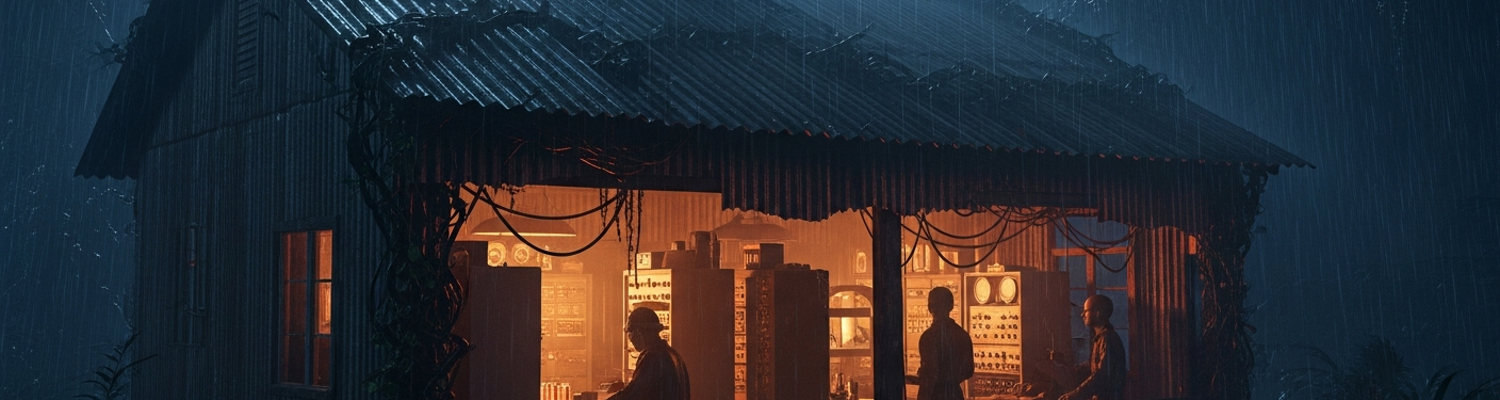

A Foundation of Mud and Compromise
The directive from Southwest Pacific Area command in mid-1943 was uncompromising. It ordered the U.S. Army Signal Corps to establish a forward-deployed radio intercept and decryption station. The facility had to be capable of processing high-volume Japanese Army air and ground force communications. The chosen location, a desolate stretch of coastline in the Territory of New Guinea, was selected for its raw proximity to planned Allied offensives, not for its suitability. Archival evidence from NARA Record Group 338 shows the unit tasked, the 126th Signal Radio Intelligence Company, was given a construction timeline that engineering assessments deemed impossible. They were to build an electronic warfare hub from scratch in a malarial jungle faster than a standard barracks could be erected in a friendly rear area.
The initial shipments of materiel reflected this desperate urgency. Delicate vacuum tubes and radio direction finding calibration instruments were packed alongside dynamite and timber. They often arrived damaged from rough sea transit and hasty offloading onto unimproved beaches. Power generation was the first significant hurdle. The plans called for three synchronized diesel generators to provide stable, clean power for the sensitive receiving equipment. Only one arrived with the initial landing force. This single generator, a temperamental pre-war commercial model, was immediately pressed into service running rock crushers and saws, a decision that guaranteed its operational life would be short.
The station was built on a foundation of mud.
Combat engineers from the 84th Engineer Combat Battalion were assigned to support the 126th, but their primary mission was airfield construction. The SIGINT station was a secondary concern. This division of labor forced Signal Corps personnel, men trained as linguists and radio technicians, to become laborers. The terrain fought them at every turn. The site was a low-lying mangrove swamp that had to be cleared by hand and backfilled with crushed coral. Relentless tropical heat and near-constant rainfall turned the area into a quagmire, bogging down the few available bulldozers. Antenna installation became a nightmare. The design required multiple rhombic antennas, massive wire arrays stretching hundreds of feet, oriented with precise magnetic headings. In the dense, triple-canopy jungle, felling trees to create the necessary clear lanes was a slow, dangerous process. Winches failed and cables snapped. The oppressive humidity caused corrosion on electrical contacts almost as soon as they were installed. A review of medical records indicates that within the first three weeks, over a quarter of the company was non-operational due to heat exhaustion, fungal infections, and malaria.
Urgency dictated that deep, structural flaws be built directly into the station’s design. Speed overrode all other considerations. To save time, the main operations building, the nerve center containing the intercept positions, was constructed using unseasoned local timber with a simple tar-paper roof. It was not shielded against electronic emissions, meaning the station’s own radio frequency leakage was a potential beacon for Japanese direction-finding teams. The structure was also not sound-proofed, an oversight that would have profound psychological consequences as the 24/7 clatter of decryption machines became an inescapable feature of life. Security was similarly compromised. Instead of a graded, cleared perimeter with interlocking fields of fire, the station was protected by a single, hastily erected barbed-wire fence. The dense jungle pressed in on all sides, providing a perfect concealed avenue of approach for enemy patrols. There were no bunkers for personnel, only shallow slit trenches that filled with water during every downpour. The entire intelligence-gathering effort was perilously fragile.
The War Against Tropical Deterioration
The environment itself was a thinking enemy. For the radio technicians of the 126th, the war was a constant, losing battle against an opponent felt in the perpetually damp air. After-action reports from the New Guinea campaign reveal a systemic crisis of what scientists termed tropical deterioration. High humidity was the most destructive element, infiltrating every seal and chassis. It condensed inside radio sets that were warmer than the ambient air, bathing sensitive components in distilled water. This moisture, combined with the heat, accelerated corrosion and created a perfect breeding ground for fungus. Maintenance logs show a pattern of failure in capacitors and resistors, their delicate internal structures compromised. A specific green-hued fungus would bloom across internal circuit boards, its filaments actively conductive, creating new electrical pathways that shorted out circuits and altered equipment performance.
The station was built on vacuum tubes. Their failure was a daily event.
The technological heart of every receiver and transmitter was the vacuum tube, a component defined by its fragility. These glass bulbs, which generated significant heat even in temperate climates, were pushed to their breaking point in the sweltering, unventilated intercept huts. The combination of high internal operating temperatures and the oppressive external heat meant tubes failed with shocking regularity. Logistical requests reveal that standard tubes, intended to have a service life of thousands of hours, sometimes failed within a day. Technicians found that most failures occurred during the warm-up and cool-down cycles. This forced a counter-intuitive solution: leaving the power on constantly, a decision that placed an even greater strain on the station’s single, overworked generator. Sourcing replacements was a logistical nightmare. Every tube was a delicate piece of glass shipped thousands of miles, and many arrived shattered. The searing heat radiating from the racks of glowing tubes turned the operations building into a sauna, adding a layer of physical misery to the strain of listening for faint signals.
The jungle actively dismantled the station’s external infrastructure. While technicians fought a microscopic war inside, another team was engaged in a constant physical struggle against the environment. The station's effectiveness depended on several massive rhombic antennas. These antennas were a constant source of anxiety. Maintenance records detail how fast-growing vines would snake up the support poles and across the wires, altering their electrical properties and rendering carefully calculated reception patterns useless. Severe tropical storms brought high winds that snapped wires and toppled antenna masts, requiring dangerous repair expeditions. Technicians on these patrols faced not only enemy patrols but also the pervasive risk of disease. The very ground they relied on was unstable. Maintaining a proper electrical ground, essential for reducing signal noise, was nearly impossible in the swampy, highly conductive soil. Copper grounding rods would corrode in a matter of weeks, forcing teams to constantly drive new ones in a futile effort to keep the receivers clear of buzzing and interference.
The Electronic Duel: Jamming and Deception
The operators of the 126th Signal Radio Intelligence Company were locked in an electronic duel. Imperial Japanese Army signal doctrine was far from passive. U.S. Army intelligence bulletins from the period show a growing awareness of specialized Japanese jamming units attached to signal regiments. These units were equipped to wage a direct assault on the radio spectrum. For the men at the New Guinea station, this assault often manifested as a cacophony of purpose-built noise. One common Japanese technique involved the transmission of a carrier wave modulated by raw alternating current, producing a loud, grating hum on tactical frequencies that could drown out faint Morse code. Another method employed a fluctuating warbling tone, engineered to interfere with the radiotelephone transmissions used by Allied air and ground controllers. The jamming was targeted, often appearing on the 5 to 8 megacycle frequencies used for tactical command and control, indicating a sophisticated enemy signals intelligence effort was actively hunting for Allied networks. For the operators, their headphones became instruments of auditory torture, forcing them to strain for hours to pick a single coherent letter from a wall of manufactured sound.
At other times, the enemy’s weapon was silence.
The Imperial Japanese military was a master of radio discipline, employing a tactic known as densemoku, or radio silence, to create crippling intelligence voids. A study of Japanese operational planning reveals this was not a simple cessation of traffic, but a coordinated, strategic act. Before major offensives, entire formations would be ordered off the air, their movements masked by a profound electronic quiet. For the SIGINT operators, this silence was more unnerving than the loudest jamming. It was a sign that something was happening beyond their electronic sight. The sudden disappearance of a known regimental net or an entire air group’s traffic created a psychological vacuum filled with uncertainty. Was the unit simply relocating, had it been destroyed, or was it massing for an attack? This ambiguity was the goal. It forced Allied intelligence into a state of constant guesswork, fostering a deep-seated anxiety that gnawed at the confidence of the analysts.
Beyond jamming and silence, the Japanese engaged in radio deception designed to actively mislead Allied intelligence. Operational directives, captured under documents detailing Navy Rules for Deception Messages and Jamming, reveal a formalized doctrine for creating false intelligence. This included OTSU deception messages, where Japanese operators would imitate features of their own communications to create phantom units or mask real movements. A more complex form, the KO deception, involved imitating Allied communication procedures to insert false information directly into American networks. The deception was multi-layered. In one strategy preceding the Pearl Harbor attack, key radio operators from capital ships, men whose unique Morse code sending style or fist was recognizable to Allied listeners, were left ashore to transmit routine traffic from naval bases. This created the illusion that the main fleet was still in home waters while it was steaming towards Hawaii. For the men of the 126th, every intercepted message existed under a cloud of doubt. The very signals they were tasked to decrypt could be a deliberate fabrication.
The Hunted: Infiltration and Direct Attack
The unshielded construction of the 126th’s operations building made it a beacon. The station’s own electronic emissions, leaking from poorly grounded decryption equipment and the overburdened generator, were actively hunted by enemy direction-finding teams. This intelligence was weaponized with precision. Beginning in late 1943, sporadic but accurate artillery fire began to fall on the compound. These were not saturation barrages, but targeted strikes. Post-action reports detail the use of the Type 92 70mm infantry gun, a light, easily concealed weapon perfect for the jungle, firing high-explosive shells. One such shell detonated just meters from the main intercept hut, blowing through the tar-paper roof and timber walls. The blast wave threw men from their chairs and showered the radio equipment in mud and splintered wood. Two RCA AR-88 receivers were destroyed instantly. The psychological impact was severe. The attacks were infrequent enough to prevent any pattern from being established, yet accurate enough to make every man feel personally targeted. The knowledge that the enemy knew exactly where they were created a new layer of constant dread.
Archival evidence shows that Japanese forces in New Guinea frequently employed small, specialized units for night infiltration. For the 126th, this threat materialized as ghost-like incursions by what were believed to be Rikusentai, or Special Naval Landing Forces, known for their jungle warfare expertise. These were not frontal assaults. The objective was disruption. Patrols from the 84th Engineer Combat Battalion discovered severed rhombic antenna wires on at least three separate occasions, the clean cuts indicating deliberate sabotage. A more direct confrontation occurred on a moonless night in January 1944. A sentry, a radio linguist with only basic infantry training, spotted movement near the single barbed-wire fence. A brief, vicious firefight erupted at close range. The infiltrators were repulsed, but they left behind two Type 100 submachine guns and canvas satchels containing demolition charges. Their objective was likely the station’s lone generator. The jungle, which pressed in on all sides of the poorly cleared perimeter, was no longer just a source of disease; it now concealed an enemy who could emerge at any moment.
This two-pronged assault, from the air and from the jungle floor, created a state of alert that ground the men down. Sleep became a luxury. Medical logs from the period indicate a sharp rise in combat fatigue cases, with men exhibiting uncontrollable tremors, severe anxiety, and a vacant, unfocused gaze indicating dissociation. The shallow, waterlogged slit trenches became the preferred sleeping quarters over the relative comfort of the barracks huts, as they offered the only real protection from incoming artillery. Decryption work, which required intense concentration, became nearly impossible for men who were sleep-deprived and constantly listening for the whistle of a shell or the snap of a twig. The inescapable clatter of the decoding machines, once a sign of productive work, became an irritant that frayed already shattered nerves.
Cascading Failure and Terminal Decline
Maintenance logs from the 126th Signal Radio Intelligence Company reveal a system on the verge of total collapse. The cumulative effect of Japanese artillery, sabotage, and environmental decay had created a state of terminal decline in the station’s physical plant. The operations hut, its roof perforated by shrapnel and its frame weakened by termites, offered little protection. After a near-miss from a 70mm shell, the structure was no longer weathertight. Rainwater dripped directly onto intercept positions, forcing operators to work under ponchos and causing short circuits. The external antenna arrays were in a state of constant disrepair. Sabotaged rhombic wires, cut by enemy patrols, were often patched with incorrect gauges of copper wire because proper spares were unavailable, altering the antenna’s electrical characteristics. The most critical point of failure was the station’s single generator. Engine repair reports show a litany of failures stemming from overuse and contaminated fuel. Piston rings were worn, bearings were failing, and the voltage regulator, damaged by power surges, could no longer provide stable electricity.
The system was eating itself to stay alive.
Technicians, facing a catastrophic lack of spare parts, resorted to cannibalization. The station had become a graveyard of electronics, with rows of decommissioned RCA AR-88 and Hallicrafters SX-28 receivers being systematically stripped for components. A working 0.1uF paper capacitor from one dead unit would be soldered into another to fix a fault, only for a transformer to fail in the newly repaired set days later. This ad-hoc repair process created equipment that was unreliable and operated far outside its design specifications. Vacuum tubes, already failing at a high rate, were now subjected to unstable voltages from the failing generator, causing them to burn out even faster. A specific crisis point was reached with the failure of specialized tubes used in the decryption machines themselves. These were not common radio parts. Logistical requests for these components, sent by radio to rear-area commands, often went unanswered for weeks, or the wrong parts were shipped.
This cascading mechanical failure translated directly into a quantifiable decline in intelligence output. The unit’s own signal logs show a sharp drop in both the volume and the quality of intelligence being forwarded to Southwest Pacific Area command. With fewer operational intercept positions, operators were forced to abandon monitoring certain Japanese army frequencies, creating blind spots. The degraded antennas and electrically noisy receivers meant many intercepted signals were too faint or garbled by static to be decrypted. The raw material of intelligence, clear, readable Morse code, was becoming a rarity. Reports sent up the chain of command became less confident and were often caveated with warnings about poor signal quality. The number of high-grade intercepts logged per week dropped by over sixty percent between late 1943 and early 1944.
The Breaking Point at Hollandia
Medical dispatches from the 126th Signal Radio Intelligence Company reveal a systemic psychological collapse in early 1944. The cumulative pressure had worn the men down to a state of raw, exposed nerves. The condition then called combat fatigue manifested in the linguists and technicians as uncontrollable tremors and an inability to concentrate, fatal flaws in a profession that demanded a steady hand and intense focus. Sleep deprivation was endemic. The constant threat of artillery drove men to prefer sleeping in water-logged slit trenches. The incessant, percussive clatter of the decryption machines inside the humid operations hut became an auditory torment from which there was no escape.
A deep and pervasive anxiety settled over the compound. It was a tangible thing, felt in the mess hall where men ate in silence and in the operations hut where sudden noises caused technicians to flinch violently. For the cryptanalysts, the work itself became a source of mental erosion. They understood that the abstract signals they wrestled with translated directly into lives and that any failure on their part could lead to an ambush or a failed offensive. This burden, compounded by physical exhaustion and the constant fear of infiltration, became unbearable. Medical logs note a sharp increase in personnel being relieved of duty for operational exhaustion, with symptoms ranging from violent outbursts of rage to catatonic states.
The breaking point arrived during the preparatory intelligence gathering for Operation Reckless, the Allied landings at Hollandia in April 1944.
In the critical seventy-two hours before the main landings, the station’s human infrastructure disintegrated. A senior Japanese-language cryptanalyst, responsible for deciphering high-level Japanese Army communications, suffered a complete psychotic break. He was found attempting to destroy the decryption machine he had operated for months, convinced it was broadcasting his thoughts to the enemy. Simultaneously, two key radio intercept operators, both suffering from acute combat fatigue, abandoned their posts. Their desertion left a critical block of the radio spectrum, the frequencies used by the Japanese 18th Army’s tactical command net, unmonitored. The timing was disastrous. A cascading equipment failure in the primary decryption unit, a fault that a healthy crew might have bypassed in hours, was left unresolved for a critical 36-hour period because the remaining technicians were too exhausted and demoralized to troubleshoot the problem.
This confluence of personnel and equipment failure created a catastrophic intelligence vacuum. Intercept logs, reviewed after the fact, showed that during the station’s period of internal collapse, the Japanese 18th Army transmitted a series of key messages. These signals detailed the repositioning of an entire artillery battalion to a ridge overlooking the planned American landing beaches. The signals were intercepted by other, more distant stations, but without the 126th’s unique decryption capabilities and contextual knowledge, they were not processed in time. The initial assault waves of the U.S. 24th and 41st Infantry Divisions went ashore expecting only light resistance. Instead, they were met with a prepared and accurate artillery barrage that inflicted significant casualties in the first hour.