
Operation Blue Sky and Pre-Flight Preparations
A tactical link to headquarters died without warning. This severed secure communications. Frontline troops found themselves isolated from the operational chain of command.
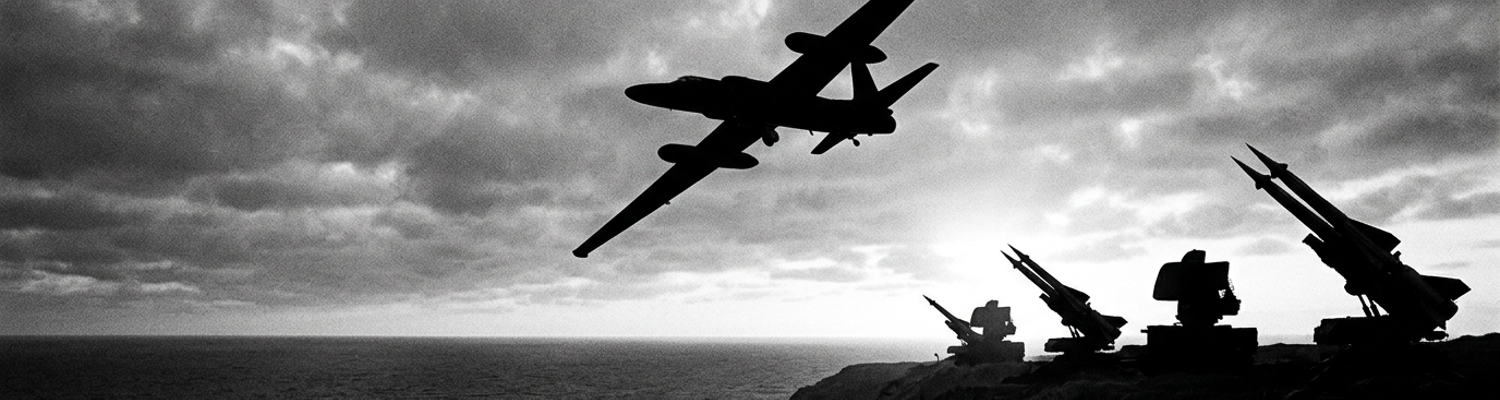
Archival evidence shows that this communications blackout unfolded during a mission prepared inside the alert revetments of McCoy Air Force Base in Orlando, Florida. At 0909 local time on October 27, 1962, Major Rudolf Anderson Jr. lifted off from the runway. He flew a modified Lockheed U-2F assigned to the 4080th Strategic Reconnaissance Wing. Technicians had spent the pre-dawn hours preparing airframe 56-6676. This specialized variant featured plumbing for aerial refueling. It carried an uprated Pratt and Whitney J75-P-13 turbojet engine. Ground crews strapped Anderson into a pressurized David Clark MC-3 suit. This specialized garment utilized pneumatic capstan tubes along the limbs. It featured inflatable pressure bladders across the torso. He completed a sixty-minute pure oxygen pre-breathing regimen. This procedure cleared nitrogen from his tissues. It prevented decompression sickness at extreme operating ceilings.
Taxiing past the staging hangars of the 4080th.
The high-altitude platform carried a full load of low-volatility JP-TS fuel across its extended wet wings. It climbed at a steep angle toward the Florida Straits. Strategic Air Command directed the deployment under the classified designation Operation Blue Sky. This was an expansion of the ongoing surveillance effort code-named Brass Knob. Ground controllers at McCoy monitored the climbing radar return. The airframe reached seventy-two thousand feet. It passed out of American airspace.
Zero radio traffic was permitted past the twenty-fourth parallel.
A close review of operational logs indicates that the mission objective required penetrating heavily defended airspace over eastern Cuba. Anderson held an assigned flight path. This route directed his high-altitude photographic and telemetry mission toward Soviet military installations across Oriente Province. The primary reconnaissance payload consisted of a Hycon Type B camera. This unit utilized a thirty-six-inch focal length lens. It held two seventy-three-pound spools of high-resolution film. The optics could resolve objects less than thirty inches wide from fourteen miles above the ground.
Beneath the skin of the fuselage sat telemetry antennas.
Electronic intercept receivers searched the frequency bands for active Soviet radar emissions. They tracked Spoon Rest early-warning arrays. They monitored Fan Song tracking systems tied to S-75 Dvina surface-to-air missile battalions. Target folders compiled by military intelligence directed Anderson over Soviet troop garrisons near Holguin. He flew over naval facilities holding cruise missile boats along the northern coastline. He documented fortified installations near the port of Banes. Photo interpreters in Washington required fresh reconnaissance. They needed to verify whether the R-12 medium-range ballistic missile emplacements in the eastern sector had achieved combat readiness.
Soviet radar operators at the Los Angeles air defense post picked up the target return eight minutes later.
When examining the historical record of the 4080th Strategic Reconnaissance Wing, the technical vulnerability Anderson faced was clear before his wheels left the McCoy runway. Soviet General Issa Pliyev had deployed thousands of combat troops across the island under Operation Anadyr. He built an integrated air defense network without the knowledge of the American military command. Anderson kept the U-2F on a steady southerly heading along the Cuban coast. The camera mechanism cycled through film frames at fixed mechanical intervals. Recording devices stored telemetry data. The unarmed aircraft possessed no defensive countermeasures beyond basic radar warning gear. It relied entirely on altitude to clear surface threats.
Intelligence officers at Omaha tracked mainland radar updates.
The National Photographic Interpretation Center awaited the recovery of the photographic canisters. His planned route took the U-2F directly into the engagement envelope of the Soviet 27th Air Defense Division. This unit maintained headquarters near Camaguey.
Soviet Radar Tracking and the Dvina Engagement
Plexiglass plotting boards in eastern Cuba filled with grease-pencil vectors at ten o'clock sharp.
Archival evidence shows that radar operators of the Soviet 27th Air Defense Division acquired the incoming trajectory. They utilized a P-12 Spoon Rest early warning radar at the Los Angeles site. Mounted on two heavy Ural-375 trucks, the mobile radar station transmitted VHF pulses. These frequencies ranged between 147 and 161 megahertz. The crew swung its twelve-element Yagi antenna array across the northern approaches to Oriente Province. At seventy-two thousand feet, the single Pratt and Whitney J75 engine produced an unmistakable blip on the cathode-ray indicators. The one-hundred-and-three-foot glider wings of the U-2F amplified the radar return. Soviet radar crews tracked the target at a constant speed of four hundred knots.
They recorded coordinates every thirty seconds.
The flight path moved south from the Atlantic coastline toward the Sierra Cristal mountain range. Plotters pushed grease markers across vertical plotting boards. They confirmed that the high-altitude intruder was penetrating directly into the defensive engagement envelope. Missile batteries guarded Holguin and the naval base at Banes. Surface search receivers recorded no escort fighters. They detected no jamming emissions accompanying the contact.
The target held course.
When examining the historical record of the underground Soviet command bunker at El Chico outside Havana, tactical authority fragmented during this specific interception window. General Issa Pliyev remained completely unavailable at his residence due to severe illness. This absence cut off senior operational leadership. Lieutenant General Stepan Grechko took operational command alongside Major General Leonid Garbuz. Grechko served as deputy commander for air defense. Strategic directives sent directly from Nikita Khrushchev strictly prohibited engaging American surveillance aircraft. The Soviet General Staff in Moscow required explicit authorization from the Kremlin for any surface-to-air launch.
Grechko viewed the photography run as direct targeting reconnaissance.
He believed an American invasion fleet was imminent. Grechko refused to let the plane complete its route. Bypassing the political leadership in Moscow, Grechko established a direct telephone connection to the headquarters of the 507th Anti-Aircraft Missile Regiment. He ordered the S-75 Dvina battery near Banes to engage the U-2F. He issued this command without direct Kremlin authorization.
Battery officers at Banes turned firing keys to the active combat setting.
A close review of operational logs indicates that the battery crew locked their RSNA-75 Fan Song radar onto the high-altitude target. They initiated the launch sequence moments later. Major Ivan Gerchenov oversaw the engagement. Two V-750 surface-to-air missiles launched into the clear morning air from revetments near the coast. Solid-fuel boosters accelerated each two-stage projectile to supersonic velocity within three seconds. The boosters dropped away. Liquid-fueled sustainer engines, burning a highly toxic mix of nitric acid and kerosene, drove the warheads toward seventy-two thousand feet under radio-command guidance.
Anderson had no onboard electronic countermeasures to deflect the incoming missile trajectory.
The first missile detonated slightly behind the airframe. Its proximity fuze triggered a 190-kilogram high-explosive fragmentation warhead. This scattered thousands of steel pellets across the thin atmosphere. Warhead shrapnel penetrated the unpressurized fuselage. It punctured the fuel cells. It ripped through the acrylic cockpit canopy. Steel fragments sliced directly through the David Clark MC-3 partial pressure suit. This caused instantaneous explosive decompression. Anderson suffered fatal physical trauma before the shattered U-2F entered an uncontrolled spin toward the ground near Veguitas.
EXCOMM Deliberations and Strike Contingencies
Teletype machines inside the National Military Command Center began spitting classified intercepts shortly past noon.
Archival evidence shows that radio monitoring posts operated by the National Security Agency caught the first proof of the shootdown. These stations sat along the southern rim of Florida. They intercepted the data before the wreckage settled in Oriente Province. Intercept operators with the 6947th Security Squadron at Key West recorded Soviet voice communications. Air defense radar stations near Banes transmitted tracking parameters and altitude assessments for the downed target. Telemetry stations confirmed that a Fan Song fire-control radar had locked its beam onto the high-altitude transponder frequency. The signal terminated at 72,000 feet.
At 1403 Eastern Standard Time, the Joint Reconnaissance Center telephoned Secretary of Defense Robert McNamara.
They provided the interception transcripts. This confirmed that Major Rudolf Anderson Jr. had been shot out of the sky by surface-to-air ordnance. McNamara walked the intelligence raw files directly across West Executive Avenue. He entered the Cabinet Room. He interrupted an ongoing Executive Committee meeting. The room dissolved into immediate crisis. Previous administration planning had assumed that any hostile launch would represent a direct order from Premier Nikita Khrushchev. This would signal that diplomatic backchannels had failed.
White House tape recorders documented the silence that followed.
When examining the historical record of military contingency planning, the response to this specific scenario had been pre-programmed days earlier. The Joint Chiefs of Staff demanded that President John F. Kennedy authorize an immediate retaliatory air strike. Chairman Maxwell Taylor and Air Force Chief of Staff General Curtis LeMay directed this push. They targeted the S-75 Dvina battery at Banes. Military planners turned to Operation Plan 312. This was a comprehensive blueprint prepared by Atlantic Command for tactical strikes across the Cuban archipelago.
Under the targeted sub-option of OPLAN 312, the Pentagon had positioned two squadrons of attack aircraft.
North American F-100D Super Sabres and Republic F-105D Thunderchiefs sat on active runway alert. They staged at Homestead Air Force Base and MacDill Air Force Base. Ground crews armed them with 750-pound M117 general-purpose demolition bombs. They loaded 2.75-inch folding-fin aircraft rockets. These low-level attack packages could cross the Florida Straits. They could pulverize the Banes launch position within ninety minutes of presidential release.
LeMay pushed to expand the operation past a single site.
He insisted that leaving the surviving twenty-three Soviet missile battalions intact would expose any subsequent low-level reconnaissance runs to direct destruction. Taylor delivered the unanimous recommendation of the Chiefs. They wanted to execute the Banes strike at dawn on Sunday. This would be followed twenty-four hours later by full-scale strikes against every known Soviet medium-range ballistic missile launcher.
The strike wings sat idling on the tarmac with full fuel tanks.
A close review of operational logs indicates that the operational chain hesitated. Kennedy recognized the rigidity of the OPLAN 312 timetable. Authorizing a strike on the Banes battery under existing military procedures would trigger automatic cascading attacks across every antiaircraft installation within range. This would rapidly escalate into the full-scale invasion outlined in OPLAN 316. McNamara opposed the demands from LeMay. He argued that a lone Soviet battery commander might have fired without direct political clearance from Moscow. Kennedy suspended the standing order that had authorized automatic retaliation against any missile site that fired upon reconnaissance aircraft. He canceled the morning air strikes. He ordered a temporary freeze on all high-altitude U-2 flights over Cuban territory.
Across the water at Key West, Navy A-4 Skyhawks of Attack Squadron 34 were re-spotted along the flight lines.
Ground crews loaded standard ordnance packages. Aircrews remained strapped in cockpits under a heightened Defense Condition Two alert posture.
Strategic Deescalation and the Jupiter Missile Exchange
The direct executive order grounding all American reconnaissance aircraft over Cuba took effect at 1630 on October 27.
Archival evidence shows that President Kennedy issued the freeze to break an automatic cycle of military retaliation. Standing operational procedures authorized by Atlantic Command called for immediate retaliatory air attacks. These applied to any antiaircraft position that fired on American surveillance platforms. Under those standing protocols, the destruction of the U-2F over Banes should have initiated immediate strikes. Sixteen F-100D Super Sabres staging out of Key West and Homestead Air Force Base were prepped for this exact scenario. Kennedy recognized that dispatching additional reconnaissance sorties would produce another shootdown. This applied to high-altitude U-2 flights from the 4080th Strategic Reconnaissance Wing. It also applied to low-level RF-101 Voodoos from the 363rd Tactical Reconnaissance Wing.
Another lost aircraft would leave the White House no operational alternative to launching Operation Plan 312.
By unilaterally halting all military surveillance flights over Cuban airspace, the administration stripped Atlantic Command of its tactical tripwire. The civilian leadership kept full control of fire decisions inside the Cabinet Room. Combat pilots in south Florida sat strapped into cockpits under Defense Condition Two. The operational chain stood frozen.
When examining the historical record of diplomatic backchannels, the White House shifted focus from military retaliation to an emergency channel.
This took place inside the Department of Justice building. Attorney General Robert Kennedy met Soviet Ambassador Anatoly Dobrynin in his private office at 1945 that evening. Dobrynin carried instructions from the Soviet Foreign Ministry. Robert Kennedy delivered an unvarnished assessment of the decaying command situation in the Caribbean. The shootdown of the reconnaissance aircraft indicated to Washington that field commanders were acting without discipline. The alternative was that Moscow had authorized open combat.
The Soviet government had to dismantle the medium-range ballistic missile emplacements within twenty-four to forty-eight hours.
Failure to do so would result in an American tactical air offensive followed by amphibious invasion. A close review of operational logs indicates the core mechanical concession centered on fifteen Chrysler PGM-19 Jupiter intermediate-range ballistic missiles. These were deployed near Cigli Air Base outside Izmir, Turkey. The Turkish Jupiter sites fell under the tactical command of the Turkish Air Force 229th Missile Squadron. The United States Air Force 7232nd Combat Support Squadron held custody of the 1.4-megaton W49 thermonuclear warheads.
These liquid-fueled weapons required four hours of propellant loading before launch.
Ground crews had to pump thousands of gallons of liquid oxygen and RP-1 kerosene into the booster stages. This made them technically vulnerable to pre-emptive air attacks. Premier Nikita Khrushchev regarded their geographic proximity to the Soviet mainland as an intolerable strategic threat. Robert Kennedy informed Dobrynin that President Kennedy agreed to remove all fifteen Jupiter missiles from Turkey. This would occur once the Soviet Union withdrew its R-12 and R-14 ballistic missile regiments from Cuba under United Nations inspection.
Dobrynin received a clear warning.
The administration would publicly deny the arrangement if Moscow revealed the trade. Formal linkage would fracture the North Atlantic Treaty Organization alliance. It would treat European defense assets as expendable leverage. The secret commitment bypassed NATO political channels completely. Dobrynin transmitted the terms directly to Moscow via Western Union commercial telegraph as Cable Number 498. He alerted the Kremlin that war would break out by Monday morning without an immediate acceptance of the mutual withdrawal.
American missile crews at Cigli Air Base carried out routine technical inspections.
They checked the pressurized Jupiter booster stages throughout the following night. They remained entirely unaware that the weapon systems had been liquidated to resolve the standoff over Banes.
Diplomatic Resolution and the Posthumous Air Force Cross
Word reached the Soviet leadership before dawn broke over Moscow.
Archival evidence shows that Soviet Premier Nikita Khrushchev received the field cable detailing the Banes shootdown. He was meeting senior Presidium members inside his dacha at Novo-Ogaryovo. The message produced sheer panic within the Soviet leadership. Soviet General Staff directives had specifically forbidden regional air defense batteries from firing without clear authorization from Moscow. Lieutenant General Stepan Grechko had issued combat orders on his own initiative. Khrushchev realized that local military discipline was collapsing across the island.
General Issa Pliyev held independent operational command over eighty tactical nuclear warheads.
These included FKR cruise missiles and 2K6 Luna rockets. They were dispersed through the Cuban jungle without electronic safety locks or permissive action links. An antiaircraft battery commander had launched an S-75 Dvina missile against explicit standing orders. A field officer facing an incoming American bombing raid might decide to launch a nuclear-tipped cruise missile at the naval base in Guantanamo Bay. They might target the staging ports of southern Florida. The Soviet leadership saw that time had run out.
Moscow had lost control of its frontline commanders.
When examining the historical record of the Soviet Council of Ministers, the Kremlin abandoned traditional diplomatic cables. They needed to prevent an American invasion scheduled for Monday morning. Transmitting an encrypted dispatch through the Soviet embassy in Washington required hours of manual cypher work. It required teletype routing. It required courier delivery across the Potomac River.
Khrushchev rejected that delay.
Bypassing his own diplomatic corps, the Premier dictated an emergency communique. This directly confirmed the complete dismantling and withdrawal of all Soviet R-12 and R-14 ballistic missiles from Cuba under international supervision. Radio Moscow broadcast the raw text on an open civilian frequency at 1700 Moscow time on October 28. They read the statement in clear voice. American monitoring stations translated the surrender of Soviet missile positions before carrier strike groups launched their strike packages.
One American officer paid the price for this diplomatic de-escalation.
A close review of operational logs indicates that Major Rudolf Anderson Jr. was recognized as the sole operational casualty from hostile enemy action during the thirteen-day confrontation. The destruction of his U-2F over the port of Banes transformed the thirty-five-year-old pilot from Greenville, South Carolina, into an immediate national symbol of military sacrifice. President Kennedy directed that Anderson receive the newly established Air Force Cross. This made him the first recipient of the service branch second-highest decoration for valor in combat. Congress had authorized this medal two years earlier under Public Law 86-593.
General Curtis LeMay personally presented the medal to Jane Anderson.
He delivered it alongside posthumous awards of the Distinguished Service Medal and the Purple Heart. Soviet troops recovered the flight suit and shattered cockpit sections from the mud near the village of Veguitas. Swiss diplomats assigned to the Havana embassy intervened with the Cuban Ministry of Foreign Affairs. They secured the aviator body. They arranged for an unarmed transport aircraft to retrieve the sealed aluminum casket from Jose Marti International Airport.
The transport touched down at Dover Air Force Base on November 4.
An honor guard from the 4080th Strategic Reconnaissance Wing received the flag-draped transfer case on the flight line. Anderson was buried two days later in Springwood Cemetery in Greenville, South Carolina. Five Air Force F-105 Thunderchiefs flew over the headstones in a missing man formation.