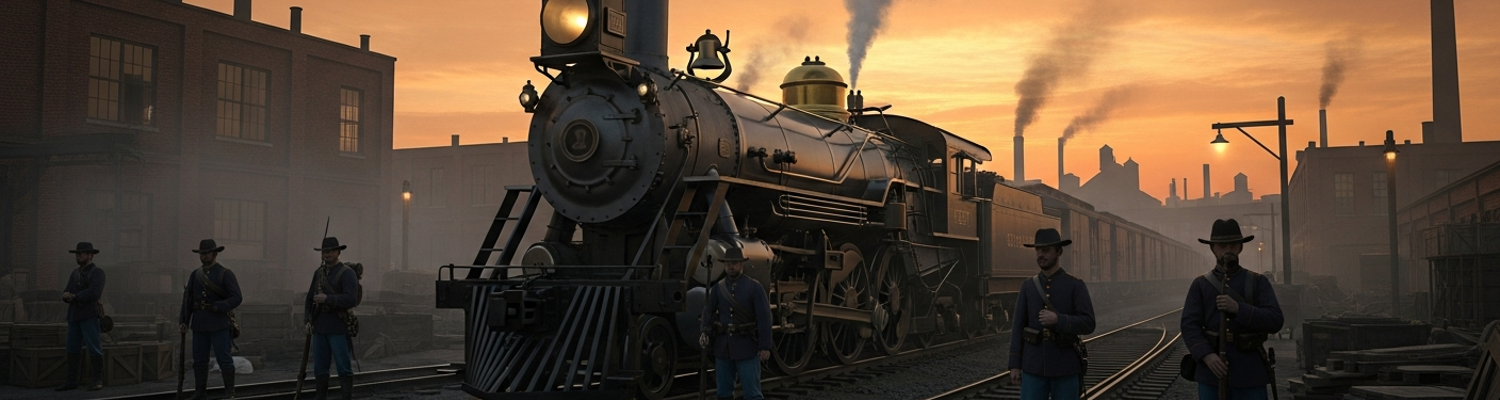

The U.S. Army that emerged from Reconstruction was an institution shaped by the immense scale of the Civil War and tempered on the harsh anvil of the western frontier. It was a small, professional force, expert in long-range campaigns against mobile, irregular adversaries across vast, underpopulated landscapes. Its logistical and operational doctrines were meticulously tailored for this specific environment. Yet, the same decades that saw the final campaigns against the Plains tribes also witnessed the violent birth of a new American conflict. This war was not fought in the arid West, but in the smoky, crowded heart of the nation’s industrial centers. The Army, institutionally unprepared for this mission, would prove remarkably, and brutally, adaptive in fighting a war of industrial unrest on the home front.
The Gilded Age’s explosion of industrial capitalism created staggering wealth and profound social dislocation. As rail lines and factories reshaped the nation, they also forged a new, powerful, and often exploited industrial working class. When tensions between labor and capital erupted into open conflict, overwhelmed local and state authorities invariably turned to Washington. Twice, in 1877 and 1894, the U.S. Army was ordered to intervene, not against a foreign foe or a tribal warrior, but against its own citizens. These deployments, executed within a complex and shifting legal framework, forced the Army to devise new logistical and operational solutions under fire, demonstrating a gritty professionalism that would redefine its domestic role for a century.
Mobilizing Against the Iron Horse
The Great Railroad Strike of 1877 ignited in July in Martinsburg, West Virginia, a protest against a wage cut by the Baltimore & Ohio Railroad. The dispute cascaded across the nation’s rail network. Within weeks, a localized walkout mushroomed into a nationwide insurrection, paralyzing the arteries of American commerce. Strikers and their sympathizers stopped trains, seized roundhouses, and tore up tracks from Baltimore to St. Louis. When state militias were called, they often proved unreliable; many militiamen sympathized with the strikers or simply refused to act against their neighbors. In Pittsburgh, militia brought in from Philadelphia fired on a crowd, killing approximately 20 people and triggering a full-blown riot that saw the Pennsylvania Railroad’s vast yards and equipment burned to the ground.
Facing a national crisis, President Rutherford B. Hayes made a momentous decision: he authorized the use of federal troops to suppress a labor dispute. Secretary of War George W. McCrary was tasked with executing the order, presenting the War Department with a logistical paradox of the highest order. Its primary means of strategic mobility—the railroad—was the very system it was ordered to subdue and reopen. The operational challenge was immense. The Army had to deploy small, scattered companies of regulars, most stationed at remote frontier posts, to multiple chaotic urban centers across thousands of miles without reliable use of the rail network itself. Commanders had to move forces, establish secure supply lines, and maintain command and control in an environment where commercial telegraph lines were frequently cut and local populations were hostile.
The Army’s response was a feat of pragmatic problem-solving. Major General Winfield Scott Hancock, commanding the Military Division of the Atlantic, became the operational architect of the eastern intervention. He prioritized securing key rail junctions, bridges, and depots to create protected corridors. Army Signal Corps detachments worked feverishly to repair and guard telegraph lines, often stringing temporary military lines alongside the rails to bypass compromised civilian networks and ensure Hancock could communicate with his dispersed units. Where rails were impassable, troops conducted long forced marches, their supply wagons a familiar sight from frontier campaigns, now rolling through the Pennsylvania countryside. In Chicago, Brigadier General Christopher C. Augur deployed his forces from western posts to secure the city’s vital rail hub. The logistical effort involved redirecting men and materiel from campaigns against the Sioux and Nez Perce to the streets of American cities. Small detachments of regulars proved uniquely effective. Unlike the often-panicked militia, these professional soldiers were disciplined, followed orders from their officers, and projected an aura of grim determination that often dispersed mobs without a shot fired. Their presence had a 'wholesome effect', as one contemporary report noted. They did not break. The Army’s success in 1877 demonstrated its capacity for rapid strategic adaptation, proving it could project force and sustain operations not just in the West, but in the heart of industrial America.
The Regulars' Resolve in Chicago
Seventeen years later, the nation was again plunged into industrial turmoil. The Pullman Strike of 1894, a response to wage cuts without corresponding rent reductions in George Pullman's paternalistic company town, escalated when Eugene V. Debs' American Railway Union (ARU) launched a nationwide boycott of any train carrying Pullman cars. Chicago, the nation’s undisputed rail hub, became the epicenter of the conflict. The strike effectively shut down rail traffic west of the city, crippling interstate commerce and, for the federal government, the U.S. Mail.
This time, the federal pretext for intervention was direct and legally fortified. Citing the constitutional obligation to ensure the delivery of mail and the new power of the Interstate Commerce Act, President Grover Cleveland, at the firm urging of Attorney General Richard Olney, obtained a sweeping federal injunction against the ARU. When Debs and the strikers defied the injunction, the U.S. Army was called to enforce it. The mission fell to Major General Nelson A. Miles, commander of the Department of the Missouri, a man who had built his reputation fighting Geronimo and the Ghost Dancers. On July 3, 1894, the first of nearly 2,000 regulars, including elements of the 7th Infantry, 15th Infantry, and supporting cavalry and artillery, began arriving in Chicago from nearby Fort Sheridan.
The operational environment was a logistical nightmare. Miles’s forces had to secure thousands of miles of track, hundreds of rail cars, and numerous yards and junctions within a sprawling, hostile city. The arrival of uniformed federal troops angered not only the strikers but also Illinois Governor John Peter Altgeld, who vehemently protested the federal intervention as unconstitutional. Miles ignored the political squabbles and established his command post to coordinate a massive, complex security operation. Troops were encamped on the lakefront, a defensible position that allowed for centralized control and rapid deployment via the Illinois Central rail lines that ran directly adjacent. A central supply depot was established, with quartermasters managing a constant flow of rations, ammunition, and forage for the cavalry horses. Communication was maintained through a dedicated network of military telegraphers and mounted couriers, ensuring Miles could direct his dispersed forces effectively as they escorted mail trains and patrolled the volatile stockyards. The troops performed their duties with stoic professionalism, clearing tracks of obstructions, guarding trains against sabotage, and facing down angry crowds with Springfield rifles and fixed bayonets. Their disciplined restraint, in contrast to the chaos around them, was a tactical weapon. The intervention was decisive. The trains ran, the mail was delivered, and the ARU was broken. The Army’s operation cemented its function as the government’s ultimate tool for imposing federal authority, underscoring the immense logistical capacity required for such domestic operations.
Forging New Boundaries of Intervention
The Army’s domestic interventions did not happen in a legal vacuum; they actively reshaped it. The year after the Great Railroad Strike, Congress passed the Posse Comitatus Act of 1878. Enacted largely as a Democratic-led response to the use of federal troops to police elections and enforce federal law in the Reconstruction-era South, the act made it a felony to willfully use the Army to enforce domestic law except when expressly authorized by the Constitution or an act of Congress.
On its face, this seemed to forbid the very actions the Army had taken in 1877 and would take again in 1894. However, the executive branch, particularly its legal counsel, developed a powerful rationale for bypassing the act’s apparent restrictions. The key was the act's exceptions. Lawyers in the Cleveland administration argued that the president had inherent constitutional authority under Article II to 'take Care that the Laws be faithfully executed.' During the Pullman Strike, Attorney General Olney masterfully combined this authority with specific federal statutes. The government's justification was not merely keeping the U.S. Mail moving, but also enforcing the Sherman Antitrust Act against the union as an illegal 'combination in restraint of trade,' and ensuring the function of interstate commerce. This interpretation created a federal question that allowed President Cleveland to deploy troops over the strenuous objections of Governor Altgeld, effectively nullifying the governor's authority on the matter.
These events created a lasting strategic and logistical template. The strikes of the Gilded Age forced the Army to confront the complexities of operating in dense, urban environments against a disaffected civilian population. It learned hard lessons in crowd control, in supplying dispersed units in hostile territory, and in the political and legal sensitivities of domestic deployment. The Judge Advocate General's Corps began to build a body of precedent and opinion that would guide future commanders. The debates surrounding the Posse Comitatus Act shaped the legal framework for all future civil-military relations, creating a high bar for domestic military intervention but preserving the president’s authority to act in a national crisis. The professionalism and logistical acumen displayed by the Army, from the company level to the departmental command, provided the government with a reliable and powerful instrument of national will during a period of profound and violent transformation.