
A Mandate to Tame the Arteries of Empire
In the decades after the War of 1812, the United States turned its focus inward. The vast continental interior, secured through the Louisiana Purchase, represented a reservoir of resources and a destination for a restless population. This national ambition, however, was choked by a fundamental logistical barrier. The great river systems of the Mississippi and Ohio, the natural highways for commerce and military movement, were treacherous and deadly. These were not open channels but obstacle courses littered with countless submerged trees. Rivermen gave them names born of hard experience: snags, sawyers, and planters. A snag, often an entire tree with its root ball wedged into the riverbed, could rip the hull of a wooden steamboat open in seconds, sending cargo and passengers to the bottom. Sawyers, trees anchored loosely, would bob menacingly in the current, their branches appearing and disappearing like a predator. Planters were rigidly fixed trees capable of punching through a hull like a spear. The danger was so pervasive that steamboat disasters were common. The average operational lifespan of a steamboat on the western rivers was a mere three to four years, with a significant percentage of losses attributed directly to river obstructions. Insurance rates for cargo and vessels on these routes could reach an astronomical 18 percent, a cost that crippled trade. These were not just commercial risks. They were strategic liabilities that constrained the federal government's ability to project power and supply its frontier outposts.
Pressure mounted from western states and commercial interests for federal intervention. This culminated in two landmark pieces of legislation in 1824. First, the General Survey Act authorized the President to use Army engineers to survey routes for roads and canals of national importance. This act, championed by figures like Henry Clay and John C. Calhoun, established the principle of federal involvement in internal improvements, a contentious issue at the time. Shortly after, the first significant Rivers and Harbors Act appropriated $75,000, a massive sum, specifically to improve navigation on the Ohio and Mississippi rivers. The language of the act was direct, calling for the removal of sandbars, snags, and other obstructions. The task fell to the only formally trained engineering body in the nation: the U.S. Army Corps of Engineers. This represented a profound shift in military doctrine. An instrument of war, composed of West Point graduates trained in fortification and siege craft, was officially tasked with a civil works mission that would come to define the Corps for the next two centuries. The mandate was clear, but the tools and techniques to execute it did not exist. Early attempts were primitive, relying on small crews on keelboats using ropes, chains, and manual winches. They were almost completely ineffective against the thousands of tons of timber clogging hundreds of miles of river. The Army was ordered to wage a war against the accumulated debris of a continent, and it would need a new type of weapon to win.
Shreve’s Iron-Toothed Solution
The scale of the problem demanded a technological leap. That leap came from a man who understood the rivers better than any bureaucrat in Washington: Captain Henry Miller Shreve. A veteran riverman, steamboat captain, and inventor, Shreve had witnessed the destructive power of snags firsthand and lost vessels to their unforgiving grip. In 1827, the War Department appointed him Superintendent of Western River Improvements, granting him authority and a budget. Shreve had already conceived of a specialized machine for the task years earlier. Now he had the federal backing to build it. In 1829, the first purpose-built, steam-powered snagboat, the Heliopolis, was completed to Shreve’s specifications at New Albany, Indiana. Its design was a radical departure from any vessel of the era. The Heliopolis was constructed with two parallel hulls, each over 100 feet long, creating an immensely stable catamaran-like platform with a wide gap between them. This twin-hull design provided the stability required for the massive lifting operations it would perform. Spanning the gap at the bow was a massive, iron-sheathed beam for ramming and breaking snags.
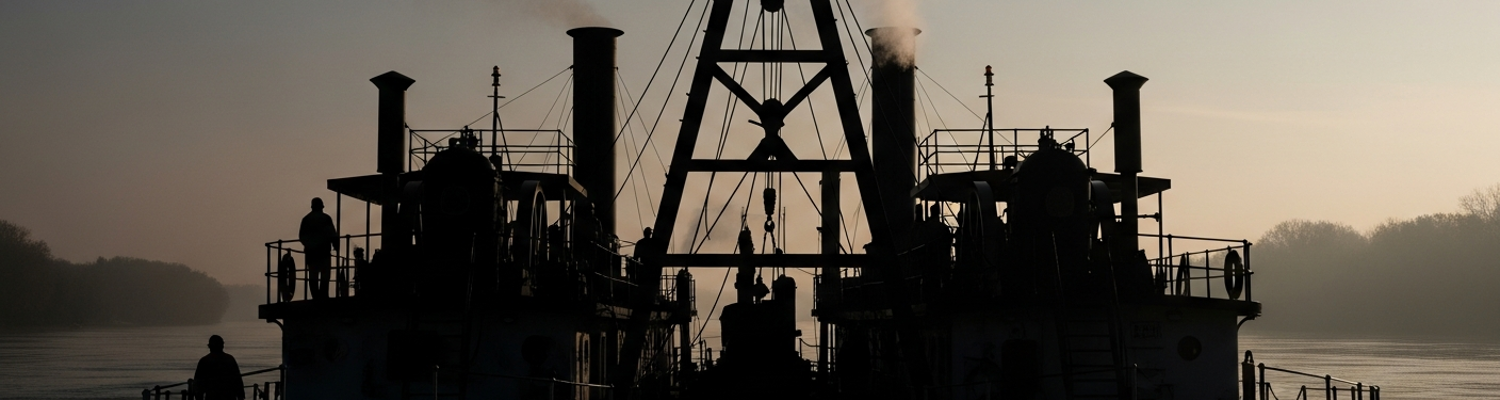
The core of the machine was a powerful, steam-driven windlass and derrick system. A single high-pressure steam engine, a technology Shreve himself had helped pioneer for river use, powered both the boat's paddlewheels and the heavy machinery. This machinery, geared directly to the engine, gave it the immense power needed to hoist entire trees, some weighing as much as seventy tons, from the riverbed. An enormous 'snag-beam' could be lowered to guide trees, and a robust A-frame structure supported the block and tackle of the main hoist. The operational principle was direct and brutal. The Heliopolis would steam at full power toward a located snag, striking it with the reinforced beam. The impact would dislodge the tree. The crew would then use the powerful lifting mechanism to haul the snag between the twin hulls. Once aboard, it was sawn apart by hand. The salvaged wood was often used to fuel the boat’s own boilers, making the operation remarkably self-sufficient. Nicknamed Uncle Sam’s Tooth Pullers, Shreve’s machines were brutally efficient. On its initial deployments, the Heliopolis cleared stretches of the Mississippi, like the notoriously dangerous Plum Point, in a matter of days. One report from an Army Corps of Engineers captain noted that in 1829, the Heliopolis single-handedly raised a snag that was 160 feet long with a root ball diameter of twenty feet. The age of mechanized river clearing had begun.
The Campaign Against the Great Raft
Shreve’s greatest challenge was the Great Raft of the Red River. This was not a simple collection of snags but a colossal logjam, hundreds of years in the making, that choked the river for an estimated 165 miles. It blocked all navigation into present-day northwest Louisiana and northeast Texas. The raft was a solid, interwoven mass of ancient timber, silt, and new vegetation, in some places so dense that mature trees grew upon its surface. Beginning in 1833, Shreve directed his snagboats in a multi-year assault on this geographic anomaly. The work was arduous and perilous. Crews faced disease like malaria and yellow fever in the swampy environment. The complexity of the intertwined mass of timber was immense. Shreve modified one of his boats, creating a powerful battering ram to splinter the outer edges of the raft. Then, the snagboats would grapple the loosened sections, pulling them apart piece by piece with their steam-powered winches. For five years, Shreve’s crews battled the raft, clearing a few miles at a time, only to have the river current re-jam the channel behind them. He devised a system of removing the raft material entirely from the river channel, a painstaking process that finally ensured a lasting solution. By 1838, they had successfully cleared a navigable channel through the entire length of the obstruction, opening a vast new region to settlement and commerce. In gratitude, the new settlement at the head of the cleared passage was named Shreveport in his honor. This campaign, more than any other single project, cemented the Army Corps of Engineers' reputation as a force capable of conquering monumental civil engineering challenges.
Forging the Logistical Sinews of a Nation
The deployment of Shreve’s snagboat fleet, which grew to include vessels like the Archimedes and Eradicator, had a transformative effect on the American interior. Between 1828 and the early 1840s, his crews systematically cleared obstructions from the Mississippi, Ohio, Arkansas, and Cumberland rivers. The impact on logistical efficiency was immediate and dramatic. With the primary danger removed, steamboat traffic surged. Shipping costs and insurance rates plummeted. By 1830, after just one year of the Heliopolis in operation, reports indicated that only a single flatboat had been lost to a snag on the main channel of the Mississippi. This newfound safety and reliability directly enabled westward expansion. Settlers and supplies could move with a degree of predictability that was previously unimaginable. Army forts on the frontier, critical nodes in the projection of federal power, could now be supplied via the rivers. This reduced the reliance on slow and vulnerable overland wagon trains. This logistical network formed the foundation for future military campaigns and the sustained presence of the U.S. Army across an expanding territory. The ability to move troops and materiel efficiently through the interior was a strategic advantage bought not with rifles, but with steam engines and iron beams. The successful war on snags demonstrated a unique capability to execute large-scale infrastructure projects in the national interest. The 1824 acts had provided the mandate, but it was the gritty, dangerous, and revolutionary work of Shreve and his crews on the inland rivers that established the enduring legacy. They did not just pull trees from the water. They built the logistical foundation for an empire's growth.