
Amphibious Deployment of Task Group 79.4
Operations across Quang Nam Province cost the III Marine Amphibious Force over 1,200 dead by the midpoint of 1969. Nearly one out of every three combat vehicles deployed into the alluvial plains suffered mine strikes or severe mechanical incapacitation. Archival evidence shows that on June 24, 1969, Task Group 79.4 directed the transfer of Battalion Landing Team 1/26 from the well decks of Seventh Fleet amphibious assault ships. These included the USS Vancouver and USS Cleveland. The transfer pushed troops directly into the surf zone off the central Vietnamese coast. Designated as Special Landing Force Alfa, the battalion brought approximately 1,100 Marines and Navy corpsmen across the sand spits of the South China Sea. They moved into the western edges of Quang Nam. The deployment targeted enemy base areas twenty-five kilometers south of Da Nang.
Saltwater corrosion aggressively fouled the electrical harnesses of the tracked vehicles before they cleared the low-water mark.
A continuous stream of LVTP-5 personnel carriers sputtered as water entered their fuel-intake vents during heavy sea swells. Maintenance crews on the beach began tearing apart water-logged carburetors using hand wrenches and field wire. They worked fast to prevent the lead platoons from stalling on open sand bars. Seawater and fine silicon sand ground internal drive assemblies to a halt within minutes of landing.
A close review of operational logs indicates that the command staff routed BLT 1/26 inland toward the grid lines encompassing Go Noi Island and the Dodge City tactical sector. This area sat bounded by the Ky Lam and Thu Bon rivers. North Vietnamese Army regulars from the 36th Regiment lay entrenched there. Reinforced concrete bunkers and overlapping subterranean trench networks laced the terrain between coordinates BT 020580 and BT 080550. The sun pushed interior temperatures within the armored hull compartments past 125 degrees Fahrenheit. This boiled the radiator coolant and vapor-locked Chrysler V-8 engines.
Tracked hulls struck buried ordnance repeatedly.
Improvised explosive devices assembled from unexploded 500-pound general-purpose bombs blew heavy road wheels completely off their torsion arms. Replacement components failed to arrive from the rear echelon at Da Nang. Combat engineers salvaged track pins and idler assemblies from charred hulks left by previous sweeps. Field mechanics cannibalized unarmored supply trucks for hydraulic fluid. They used makeshift rubber siphons to top off ruptured brake lines under direct mortar fire. Metal fatigued and split under the concussive force of buried artillery shells.
Task Group 79.4 attempted a synchronized maneuver along the Thu Bon River corridor. Armored columns pushed along the silty riverbanks. CH-46 Sea Knight helicopters from Marine Medium Helicopter Squadron 265 ferried assault companies into forward landing zones. Riverbed silt instantly clogged the water-jet propulsion systems of the LVTP-5s during deep water crossings. Crews stripped off bilge intake covers with bayonets. They pulled out mud with bare hands.
Overhead, helicopter turbine compressors ingested massive clouds of kicked-up alluvial dust during low hover cycles. This precipitated compressor stalls and rapid loss of rotor lift. Crew chiefs used field knives to clear shredded filter mesh. Rotor downwashes kicked burning debris through unsealed troop doors. Radio operators struggled with overheated AN/PRC-25 transmitters as the humidity boiled off internal battery contacts. Radiomen spliced wet copper telephone wire across broken aerial bases to maintain contact between river platoons and flight leads. Combat engineers on the ground manually secured pontoon bridging sections with tow cables anchored to half-buried tree trunks. Sniper rounds chipped paint from the armor plate.
Terrain Challenges in the Go Noi Basin
Archival evidence shows that Go Noi Island functioned for five years as an unyielding sanctuary for the North Vietnamese Army 2nd Division and the Viet Cong R20 Doc Lap Battalion. Beneath the pulverized surface of abandoned hamlets like Cu Ban and Xuan Dai lay three discrete levels of interconnected earthworks. Heavy ironwood timber and woven bamboo mesh reinforced these structures. These redoubts housed elements of the 36th and 141st NVA Regiments alongside regional sapper companies.
Deep combat bunkers resisted direct strikes from 250-pound bombs.
Firing apertures sat flush with the ground to create interlocking bands of grazing fire. Marine combat engineers from Company A, 7th Engineer Battalion quickly exhausted their supplies of standard M183 demolition assemblies while trying to collapse these underground labyrinths. Field teams improvised. They filled discarded 105mm ammunition cans with salvaged C-4 plastic explosive and raw bags of ammonium nitrate. They detonated the charges with short lengths of time fuse.
Hand-cranked M106 CS gas dispensers failed when internal rubber gaskets deteriorated in the hundred-degree heat.
Engineers dropped smoking CS canisters directly down vertical ventilation shafts. They sealed the holes with rubberized poncho covers and packed mud to push the chemical agent through the lower crawlways. Subterranean chambers absorbed explosive overpressures without caving in. Across the floodplain, mechanical movement stopped against an intricate maze of watercourses and dried agricultural barriers. The Ky Lam and Ba Ren rivers bounded the operational zone. This funneled tactical movement into narrow corridors bisected by centuries-old irrigation canals and five-foot-high clay rice paddy dikes.
Forty-five-degree embankments trapped tracked vehicles in deep mud.
Engineers carried heavy wooden planks to bridge the smaller gaps. They worked under constant observation from concealed spider holes. When a tractor slipped into a canal, recovery required two additional vehicles and heavy steel tow cables. The mud sucked the boots right off the infantrymen.
Technical Troubleshooting of the AN/PRS-4 Detector
Sweep teams from Company A, 7th Engineer Battalion experienced equipment failure rates exceeding seventy percent within forty-eight hours of crossing into the Go Noi sector. The AN/PRS-4 mine detector relied on a high-frequency oscillator circuit and fragile subminiature vacuum tubes. These components sat inside a supposedly sealed aluminum control box.
Saturated monsoon air penetrated the rubber gaskets during operations near coordinate BT 042571.
This soaked internal wiring plates and caused severe dielectric leakage across the tuning capacitors. Liquid alluvial mud coated the hollow fiberglass search heads. This threw off the delicate electromagnetic balance between the transmitter and receiver coils. Technicians observed that silica gel desiccant canisters saturated within two hours of field immersion. Internal circuitry shorted as moisture condensed across the tube sockets. This generated false target hums in the operator headphones or killed the audio output entirely.
Sweep teams had to choose between advancing blindly across mine belts laced with non-metallic toe-popper mines or disassembling the electronic chassis on wet ponchos. Monsoon rains poured over the exposed circuit boards. Moisture destroyed the fragile vacuum tubes faster than enemy fire.
A close review of operational logs indicates that during the clearing of an irrigation embankment outside Xuan Dai at coordinate BT 063554, NVA snipers pinned a four-man engineer team behind a three-foot dirt dike. Continuous high-resistance shorts caused by water intrusion melted the primary search head coils inside two PRS-4 units. This rendered them inert. Rifle rounds struck the dirt ridge inches above their heads. Dust sprayed over the open tool rolls.
Engineers used pocket knives to strip rubber insulation from WD-1/TT communications line. They salvaged this wire from a severed battalion telephone link. The Marines worked flat on their stomachs in six inches of stagnant water. They bypassed the burnt-out internal induction coils. They rigged external bypass loops directly to the terminal strips. They bound the bare copper strands with black vinyl friction tape. They melted candle wax over the connections to form a crude waterproof barrier.
This crude circuit bypass restored raw conductivity to the receiver head.
It stripped the unit of its fine discrimination adjustments. Operators accepted the deafening background squelch so long as the needle kicked when the wand hovered over buried wooden box mines. Engineering survival depended entirely on scavenged junk. When examining the historical record of BLT 1/26 operations along the Ky Lam corridor, battery replenishment for specialized electronic gear remained completely absent from forward supply drops. The proprietary battery assemblies powering the AN/PRS-4 decayed rapidly. High ambient heat caused the zinc casings to swell and leak corrosive acid into the battery tray.
Engineers broke down dead BA-386 radio battery casings with entrenching tools.
They extracted undamaged 1.5-volt dry cells. Marines wired thirty of these salvaged cylindrical cells in series using discarded telephone copper. They taped the massive bundle together with olive-drab duct tape. Soldering irons did not exist at the forward edge of the trace. Repair personnel heated brass rifle bore-cleaning rods over chunks of smoldering C-4 explosive until the metal glowed dull red. They used the hot rods to melt scavenged lead-tin solder over severed internal connections.
Fractured printed circuit tracks were bridged with individual strands pulled from stranded copper wire. These improvised voltage packs dangled from the engineers web gear in canvas sandbags. They connected to the detectors by exposed wires that sparked when dragged through tall elephant grass. Technicians measured battery output with salvaged Simpson 260 multimeters scavenged from disabled amphibious tractors. If plate voltage dropped below sixty-seven volts, the detector amplifier dropped below audible threshold. This blinded the point man to non-metallic ordnance buried three inches deep in the red clay.
Engineers marked erratic resistors by notching the phenolic board with razor blades. They replaced failed carbon-film resistors with lengths of nichrome wire stripped from broken vehicle cabin heaters. By July 8, 1969, Company A had zero factory-stock AN/PRS-4 detectors remaining in operational status. They relied entirely on eight patched chassis held together by electrical tape and salvaged field wire to clear lanes through coordinate BT 051569.
Field Neutralization of Improvised Explosive Devices
Archival evidence shows that between July 2 and July 14, 1969, sweep teams from Company A, 7th Engineer Battalion encountered an average of twelve buried explosive devices per kilometer of beaten path across the Go Noi sector. Viet Cong sappers from the R20 Doc Lap Battalion concealed non-metallic toe-popper mines flush with the dirt trails leading through Cu Ban. These often consisted of a single 7.62x39mm or 12.7mm round balanced on a nail inside a hollow bamboo tube. Foot pressure on the exposed cartridge primer crushed it against the nail. This drove the bullet directly through the boot sole of the victim.
A single misaligned footstep consistently severed an entire lower leg below the knee.
In the adjacent hedgerows along coordinate BT 048566, enemy ordnance specialists deployed modified American 105mm and 155mm high-explosive artillery shells. They stripped these of their mechanical nose fuzes and retrofitted them with electrical blasting caps or dry-cell firing loops. Sapper units packed cast-iron friction fuses into crude wooden box mines filled with ten to twenty pounds of recovered naval cordite. These boxes sat buried beneath three inches of dry silt on canal dikes. Their friction igniters connected to concealed pull-wires anchored across buffalo paths.
Factory-issued grappling hooks and standard mine prodders were depleted within the first seventy-two hours of the sweep.
Combat engineers faced with dense foliage improvised their own mechanical tripwire feelers. They uncoiled heavy steel safety wire taken from discarded aviation rocket pods. Marines straightened the stiff metal with pliers. They bent the tips into blunt loops to prevent snagging on harmless grass stems while probing blind brush. For remote detonation, troops collected scrap rebar from destroyed French railway embankments near Dien Ban. They bent the iron into four-pronged grappling anchors.
They lashed these improvised hooks to fifty-meter coils of scavenged nylon suspension line stripped from parachute flares.
An engineer moved behind the protection of three-foot rice paddy dikes. He lobbed the weighted hook by hand into overgrown canal cuts. He dropped flat into the drainage ditch. He dragged the grapnel backward to snag taut tripwires or trigger friction-ignited box mines from outside the blast radius. Remote friction snagging triggered secondary blasts that routinely sprayed jagged shrapnel across seventy meters of open paddy.
Clearing teams faced heavy small-arms fire whenever an engineer stopped movement to probe a confirmed booby trap. Marksmen from the NVA 36th Regiment positioned themselves in concealed spider holes and camouflaged palm platforms. They specifically targeted kneeling or prone sappers whose hands were occupied with clearance tools. Disarming a modified 155mm shell required an engineer to crawl flat on his stomach. He scraped away compacted red clay with a field knife. He unscrewed the improvised detonator without shifting the main body of the charge.
During this ten-to-fifteen-minute window of complete immobility, sniper rounds systematically struck the unprotected shoulders and necks of the clearance personnel.
Operational returns for the second week of July record that forty-one percent of all engineer casualties in the northern sector resulted from direct sniper fire during neutralization attempts rather than accidental detonations. Corpsmen attempting to drag wounded sappers from the kill zones drew immediate accurate bursts from hidden light machine guns. On July 11, three separate sweep teams outside Xuan Dai lost their lead clearing technicians to sniper fire in less than forty minutes.
Rome Plow Clearance and Mechanical Maintenance
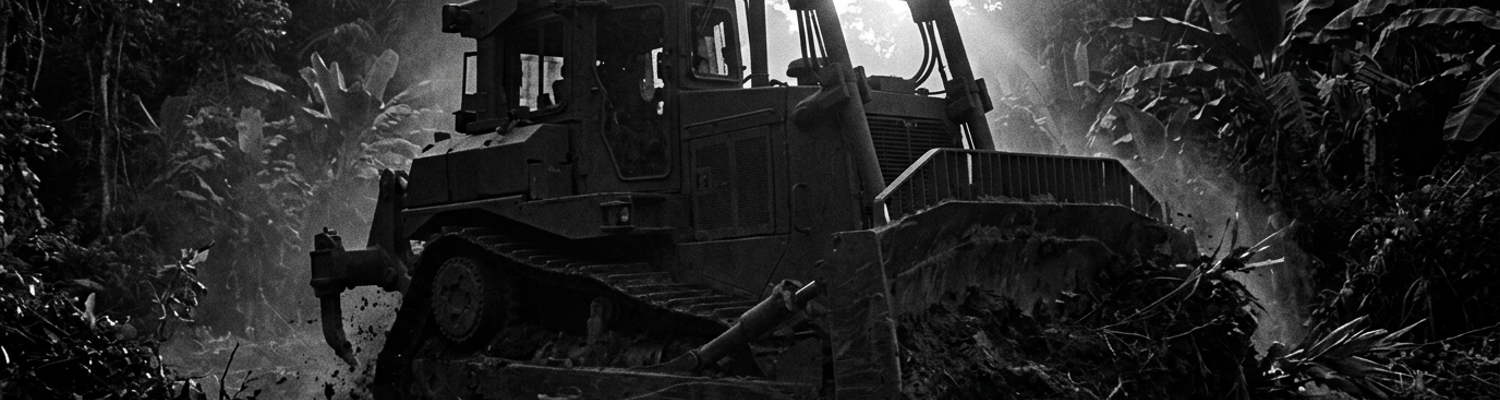
Task Group 79.4 integrated the Provisional Land-Clearing Company into the western sector of Go Noi Island on June 13, 1969. They aimed to systematically strip the dense agricultural cover sheltering elements of the NVA 36th Regiment. Marine command committed thirty-five-ton Caterpillar D7E tractors. These machines featured armored operator cabs, heavy belly pans, and front-mounted Rome K/G clearing blades.
Manufactured in Cedartown, Georgia, each three-ton blade featured a forward-projecting cast-steel stinger.
This stinger split tree trunks before the angled cutting edge sheared the timber flush with the soil. These armored plows moved abreast through grid squares BT 045565 and BT 060555. They leveled hundreds of acres of fortified hedgerows. They collapsed subterranean communications trenches. They exposed deep ironwood-reinforced bunker systems that had previously deflected direct artillery preparation. The heavy tractors shaved away defensive berms six inches above grade. This turned fortified villages into open expanses of bare earth.
Stripping the vegetation eliminated the concealment required for NVA mortar pits. The slow-moving tractors presented large targets for rocket-propelled grenade teams waiting in spider holes along the irrigation lines. Hardened steel blade stingers cleaved dense timber while incoming small-arms fire ricocheted off the tractor cabs. Hostile fire exacted an immediate mechanical toll on the clearing units. Engineer mechanics executed improvised technical repairs under constant sniper and mortar harassment.
Rocket-propelled grenade fragments and 7.62mm armor-piercing fire repeatedly sliced through the exposed hydraulic hoses operating the heavy front-blade lift cylinders.
A fractured line sprayed hot pressurized fluid over exhaust manifolds. This created a fire hazard while instantly neutralizing the lifting leverage of the plow. Mechanics from the 7th Engineer Battalion bypassed factory supply protocols. They spliced punctured hydraulic lines using high-pressure rubber tubing clamped tight with doubled safety wire and salvaged metal sleeves. Shrapnel punctures through the forward armor louvers routinely perforated the brass radiator cores of the D7E diesel engines.
Coolant dumped into the dirt.
Cylinder head temperatures spiked past safe operating thresholds within three minutes. Repair teams crawled under fire to drive wooden dowel pins and lead shot directly into the ruptured cooling tubes. They coated the exterior seams with quick-curing resin before refilling the dry cooling jackets with silt-laden water drawn from drainage canals. Wrenches slipped in blood and hydraulic fluid as snipers targeted the repair crews.
The most persistent hazard to mechanical mobility came from the dense subterranean root clusters of native iron bamboo. These fibrous calcified root clumps wound through track links. They packed solidly behind the drive sprockets and locked track shoes against the recoil spring assemblies. Once the undercarriage jammed, track tension skyrocketed until massive master pins sheared clean off. This completely disabled the tractor in the direct line of enemy machine guns.
Crews could not abandon the disabled machines without inviting immediate infantry assaults from nearby NVA sapper teams.
Under defensive small-arms suppression from accompanying riflemen of BLT 1/26, clearing crews dismounted into the mud. They carried hand axes, entrenching tools, and portable oxyacetylene cutting torches. Operators worked flat on their sides in six-inch clearance gaps between the track pads and hull armor. They burned through tangled root balls and pried free splintered wood with crowbars. Field teams maintained this mechanical intervention along the Ky Lam perimeter until all seven damaged tractors cleared coordinate BT 054561 by nightfall.
County Fair Cordons and Hamlet Screening
Archival evidence shows that during the second week of July 1969, Task Group 79.4 shifted Company B and Company C of BLT 1/26 into cordon maneuvers around the hamlets of Dong Phu and Tay Binh near coordinate BT 072588. Rifle platoons moved through chest-deep irrigation canals between 0100 and 0330 hours. They surrounded the perimeter to trap the village infrastructure before daylight. Infantrymen hammered iron pickets into dry clay to anchor triple-strand concertina wire. This isolated roughly eight hundred inhabitants from Viet Cong cadres hiding inside family bunkers.
Battery-operated AN/PVS-2 starlight scopes failed immediately.
Internal optical seals broke under ninety-eight percent humidity. This fogged the night-vision objective lenses with interior condensation. Squad leaders stripped down the scope assemblies in the dark. They wiped moisture from internal prism glass with sterile gauze pads pulled from medical kits. Improvised tripwire systems replaced non-functioning electronic sensors. Marines rigged salvaged aviation safety wire to M49 trip flares along canal dikes. They twisted the wire with lineman pliers to catch night swimmers attempting to slip into the Ba Ren River.
Barbed wire sank into mud under the weight of wet reeds.
Dawn brought teams from the 1st Civil Affairs Group alongside two dozen South Vietnamese National Police officers into the cordoned center to screen the population. Search teams herded villagers toward a central collection point set up inside a local pagoda compound. National Police interrogators examined laminated identity cards against handwritten district blacklists. They aimed to detect members of the Viet Cong R20 Doc Lap Battalion. Extreme heat melted the stamping ink on official registration tables.
Thumbprint ledgers turned into illegible black smears.
Civil affairs personnel solved this problem by mixing dry carbon powder scraped from dead radio batteries with standard-issue CLP rifle lubricant. This produced a thick grease that held fingerprint ridges on coarse paper. The portable 1.5-kilowatt gasoline generator powering the screening tent shorted out after twenty minutes. Blown sand fouled the open armature brushes. A motor transport mechanic from BLT 1/26 used an entrenching tool to reshape a flattened copper rifle casing into a replacement brush contact. He soldered it directly to the brush holder with a heated cleaning rod.
Maintaining the outer containment ring pushed forward supply lines past their design limits. Marines standing in defensive trenches had to receive five thousand gallons of potable water each day while guarding detainees and fending off probes from the NVA 36th Regiment. VC sappers threw concussion grenades at outer listening posts every ninety minutes to identify gaps in the wire. Direct mortar hits systematically severed the WD-1/TT field telephone wire running between rifle pits and the battalion command post at coordinate BT 068592.
Communications linemen crawled across open rice paddies under sniper fire to find the breaks.
They stripped burnt rubber casing with their teeth. They twisted bare copper strands together inside empty ration cans to keep water off the splices. Primary vehicle searchlights burned out under continuous night operations when voltage regulators on M37 supply trucks failed. Combat engineers stripped the sealed-beam headlamps out of disabled mechanical mules. They wired them directly to wet 12-volt truck batteries using scavenged alligator clips. By midnight on July 16, BLT 1/26 had screened 1,140 civilians and detained twenty-seven confirmed administrative cadres without breaking the outer cordon.
Medical Civic Action Programs and Attrition
By July 18, 1969, Task Group 79.4 established forward Medical Civic Action Program sites in cleared hamlets surrounding grid coordinate BT 066578. Navy hospital corpsmen assigned to Battalion Landing Team 1/26 operated these field clinics from open-sided thatched structures or sandbagged village administrative huts. Across a seventy-two-hour window, two medical officers and six corpsmen treated 640 South Vietnamese civilians. These patients presented with deep parasitic skin infections, untreated yaws, severe trachoma, and open lacerations caused by artillery fragments.
Supplies of topical bacitracin and tetracycline ran out by midday.
Medical personnel washed infected tissue with saline solutions salvaged from heat-damaged intravenous bags. Villagers arrived carrying children with advanced respiratory illnesses alongside elderly residents bearing shrapnel wounds sustained weeks earlier during preparatory air strikes. Corpsmen cleaned putrefying tissue using straight surgical scissors without local anesthetics. They bandaged wounds with field dressings collected from incoming supply crates. Flies covered the open antiseptic trays within seconds of exposure.
Security platoons from BLT 1/26 suffered profound psychological wear while maintaining outward security rings during these civic operations. Riflemen stood guard behind sandbag revetments in 105-degree heat. They alternated between assisting frightened children through screening queues and training their M16A1 rifles on nearby tree lines. The proximity of non-combatants prevented Marines from establishing protective free-fire perimeters. This left squads exposed to close-range sniper fire from the NVA 36th Regiment.
Every approaching villager had to be treated simultaneously as a recipient of medical aid and a potential sapper concealing hand grenades under loose black clothing.
Sleep deprivation accelerated this mental exhaustion. Men who spent six hours patting down villagers spent the ensuing eight hours on night listening posts enduring constant grenade probes along drainage ditches. Company commanders noted marked increases in hypervigilance, combat reaction syndromes, and involuntary hand tremors among infantrymen who had endured thirty consecutive days without rotation out of the Go Noi Basin. Exhaustion stripped riflemen of emotional tolerance.
Concealed ordnance caused catastrophic trauma that overwhelmed field triage posts along the Ky Lam perimeter.
Toe-popper cartridges, buried M26 grenades, and rigged 105mm shells produced severe blast injuries. These required immediate bilateral limb amputations and massive blood volume replacements at forward clearing stations. Navy corpsmen stationed at coordinate BT 059572 exhausted standard supplies of arterial tourniquets during a single morning sweep on July 21. Four Marines in the lead squad triggered a daisy-chain booby trap. Field medics improvised mechanical tourniquets using cut strips of canvas web belts tightened with brass cleaning rods.
Dust and ambient heat caused intravenous blood-expansion fluids to overheat inside rubber bladders.
Corpsmen submerged the plastic tubing in water-filled ammunition cans before administration. Deep blast wounds driven full of river silt and agricultural fertilizer caused rapid anaerobic bacterial colonization. This demanded complete debridement of shattered muscle tissue on canvas litters set atop discarded ration boxes. Bone fragments tore surgical gloves during emergency cutdowns.
Medevac protocols broke down repeatedly under the volume of traumatic amputations and incoming mortar fire directed at forward pickup zones. CH-46 helicopters from Marine Medium Helicopter Squadron 265 faced intense automatic-weapons fire whenever they touched down in cleared paddy fields to load casualties. Pilots hovered with their aft ramps scraping mud while corpsmen loaded litter cases under direct sniper fire. The rotor wash blew wet clay directly into exposed abdominal trauma and severed arterial stumps.
Hydraulic lines on two transport helicopters ruptured from small-arms fire during lift-off from coordinate BT 063568.
This disabled their power-steering assists. Flight crews wrestled mechanical stick controls manually back to the surgical facilities at the 1st Medical Battalion in Da Nang. Field records for July 24 indicated that fifty-eight percent of all surgical cases received from the Pipestone Canyon operational area required surgical amputation of one or more extremities before patient transfer to hospital ships offshore.