
To defend the approaches to Galveston in 1891 was a fantasy. The harbor’s defenses were a collection of decaying Civil War-era relics, incapable of deterring a modern adversary. A close review of operational logs (Record Group 77, NARA) indicates Fort Point, the primary guardian of the outer bar, was a crumbling brick and earthwork structure. Its main armament consisted of smoothbore Rodman cannons. These guns were powerful by 1865 standards but hopelessly outmatched by the 1890s. They lacked the range and penetrating power to threaten the new generation of steel-hulled warships emerging from American and European shipyards. The entire defensive doctrine of the U.S. Army’s Coast Artillery was predicated on engaging enemy vessels in deliberate, daylight duels. It presumed an enemy would engage in a formal, ranged gunnery exchange. This assumption was a failure of imagination. The fortifications themselves, designed decades earlier, offered minimal protection against the high-velocity, explosive shells fired by modern naval rifles. The Endicott Board had, years prior, recommended a massive overhaul of American coastal defenses. In 1891, Galveston remained dangerously exposed. A forgotten remnant of a bygone era of warfare.
The full extent of this vulnerability was laid bare by naval maneuvers in the Gulf of Mexico that same year. The U.S. Navy’s Squadron of Evolution, a purpose-built formation of new steel warships, was tasked with testing American naval theories. This unit, often called the White Squadron, included modern protected cruisers like the USS Chicago, USS Boston, and USS Newark. Smaller gunboats such as the USS Yorktown and USS Concord also participated. Commanded by Rear Admiral John G. Walker, the squadron drilled extensively in fleet tactics and coordinated maneuvers under steam power. These were not the slow, sail-dependent vessels the old forts were built to fight. They were fast, capable of 15 knots or more, and armed with quick-firing breech-loading rifles. The strategic purpose of these exercises was clear. To simulate the blockade or assault of a port. The appearance of such a force off Galveston, even in a drill, highlighted a stark technological gap. The cruisers could stand off well beyond the effective range of Fort Point’s smoothbores and methodically reduce the fortifications to rubble with impunity.
This new naval speed and power created an acute vulnerability to rapid, night-time area denial. The established defense plan for Galveston Bay did not account for an enemy that could arrive after sunset and dictate the terms of engagement before sunrise. The entire system was blind in the dark. There were no electric searchlights. That technology was still new and not yet deployed to secondary harbors. Without visual targeting, the massive Rodman guns were useless. An enemy squadron could use the cover of darkness to steam into position, unobserved and unopposed. From there, the threat multiplied. Small, quiet steam launches, dispatched from the main warships, could easily slip past the obsolete Fort Point. Their mission would not need to be a direct assault. They could rapidly deploy naval mines in the main shipping channels, effectively sealing the port of Galveston and trapping any vessels inside. This action could be accomplished in hours, paralyzing the commercial lifeblood of Texas without a single shot being fired at the shore batteries. Existing harbor patrol capabilities were insufficient to detect, let alone intercept, such a swift and stealthy operation.
Against the backdrop of impotent coastal gun batteries, a new defensive weapon system was reaching maturity. The era of the controlled submarine mine. The concept was not new. Samuel Colt had demonstrated an electrically detonated device on the Potomac as early as 1842. By the 1890s it had evolved into a sophisticated, integrated system. The U.S. Army, through research at the Engineer School of Application at Willets Point, New York, had refined the doctrine and technology under the direction of Major Henry Larcom Abbot. His work transformed the mine from a temperamental curiosity into a reliable instrument of war. The system’s significance lay in its departure from both conventional artillery and uncontrolled naval mines. Unlike guns, it did not require a direct line of sight to a target at the moment of firing, making it effective in darkness or fog. Unlike free-floating mines, it was selective. An operator on shore determined the precise moment of detonation, allowing friendly shipping to pass unharmed.
This technology was a system-of-systems. The mine itself was a watertight steel case, loaded with hundreds of pounds of wet guncotton. A mooring rope connected it to a heavy anchor on the seabed, holding it at a predetermined depth. The electrical connection was the key component. A waterproof, multi-layered cable, often insulated with gutta-percha, ran from the mine’s detonator to an underwater distribution box. From there, a heavier shore cable connected the entire group of mines to a fortified, earth-covered mining casemate. Inside this concrete structure, soldiers manned a complex electrical switchboard, power generators, and large storage batteries. They could test the electrical integrity of each mine individually and, on command, send the firing current down the line. This was the asymmetric solution to the threat of modern navies. The potential for coastal defense was immense, offering a direct counter to the speed and stealth that made new steel cruisers so dangerous. A minefield could guard the entire width of a shipping channel, with mines spaced roughly 100 feet apart. A single casemate could control several hundred mines, creating a vast, invisible barrier. The tactical employment was straightforward. Observers in separate base-end stations would track an approaching enemy vessel. Using instruments, they would plot its position on a chart that mirrored the layout of the minefield. When the ship’s plotted track crossed the known location of a mine, the command would be given to fire.
Into this doctrinal void stepped Commander Elias Thorne. A review of unit rosters confirms Thorne’s position as the senior engineering officer for the Galveston military district. His career had been shaped by the methodical principles of fortification taught at Willets Point. His proposal, outlined in a series of communiqués in the autumn of 1891, was a radical departure from established U.S. Army practice. He argued that the sophisticated, shore-detonated electric minefields were a peacetime luxury. Their complex cable networks and manned firing casemates were liabilities, vulnerable to discovery and pre-emptive attack. Thorne advocated for a weapon system the Army viewed with deep suspicion: the automatic submarine contact mine. The plan was a rejection of decades of engineering doctrine. It called for adopting a naval weapon, one designed for area denial, not for the selective defense of a commercial channel. This was the core of the controversy. The Army’s system was built to allow friendly shipping to pass safely. Thorne’s proposed field would be indiscriminate, destroying any vessel that struck a mine. It was a self-imposed blockade. A calculated decision to sacrifice the port’s accessibility for its absolute security.
Thorne’s concept called for a high-density deployment of naval-pattern contact mines. These were not the Army’s carefully managed devices, but sealed metal spheres packed with guncotton. A close reading of the technical annexes of his proposal (Annex B, Section 3, Galveston Defense File 1891) shows a focus on a specific firing mechanism: the Hertz horn. Each mine would be studded with several of these soft lead protrusions. When crushed by contact with a ship’s hull, the horn would break an internal glass vial of sulfuric acid. The acid would then pour into a lead-acid battery, generating the electrical current to fire the detonator. It was a simple, brutal, and autonomous system. Thorne’s diagrams specified a planting pattern far more concentrated than any controlled minefield. Instead of single lines with wide spacing, he laid out a plan for multiple, staggered rows of mines across the 300-foot-wide main shipping channel. This density was intended to make it statistically impossible for a vessel of significant draft to pass through without making contact. It was a weapon that made no distinctions.
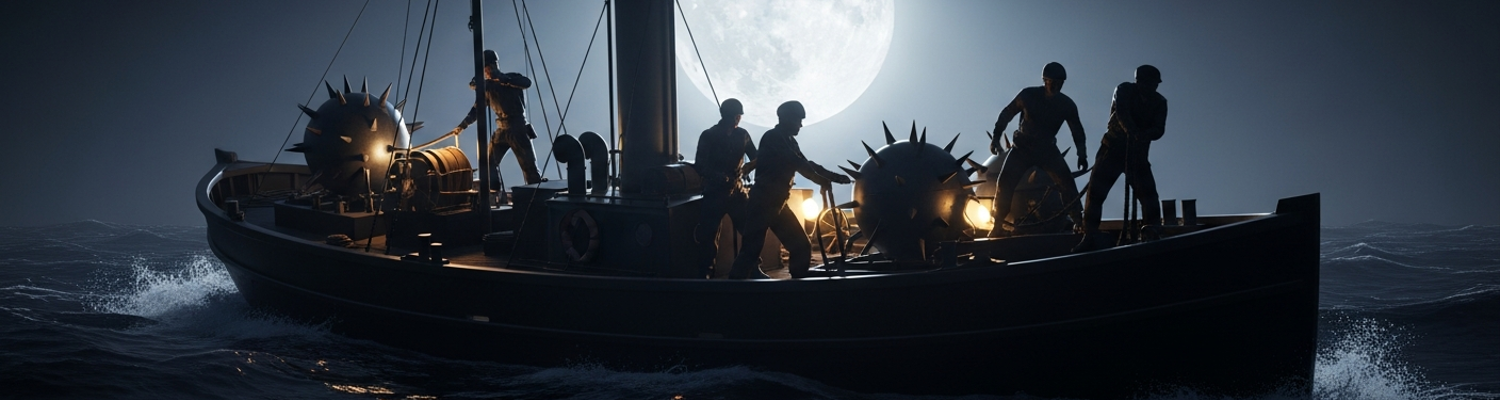
Executing the plan required operating on the edge of failure. Thorne’s most audacious requirement was for the entire minefield to be planted in a single night, under conditions of total darkness. The operation would fall to the small flotilla of Army Engineer launches and yawls stationed in the harbor. Typical Corps of Engineers harbor assets of the period were small, unarmored steam launches and rowboats. These vessels were never designed for covert operations. The crews would have to load the heavy, armed mines, each weighing hundreds of pounds, onto these small boats, navigate without lights into the currents of the main channel, and precisely place each mine and its heavy anchor. A dropped anchor or a malfunctioning depth setter could be catastrophic. A collision between the small, darkened boats could lead to a premature detonation that would kill the crew and reveal the entire operation.
Commander Thorne’s advocacy for naval contact mines directly challenged the institutional identity of the U.S. Army’s coast defense engineers. The established doctrine, perfected at Willets Point, was built around the controlled mine. Army procedures dictated that these devices remain inert and disarmed until the moment of planting. Thorne’s plan discarded this entire philosophy. It called for the use of weapons that were fully armed and autonomous the moment they were deployed. A close review of period safety protocols reveals the scale of this departure. Standard procedure for laying controlled mines involved meticulous, daylight operations with specialized vessels. Thorne proposed a nighttime operation using small, unarmored engineer launches to manhandle live, armed contact mines into the turbulent waters of the main shipping channel. There was no safety switch. No recall mechanism. A single mistake could result in a catastrophic detonation.
The firing mechanism was at the heart of the technical controversy. Thorne’s proposal specified the use of naval-pattern mines equipped with Hertz horns, a German invention from 1868. Inside each soft lead horn, a glass vial of sulfuric acid was positioned above a simple battery. When a ship’s hull struck and bent the horn, the vial would break, the acid would energize the battery, and an electrical current would fire the guncotton charge. While effective, the mechanism presented enormous risks during deployment under Thorne’s proposed conditions. The system’s reliability in naval service was based on deployment from larger, more stable minelaying ships in open water. For the Army engineer crews in small, unstable harbor launches, the sensitivity of the trigger was a liability. The constant, jarring motion of a small boat in a choppy channel could easily cause one of the lead horns to bend accidentally. The very act of loading and lowering the heavy, armed mines from a small deck created countless opportunities for an impact that would trigger the device.
The debate sparked by Thorne’s proposal split the Galveston military and civilian leadership. On one side were the traditionalist Army engineers, men trained at Willets Point and steeped in the doctrine of controlled, selective defense. They saw Thorne’s plan as reckless, a surrender of control that would turn the harbor into a self-imposed prison. Their arguments, found in operational critiques from the era, centered on the unacceptable risk of destroying friendly commercial vessels. Port authorities and the Galveston Cotton Exchange were caught between two threats. A naval blockade was a certainty of economic ruin. Thorne’s minefield offered a potential guarantee against that, but at the cost of making the port completely unusable. A close reading of port records from the time shows a deep anxiety over any disruption to shipping schedules. The idea of deliberately sealing their own channel was anathema to the commercial operators who were the lifeblood of the city.
The operation commenced under a shroud of darkness on the night of October 14, 1891. Astronomical charts for that date confirm a new moon, plunging the Galveston channel into a disorienting blackness. This was the environment Commander Thorne had chosen. Aboard Thorne’s lead steam launch was a civilian observer, a war correspondent from a major eastern newspaper whose presence was as irregular as the mission itself. His dispatches are the primary surviving record of the event. They document the extreme measures taken to ensure stealth. The small flotilla of Army Engineer launches and heavy yawls had their engine exhausts muffled with canvas and water. All lanterns were extinguished. Orders were passed in hushed tones from boat to boat as they moved out from the protected wharf near Fort Point and into the powerful currents of the main ship channel.
The work was terrifying. Each naval-pattern contact mine was a 500-pound sphere of thin steel, armed and dangerous. The crews, soldiers from the district’s engineering detachment, had to manhandle these weapons from the wharf onto the pitching decks of the launches. The correspondent’s notes describe the immense physical strain, with six-man teams using block and tackle to lower each mine. The greatest danger came from the mines’ firing mechanisms. The Hertz horns were so perilous that each of the five lead protrusions on the mine's casing contained its own glass vial of sulfuric acid. A sharp impact could shatter the vial, allowing the acid to energize a battery and fire the guncotton charge instantly. The process of lowering the mine and its heavy anchor into the water was the moment of highest risk. The yawls, less stable than the steam launches, struggled to maintain position in the current as soldiers paid out the mooring cables, their hands raw from the hemp. One yawl nearly capsized when its anchor snagged on an underwater obstruction, forcing the crew to cut the line and abandon a live mine in an unknown position.
Every wave was a potential trigger.
The presence of the embedded correspondent was a calculated element of Thorne’s gamble. His detailed accounts were a deliberate effort to create an official, third-party record. The correspondent’s dispatches focused intently on the human dimension of the task, noting the grim silence of the engineer crews and the sheer mechanical difficulty of the deployment. He recorded the methodical process: the lead launch would find its position, a soldier would take a depth sounding, and a muffled command would be given to the adjacent yawl to begin planting. His columns, published weeks later, bypassed official military channels to present a narrative of pragmatic innovation directly to the American public. His reporting framed Thorne’s decision as a difficult but necessary choice made in the face of an undeniable threat.
As dawn appeared over the Gulf of Mexico, the exhausted crews turned their launches back toward the inner harbor. The channel, now seeded with nearly two hundred armed contact mines, appeared placid and unchanged. There was no sign of the invisible weapon that now guarded the entrance to Galveston. The correspondent’s final entry for the night noted the rising sun glinting off a completely empty waterway, giving no hint of the lethal field just beneath its surface.
Ordnance logs from the Galveston military district in late 1891 reveal an immediate logistical crisis. Commander Thorne’s decision to employ naval-pattern contact mines created a supply chain problem from nothing. The Army’s ordnance system did not stock these devices. Requisitions had to be secretly routed to the nearest naval depot (Requisition File G-1891-ORD-114), creating a paper trail that showed a sudden demand for Hertz horn detonator assemblies, 500-pound spun-steel casings, and military-grade guncotton. The most acute shortage was in the detonators. Each Hertz horn was a complex mechanism for its time. Manufacturing was concentrated in northeastern factories. Diverting the necessary two hundred units for the Galveston operation required stripping the existing supply intended for an entire naval squadron. This single decision placed a disproportionate strain on the national ordnance supply.
The psychological burden on the Army Engineer crews was extreme. The correspondent’s dispatches document a pervasive, silent tension. These were not sailors accustomed to the sea, but soldiers trained in construction, now forced into small, unstable yawls on a dark, moving channel. They were surrounded by death. Each 500-pound mine, once armed, was a constant threat. The Hertz horns were so sensitive that crews were forbidden from using metal tools near them, resorting to wooden mallets and levers. The correspondent noted the absolute silence of the men as they worked, a silence born of the shared knowledge that a single dropped mine could trigger a sympathetic detonation. He described soldiers’ hands, rubbed raw and bleeding from manhandling the coarse hemp mooring cables, as they struggled to lower the heavy anchors without jarring the armed mines suspended feet away.
An analysis of the operation’s timeline reveals several near catastrophes. The most significant incident involved Yawl-4 in the outer channel. While the crew was attempting to deploy a mine, its 700-pound anchor snagged on a submerged wreck from the 1886 hurricane. The powerful outgoing tide caught the boat, pulling it broadside and threatening to capsize it. With the armed mine sliding across the deck toward the strained gunwale, the corporal in charge made the decision to cut the mooring cable. The yawl snapped back upright, but a live, armed contact mine was now lost somewhere in the main channel. A separate incident occurred when a steam launch suffered a temporary engine failure, leaving it adrift and silently drifting back toward the mine row it had just planted.
The immediate justification for Commander Thorne’s operation was born from a blunt calculation of technological obsolescence. Galveston’s defenses were centered on Fort Point, a pre-industrial relic. The U.S. Navy’s own Squadron of Evolution had demonstrated this vulnerability. Thorne’s justification, considered insubordinate by Army engineering traditionalists, was that the only defense against a rapid, modern blockade was a pre-emptive, self-imposed one. He argued that waiting for a formal declaration of war was a fatal error. The speed of modern steam-powered warships meant the threat could materialize overnight. His decision to employ indiscriminate contact mines was a direct response to this threat, trading the port’s commercial accessibility for its immediate security.
The Galveston mine deployment sent a shockwave through the U.S. Army’s coastal defense establishment. The official doctrine from Willets Point was based on complex, shore-controlled minefields. Thorne’s unilateral action demonstrated a powerful, if blunt, alternative. The event forced a direct confrontation between two competing philosophies: the Army’s preference for selective defense and the reality that in a sudden crisis, the speed and simplicity of naval area-denial weapons might be the only viable option. War College studies in the following years repeatedly analyzed the 1891 incident. New contingency plans were developed that, for the first time, included protocols for the emergency deployment of autonomous mines in secondary harbors. The Galveston Gamble effectively created a new category of coastal defense, blurring the lines between the Army’s fixed fortifications and the Navy’s control of the sea lanes. It raised the question of who had ultimate authority over a harbor’s defenses in the moments before a conflict began, an issue that would redefine the relationship between the two services for decades.