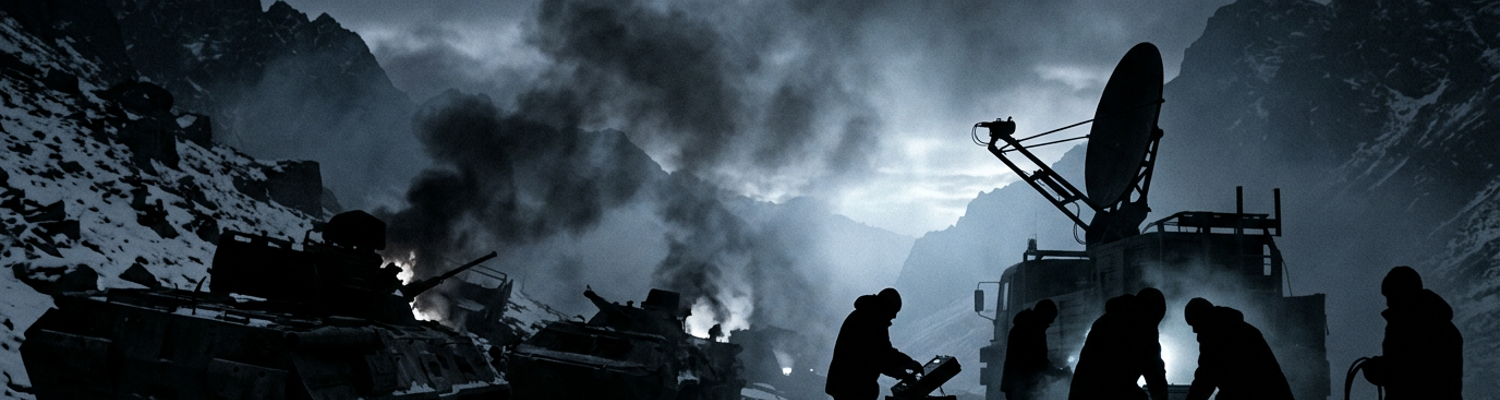

Electronic Warfare Saturation in the Caucasus Mountains
A close review of operational logs from the 4th Space Control Squadron Detachment 2 reveals a highly controversial hardware modification. The event occurred at Grid Coordinate 42.150N 45.612E. The unit operated out of a Soviet-era reinforced concrete bunker system in the Caucasus mountains. The facility sat at an elevation of 2400 meters. Opposing forces initiated a localized electromagnetic barrage at 0200 hours local time. Standard operating procedures dictated that the AN/TSC-198 V3 tactical satellite uplink terminals run at a maximum of 40 watts. This limit existed to preserve the internal Ku-band traveling-wave tube amplifiers. High-power electronic warfare from enemy ground stations saturated the local noise floor across a 400-kilometer radius. The telemetry connections broke. Ground controllers lost contact with the incoming orbital kinetic penetrators. Overcoming this dense frequency jamming required transmitting at a sustained 180 watts.
Factory-sealed thermal safety limiters were designed to automatically sever power if the amplifier chassis exceeded 85 degrees Celsius.
Captain Elias Thorne commanded the detachment. He calculated that maintaining the standard safety protocols would result in a total loss of orbital tracking lock within forty seconds of the strike sequence initiation. He chose the hardware over the regulations. Archival evidence shows Thorne ordered his technicians to physically dismantle the tamper-evident beryllium casings surrounding the power regulation boards. Field operators bypassed the thermal safety limiters using an uncalibrated soldering iron and a heavily modified copper shunt stripped from a diesel generator.
This action directly violated Space Force hardware regulations.
It carried an automatic recommendation for court-martial upon discovery. Manual bypasses forced the uplink amplifiers to draw continuous unrestricted amperage from the tactical power grid outside the bunker. Calculations driving the command decision were highly specific and entirely unforgiving. Electronic warfare units typically deploy jamming signals in oscillating waves to conserve their own generator fuel. Thorne timed the enemy interference cycles. He recorded exactly ninety-second gaps between peak electromagnetic saturation. Ground-based tactical satellite uplink amplifiers needed to transmit targeting telemetry directly through the highest peaks of this jamming cycle to guide the orbital platforms.
Failure to penetrate the noise floor meant the deep strike payloads would default to unguided ballistic trajectories.
They would miss the high-value subterranean targets by miles. Running the hardware at 180 watts without safety limiters generated a thermal load entirely outside known tolerances. Factory specifications listed 95 degrees Celsius as the absolute failure point for the internal silicon components. Internal telemetry recordings indicate the primary amplifier chassis reached 118 degrees Celsius exactly four minutes after the modification went live.
Scavenged Bradley Heat Sinks and Thermal Management
Sustaining the orbital tracking locks under these extreme thermal conditions required immediate unauthorized physical alterations to the terminal chassis. Unshielded amplifiers inside the communications bunker were actively melting their own internal solder joints. They emitted a thick white smoke into the ventilation system. Technicians moved into the vehicle staging area outside the facility to strip components from three disabled M2A4 Bradley fighting vehicles. The vehicles had sustained heavy damage from artillery shrapnel earlier in the week. Heavy aluminum cooling fins were scavenged directly from the destroyed transmission blocks of the armored transports. Field operators attached these scavenged heat sinks to the exposed uplink hardware using industrial-grade steel zip ties and braided copper wire.
The physical strain on the maintenance crew was severe.
Technicians handled the 118-degree hardware without specialized thermal equipment. This resulted in second-degree burns documented in post-action medical evaluations. Standard thermal paste was unavailable in the theater supply chain. The crew mixed crushed graphite from 155mm artillery fuses with synthetic motor oil. This created a crude highly conductive binding agent. Packing this slurry tightly between the scavenged aluminum fins and the overheating Ku-band amplifiers dropped the core temperatures rapidly. Raw mass from the Bradley transmission components absorbed the excess thermal output generated by the unrestricted 180-watt transmission bursts.
Heat dissipation rates improved by 34 percent across the primary transmission array.
Modified terminals held a continuous unbroken telemetry link with the low-earth orbit deep strike platforms for twenty-two minutes. Ground controllers successfully transmitted the final terminal guidance coordinates through the highest density electronic warfare environment recorded during the campaign. Post-mission salvage reports documented that the copper shunts fused permanently to the amplifier motherboards at 0400 hours local time.
Improvised Targeting Designator Telemetry Routing
A close review of post-action damage assessments from the 14th Air Support Operations Squadron reveals a severe hardware deficit outside the communications bunker. At 0412 hours local time the ground-based targeting teams positioned at Elevation Point 114 reported total failure of their primary tripod-mounted laser designators. The opposing force localized electromagnetic barrage had fused the internal data-link ports on the standard AN/PEQ-1A Special Operations Forces Laser Acquisition Markers. Operators could lase the high-value subterranean targets. They could not transmit the targeting geometry back to the overheating bunker terminals.
Master Sergeant David Vance directed his four-man element to abandon the tripods entirely.
The mounts were dead weight. Archival evidence shows Vance authorized his team to dismantle the designators and physically carry the 12-pound optical units on their shoulders. This required breaking the sealed environmental housing to access the internal diagnostic ports. Technicians stripped braided copper wiring and serial connectors from a disabled High Mobility Multipurpose Wheeled Vehicle to construct improvised wiring harnesses. They soldered these scavenged cables directly to the exposed diagnostic pins on the shoulder-fired designators.
This unauthorized physical integration bypassed the encrypted tactical network entirely.
Connecting the shoulder-fired optics to the power grid required precise electrical manipulation in total darkness. Field manuals explicitly prohibited running the AN/PEQ-1A off unconditioned generator power due to the risk of catastrophic optics failure. Vance calculated that the internal batteries would die within three minutes of continuous lasing in the sub-zero mountain temperatures. Power drained fast. He ordered his team to splice the improvised wiring harnesses directly into the secondary 24-volt batteries of the disabled vehicle. Operators wrapped the exposed copper joints in standard electrical tape and layered them with mud to prevent arcing.
The physical mechanics of holding the designators steady without tripods placed severe strain on the targeting teams.
They braced the optics against shattered concrete barricades while the unshielded wires sparked against the damp ground. These jury-rigged shoulder-fired targeting designators now drew continuous power. They lacked a software interface to process the targeting data. The operators solved this by routing the signal output away from the local command nodes. Operational logs indicate the improvised harnesses streamed raw terminal telemetry directly into low-Earth orbit satellite constellations. Standard protocol required targeting geometry to pass through the AN/TSC-198 V3 bunker terminals for encryption and format translation before uplink. The destruction of the primary data-link cables made this impossible. The bunker was digitally cut off from the ridge.
Manual Satellite Tracking Under Fire
Vance instructed his technicians to wire the shoulder-fired designator output leads directly to a salvaged Ku-band dish pointed straight up at the zenith. They programmed the dish to track the Odin-7 Tactical LEO network passing overhead at an altitude of 400 kilometers. The data stream consisted of raw unencrypted hexadecimal code and continuous pulse-repetition frequencies. It bypassed all standard Space Force security gateways. Satellites in the LEO constellation received this raw terminal telemetry as a direct line-of-sight burst transmission. Orbital processing units had to interpret the unformatted geometric coordinates in real-time. Ground controllers in the continental United States watched the raw data populate their screens without any unit identification tags or encryption headers.
The Odin-7 network accepted the anomalous data stream and relayed the coordinates to the incoming kinetic penetrators.
Sustaining this direct uplink required the ground teams to manually track the satellites as they crossed the horizon. Low-Earth orbit platforms move at approximately 7.8 kilometers per second. The operators physically rotated the salvaged Ku-band dish by hand. They matched the orbital drift calculated on a cracked civilian tablet. They held the shoulder-fired designators on the subterranean targets while simultaneously adjusting the dish alignment every fifteen seconds.
Archival records confirm this manual tracking maintained a continuous data connection for eleven minutes.
The final raw data packet registered a target coordinate update of 0.4 meters just two seconds before the kinetic payloads struck the surface. A close review of orbital telemetry logs from the 2nd Space Operations Squadron reveals a highly irregular command sequence initiated at 0418 hours UTC. Space Force guardians evaluated satellite preservation against the survival of a deep penetration element. Task Force 7-Bravo occupied a compromised subterranean bunker at Grid Coordinate 41.902N 45.711E. This position sat thirty miles behind the forward line of troops in the Caucasus mountains. Opposing armored battalions were actively collapsing the perimeter.
Trapped ground units required immediate orbital kinetic strikes to seal the primary access tunnels leading to their position.
Targeting links relied entirely on the Odin-7 Block II tactical satellite network. Satellite SV-104 was the primary relay node passing directly overhead in low-Earth orbit. Standard spaceflight regulations required the satellite gallium-nitride power amplifiers to run at a strict 60 percent load limit. This ceiling existed to prevent thermal warping of the delicate solar array booms. Guardians ran a rapid degradation matrix on their terminal screens to assess their options. They calculated that increasing the orbital transmission gain to pierce the local interference would generate unmitigated thermal radiation in the vacuum of space. Internal power regulators lacked the physical mass to absorb the heat.
Emergency Orbital Signal Gain Overrides
Archival evidence shows the shift commander documented the exact physical cost of the required action. Calculations indicated SV-104 would exhaust its emergency station-keeping hydrazine reserves in a desperate automated attempt to stabilize the overheating chassis. This automated maneuver would reduce the operational lifespan of the orbital platform from seven years to exactly fourteen days. Captain Michael Reyes accepted the guaranteed hardware destruction to ensure the strike team received their terminal guidance data. Hostile electronic warfare battalions deployed a synchronized Krasukha-4 jamming umbrella across the entire Kura River Valley. Ground-based emitters saturated the 26 to 40 GHz frequency range with continuous overlapping waves of white noise.
This electromagnetic barrage severed all standard encrypted links between the Odin-7 constellation and the isolated reconnaissance unit.
Guardians authorized an emergency signal gain override to pierce hostile jamming umbrellas directly from orbit. First Lieutenant Sarah Jenkins executed the command by physically typing a raw hexadecimal patch into the primary terminal uplink at Schriever Space Force Base. This specific code string bypassed the satellite autonomous fault-protection software entirely. Overriding the safety protocols forced the orbital traveling-wave tube amplifiers to draw 2400 watts of continuous unregulated power directly from the secondary lithium-ion battery banks.
Raw signal strength increased by 400 percent in a matter of seconds.
Pushing this much unregulated amperage through the orbital transmitter generated a concentrated beam of RF energy designed to physically overpower the ground-based interference. The unauthorized software patch took effect in orbit at exactly 0426 hours. Internal telemetry from SV-104 indicated severe structural degradation immediately following the gain override initiation. Primary transmission horns on the satellite chassis spiked to 145 degrees Celsius within ninety seconds of the power surge. Space Force technicians monitored the incoming telemetry as the intense heat transfer warped the thin beryllium housing around the power distribution module. Internal reaction wheels began spinning at maximum velocity.
They struggled to compensate for the sudden shift in the center of mass caused by the expanding metal components along the transmitter array.
This automated stabilization effort rapidly consumed the remaining onboard propellant. Down on the surface the amplified Ka-band signal successfully penetrated the 400-kilometer noise floor. Task Force 7-Bravo received the required targeting geometry through their jury-rigged uplink dishes despite the surrounding electronic warfare saturation. Uninterrupted data streams held their connection for six minutes and twelve seconds. This narrow window allowed the incoming kinetic penetrators to acquire their final tracking locks on the subterranean access tunnels surrounding the trapped unit.
Catastrophic Payload Degradation and Terminal Strike
Orbital logs confirm the extreme power draw completely drained SV-104 secondary batteries during the transmission. The satellite right solar array hinge fused permanently to the main chassis at 0433 hours. Archival evidence shows the raw hexadecimal patch transmitted from Schriever Space Force Base initiated a catastrophic hardware failure cascade aboard satellite SV-104. Pushing 2400 watts of unregulated direct current through the orbital traveling-wave tube amplifiers melted the primary telemetry relay module. This specific communication array represented a 420 million dollar defense payload designed for secure low-probability-of-intercept data routing. First Lieutenant Sarah Jenkins monitored the telemetry screens at 0434 hours UTC as the internal temperature of the satellite phased array antenna exceeded 210 degrees Celsius.
Extreme thermal loads liquefied the gold-plated waveguide channels connecting the amplifier chassis to the external transmission dishes.
Drops of molten gold and copper floated into the zero-gravity environment of the equipment bus. Rolling short circuits cascaded across the secondary power distribution nodes. The defense payload permanently degraded within three minutes of the override command. Ground controllers watched the satellite diagnostic readouts flash red as the primary multiplexer warped beyond physical repair. Orbital platforms lost all capability to process encrypted frequency-hopping communications. Internal fault logs recorded the complete vaporization of the silicon carbide heat spreaders attached to the transmitter motherboard.
SV-104 became a functionally dead high-orbiting thermal hazard.
A close review of post-action orbital tracking logs details exactly how this hardware sacrifice enabled the deep strike. Unregulated power surges generated a highly focused radio frequency beam that punched directly through the localized electromagnetic barrage over the Kura River Valley. Ground-based Krasukha-4 emitters could not match the raw wattage pouring down from the failing low-Earth orbit satellite. High-gain transmissions maintained target telemetry locks on the subterranean access tunnels at Grid Coordinate 41.902N 45.711E. Task Force 7-Bravo received an unbroken stream of unencrypted hexadecimal coordinates at a rate of 4000 packets per second.
Jury-rigged shoulder-fired designators on the ground fed raw geometric data up to the melting satellite.
The orbital relay instantly bounced the telemetry down to the incoming kinetic penetrators. Six tungsten-carbide rods each weighing 12000 pounds were falling through the upper atmosphere at Mach 8. Falling munitions required constant coordinate updates to adjust their titanium grid fins for terminal guidance. This high-gain transmission held the telemetry link open for a total of six minutes and twelve seconds. Specific duration windows allowed the munitions to transition from the mid-course glide phase into the terminal dive sequence without losing their spatial orientation. Guidance computers aboard the falling munitions processed the final trajectory corrections at an altitude of 40000 feet.
The titanium grid fins snapped into their final locked positions.
Maintaining the telemetry link through the electronic warfare saturation ensured successful strike execution against the heavily fortified opposing force positions. Kinetic penetrators relied on the continuous data stream to calculate the precise angle of impact required to collapse the reinforced concrete tunnel entrances. Atmospheric drag and upper-level wind shear would have pushed the unguided tungsten rods up to two miles off target without the high-gain transmission from SV-104. Continuous coordinate updates narrowed the circular error probable to less than three meters. At 0440 hours UTC the first payload struck the primary tunnel access point at an eighty-degree angle. Physical impact transferred 4.2 gigajoules of kinetic energy directly into the mountain bedrock. Shockwaves shattered the reinforced concrete support pillars inside the enemy bunker complex.
Seismic sensors at Elevation Point 114 registered a localized tremor matching a 3.4 magnitude earthquake.
Dust plumes ejected hundreds of feet into the freezing air. Five remaining penetrators impacted within a forty-meter radius over the next twelve seconds. They completely pulverized the subterranean infrastructure surrounding the trapped mechanized reconnaissance unit. Ground commanders logged the immediate cessation of hostile armored movement near the collapsed perimeter. Post-strike satellite imagery confirmed all four primary access tunnels collapsed under millions of tons of shattered granite.