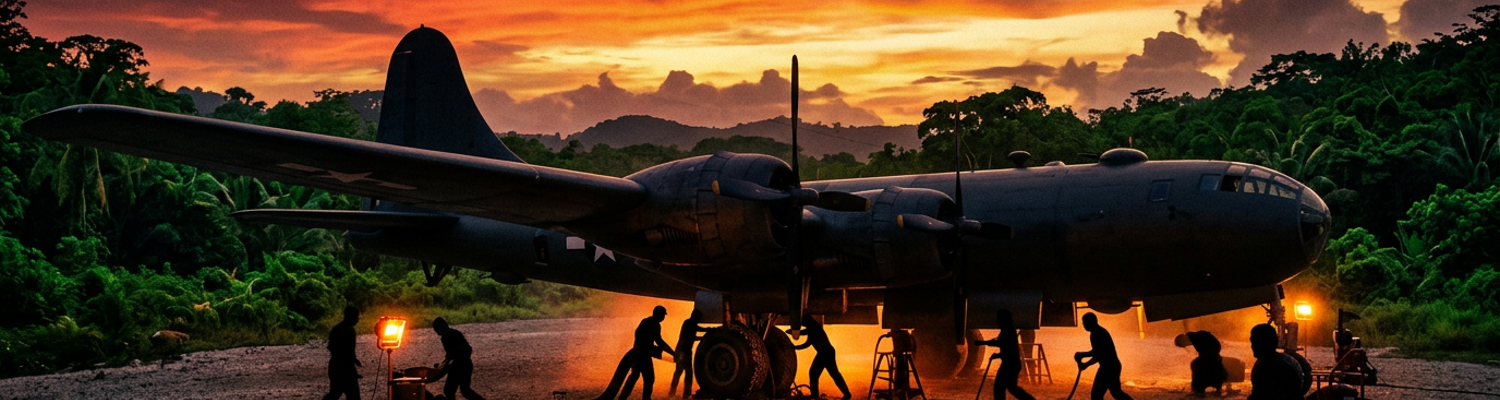

B-24J Conversions at Northwest Airlines Modification Center
Navigators across the South Pacific flew heavy bombers over unmapped archipelagoes using outdated prewar hydrographic charts and crude hand-drawn sketches. These poor maps left aircrews guessing at mountain elevations and coastline profiles, causing disastrous navigational errors and wasted bomb loads. Combat units needed accurate aerial maps before Allied invasion forces could assault fortified Japanese island bases. Standard twin-engine reconnaissance planes lacked the range and defensive firepower to survive long flights deep over enemy airspace. Army Air Forces commanders ordered factory-fresh heavy bombers stripped of their conventional ordnance gear and rebuilt into specialized long-range mapping platforms.
Consolidated B-24J Liberator heavy bombers rolled straight off assembly lines and flew into the commercial hangars of the Northwest Airlines Modification Center in St. Paul, Minnesota. Civilian machinists and military engineers tore out standard bomb racks, mechanical releases, and heavy armor plating from the massive four-engine airframes. The conversion team sealed off drafty fuselage seams and ran heavy electrical conduits to power complex photographic equipment. Technicians reinforced the structural bulkheads to carry the extra weight of the new mission gear and cut precisely measured optical ports through the aluminum skin of the lower fuselage. Workers installed flat panes of optical-grade glass into these circular openings.
Fairchild K-17 trimetrogon wide-angle camera arrays went directly into the nose compartment, locking into heavy shock-absorbing mounts positioned over the newly cut glass ports. These specialized trimetrogon setups combined three synchronized six-inch lenses, with one camera pointing straight down at the ground and two side cameras angling outward toward the horizons to capture wide panoramic strips. Technicians paired these mapping rigs with long-focal-length Fairchild K-18 reconnaissance cameras mounted inside the bomb bays alongside the wide-angle units. Electric heating jackets and insulated warm-air ducting enclosed each bulky camera body, shielding delicate mechanical shutters and celluloid film rolls from freezing in the thin air above twenty-five thousand feet. Skilled draftsmen and camera mechanics wired remote intervalometers into the forward cockpit, allowing a single photographic officer to trigger rapid exposures across all camera banks simultaneously.
Fuel tanks installed as supplementary internal cells inside the bomb bays gave these camera ships the extreme endurance required to map distant Pacific targets across eighteen-hour flights. Thousands of gallons of high-octane aviation gasoline packed tightly inside the forward bomb bay caused acute center-of-gravity shifts that severely degraded the flight characteristics of the F-7A. Test pilots wrestling with the heavily laden airframes reported sluggish elevator response, heavy control forces, and severe handling instability at heavy takeoff weights. Any sudden shift in internal fuel distribution threatened to push the nose downward during the critical climb after clearing the runway. Flight engineers counteracted this dangerous weight imbalance by calculating rigid fuel-burn schedules and manually operating transfer pumps between tanks to stabilize the modified Liberators.
Cabin Heating Failures and Shutter Freezes
Liberators arrived at frontline Pacific airfields and immediately climbed to mission altitudes exceeding twenty-five thousand feet to map enemy island positions beyond the reach of Japanese interceptors. Severe cabin heating distribution failures crippled these photographic flights almost immediately, as the factory-installed heating ducts sent nearly all available warm air into the forward cockpit. Operational photographic compartment temperatures plummeted below minus forty degrees Fahrenheit inside the converted bomb bays, overwhelming the thin insulation blankets glued between the structural ribs. Drafts of sub-zero air rushed through unsealed structural joints, nose wheel wells, and bomb bay seam cracks. Photographic technicians shivering inside the unpressurized fuselage watched the compartment thermometers bottom out as icy drafts swept unchecked through the converted camera bays.
Lubricants formulated for normal operating conditions congealed into heavy waxy paste inside the camera bodies as this extreme cold soaked through the aluminum airframe. Standard petroleum greases in the Fairchild K-17 and K-18 units stiffened until the delicate camera shutter mechanisms jammed halfway through their cycles. Exposure timing clocks suffered identical failures when the thickened oil seized their tiny gear trains, preventing the intervalometers from firing the synchronized cameras. Film strips tore apart when motorized rollers attempted to pull brittle frozen celluloid across immobilized sprockets. Camera operators peeled off their bulky sheepskin mittens to free the jammed levers with bare hands and repeatedly swapped out frozen components in sub-zero drafts.
Glass ports mounted flush against the lower fuselage skin frosted over completely because the factory conversion included no dedicated heating elements for the optical windows. Condensation gathered across the interior faces of these optical-grade glass ports whenever warm humid air escaped from the crew compartments into the freezing bomb bays. Heavy frost accumulation spread across the chilled glass panes within seconds, creating an opaque white barrier that blocked the camera lenses. Wide-angle lenses fired their shutters through this thick film of ice, producing washed-out blurry exposures that obscured coral reefs and concealed artillery positions. Photographic officers returned to base with miles of unusable film that showed only blank white blurs instead of the heavily defended anchorages required for invasion planning.
Mechanics in frontline maintenance huts dismantled the frozen camera systems and overhauled the airframe heating ducts to salvage the mapping program. Ground crews stripped the congealed factory grease out of every shutter mechanism and cleaned the precision teeth with gasoline before reapplying light watch oil mixed with kerosene. Sheet metal workers hammered scrap aluminum into makeshift hot-air scoops behind the engine superchargers, routing flexible canvas hoses into the camera bays to direct warm air directly across the optical glass ports. Flight engineers fitted manual scraper handles and alcohol wash bottles near the camera bays, allowing photographic technicians to wipe away condensation and ice crystals minutes before the cameras activated. Operational squadrons tested these modified Liberators over Japanese-held archipelagos and finally secured clear vertical and trimetrogon images.
Operations of the 20th Combat Mapping Squadron
F-7A Liberators deployed across muddy forward airstrips in the Southwest Pacific Area under the operational command of the 20th Combat Mapping Squadron. Pilots flew these specialized reconnaissance conversions onto raw crushed-coral runways carved out of thick jungle, establishing base operations at forward clearings like Port Moresby and Nadzab. Flight crews parked the converted four-engine bombers inside open dirt revetments without hangars or protective tarpaulins, exposing the aluminum airframes to relentless tropical downpours and blinding equatorial sunlight. Ground echelons lived in waterlogged canvas tents alongside the dispersed flight line, working through recurring malaria fevers and severe parts shortages while preparing the aircraft for grueling multi-thousand-mile charting missions. Daily operational taskings pushed the camera-equipped bombers over vast hostile ocean corridors to photograph heavily fortified Japanese airfields and shipping anchorages.
Film emulsions inside the parked camera bays softened and blistered as trapped interior cabin heat regularly exceeded one hundred and twenty degrees Fahrenheit during midday hours. Near-saturated tropical humidity seeped into every unsealed fuselage seam and access hatch, settling onto the massive rolls of wide-format aerial film loaded into the reconnaissance magazines. Moisture broke down the chemical emulsion layers on the exposed celluloid strips, turning the gelatin coatings into gummy paste that glued adjacent film layers together and jammed the motorized feed sprockets. Damp jungle air wreaked equal havoc on the intricate electrical harnesses powering the trimetrogon camera banks and intervalometers, sparking rapid galvanic corrosion across copper wire terminals and microswitches. Circuit breakers tripped repeatedly during preflight run-ups when soaked wiring shorted against structural stringers, while electric shutter motors seized after corroded internal brushes refused to turn.
Mechanics quickly realized that salvaging the camera systems would count for nothing if the heavily burdened aircraft remained too slow and low to survive over contested enemy airspace. Armorers tackled this vulnerability through drastic field modification procedures on the forward dispersals, attacking the airframes with wrenches and torches to cut away hundreds of pounds of protective steel armor plate from the cockpits and camera compartments. Ground crews maintained the heavy hydraulic nose turrets, retracted belly ball units, and serviced flexible waist machine guns, retaining essential defensive armament alongside massive steel ammunition cases. Sheet-metal workers riveted lightweight aluminum fairings over the emptied gun ports to smooth out aerodynamic drag and prevent high-altitude air leaks. Stripped F-7A Liberators gained the ability to climb to unrefueled operational ceilings exceeding thirty-two thousand feet, soaring cleanly above the effective reach of Japanese anti-aircraft fire and interceptors.
Mapping Runs Over the Formosa Strait
Pilots directed these high-altitude F-7A Liberators across the Formosa Strait on unescorted multi-hour deep-penetration flight profiles without fighter protection against Imperial Japanese Army interceptors. Allied escort fighters lacked the fuel capacity needed to reach the western side of Formosa, forcing the four-engine camera ships to operate completely alone across hundreds of miles of hostile water. Japanese radar stations along the shoreline detected the incoming Liberators, scrambling Nakajima and Kawasaki fighters from coastal airfields to climb toward the high-altitude intruders. Converted Liberators depended entirely on their extreme operational ceiling and sustained cruising speed to outrun these climbing pursuit planes. Navigators constantly checked compass headings and drift angles over the open water while flight engineers monitored fuel transfer pumps to keep the engines running at continuous high boost.
Engines strained against severe low-level turbulence as abrupt weather transitions and localized monsoonal squalls created extreme navigation hazards throughout the Taiwan maritime corridor. Towering storm clouds built up rapidly over the island mountains, generating heavy crosswinds that pushed the Liberators off course and obscured the coastline beneath dense bands of torrential rain. Pilots wrestled with the dual control wheels to keep the wings level while sudden vertical downdrafts caused the aircraft to drop hundreds of feet in seconds. Violent air currents threatened to misalign the delicate camera mounts in the converted bomb bays and break the electrical synchronization between the shutters and the intervalometers. Technicians in the rear compartment braced themselves against structural bulkheads, monitoring the optical glass heaters and camera drive gears as the aircraft pushed through the squall line into clear air over the target beaches.
Liberators locked into mandatory straight-and-level photographic runs, maintaining continuous ten to twenty-minute flight profiles directly through hostile flak envelopes over the fortified shoreline. Cartographic regulations required unyielding course headings and constant altitudes so that overlapping exposures could produce accurate stereoscopic terrain maps for Allied invasion planners. Japanese anti-aircraft gunners on the coast tracked the steady flight paths of the unarmed mapping planes and bracketed the bombers with dense barrages of heavy explosive shells. Shrapnel tore through outer wing panels and peppered the aluminum fuselage skin while the flight crews maintained their course without taking evasive maneuvers. Camera operators watched the intervalometers fire every few seconds, listening to the motorized film rollers advance while black bursts of flak detonated close to the wingtips.
Engineers monitored fluctuating oil pressures and inspected punctured skin panels as the Liberators completed the final photographic exposures and broke away from the coastal target grid. Technicians secured the exposed film magazines inside protective metal transport cases, verifying that the motorized sprockets had advanced hundreds of feet of film without tearing or jamming during the flak run. Navigators plotted return headings through the storm fronts of the Formosa Strait, calculating remaining fuel supplies to confirm the damaged bombers could reach forward landing strips in the Philippines. Ground crews waited on distant coral runways to meet the returning aircraft, ready to unload the exposed film canisters and rush them into field development laboratories for immediate cartographic evaluation.
Photogrammetry Operations Over Mako Naval Base
Technicians rushed the newly developed negative rolls to tactical planning rooms, where intelligence officers ordered a dedicated mapping sweep over the Imperial Japanese Navy anchorage and seaplane base at Mako in the Pescadores Islands. Pilots flew stripped F-7 Liberators back out over the Formosa Strait to carry out the systematic exposure of overlapping target mosaics across the sprawling island chain. Cameras clicked in the bomb bays at steady intervals of six to eight seconds, exposing sixty percent forward overlap along each survey track to give photogrammetrists the stereoscopic depth needed for beachhead and harbor mapping. Flight crews held the modified bombers on strict magnetic headings across the harbor entrance, allowing the wide-angle lenses to capture water depths, barrier reefs, and hidden seaplane ramps around the naval installation. Camera mechanisms advanced hundreds of feet of continuous acetate film as the aircraft traversed the harbor basin, recording every warship anchorage and sheltered inlet across an organized grid of high-altitude photographs.
Lenses mounted in the camera ports recorded precision vertical and oblique cartographic documentation of fortified coastal artillery positions, repair docks, and fuel bunkering depots scattered across the Makung shore. Technicians operating the long-focal-length Fairchild K-18 cameras focused directly on concrete gun revetments and underground fuel tanks, recording fine structural details that standard mapping passes missed. Oblique camera angles exposed areas beneath the camouflage netting that Japanese garrison troops had draped over hillside bunker complexes, documenting hidden revetments and ammunition storage caves along the coastal bluffs. Shutter timers fired simultaneously to synchronize the vertical cartographic cameras with the side-looking oblique units, producing matched sets of images that pinpointed the elevation of coastal gun emplacements above the high tide line. Cartographic specialists required these exact vertical measurements to determine the firing arcs of the Japanese naval batteries, ensuring invasion fleet navigators could steer troop transports outside coastal artillery kill zones.
Gunners guarding the Makung naval fortress opened fire as the high-altitude Liberators entered their third overhead mapping pass. Evasion of intense anti-aircraft fire and localized flak patterns concentrated around the fortress tested the structural limits of the modified Liberators during their repeated photo runs. Explosive shells bracketed the unarmed aircraft with dense black puffs of shrapnel, buffeting the wings and forcing the pilots to execute sharp climbing turns between photo lines to spoil the tracking solutions of enemy gun directors. Pilots kicked the rudder pedals and banked through the expanding flak bursts, diving into momentary clear pockets before leveling off to line up the next photographic strip. Shrapnel fragments ripped through the thin aluminum skin of the unarmored waist section, narrowly missing the delicate electrical lines that supplied power to the camera drive motors.
Camera operators inspected the vibrating film spools to confirm the drives had functioned continuously despite the concussions of nearby flak bursts. Flight engineers monitored engine oil temperatures and checked fuel transfer lines, verifying that the auxiliary bomb bay tanks had delivered enough gasoline to allow a safe withdrawal across the South China Sea. Pilots swung the scarred aircraft southward toward the Philippines, leaving the firing guns of Mako behind as the camera compartments cooled in the thin high-altitude air. Photogrammetrists in field laboratories prepared their stereoscopic drafting tables to convert the recovered film strips into detailed air objective folders, readying invasion planners for upcoming naval bombardments.
Intelligence Air Objective Folders and Target Destruction
Photogrammetrists assigned to Assistant Chief of Air Staff Intelligence teams unspooled the long rolls of aerial negative across backlit glass drafting tables to run detailed stereoscopic measurements. Technicians examined consecutive frames through optical mirror stereoscopes, calculating elevation changes down to the foot by measuring the precise shift of shadows cast by factory chimneys and radio towers. Cartographers combined these depth readings with coastal hydrographic soundings to build standardized Air Objective Folders, binding the multi-page target summaries in stiff manila covers for operational use. Every folder assembled for the Pescadores contained high-resolution photographic mosaics, annotated approach diagrams, and precise structural evaluations of the coastal defense batteries guarding Makung. Intelligence officers marked recommended bombing axes and anticipated anti-aircraft concentration zones directly over transparent tracing paper laid across the master photographs. Couriers packed these standardized target folders into waterproof canvas pouches and flew them immediately to forward air bases across the Philippines.
B-25 Mitchell crews of the Far East Air Forces unpacked these canvas pouches inside squadron briefing huts, spreading the target sheets across rough plywood tables to organize low-altitude strikes against Mako harbor. Flight leaders made direct application of the compiled target folders to plan mast-height runs, choosing entry headings that used outer island hills to block the line of sight from Japanese shore spotters. Twin-engine Mitchell bombers skimmed the waves of the Formosa Strait in tight formations, popping up over coastal headlands exactly where the F-7 photographic charts indicated gaps in the light anti-aircraft perimeter. Pilots triggered eight nose-mounted fifty-caliber machine guns to sweep gun crews from dockside revetments, while bombardiers released delayed-action bombs and parachute fragmentation clusters directly into dry docks, crane towers, and repair shops. Exploding ordnance tore through fuel pipes and collapsed wooden loading piers along the waterfront, leaving damaged merchant hulls burning at their berths. Crews reformed over the open water and turned south toward their home fields, leaving the surviving Japanese supply ships trapped inside the inner harbor basin.
Carrier air groups from Third Fleet Task Force 38 coordinated their flight divisions against these trapped targets, carrying identical Air Objective Folders into combat during their January 1945 sweep into the South China Sea. Fleet intelligence officers distributed photographic overlays of Mako to carrier ready rooms, allowing navy strike planners to assign specific vessel anchorages and anti-aircraft nests to dive-bomber and torpedo squadrons. Curtiss SB2C Helldivers and Grumman TBM Avengers pushed over into steep dives out of the morning cloud cover, matching the silhouettes of ships anchored below against the annotated harbor diagrams strapped to their flight boards. Navy pilots dropped heavy armor-piercing bombs and launched glide-bombing runs across the anchorage, blowing open cargo holds, wrecking escort vessels, and igniting fleet oilers that had taken shelter along the western seawall. Fighter pilots flying Grumman F6F Hellcats followed the bombing runs with rocket attacks and machine-gun passes against coastal gun pits that tried to engage the exiting bombers. Smoke from sinking transports and burning oil tanks covered the entire naval anchorage by late afternoon, confirming that the coordinated strikes had neutralized the remaining Japanese logistics vessels in Mako harbor.
Airframe Scrapping and Postwar Obsolescence
F-7 Liberators banked through the drifting smoke over the Formosa Strait to carry their final film rolls back to Philippine staging fields as combat operations across the Pacific theater came to an end. Photographic laboratory technicians quickly processed the final frames for maritime records, but tactical planners in Washington had already shifted their attention toward next-generation reconnaissance doctrine. Air Force strategists recognized the immediate postwar tactical obsolescence of the reciprocating-engine F-7 airframe in favor of higher-performance platforms such as the Boeing F-13 and jet reconnaissance aircraft. Boeing F-13 conversions of the B-29 Superfortress provided fully pressurized crew compartments, automated high-altitude camera controls, and cruising speeds that allowed continuous operations above thirty thousand feet without exposing crews to sub-zero cabin temperatures. Emerging jet reconnaissance designs promised even greater speed and climb rates, rendering the unpressurized piston-engine Liberator completely incapable of surviving against postwar jet interceptor networks.
Inspectors at forward Pacific depots unbolted structural access panels to assess the physical condition of the high-time reconnaissance fleet. Post-hostilities structural inspections documented severe wing-spar and fuselage fatigue caused by recurring maximum-gross-weight missions throughout the island campaigns. Overloaded auxiliary fuel tanks packed inside the bomb bays had repeatedly forced the airframes into violent takeoff runs from rough coral airstrips, twisting the internal wing spars under severe upward flexing and aerodynamic buffeting. Ground technicians detected extensive hairline fracture lines along primary wing carry-through joints and discovered popped structural rivets stretching across the corrugated fuselage bulkheads. Engineering evaluation teams calculated that repairing these heavily fatigued airframes would cost far more than purchasing newly manufactured aircraft, leading military commanders to declare the entire F-7 inventory permanently unairworthy.
Army Air Forces administrators initiated mass administrative demobilization to clear operational squadrons of the worn mapping planes. Base mechanics unbolted the valuable Fairchild cameras, navigation drift sights, and electronic radio gear, packing the specialized optical instruments into wooden crates for return shipping before riveting protective sheet metal over the empty camera ports. Skeleton ferry crews boarded the stripped aircraft to carry out the rapid flight delivery of surviving F-7 variants to desert reclamation depots across the American Southwest. Delivery pilots guided the aging reconnaissance planes on one-way flights across Pacific island stepping stones, touching down at vast storage installations such as Kingman Army Airfield in Arizona and Walnut Ridge in Arkansas. Dispersal teams directed the arriving aircraft onto wide gravel hardstands, disconnecting the electrical batteries, draining remaining fuel from the auxiliary lines, and chalking yellow disposal codes across the nose cowlings.
Workers moved down the dusty storage lines with pneumatic shears and acetylene torches to dismantle the retired aircraft for commercial scrap. Salvage laborers sliced away the high-aspect-ratio Davis wings, unbolted the twin rudders, and cut the camera-equipped fuselages into portable chunks of raw sheet metal. Bulldozer operators shoved the flattened aluminum carcasses directly into commercial smelting yards operating along the perimeter of the desert airfields. Industrial furnaces melted down thousands of pounds of airframe aluminum at high heat, pouring the molten metal into rectangular ingots intended for civilian manufacturing and postwar consumer goods. Heavy crane claws dumped the remaining steel engine mounts and iron landing gear struts into waiting railroad freight cars, clearing the desert ramps of the camera ships that had mapped the Formosa Strait.