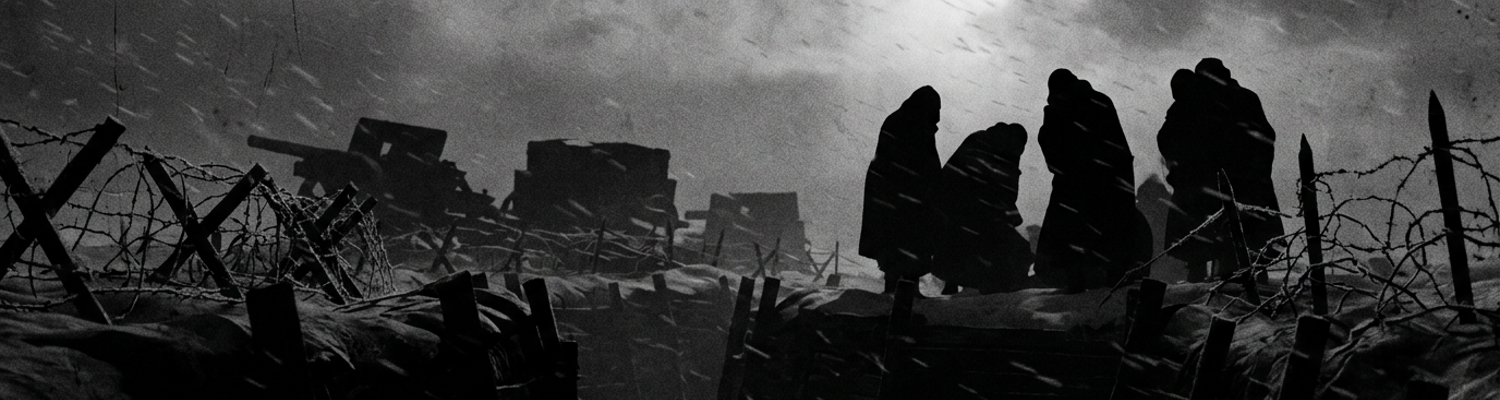

Arctic Fortifications at the Ust-Padenga Outpost
At dawn on the Ust-Padenga bluffs, absolute silence hung over the frozen Vaga River valley. Not a rifle discharged across the four-foot snowdrifts. The wind had stalled. Ambient temperatures pinned at forty-five degrees below zero Fahrenheit. Soldiers of Company A, 339th Infantry Regiment, alongside detachments of the 310th Engineers, spent the opening weeks of January 1919 attempting to carve defensive positions out of the taiga. Subzero blizzards repeatedly buried their progress. Newly cleared traverses filled with packed snow within thirty minutes. Archival evidence shows that these men faced weather conditions that froze the lubricating oil inside Lewis machine guns. Issue wool overcoats turned into brittle shells. Captain Charles G. Phillips placed his forward platoon atop a narrow ridge at Nijni-Gora. He ordered round-the-clock shifts to throw up parapets before the Red Army could advance down the frozen riverbed.
Permafrost hardened the tundra to the density of reinforced concrete.
Standard Model 1910 entrenching tools failed immediately upon contact with the topsoil. Soldiers drove stamped-steel shovel blades and light pick mattocks into the frozen peat. The metal snapped clean at the socket. Sometimes it shattered across the blade face. A close review of operational logs indicates that the 310th Engineers exhausted their entire supply of replacement wooden handles within forty-eight hours of breaking ground. Work parties built localized fires with pine branches to thaw the upper six inches of mud. They shoveled away the resulting slush and repeated the process foot by foot. Open fires proved too slow to meet defensive schedules. Combat engineers detonated quarter-pound blocks of TNT to crack the surface. The blasts left jagged craters that squads leveled out using two-man felling axes brought down from British supply depots at Shenkursk.
Every explosion signaled the American positions directly to Soviet spotters.
Red Army forward observers from the 6th Army occupied elevated vantage points across the river. They adjusted field batteries by watching timber stockpiles collect on the ridge. American work parties hauled spruce logs from the nearby tree line. They stacked them into double-walled revetments filled with packed earth to resist high-explosive fragments. Working during daylight exposed the construction parties directly to Soviet 75mm guns and three-inch Putilov field pieces. The 339th Infantry strung barbed wire aprons exclusively during brief lulls or in the arctic twilight. Engineers drove wooden stakes into holes bored through the ice-bound ground. They strung coils of British barbed wire while wearing bulky mittens. The mittens ripped raw skin whenever bare fingers contacted the freezing metal. Soviet shrapnel shells clipped the pine parapets while work crews were still spiking the top crossbeams. The half-finished redoubts sprayed iron shards and splintered wood across the trench lines.
This small forward outpost on the Vaga represented an unstable geopolitical gamble by the Allied Supreme War Council.
Committees committed American troops to northern Russia without clear diplomatic agreements between Washington and Whitehall. British Brigadier General Edmund Ironside insisted on holding Ust-Padenga to protect the supply base at Shenkursk. Officials in the United States Senate questioned the legal authority for keeping Michigan infantrymen stationed along an unmapped Russian river. Strategic friction surrounding this position reached its peak on January 18, 1919. Soviet commanders massed two full infantry brigades, twelve artillery pieces, and three thousand rounds of shrapnel shells against the Nijni-Gora parapets.
Tactical Pressures along the Dvina River Front
Archival evidence shows that elements of the 339th Infantry Regiment found themselves strung out along a fractured line. The line stretched more than two hundred miles south of their maritime supply terminal at Archangel. Outposts at Toulgas on the Northern Dvina and along the winding bed of the Vaga River operated in complete geographic detachment. Frozen marshes and dense boreal forests separated them from brigade headquarters. Supply lines depended entirely on single-track horse cart trails and sledge routes running along packed snowdrifts. Round-trip transit required up to ten days.
Reinforcements lay a week away across trackless snow.
Telephone lines snapped continuously under accumulating rime ice. The 310th Field Signal Battalion hastily laid these lines across pine trees. Roving Bolshevik ski patrols frequently severed the remaining connections. The Dvina froze solid until May. Naval gunboats could no longer provide suppressive artillery support. Small detachments of forty to sixty American soldiers found themselves isolated inside wooden blockhouses. Every tactical outpost had to function as an independent redoubt. They were unable to request immediate reinforcements if Soviet battalions severed the solitary road heading north.
Environmental exposure incapacitated men faster than enemy rifle fire during defensive operations along the Vaga River.
A close review of operational logs indicates that ambient temperatures frequently dropped below minus forty-five degrees Fahrenheit. Tallow grease solidified inside the mechanisms of American-issued Westinghouse Mosin-Nagant rifles. British Vickers machine guns jammed during active skirmishes. Soldiers stationed in exterior foxholes suffered deep-tissue frostbite within fifteen minutes of sentry duty. Bare skin tore away upon contact with frozen steel breeches or brass cartridge casings. Battalion medical reports from the 337th Field Hospital at Shenkursk recorded specific casualty data. Over one-third of company-level casualties stemmed directly from black gangrene in toes and fingers rather than combat shrapnel. Transporting wounded men north required open horse-drawn rospuski sledges covered only with canvas tarpaulins. This journey routinely turned minor extremity frostbite into fatal hypothermia before the casualties could reach surgical tents at Bereznik.
Frozen limbs accounted for more hospital admissions than Bolshevik artillery.
This forward posture triggered sharp disagreements between British headquarters staff and American tactical commanders on the ground. Major General Edmund Ironside pursued a British War Office strategy aimed at pushing deep south toward Kotlas. He wanted to achieve a physical junction with the anti-Bolshevik army of Admiral Alexander Kolchak in Siberia. American field officers openly protested this deployment. Regimental commander Colonel George E. Stewart and frontline captains pointed out that President Woodrow Wilson had authorized the expedition solely to secure Allied military stores at Archangel. Operational orders issued by British sector chiefs forced small American companies to hold indefensible salients far beyond the range of mutual artillery protection.
Friction intensified when American platoon leaders discovered British officers remaining safely housed at base depots.
US infantrymen guarded the outermost pickets. This divergence in military philosophy sparked immediate diplomatic protests. Reports of American units facing encirclement reached the United States Senate. Lawmakers provoked sharp demands for an immediate withdrawal of American armed forces from Russian territory. Field reports dispatching from Shenkursk during mid-January confirmed that Soviet forces under the 6th Army had begun massing along the flanks of the American Vaga River positions. They possessed superior numbers and heavy artillery. British sector directives ordered the American companies to hold their forward trenches to the last man. The orders explicitly forbade planned retrograde movements toward the secondary line at Bereznik. Captain Charles G. Phillips received orders to retain the high ground at Nijni-Gora despite facing an opposing force outnumbering his platoon five to one. By January 19, 1919, Soviet field guns opened fire on the forward American log dugouts. The bombardment destroyed the single wire telegraph connection to Shenkursk within twenty minutes.
Allied Administration of the Mudyug Island Stockade
Mudyug Island sat forty miles north of Archangel inside the frozen approach channels of the Dvina Gulf.
Archival evidence shows that Allied military authorities opened the penal facility on August 23, 1918. They converted an isolated maritime quarantine post and pilot station into a maximum-security internment stockade. French naval officers operated with the formal consent of the British military command and the anti-Bolshevik Provisional Government of the Northern Region. They established the camp to process captured Red Army combatants, dockyard strike leaders, and suspected political agitators. Two concentric rows of barbed-wire fencing enclosed three single-story wooden sheds previously used to store maritime gear. The engineers strung the wire between heavy pine posts cut from the island interior. Sentries drawn from French colonial marine detachments and British-supervised Russian personnel manned four corner watchtowers. The towers featured searchlights and Hotchkiss machine guns aiming their fields of fire directly across the treeless sand spit.
Access depended entirely on small dispatch tugs pushing through the narrow Murmansk channel.
Pack ice sealed the bay in November 1918. Over one thousand prisoners remained locked inside the perimeter with guard details that answered to fragmented command chains in Archangel. Escape across the surrounding sheet ice meant immediate death by hypothermia. A close review of operational logs indicates that the stockade administration deliberately capped daily food allotments at six hundred calories per internee. The standard morning ration consisted of three ounces of moldy rye biscuit and a tin of hot water steeped with dried fish scraps. Scorbutic ulcers spread across the camp population by early December. Internal body weights plummeted by forty percent within sixty days of arrival. Barrack blocks possessed single-skin softwood walls full of wide gaps. Arctic sea gales blew drift snow straight through the boards onto the stacked wooden sleeping shelves.
Internees slept pressed together on bare pine planks without straw mattresses or woolen blankets.
Prisoners burned green birch bark in two cracked cast-iron stoves that produced suffocating soot instead of warmth. Body lice rapidly saturated these unwashed wool garments. An epidemic of louse-borne typhus triggered by mid-winter. Camp medical personnel lacked both sulfur delousing chambers and basic cardiac stimulants. Orderlies stacked sixty unburied corpses inside an unheated fish salting shed when the permafrost prevented the excavation of burial trenches. Joint intelligence oversight at the camp fractured along national and ideological fault lines between American observers and White Russian authorities.
Field agents from the American Military Intelligence Division reported directly to the Allied Military Control office in Archangel.
They cataloged instances where White Russian counter-intelligence officers from the Kontrrazvedka conducted summary executions without Allied military tribunals. White Russian general Vladimir Marushevsky insisted on complete judicial authority over Russian subjects interned on the island. He viewed all political dissidents as mutineers subject to martial law. American diplomatic liaisons feared that reports of stockade atrocities would leak to anti-intervention senators in Washington. They also worried the news would incite general strikes among the eight thousand Russian dockers unloading Allied transport ships at Bakaritsa. Intelligence officers documented how White Russian guards traded intelligence with Bolshevik prisoners in exchange for jewelry or promised immunity in the event of an Allied evacuation. This collapse of trust led American officers to withdraw from formal inspection rounds by February 1919. White Russian interrogators assumed unchecked control of the interrogation cells.
Detainee Revolt and Escalating Prison Instability
On February 15, 1919, twenty-four prisoners disarmed an exterior guard patrol with stolen iron spikes.
They fled into the offshore blizzards toward the mainland. This escape attempt exposed the severe operational vulnerabilities within the Mudyug Island stockade. Archival evidence shows that the remaining detainee population recognized the numerical weakness of the garrison. The camp held over eight hundred surviving prisoners guarded by fewer than fifty active sentries. Typhus had incapacitated a significant portion of the French colonial detachment. White Russian conscripts assigned to perimeter duty began abandoning their posts during night shifts. Shifting loyalties among the White Russian wardens accelerated the breakdown of camp security.
Bolshevik detainees established clandestine communication networks with sympathetic guards.
A close review of operational logs indicates that several Russian sentries actively smuggled files and heavy iron tools into the barrack blocks. The guards recognized the deteriorating military situation along the Vaga River. They sought to secure leniency from the Red Army in the event of a Soviet victory. Prisoners used the smuggled tools to pry loose the heavy pine floorboards inside the main detention shed. They stockpiled makeshift weapons including sharpened wood splinters, heavy iron stove grates, and lengths of rusted chain. The internal camp leadership organized a coordinated uprising scheduled for the morning ration distribution.
The revolt commenced at dawn on March 8, 1919.
Over two hundred detainees rushed the central courtyard when the guards unlocked the barrack doors. They overwhelmed the initial sentry detail through sheer numbers. The prisoners seized three bolt-action rifles and immediately opened fire on the southern watchtower. French machine gunners responded by sweeping the courtyard with Hotchkiss fire. The heavy caliber rounds splintered the wooden barrack walls and struck dozens of unarmed prisoners attempting to flee the crossfire. A group of detainees managed to breach the inner barbed-wire fence using heavy wooden planks as ramps. They engaged in hand-to-hand combat with the remaining White Russian guards near the administrative block.
The fighting lasted for forty-five minutes.
Camp authorities eventually suppressed the uprising by deploying a reserve squad armed with hand grenades. The detonation of explosives within the confined courtyard caused severe casualties among the rioters. Medical reports filed by the Allied Military Control office documented forty-two prisoners killed during the revolt. Another seventy suffered severe gunshot or shrapnel wounds. The garrison lost four guards killed and nine injured. Following the suppression of the revolt, White Russian authorities instituted severe punitive measures. They executed suspected ringleaders without trial and further reduced the daily caloric rations for the entire camp population. The violence at Mudyug Island demonstrated the complete failure of the Allied internment strategy.
Congressional Backlash and the Hiram Johnson Revolt
Clandestine reports detailing Mudyug detainee mortality and trench frostbite reached Capitol Hill in March 1919.
Archival evidence shows that handwritten field diaries, unauthorized letters, and unofficial casualty manifests slipped past Allied military censors at Archangel. Discharged civilian workers from the American Red Cross and returning YMCA couriers concealed soldier accounts inside personal luggage aboard outbound transport steamers leaving the White Sea. These packets bypassed British naval intelligence inspectors before landing directly on congressional desks in Washington. Michigan representatives received direct accounts from constituent families whose sons served in the 339th Infantry Regiment. The documents provided lawmakers with their first unvarnished records of operations along the frozen Vaga and Dvina river sectors.
Censors at Archangel had lost control of the outbound mail.
A close review of operational logs indicates that the smuggled files detailed horrific physical trauma among the doughboys holding advanced pickets at temperatures dropping past forty degrees below zero. Letters from frontline medics described soldiers enduring third-degree frostbite during fifteen-minute sentry rotations at Nijni-Gora and Ust-Padenga. Blackened fingers and toes sloughed away before field surgeons could administer basic antiseptic wash. Even more alarming to lawmakers were eyewitness memos detailing conditions inside the French-administered stockade on Mudyug Island. The accounts described how typhus and extreme malnutrition claimed dozens of emaciated prisoners each week in unheated wooden sheds. Guards stacked unburied corpses in fish warehouses. American officers stationed near the Dvina Gulf confirmed that Allied authorities capped prisoner rations at six hundred calories of moldy rye biscuit per day.
Conscripts were freezing along an unmapped Russian front while Allied administrators operated an arctic penal colony.
Senator Hiram Johnson of California seized these disclosures to mount an aggressive, weeks-long revolt across the Senate floor. Johnson challenged the constitutional authority of President Woodrow Wilson to wage an undeclared military campaign against Soviet forces. Standing before the Senate chamber, the California progressive demanded an immediate accounting. He wanted to know who authorized American soldiers to advance two hundred miles into the Russian interior under direct British operational command. Johnson introduced formal resolutions demanding the immediate recall of all American expeditionary troops from Archangel. He argued that the executive branch had usurped the war powers reserved exclusively for the legislative branch under Article I of the Constitution. Debate grew venomous as administration loyalists struggled to produce a treaty or statutory authorization for combat actions along the Northern Dvina.
Johnson forced a roll-call vote on troop withdrawal.
The vote tied at thirty-three votes apiece. Vice President Thomas Marshall cast the deciding ballot to table the inquiry. Public anger erupted nationwide as citizens realized their soldiers were being killed months after the November 11, 1918 armistice with Germany. Families across Michigan, Wisconsin, and Illinois formed grassroots leagues to bombard the War Department with petitions. They demanded the immediate repatriation of the 339th Infantry. Parents opened telegrams announcing the deaths of their sons at Ust-Padenga and Toulgas in late January and February 1919. They struggled to comprehend why combat operations persisted long after the European war had ceased. Detroit civic organizations held public rallies where speakers read casualty tallies detailing over two hundred American battle deaths and fatal influenza cases in the Russian snow. The Michigan State Legislature adopted concurrent resolutions petitioning Congress to bring the troops home without delay.
War Department Directives and the North Russia Evacuation
The War Department yielded to the political pressure on March 18, 1919.
Archival evidence shows that Secretary of War Newton D. Baker formally transmitted the decision to withdraw all American combat units from northern Russia. The orders dictated departure as soon as spring ice conditions permitted transit out of the White Sea. Acting under direct instruction from President Woodrow Wilson following mounting domestic fury, Baker bypassed British objections. He directed Army Chief of Staff General Peyton C. March to draft immediate redeployment timetables. The War Department selected Brigadier General Wilds P. Richardson, an officer with extensive arctic operational experience from Alaska. They ordered him to proceed to Archangel to execute the evacuation. Baker specified that the 339th Infantry, the 310th Engineers, and attached ambulance detachments were not to participate in any expanded Allied spring offensives toward Kotlas or Viatka. American forces were restricted strictly to defensive postures along the Vaga and Dvina rivers. They held their redoubts until maritime lanes through the White Sea opened in late May.
Washington severed the tactical lifeline without coordinating an exit strategy with British headquarters.
A close review of operational logs indicates that the withdrawal order triggered an immediate collapse in the authority of the anti-Bolshevik Provisional Government of the Northern Region. General Evgenii Miller had assumed effective control of the White Russian administration in Archangel after Nikolai Tchaikovsky departed for Paris. Miller found himself politically and militarily isolated. Without American manpower securing the advanced pickets, White Russian conscription efforts collapsed across rural settlements south of the Dvina. Local peasant recruits knew that Allied expeditionary battalions were packing their equipment for departure. They refused to take the oath of allegiance to Miller or report to training depots. Mutinies erupted inside newly raised White units. The 1st Archangel Regiment murdered its officers and defecting to Bolshevik detachments near Obozerskaya. Soviet 6th Army commanders capitalized on the disarray. They launched concentrated artillery strikes against forward White positions that no longer enjoyed American machine-gun support.
White Russian recruitment officers faced armed defiance whenever they entered riverbank villages.
The physical disengagement of the 339th Infantry Regiment required a phased retreat across two hundred miles of melting terrain. Beginning in late April 1919, newly arrived British relief brigades under Brigadier General George Grogan moved into the forward log blockhouses at Toulgas, Nijni-Gora, and Bereznik. They relieved the exhausted doughboys. American companies withdrew northward along the muddy banks of the Dvina. They hauled Lewis guns, mortar tubes, and medical crates aboard flat-bottomed wooden barges while river ice fractured around their hulls. Units holding rail outposts along the Vologda line dismantled their field telephone networks. They boarded narrow-gauge boxcars and assembled at the staging grounds of Economia and the Archangel port perimeter. By May 26, port authorities began processing over five thousand American troops through medical fumigation stations and customs sheds on the Dvina waterfront. Soldiers surrendered British issue equipment. They turned over their surplus ammunition supplies to British ordnance depots and received clean wool uniforms for sea transit. Between June 2 and June 15, the soldiers boarded British transport ships, including the steamers Czar, Czaritza, and Porto, which were moored along the Bakaritsa docks.
On June 16, 1919, the transport ship Porto weighed anchor and steered through the narrow swept channel past Mudyug Island into the open waters of the Arctic Ocean.
The American departure from Archangel finalized the collapse of the Northern Front. The withdrawal demonstrated that tactical endurance on the ground could not sustain a military intervention lacking clear legislative authorization and domestic political support. The diplomatic fallout of the Siberian and North Russian expeditions permanently hardened relations between Washington and the newly formed Soviet state. The frozen trenches at Ust-Padenga and the mass graves at Mudyug Island established a foundation of mutual hostility that dictated global military strategy for the next seventy years.