
Naval aviation training manuals of the late 1950s offered a vision of clear skies. They described an environment where carrier-based attack aircraft would confront threats that were understood and largely static, a continuation of tactics from the Korean War. The conditions awaiting pilots over North Vietnam involved a new dimension of lethality, one for which no manual existed.
A close review of operational logs shows that pre-Vietnam doctrine for the Suppression of Enemy Air Defenses (SEAD) was reactive. The concept focused on striking known, fixed anti-aircraft artillery (AAA) emplacements, a holdover from World War II strategy. No dedicated, systematic approach existed for proactively hunting and destroying the command, control, and radar elements of a modern, integrated air defense system. Early electronic warfare efforts centered on passive countermeasures like chaff or basic jamming. The idea of a dedicated hunter-killer mission to eliminate an enemy's electronic eyes was not a formalized component of naval strike planning.
Into this doctrinal void flew the Douglas A-4 Skyhawk. The aircraft was the physical manifestation of designer Ed Heinemann’s obsession with minimalism, a direct response to the trend of larger, heavier, and more complex combat jets. Its primary design goal was to deliver a single nuclear weapon or a conventional bomb load from a carrier deck. Weighing half of the Navy’s original specification, its delta wing was so compact it did not require the heavy folding mechanisms common to other carrier aircraft. The A-4 was a study in simplicity, a nimble and cost-effective attack asset. It was not, however, designed for a sophisticated electronic warfare role. Its small airframe offered little room for the bulky electronics and specialized weapons that would soon become necessary for survival.
It was a delivery vehicle, not a hunter.
The strategic landscape changed on July 24, 1965. On that day, a Soviet-made S-75 Dvina surface-to-air missile, designated SA-2 Guideline by NATO, climbed into the sky west of Hanoi and destroyed a U.S. Air Force F-4C Phantom. For the American pilots prosecuting Operation Rolling Thunder, the war had been irrevocably altered. The SA-2 was a large missile that could reach altitudes of 82,000 feet and speeds of Mach 3.5, making it lethal to the medium and high-altitude bombing profiles then in use. The initial American response was a failure. A retaliatory strike three days later against the suspected SAM sites resulted in the loss of six F-105 Thunderchiefs to conventional AAA. The North Vietnamese had moved the mobile missile launchers and left behind a flak trap. An urgent requirement for a new type of warfare was established. The Navy, needing a carrier-based solution, turned to the A-4 Skyhawk. This began the "Iron Hand" missions, the first true naval SEAD operations. These were high-risk affairs where A-4s would act as bait, deliberately flying to trigger the "Fan Song" guidance radar of an SA-2 battery. Once the radar locked onto the Skyhawk, a second aircraft would fire an AGM-45 Shrike anti-radiation missile, designed to home in on the radar emissions. The early Shrike was a primitive weapon with a fixed seeker head that had to be tuned to a specific radar frequency before the mission. Its limited range often required the pilot to fly directly at the missile site. The A-4, a simple bomb truck, was now a hunter, its pilots forced to invent tactics in hostile skies.
The adaptation of the Douglas A-4 Skyhawk for the SEAD mission was a field-expedient solution. This diminutive attack jet, valued for its simplicity and small carrier footprint, was never envisioned as an electronic warfare platform. Its transformation began with the urgent need to counter North Vietnamese SA-2 Guideline missile sites. The initial approach was crude, adding new capabilities with minimal airframe modification. The primary weapon was the AGM-45 Shrike, an anti-radiation missile developed by the Navy from the AIM-7 Sparrow air-to-air missile. This weapon was designed to home in on the emissions from the SA-2’s "Fan Song" guidance radar. The early Shrike was a basic tool. It had a fixed seeker head, meaning its sensor had to be tuned to a specific radar frequency band on the carrier deck before the mission began. If the enemy used a different frequency, the missile was useless. The A-4E and A-4F models assigned to the task were fitted with the APR-25, a radar homing and warning (RHAW) receiver that provided the pilot with a visual bearing to a threat radar on a small cockpit scope, accompanied by audible tones. This gear gave the pilot a direction, but little else.
This was not a platform for standoff engagement.
The Shrike’s limited range, in some versions as little as seven miles, was shorter than that of the SA-2 it was hunting. This forced pilots into a perilous tactical situation. The core of the "Iron Hand" mission profile required the A-4 pilot to fly directly toward the threat radar to get the Shrike close enough to launch. This meant deliberately acting as bait, hoping the enemy radar operator would keep their system active long enough for the Shrike to guide, but not long enough for the SA-2 to complete its own intercept. The A-4’s small airframe, lacking space for extensive electronics or redundant systems, made it a high-risk platform for such a mission.
Operating this new mission from an aircraft carrier introduced another layer of constraints. A close review of operational logs shows that the A-4’s celebrated small size was both a benefit and a liability. While it allowed for more aircraft to be packed onto the deck of a carrier like the USS Hancock (CVA-19), its limited internal fuel capacity became a vulnerability. An A-4 configured for an Iron Hand mission, carrying two AGM-45 Shrikes and perhaps rocket pods for marking targets, had significantly reduced range and loiter time over enemy territory. This forced mission planners into predictable flight paths dictated by the carrier’s position offshore and the aircraft’s fuel endurance, giving North Vietnamese defenders a temporal and geographic advantage. Maintenance crews, already stretched thin, now had to service unfamiliar and often temperamental electronic pods and missile interfaces in the cramped, high-pressure environment of a carrier at sea. The constant demand for SEAD escorts on nearly every major Alpha strike meant that the few modified airframes and qualified pilots were perpetually cycled into the most dangerous missions, leading to high operational tempo and combat fatigue.
Pilot training for this entirely new form of warfare was almost nonexistent in a formal sense. No established schoolhouse or syllabus for hunting SAMs existed. Instead, attack pilots from squadrons like VA-55 were thrust into the role, forced to develop tactics through trial and error over North Vietnam. A pilot’s primary interface with the enemy was the cryptic display of the APR-25 scope and a series of audio cues in his headset. He had to interpret these signals, fly his aircraft low and fast through heavy anti-aircraft artillery, and make a split-second decision to launch his missile. The entire engagement was a high-stakes gamble. The pilot had to point his entire aircraft at the threat to get a missile lock, a maneuver that made him a perfect target. If the "Fan Song" operator simply switched off his radar, the Shrike would lose guidance and fly ballistic. The A-4 pilot, now deep in the engagement zone and out of options, would be left completely exposed. This tactical knowledge was passed down from tour-veteran to replacement pilot not in a classroom, but in the quiet of a carrier ready room.
The urgent need for an anti-radiation missile came into sharp focus with the confirmed introduction of the Soviet SA-2 Guideline system in North Vietnam. The appearance of the SA-2’s "Fan Song" guidance radar fundamentally changed the air war, rendering existing high and medium-altitude bombing tactics nearly suicidal. In response, the U.S. Navy tasked its Naval Ordnance Test Station (NOTS) at China Lake with developing a counter-weapon at maximum speed. A review of the program’s origins (under project designation ASP-I) shows a clear mandate for expediency over perfection. To accelerate development, engineers decided against a clean-sheet design, instead opting to modify an existing weapon. They selected the airframe of the AIM-7C Sparrow III air-to-air missile, a proven design that could be readily adapted. This decision provided a known rocket motor, airframe, and control surfaces, drastically cutting down on research and development time. The core of the project, conducted by Texas Instruments, involved replacing the Sparrow’s semi-active radar seeker with a new, purpose-built passive radiation homing guidance section. The resulting weapon, designated the AGM-45 Shrike, was a product of this rapid, compromised development process, going from concept to initial deployment in a remarkably short period.
The technological heart of the Shrike was its passive homing guidance system, a piece of engineering that was rudimentary and, at times, inadequate. The seeker head did not contain a sophisticated broadband receiver capable of scanning across the electromagnetic spectrum. Instead, it housed a simple crystal video receiver tuned to a specific, narrow frequency band. This design choice meant that a Shrike missile had to be physically configured on the carrier deck or at an airbase before a mission even began. Maintenance crews would install a specific seeker module, one of several different versions, that corresponded to the presumed operating frequency of the target radar. There were different seeker heads designed to detect the various bands used by Fan Song, "Fire Can," and other Soviet-bloc radar systems. If intelligence was faulty, or if an enemy radar operator switched to a different frequency than anticipated, the Shrike was rendered completely ineffective. The missile’s logic was simple: its fixed antenna would detect the strongest point of radar emission within its narrow field of view and command the control fins to steer the weapon toward it. There was no memory or advanced processing; if the target radar was turned off, the Shrike would lose guidance and fly ballistically.
An A-4 Skyhawk pilot hunting for a SAM site relied entirely on a new and often overwhelming suite of cockpit electronics to acquire a target. The primary tool was the AN/APR-25 Radar Homing and Warning (RHAW) system. This system used four spiral antennas mounted on the aircraft’s fuselage, two facing forward and two aft, to detect radar emissions. Inside the cockpit, this information was presented to the pilot on a small, three-inch cathode-ray tube display. Threats appeared as lines, or "strobes," radiating from the center of the screen, with the line’s direction indicating the bearing to the emitter. Accompanying the visual display was a series of distinct audio tones played in the pilot’s headset, with the pitch and cadence changing to identify the type of radar detected. To engage a target, the pilot had to first identify the threatening strobe on his APR-25 scope. He would then have to point the entire A-4’s nose directly at that strobe, as the Shrike’s own seeker had a very restrictive field of view, essentially looking straight ahead. This maneuver, required for the missile to gain a lock, simultaneously placed the aircraft on a predictable, non-evasive flight path, making it a perfect target for the very SAM battery it was trying to destroy.
The core of the AGM-45 Shrike was a study in compromised engineering, a weapon system rushed from concept to combat. Its guidance section was not a sophisticated electronic brain. A close review of the missile’s design reveals that its seeker head contained a simple crystal video receiver tuned to a specific, narrow frequency band corresponding to a known enemy radar system. There was no onboard logic to process a complex electromagnetic environment or a memory to recall a target’s last known position. The missile functioned on a simple premise: detect the strongest point of radar emission within its pre-set frequency and steer toward it. If the North Vietnamese "Fan Song" radar operator simply turned off his transmitter, the Shrike instantly lost its only source of guidance and became an unguided 390-pound rocket. This design forced an enormous tactical burden back onto the supply chain and pre-mission planners. Several different seeker head modules had to be manufactured, cataloged, and shipped to carriers on Yankee Station, each designed for a different radar band. If intelligence failed to correctly predict the frequency the SA-2 battery would use on a given day, the entire mission was compromised before the pilot even manned his aircraft.
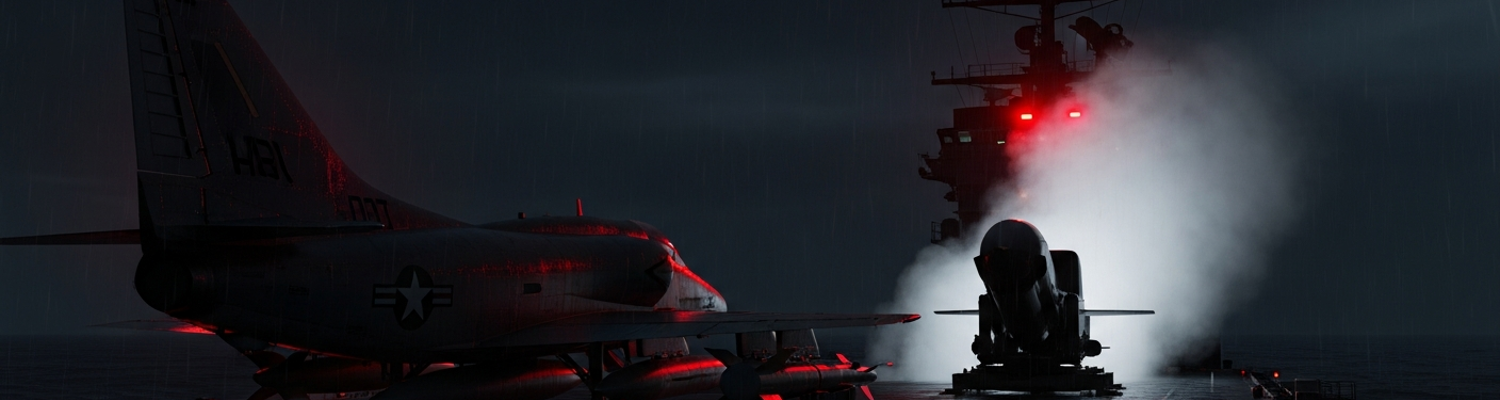
The strain of this technological inflexibility fell squarely upon the shoulders of the Aviation Ordnancemen working on the flight decks of carriers like the USS Hancock (CVA-19). Archival analysis of carrier operational procedures highlights the pressures these crews faced, particularly during night operations. The flight deck of a carrier at sea is one of the most hazardous industrial environments on Earth. At night, it became a choreographed vortex of darkness, noise, and controlled violence. Ordnancemen, known as "AOs" or "ordies," had to maneuver heavy munitions across a pitching steel deck slick with salt spray and hydraulic fluid, all while jet engines screamed and aircraft were taxied in close proximity. The task of loading a Shrike onto an A-4 Skyhawk’s pylon was a physically demanding job that required precision and teamwork in the worst of conditions. Compounding this was the electronic preparation. Guided by orders passed down from the ship’s Combat Information Center, the ordies were responsible for selecting and installing the correct seeker head for that specific mission. This was not a simple plug-and-play operation. It involved opening up the missile, carefully handling the delicate electronic modules in the open, often humid sea air, and ensuring a proper connection. A single dropped module or a misaligned pin could render the multi-thousand-dollar weapon useless.
The pre-flight programming of the Shrike was where the isolation of high-level command collided with the unforgiving physics of the weapon. The entire process was a rigid chain of assumptions. It began miles away with an intelligence analyst interpreting electronic signals intelligence, trying to guess the specific operating parameters of a mobile SAM battery hidden in the jungles of North Vietnam. That guess was relayed to strike planners, who then issued a directive for the ordnance loadout. This directive flowed to the ordnancemen on the flight deck, who then had to physically configure the missile based on that chain of information. There was no room for adaptation once the process was complete. A pilot launching off the catapult had a weapon tuned for a single, specific electronic signature. He had no ability to adjust the missile’s seeker in flight. If he encountered a different radar threat, his primary SEAD weapon was dead weight.
The operational tempo of Iron Hand missions over North Vietnam created a voracious appetite for AGM-45 Shrike missiles, an appetite that the Pentagon’s supply chain consistently failed to satisfy. A review of ordnance consumption rates versus production capacity reveals a chronic deficit. The total production run of the Shrike across all variants was approximately 18,500 units. This number seems substantial until cross-referenced with combat expenditure and a low success rate, which some pilots estimated to be around 25 percent. Each SEAD mission required multiple aircraft carrying at least two Shrikes, and with the proliferation of SA-2 sites, these missions became a daily feature of carrier operations on Yankee Station. This high expenditure rate, coupled with the missile’s frequent failure to destroy its target, meant that carriers were constantly requesting resupply. The problem was systemic. The missile was rushed into service based on a modified Sparrow airframe, but the manufacturing of its specialized guidance sections and rocket motors could not keep pace with the demands of a high-intensity air war. The result was a persistent shortage felt at the tip of the spear, forcing strike planners to ration their most important SEAD asset.
The physical nature of the Shrike missile and its solid propellant rocket motor introduced a second, equally difficult logistical challenge: the need for strict environmental control. Archival military specifications for solid rocket motors, like the Aerojet Mk 78 used in later Shrike variants, show that their chemical stability and mechanical integrity are highly dependent on temperature and humidity. The propellant grain was susceptible to cracking if subjected to significant temperature swings. High humidity could degrade its ballistic performance or cause catastrophic failure. For naval quartermasters, this meant the missiles could not simply be stored in any available space. They required placement in specially designated magazines aboard carriers and supply ships where relative humidity could be kept below 60% and temperatures held within a stable, narrow range. The environment of the South China Sea, with its punishing tropical heat and near-constant high humidity, was the worst possible setting for such delicate ordnance. A failure to maintain these conditions during the long sea voyage from a depot like Naval Weapons Station Concord or a forward base like Subic Bay could render a missile inert before it ever reached the flight deck.
This was a supply crisis measured in missed targets and lost aircraft.
The logistical burden of managing this fragile and complex weapon system fell squarely on the Aviation Ordnancemen (AOs) and supply officers of the fleet. Their task was far more complicated than simply moving bombs from magazine to flight deck. A close review of operational procedures shows they were managing a sprawling, convoluted inventory of not just missiles, but numerous, distinct seeker heads. At least 12 different seeker variants were produced for the Shrike, each tuned to a specific radar frequency band. An aviation ordnanceman, often working in the chaotic environment of a flight deck, had to receive an order based on intelligence that was hours or days old, retrieve the correct missile body, and then physically install the specified seeker module for that day’s target. This process of tracking, handling, and assembling multiple sub-components for a single weapon system created a massive administrative and physical workload. Every carrier had to stock a wide array of these seekers, many of which might never be used, consuming valuable and limited magazine space. The entire system was a high-stakes gamble on intelligence, where a quartermaster’s failure to have the right seeker head in stock, or an AO’s error in installing it, guaranteed mission failure.
A close review of operational logs from Task Force 77 reveals that SEAD mission planning was a process defined by great physical and temporal distance. The nerve center for an Iron Hand strike was not the cockpit but the carrier’s Combat Information Center (CIC), a windowless, dimly lit space deep within the ship’s hull. Here, intelligence officers and strike planners from staffs like Carrier Air Wing Five would huddle over charts and grease-pencil reconnaissance photos. The information they used was inherently old. Electronic intelligence (ELINT) from specialized aircraft like the EA-3B Skywarrior or imagery from RF-8 Crusader photo runs had to be gathered, returned to the carrier, processed, and analyzed. This cycle could take hours. A SAM site detected on a morning reconnaissance flight would become the target for an afternoon strike, a plan built on the assumption that the enemy would remain static. Based on these aging data points, planners would determine the flight paths, altitudes, and ordnance loadouts, including the specific seeker head required for the AGM-45 Shrike. These orders were then delivered to the ready rooms and flight deck, setting in motion a complex and rigid operational sequence based on a snapshot of a battlefield that no longer existed.
Once launched from the catapult, the A-4 pilot was almost completely severed from the command nexus. Archival analysis of the era’s communications technology shows a lack of real-time data links capable of updating a pilot in the cockpit. Secure voice communications were limited and primarily used for tactical coordination between aircraft, not for relaying complex new targeting data from the carrier. The pilot’s entire universe of electronic intelligence was confined to what his own aircraft could detect. His primary tool, the AN/APR-25 RHAW gear, provided a bearing to a threat radar on a small cathode-ray tube, accompanied by audio tones. It gave no range information. It could not differentiate between multiple emitters of the same type clustered together. An A-4 pilot heading for a pre-briefed target coordinate had no way of knowing if the SAM battery had been moved five miles to the south just an hour before his launch. He was committed to executing a plan based on hours-old data, a plan he could not adapt until he was already deep within the enemy’s engagement envelope, relying solely on the strobes and sounds generated inside his own cockpit.
The North Vietnamese air defense network did not operate as a static, predictable target set. It was a thinking, adaptive, and highly mobile system that actively exploited the delays in the American command and control cycle. Examination of after-action reports from squadrons like VA-72 shows that North Vietnamese operators quickly deduced the operational parameters of the AGM-45 Shrike. They understood its reliance on continuous radar emissions. In response, they perfected tactics of brief, intermittent radar operation. They switched the Fan Song guidance radar on for just long enough to acquire a target and guide a missile, then shut it down before a homing Shrike could lock on and complete its flight. They would frequently move their mobile SA-2 launchers but leave the associated radar in place, creating lethal traps where American pilots expecting to find a missile battery would instead fly into a hail of conventional anti-aircraft artillery. Critically, they also learned to alter the operating frequencies of their radar sets, a simple adjustment that could render an entire carrier’s inventory of pre-tuned Shrike seeker heads completely useless.
The physics of a night Iron Hand mission bore no resemblance to any existing doctrine. A close review of after-action reports from squadrons like VA-55 reveals a multi-layered assault on the senses. On the pitching deck of a carrier like the USS Hancock, darkness was absolute, broken only by the dim red glow of flight deck lighting and the momentary blue-white flash of a catapult firing. In this disorienting environment, ordnancemen wrestled with the AGM-45 Shrike, a weapon whose effectiveness depended entirely on pre-mission intelligence. Below deck, a pilot received a briefing on a target whose coordinates were already hours old, a ghost position in the dark. Strapped into the tight confines of the A-4’s cockpit, the world shrank to the green glow of the instrument panel and the small, three-inch scope of the AN/APR-25 RHAW gear. Once launched, the pilot was thrust into a black sky, often in radio silence, guided only by his instruments and the abstract electronic cues that represented a lethal enemy. The sudden appearance of a "Fan Song" radar on his scope was a spike of adrenaline, a bright line accompanied by a distinct, warbling tone in his headset. A moment later, the sky could split open with the brilliant flash of an SA-2 launch, a large missile of fire climbing toward him at Mach 3.5. Evasive maneuvers were violent, gut-wrenching breaks and dives, sometimes plunging the aircraft to altitudes below 100 feet where the missile’s radar could be confused by ground clutter. For the pilot, it was a desperate, solitary duel fought in the dark.
Archival analysis of the American command and control cycle during Operation Rolling Thunder shows a time deficit that North Vietnamese forces systematically exploited. An electronic intelligence aircraft would detect a SAM site’s emissions, but the process of returning to the carrier, processing the data, briefing the crews, and launching a strike package could take many hours. North Vietnamese air defense commanders understood this delay. They adopted highly effective tactics of moving their mobile SA-2 launchers after brief periods of operation, often leaving behind dummy positions or concentrating conventional anti-aircraft artillery in the now-empty location. An A-4 pilot arriving at his pre-briefed coordinates hours later would find nothing on his scope. He was then forced to fly a search pattern deep inside hostile territory, hunting for a signal. This turned the hunter into the hunted, a predictable target trolling for a radar to turn itself on. Even when a radar was active, enemy operators learned to use intermittent emissions, switching the radar on for just long enough to guide a missile, then shutting it down, causing the incoming Shrike to lose its lock and fly ballistic. The American pilot was committed to a rigid plan based on old information, while his enemy was adaptive and mobile.
The shortcomings of the A-4 and Shrike combination forced a deep, generational change in naval SEAD doctrine and equipment. The experience in Vietnam proved that suppressing a modern, integrated air defense system was not a part-time job for a single-seat attack jet; it was a dedicated, full-time mission requiring specialized platforms. This led directly to the development of two-crew aircraft like the Air Force’s F-4G Wild Weasel and the Navy’s own EA-6B Prowler, platforms with the space, power, and the second crew member needed to manage a complex electronic battle. The primitive, fixed-frequency seeker of the AGM-45 Shrike gave way to a new generation of anti-radiation missiles. Weapons like the AGM-78 Standard ARM and, later, the AGM-88 HARM, were designed specifically to overcome the Shrike’s failures. The HARM featured a broadband seeker that could target a wide variety of radars, an inertial guidance system with memory to continue toward a target even if the radar shut down, and a significantly higher speed and longer range that allowed the launch aircraft to remain outside the SAM’s lethal envelope.