
A Contradictory Design Genesis
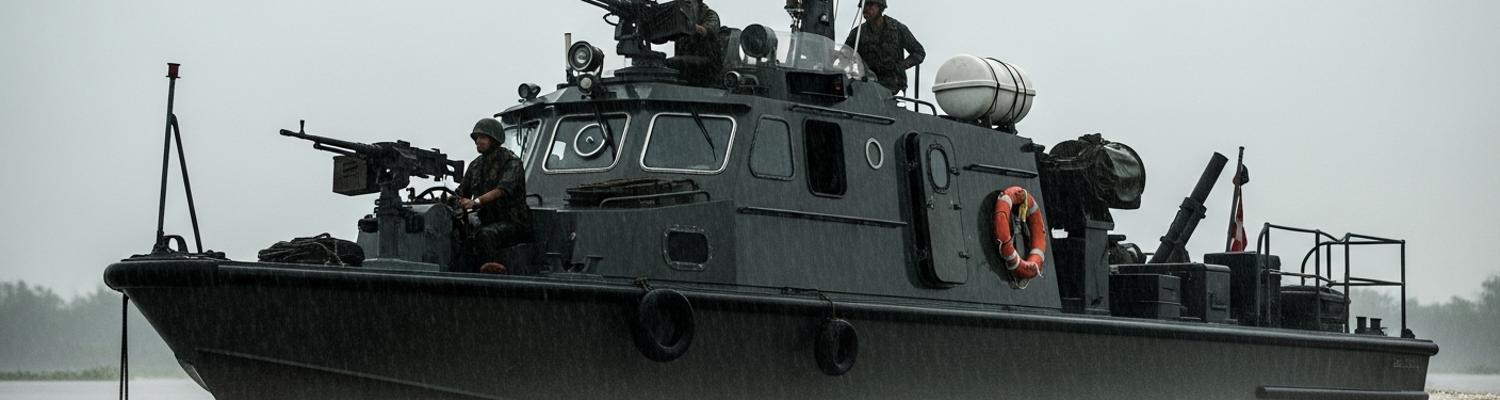
The Assault Support Patrol Boat was the only entirely new craft conceived specifically for the riverine navy in Vietnam. Its conceptual origin in 1965 came from a direct operational requirement identified by the Naval Advisory Group. The need was for a single vessel that could escort, provide fire support, and sweep for mines ahead of river assault squadrons. The U.S. Navy's Bureau of Ships initiated design work in 1966, intending to build an American successor to the French STCAN patrol boats used previously in Indochina. The core requirements were demanding and contradictory. The boat needed speed greater than the modified Landing Craft, Medium (LCM) it would protect. It required heavy armor for its crew and machinery, a shallow draft, and high maneuverability for tight canals. It also needed a specialized hull resistant to mines.
This was a hybrid vessel from its inception. For minesweeping, the design specified a robust 7/32-inch steel hull form intended to withstand the blast of a 55-kg mine. It was also equipped with a straight drag chain to snag and sever the wires of underwater command-detonated explosives. For its fire support mission, it required extensive armor and a heavy arsenal. Armament configurations varied but typically included two Mk 48 turrets that could mount 20mm cannons or twin .50 caliber machine guns, alongside an 81mm mortar in a stern well on initial models. Fusing these two functions into a single 50-foot hull forced significant design compromises.
A review of the development process shows engineers struggling to balance the weight of armor and weapons against the need for speed and a shallow draft. The boat displaced 36.5 tons, powered by two General Motors 12V71 diesel engines. To protect against .50 caliber armor-piercing rounds, the design incorporated dual-hardness steel and a quarter-inch of STS steel over the engine room. The superstructure was made of aluminum to save weight. This heavy protection scheme created inherent problems. The boat was top-heavy. Early versions, the initial Program 4 boats, suffered from dangerously low freeboard due to a construction error during the lofting process. Some of these boats were known to sink from the wake of a passing vessel, a flaw that necessitated the hasty addition of foam-filled sponsons to their sides for extra buoyancy.
The propulsion system represented another area of compromise. The boat used water-jet pumps instead of conventional propellers. This choice helped meet the shallow-draft requirement and offered exceptional maneuverability, allowing a turning circle of just 50 feet at 6 knots. The system also expelled exhaust directly into the water, making the ASPB the quietest craft in the riverine fleet. The trade-off was a system highly susceptible to its intended environment.
The boats were never subjected to rigorous, environment-specific operational testing that would have revealed these flaws. The first contract for 36 boats was awarded to Gunderson Brothers Engineering in Oregon on October 25, 1966. The first units were completed and shipped by the summer of 1967, arriving in Vietnam that September. There was no time for a thorough trials period replicating the vegetation-choked, debris-filled canals of the Mekong Delta. The water-jet propulsion systems, while quiet in open water, proved disastrously prone to fouling with river grass and trash. This led to frequent breakdowns during combat patrols. The armor also failed to perform as specified. Field reports from 1968 indicated that a direct hit from a 75mm recoilless rifle could shatter an entire plate of the brittle armor, sending a massive piece of shrapnel through the cockpit. The initial batch of boats arrived at Vung Tau on September 20, 1967, and were thrust into action just eight days later.
Inherent Flaws on Delta Deployment
The first two Assault Support Patrol Boats arrived at Vung Tau on September 20, 1967, aboard the SS Ohio. Unloaded two days later, they were immediately integrated into Task Force 117 and assigned to River Assault Squadron 9. The urgent need for a dedicated minesweeper to replace vulnerable Armored Troop Carriers (ATCs) meant there was no graduated work-up period. Eight days after arrival, the ASPBs were in their first combat operation, Coronado V, sweeping for mines ahead of an assault on An Dinh village on September 28. The deployment was an exercise in improvisation. Shipping manifests were incomplete. Essential boat kits were found missing, stowed under hundreds of tons of other cargo destined for Saigon. The boats were thrust into the labyrinthine network of canals and rivers of the Mekong Delta, an environment that would prove to be their most formidable adversary.
The ASPB’s sophisticated water-jet propulsion system became its primary point of failure.
Operational logs from late 1967 and early 1968 document a consistent pattern. The Jacuzzi Brothers pumps, which propelled the boat by expelling water at high pressure, were fitted with intake screens. In the debris-filled canals of the Delta, these screens were overwhelmed. River grass, hyacinth, and plastic bags were sucked against the grates, starving the pumps of water. This caused the General Motors diesel engines to overheat and often forced a complete shutdown to prevent permanent damage. An ASPB leading a column on a minesweeping run could lose all power in seconds, becoming a stationary target in a known enemy kill zone. After-action reports show this was a daily struggle.
The boat’s armor scheme presented another life-threatening shortcoming. While designed to defeat .50 caliber rounds, the dual-hardness steel plate proved dangerously brittle against the shaped charges of B-40 rockets and 75mm recoilless rifles. Instead of absorbing and deforming upon impact, the armor had a tendency to shatter. A direct hit could break off a large section of the interior armor and propel it through the confined space of the cockpit or gun turrets. This secondary spalling effect turned the boat’s own protection into shrapnel. Archival evidence shows that by early 1968, crews understood this vulnerability. The problem was amplified by the boat’s top-heaviness and low freeboard. Between February and March 1968, four ASPBs sank due to non-combat causes. One instance involved a passing boat’s wake swamping an ASPB, causing it to sink in under a minute and drown a crewman.
Crew feedback was immediate. The men who operated the boats, often called Alpha Boats, quickly developed a deep distrust of their vessel’s capabilities. Reports from the field consistently highlighted the propulsion failures, forcing crewmen to hang over the side or enter the water under potential fire to manually clear fouled water-jet intakes. This led to the rapid field modification of welding crude steel grates, known as trash racks, over the pump intakes as a desperate measure. Sailors also reported the unreliability of the Mk 48 turrets housing the 20mm cannons and the exposed position of the stern 81mm mortar operator. A Navy investigation into the series of sinkings in early 1968 confirmed the boat’s inherent lack of seaworthiness and excessive weight. As a direct result, Naval Forces Vietnam made a command decision to strip the ASPB of its primary role as a fire support and assault craft. By late 1969, most of the fleet was relegated to minesweeping and base security.
Relentless Demands in I Corps
The ASPB’s transfer north into I Corps represented a shift in its operational environment. The Viet Cong guerillas and trash-choked canals of the Mekong Delta were replaced by conventional, well-equipped divisions of the North Vietnamese Army (NVA). The rivers here, primarily the Cua Viet and Perfume River, were the essential logistical arteries for exposed U.S. Marine combat bases like Dong Ha. These bases were under constant threat of bombardment from NVA guns positioned just north of the Demilitarized Zone (DMZ). This strategic context created a relentless operational tempo for the ASPBs of Task Force Clearwater, the naval command responsible for securing these waterways. Every convoy of supply-laden landing craft was a calculated risk, a slow-moving target for an enemy who could bring down 122mm rockets and 130mm artillery fire.
The ASPB was immediately pressed into service as a convoy escort, a mission that stretched its compromised design to the breaking point. The boat’s primary function became screening the slow Landing Craft, Utility (LCU) and Landing Craft, Medium (LCM-8s) that formed the bulk of the supply trains. In April 1968, ASPBs were heavily engaged in supporting patrols by the 4th Marine Regiment, which was tasked with clearing the banks of the Cua Viet River following a series of NVA attacks on naval supply boats. Archival imagery from Operation Napoleon/Saline shows Marines of the 2nd Battalion, 4th Marines, disembarking from riverine assault craft to sweep for NVA positions in the village of Dai Do. The ASPBs would patrol ahead and along the flanks of the convoys, their 20mm cannons and .50 caliber machine guns providing suppressive fire against suspected ambush sites. The NVA, however, employed heavier weapons, and the ASPB’s brittle armor proved even less adequate against artillery and rocket attacks.
This constant kinetic activity forced an expansion of the ASPB’s duties. Its speed, relative to the landing craft it protected, made it the default first responder. When an LCU was struck by a rocket or mortar round, it was the Alpha Boat expected to race to the scene, suppress the enemy position, and begin medical evacuation (MEDEVAC). Pulling alongside a burning vessel to transfer wounded Marines made the ASPB a stationary target. The boat’s low freeboard and crowded decks made the physical act of moving litter patients from one vessel to another a difficult process.
Mission creep extended into direct logistical support. The ASPB was frequently detached from escort duties to perform urgent, high-speed resupply runs to isolated Marine outposts too small or dangerous for larger craft to approach. A forward observation post running low on ammunition or a reconnaissance team needing extraction would call for an ASPB. These missions often required a single boat to transit a known high-threat area, stripping it of the mutual protection of the convoy. Operational records indicate that crews often had to lash ammunition crates and medical supply boxes directly to the exterior deck plates and turret roofs, exposing cargo to the elements and enemy fire. This ad-hoc use as a transport and ambulance placed the crews and their flawed vessel in near-constant peril.
Systemic Mechanical Degradation
The corrosive environment of the Mekong Delta was a relentless opponent. The humid, salt-laced air and brackish water initiated an aggressive oxidation process on the boat’s 7/32-inch steel hull. Rust bloomed almost immediately around weld seams and armor impact points. This decay threatened the vessel’s already marginal buoyancy by compromising structural integrity. More immediate was the mechanical degradation caused by the water it navigated. The twin General Motors 12V71 diesel engines, each producing 430 horsepower, were dependent on a constant flow of river water for cooling. A close review of operational logs from Task Force 117 shows a constant battle against overheating as water-jet propulsion intakes became clogged. This forced crews to either shut down the engines, turning the boat into a static target, or risk catastrophic mechanical failure. The weapons systems suffered a similar fate. The complex Mk 48 turrets were vulnerable to the fine grit and mud of the riverbanks. Maintenance reports document repeated instances of turret rings seizing and ammunition feeds jamming in the middle of a firefight.
The Naval Support Activity Saigon was tasked with supplying all riverine forces, but the ASPB was a difficult case. As a new design with a small production run of just over 80 boats, it did not benefit from large stockpiles of common parts. Specific components for the Jacuzzi Brothers water-jet pumps, the GM 12V71 diesel engines, and the Mk 48 turret mechanisms were in chronically short supply. When a pump impeller or a specialized engine seal failed, a replacement was often not available in-country at forward bases like Dong Tam or Binh Thuy. The requisition had to travel through logistical hubs at Saigon or Da Nang, and often back to stateside manufacturers. This process could sideline a boat for weeks.
By 1968, cannibalization was the standard procedure to keep a portion of the fleet active. Repair shops became graveyards where two or three damaged ASPBs were systematically stripped of functioning parts to make one boat mission-capable. This practice created a misleading picture of readiness, where official reports masked a steady decline in the number of truly functional vessels.
A punishing operational tempo precluded proper upkeep. The constant demand for convoy escorts and minesweeping runs meant that ASPBs returned to base only to be refueled, re-armed, and sent back out. Preventive maintenance schedules were rarely followed. The intense pace of operations, particularly for Task Force Clearwater in the I Corps Tactical Zone, subjected the boats to near-constant high-stress use. An engineman was fortunate to have time to check fluid levels and clear debris from the pump intakes before the next mission. Deeper inspections of engine components, electrical systems, and weapon linkages were deferred indefinitely. This accumulation of deferred maintenance guaranteed that mechanical failures would occur at the worst possible moments. A repair ship, the USS Askari (ARL-30), provided indispensable service and kept many boats in the fight, but it could not fabricate parts that did not exist in-country or reverse the systemic wear caused by overuse.
The Gauntlet of Mines and IEDs
The boat’s minesweeping function placed it in a uniquely perilous position at the head of every riverine assault column. This was the Alpha Boat’s designated station. Task Force 117 operational doctrine dictated that the ASPB lead the slow-moving Armored Troop Carriers and Monitors, tasked with neutralizing Viet Cong explosives before they could strike the main force. To this end, the ASPB was fitted with a chain drag apparatus intended to snag the command wires of submerged mines. These enemy devices were typically constructed from dud American artillery shells or large caches of explosives, buried in the river bottom mud, and connected by wire to a hidden observer on the bank. The ASPB’s job was to drag its chain along the riverbanks to sever these wires. The design itself was intended to provide a degree of protection, with a reinforced steel hull specified to resist the blast of a 75-pound charge. An incident on December 21, 1967, provided a test of this capability when ASPB 111-4 struck a large mine two miles from Đồng Tâm Base Camp. The detonation was massive but failed to puncture the hull, and the boat returned to base under its own power with only moderate damage.
This was not the norm.
The reality for most crews was that their vessel’s specialized equipment offered little defense against the variety of enemy-improvised devices. A review of after-action reports from Mobile Riverine Force operations details encounters with floating charges disguised as clumps of water hyacinth, booby-trapped sampans designed to detonate on contact, and pressure-activated mines that no chain drag could counter. For the ASPB crews leading these patrols, every piece of river debris became a potential threat, transforming routine sweeps into nerve-shredding ordeals. An explosion, even one that failed to breach the hull, would send a violent shockwave through the boat, capable of disabling systems and inflicting concussive injuries on the five-man crew.
The psychological weight of this constant, invisible threat was significant. Leading a column through a canal known to be an enemy kill zone, dragging a chain that might not work, while sitting in a boat known for its mechanical and structural flaws, created a persistent strain. Combat stress was directly linked to the level of exposure, and ASPB crews were at the forefront of that exposure on every mission. The fear of a sudden explosion from beneath the water was a universal experience. This anxiety was amplified by the boat’s own untrustworthy nature; crews knew the armor could shatter and that the water-jet intakes were prone to fouling at the worst possible moment. The sensory experience of a minesweeping run was one of intense tension: the low rumble of the diesel engines, the metallic scrape of the drag chain on the river bottom, and the hyper-vigilant scanning of the water’s surface. Post-war medical studies of Vietnam veterans confirmed that the persistent threat of mines and booby traps was a primary contributor to long-term post-traumatic stress.
A Legacy of Rapid Obsolescence
The ASPB’s design flaws directly degraded the combat effectiveness of the units it was meant to support. This was apparent with the 4th Marine Regiment operating along the Cua Viet River in I Corps. Task Force Clearwater, the naval command responsible for this waterway, relied on the ASPB for convoy escort. A close examination of after-action reports from this period reveals a consistent pattern of ASPB failures hamstringing Marine operations. When an ASPB suffered a propulsion failure due to fouled water jets, the entire convoy was forced to halt in channels often bracketed by known North Vietnamese Army artillery positions. This delayed the delivery of ammunition and rations and turned the slow-moving LCU and LCM supply boats into static targets. The ASPB, intended as a shield, instead became an anchor.
Its role in providing timely fire support was similarly compromised. The brittle armor, known to shatter into lethal fragments when struck by a 75mm recoilless rifle round, made crews hesitant to close with and suppress enemy positions. This directly affected Marines on the ground who were counting on the boat’s 20mm cannons for support. A crew’s justified concern for their vessel’s survivability translated into a measurable decrease in the responsiveness of available naval gunfire for Marine units locked in firefights along the riverbanks.
Sustained combat operations exposed the ASPB’s unsuitability for its intended role. The vessel was a collection of systems at war with each other and their environment. The weight of the armor and weapons package, which already proved inadequate, made the boat top-heavy and low in the water, contributing to a series of non-combat sinkings in early 1968. This forced the Navy to relegate the ASPB primarily to minesweeping and base security duties by late 1969, a tacit admission of its failure as a front-line assault craft. The operational tempo meant that boats returned from patrol only to be refueled, rearmed, and sent back out, leaving no time for the preventative maintenance required by its complex systems. A state of constant mechanical degradation became the norm.
This cascade of tactical and mechanical failures sealed the ASPB’s fate. The strategic shift in American policy toward Vietnamization was the final factor. Beginning in 1969, the U.S. began the accelerated turnover of military assets to the Republic of Vietnam Navy (VNN). The ASPB, with its demanding maintenance requirements and a broken supply chain for proprietary parts, was a poor candidate for transfer. The VNN, which suffered from a shortage of experienced technicians, was ill-equipped to handle the ASPB’s complex water-jet pumps and temperamental weapon systems. As U.S. forces withdrew, the ASPB fleet was rapidly drawn down. The Navy officially ended Task Force Clearwater’s operations in I Corps and transferred the last of its combat craft to the VNN by the end of 1970. The few ASPBs that were handed over were often cannibalized for parts, a continuation of the maintenance practice that had defined their service life.