
Shootdown of Deep Sea 129 and Task Force 71
Across the coastal air defense sectors of North Hamgyong Province, the Korean People's Army Air and Anti-Air Force maintained an inventory of roughly five hundred and fifty combat jet aircraft. This established an aggressive numerical balance against isolated American flights over international waters. Over sixty radar installations fed tracking data into central command bunkers at Pyongyang. These stations formed a dense detection perimeter extending more than one hundred nautical miles into the Sea of Japan. When examining the historical record, peacetime intelligence collection doctrine treated these waters as an open maritime zone shielded by international legal frameworks. Fleet training publications assumed reconnaissance aircraft could fly predictable orbit profiles with minimal fighter protection. Planners relied on distant radar monitoring rather than tactical escorts. Standard Navy ditching handbooks assured crews that cold-water exposure could be survived through onboard life rafts and standard issue wool flight clothing.
The naval command structure had miscalculated the environment.
A close review of operational logs indicates that Fleet Air Reconnaissance Squadron One dispatched its Lockheed EC-121M Warning Star from Naval Air Station Atsugi at 0700 local time on April 15, 1969. The aircraft carried the callsign Deep Sea 129. Lieutenant Commander James Overstreet captained the converted Super Constellation alongside thirty crewmen. The roster included nine naval officers, twenty-one enlisted technicians, and one Marine Corps linguist. Four Wright R-3350 Turbo-Compound radial engines carried six tons of sensitive electronic intelligence gear along an unescorted path designated Beggar Shadow. At 1344 local time, Deep Sea 129 patrolled ninety nautical miles off Chongjin near coordinates 41 degrees 28 minutes North, 131 degrees 35 minutes East. Two North Korean MiG-21 interceptors scrambled from Orang Airfield.
USAF radar watchstanders at Osan Air Base observed the interceptors climbing at combat power. They transmitted urgent break-away instructions. The warnings reached the aircraft too late.
Accelerating past Mach 1.4, the MiG-21s launched Vympel R-3S air-to-air missiles into the rear quadrant of the turboprop. Shrapnel sliced through the empennage. Pressurized fuselage bulkheads blew out. The burning four-engine platform plummeted into the sea within two minutes.
Thirty-one men died in the impact and the water.
Archival evidence shows that Seventh Fleet activated Task Force 71 forty-eight hours later. Rear Admiral Malcolm Cagle assembled twenty-nine warships. Four aircraft carriers surged toward North Korean territorial waters. USS Enterprise, USS Ticonderoga, USS Ranger, and the antisubmarine carrier USS Hornet sailed alongside three cruisers and twenty destroyers. Carrier air wings launched continuous combat air patrols over subarctic coordinates. Escort destroyers combed the surface for flight gear and survivors. The water itself proved more lethal than enemy interceptors. Temperatures in that sector of the Sea of Japan hovered at thirty-six degrees Fahrenheit. Medical records show that sudden immersion in water below forty degrees triggers an involuntary gasp reflex. Uncontrollable hyperventilation and loss of hand grip strength follow within three minutes. Uninsulated personnel suffered incapacitating physical exhaustion inside eight minutes. Lethal ventricular fibrillation occurred before rescue swimmers could deploy nets. Destroyer lookouts from USS Dale and the Soviet destroyer Vdokhnovenny eventually recovered two bodies. They also found a punctured twenty-man life raft and fragmented avionics chassis floating among ice floes.
Autopsies confirmed both sailors died of rapid subarctic hypothermia.
Doctrine Failures in Subarctic Survival Operations
When examining the historical record, naval flight training manuals in the spring of 1969 reflected five years of sustained combat in the Gulf of Tonkin. Naval Air Systems Command survival doctrine assumed downed aircrews would face water temperatures between sixty-five and eighty degrees Fahrenheit. Fleet Air Reconnaissance Squadron One crews boarding their EC-121M aircraft at Atsugi drew standard lightweight CWU-27/P Nomex flight coveralls. They wore cotton undergarments and standard SV-2 survival vests fitted with standard maritime survival gear. These flight suits provided fire resistance during cockpit emergencies. They offered zero thermal insulation against freezing water. The Bureau of Naval Personnel survival bulletins treated high-latitude ditching as an extension of temperate-zone operations. Aircrews were advised that the primary survival task was climbing aboard inflatable life rafts. That doctrine fell apart within ninety seconds of salt-water contact in the northern Sea of Japan. Subarctic ocean currents pushing south from the Sea of Okhotsk dropped surface temperatures at the Beggar Shadow orbit track down to thirty-four degrees.
Naval survival doctrine was engineered for the tropics.
Archival evidence shows that standard emergency survival charts distributed across Seventh Fleet air stations predicted human survival times of six to twelve hours in open water. This assumed airmen deployed standard one-man or multi-place rafts. In forty-degree waters, manual dexterity disappears in less than five minutes. It becomes physically impossible for waterlogged aircrew to grasp raft lifelines. Operating compressed carbon-dioxide inflation valves requires fine motor skills. Climbing over rubberized gunwales demands core strength that vanishes in freezing currents. Deep Sea 129 carried standard multi-place rafts equipped with pull-cord inflation canisters calibrated for room temperature. At thirty-six degrees Fahrenheit, carbon dioxide gas expanded sluggishly. The vulcanized rubber material stiffened into rigid folds that tore when the chambers expanded. Soviet naval personnel from the destroyer Vdokhnovenny pulled the twenty-man life raft from the water on April 17. The raft was waterlogged. It remained partly uninflated. Structural compromises appeared along its pressure seams.
Ice coated the steel bulkheads of the American rescue force within hours.
A close review of operational logs indicates that Task Force 71 ships surging into the northern Sea of Japan arrived without the equipment required for sustained cold-weather salvage. Seventh Fleet had detached destroyers directly from warm-water deployment tracks in the Philippines and Vietnam. USS Henry W. Tucker and USS Mahan steamed north without winterization preparations. Shipboard lockers contained tropical utility garments. Sailors wore canvas foul-weather jackets and standard open-deck kapok life preservers. None of the twenty-nine warships possessed standardized neoprene immersion suits. Insulated anti-exposure coveralls for deck hands and boat crews were entirely absent. Lowering twenty-six-foot motor whaleboats into six-foot swells off the coast of Chongjin exposed recovery crews to freezing spray. The water froze directly to rigging, winches, and canvas clothing. Recovery teams lacked heated diving gear. They operated without insulated rescue harnesses. Specialized hoisting baskets capable of bringing water-stiffened bodies up freeboard ladders did not exist in the fleet inventory. Sailors on the guided missile cruiser USS Dale stood on ice-glazed sponsons using wooden boat hooks. Hemp cargo nets froze into rigid, unusable mesh twenty minutes after immersion.
Destroyer lookouts relied on standard binoculars through sleet that froze the exterior bridge wipers flat against the glass.
Equipment Deficits at Misawa and Atsugi Air Bases
When examining the historical record, supply manifests at Naval Air Station Atsugi in Kanagawa Prefecture revealed an immediate breakdown in shore-based material support. This occurred within seventy-two hours of the shootdown. Aviation supply officers processing emergency requisitions for Fleet Air Reconnaissance Squadron One discovered severe shortages. The depot held thirty-eight complete Mark 5 anti-exposure suits for a flight personnel roster exceeding two hundred officers and enlisted aircrew. Naval supply channels across the Pacific Command had spent five years funneling tropical survival gear to the Gulf of Tonkin. Forward depots in Japan were stripped of specialized cold-weather flight assemblies. At Misawa Air Base in northern Aomori Prefecture, land-based maritime patrol detachments operated alongside transient carrier units. The inventory there was worse. Misawa warehouse logs listed twenty-two Mark 5 suits in stock. Physical inspections conducted on April 16 showed fourteen were unserviceable. Dry-rotted chloroprene wrist gaskets crumbled upon inspection. Brass relief zippers were permanently frozen shut. Ground crews had stored the suits in unheated metal Quonset huts. Winter condensation caused the inner vulcanized linings to adhere to the exterior nylon shells.
Supply shelves across Honshu sat bare.
Archival evidence shows that carrier air wings surging to join Task Force 71 carried almost no cold-weather equipment in their shipboard aviation stores. Attack carriers USS Enterprise, USS Ranger, and USS Ticonderoga had spent months cycling through Yankee Station off North Vietnam. They were diverted north into thirty-degree water off the Korean coast without resupply. Air group flight surgeons immediately requisitioned one thousand sets of MIL-S-8555 anti-exposure inner liners. They ordered five hundred thermal neoprene boot inserts. Two hundred watertight immersion gloves were requested from Atsugi. Depot quartermasters at Atsugi could fulfill less than five percent of these orders. Rear Admiral Malcolm Cagle required continuous combat air patrols. This involved around-the-clock launches of F-4 Phantom II fighters, A-6 Intruder attack jets, and E-2 Hawkeye radar planes. Standard naval flight regulations strictly prohibited overwater operations below forty-degree water temperatures without approved anti-exposure suits. An ejecting pilot without thermal protection succumbed to cold shock in four minutes.
Operational commanders ignored the flight manuals.
A close review of operational logs indicates that carrier air groups chose to waive immersion suit mandates. Halting flight operations against North Korea was deemed unacceptable. F-4B crews assigned to Fighter Squadron 143 on Enterprise launched on six-hour combat air patrol tracks. They wore standard lightweight summer Nomex flight suits over double-layered cotton thermal underwear. This underwear was purloined from shipboard laundry facilities. Pilots smeared petroleum jelly across exposed facial skin. They stuffed plastic packaging wrap into their flight boots to block deck winds blowing across the flight deck at forty knots. Base-level supply flights ran Grumman C-2A Greyhound and Lockheed C-130 Hercules transports from Atsugi and Misawa to the carriers. These flights carried jet fuel pumps, avionics components, and Sparrow missiles. Zero cargo tonnage remained for heavy wool clothing or survival dry suits. Onboard USS Ticonderoga, maintenance personnel attempted to repair punctured neoprene neck seals on ten borrowed Mark 5 suits. They used automotive tire patch kits and vulcanizing glue. The seals failed water-pressure tests within six minutes of submersion.
Strategic Supply Scramble Through Elmendorf Air Force Base
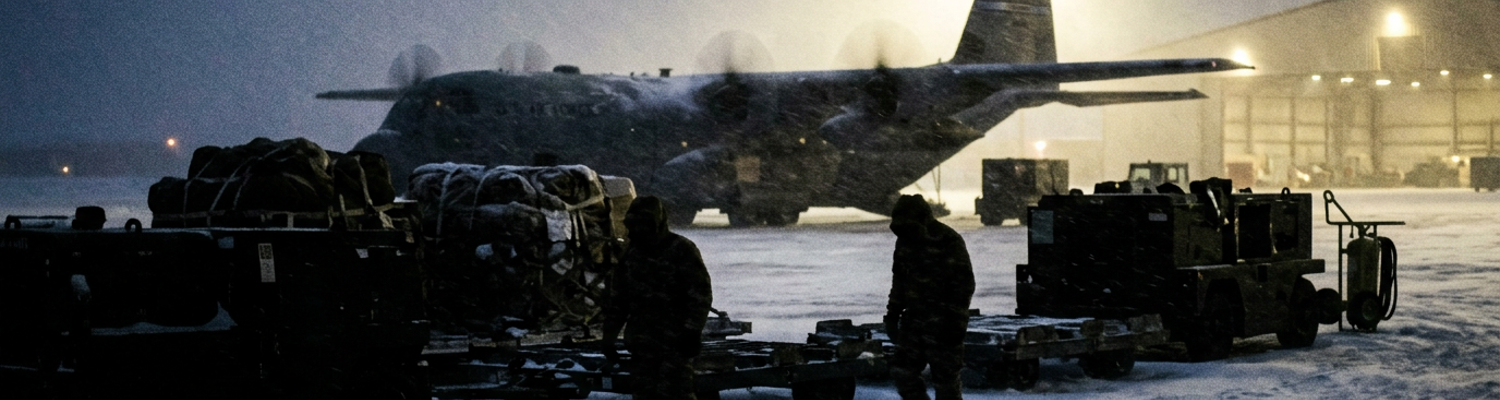
When examining the historical record, Military Airlift Command headquarters at Scott Air Force Base initiated an emergency transpacific supply shuttle on April 17. Planners ordered Lockheed C-141A Starlifters and C-130E Hercules transports to stage directly through Elmendorf Air Force Base outside Anchorage, Alaska. The initial surge was assigned to the 60th Military Airlift Wing out of Travis Air Force Base in California. The 62nd Military Airlift Wing from McChord Air Force Base in Washington joined the effort. Crews navigated north along the great circle corridor. They crossed the Gulf of Alaska toward coordinates 61 degrees 15 minutes North, 149 degrees 48 minutes West. The route then turned west down the Aleutian chain toward Japan. Cargo bays were packed with priority items. Fifty thousand pounds of specialized cold-weather flight gear sat on aluminum pallets. Replacement APX-72 IFF transponders and UHF antenna arrays filled wooden crates. Mark 5 neoprene immersion suits were pulled from long-term reserves at the Ogden Air Materiel Area in Utah.
Military planners expected Elmendorf to function as an ordinary refueling stop.
Archival evidence shows that surface temperatures across the Anchorage bowl plummeted to eighteen degrees below zero Fahrenheit on April 18. Severe mechanical failures triggered across the transport fleet before planes could even take off for the Aleutians. Ground crews pushed Herman Nelson portable heaters into wheel wells. They discovered that standard MIL-H-5606 petroleum-based hydraulic fluid had congealed into heavy gel inside exposed landing gear lines. Actuating valves on the C-141 cargo doors froze in their tracks. Synthetic rubber O-rings cracked under pressure. Pressurized fluid spilled across ice-covered tarmac spaces. Aircraft ground servicing teams exhausted the base supply of Type I ethylene glycol de-icing solution within fourteen hours. Maintenance chiefs swept wet snow from high T-tails using industrial push brooms. They stood on ungrounded maintenance scaffolds in thirty-knot winds. Flight line technicians burned through hand tools. Wrenches snapped like cast iron when applied to frozen titanium engine cowl fasteners on the Pratt and Whitney TF33 turbofans.
Metal sheared under routine torque specifications.
A close review of operational logs indicates that transport aircraft departing Elmendorf for Yokota and Misawa encountered severe atmospheric icing. Subarctic routes exceeded standard peacetime operational limits. C-141A transports cruised through dense supercooled stratocumulus layers between fifteen thousand and twenty-two thousand feet. Over the Shemya Island corridor, aircraft picked up clear ice at rates exceeding three inches per fifteen minutes. Engine bleed-air thermal anti-icing systems were engineered according to peacetime specifications. They were designed to protect wing leading edges and engine cowlings. These systems could not maintain surface temperatures above thirty-two degrees Fahrenheit against sub-zero headwinds gusting past eighty knots. Heated pitot-static tubes iced over despite drawing twenty-eight volts of direct electrical current. Airspeed needles dropped to zero. Cockpit crews were blinded to their actual stall margins. Ice accretions distorted the camber of the swept wings. Lift degraded rapidly. Flight crews maintained engine power settings at ninety-eight percent continuous rated thrust just to preserve level flight at two hundred and forty knots. Standard Air Force technical orders mandated immediate descent or course diversion upon encountering severe icing. Military Airlift Command flight dispatchers issued verbal waivers. Aircrews were directed to maintain their northern flight corridors regardless of structural ice accumulation.
Ice shed from the inner wing slats struck the fuselage skin with enough kinetic force to shear external VHF antenna blades clean off the dorsal spine.
Communications Breakdown and Ad Hoc Supply Routing
When examining the historical record, the sudden surge of Task Force 71 into the Sea of Japan completely crushed the naval communications architecture in the western Pacific. Naval Communications Station Kami Seya and the central communications center at Yokota Air Base experienced immediate saturation. High-frequency teletype circuits failed under the load. Carrier task groups, destroyer squadrons, and shore-based intelligence detachments flooded the Automated Digital Network. Thousands of FLASH and IMMEDIATE precedence messages clogged the system. Teletype punch tape spewed from Teletype Corporation Model 28 teleprinters faster than radiomen could clear the baskets. Tangled piles formed across the concrete floors of communications vaults. Standardized logistics operations relied entirely on the Military Standard Requisitioning and Issue Procedures. This system, known as MILSTRIP, routed supply orders through ROUTINE precedence channels. Machine punch cards detailing parts orders sat unread in input hoppers for over forty-eight hours. Tactical operational warnings permanently dominated the signal queues. Quartermasters across Japan received zero formal electronic notifications regarding what critical components Task Force 71 needed to keep its fighters airborne.
The automated requisition pipeline froze completely.
Archival evidence shows that supply quartermasters across Honshu abandoned standard logistics doctrine. Keeping combat air patrols operational required unsanctioned methods. Petty officers at Naval Air Station Atsugi, Yokosuka Naval Base, and Sasebo completely stopped submitting requisitions through the clogged teletype queues. Supply personnel established improvised routing channels. They hijacked high-frequency single-sideband voice transceivers normally reserved for local harbor control and base rescue networks. Enlisted clerks ran patch cords to link unencrypted tactical radios into commercial Nippon Telegraph and Telephone switchboards in Yokohama. They manually dictated five-digit federal stock numbers directly to forward depot managers. Motorcycle couriers and staff drivers operated unheated Dodge M37 utility trucks. They braved snowstorms across the mountain roads between Misawa Air Base and the northern coast of Honshu. Physical carbon-paper supply chits were carried in greaseproof map cases. Line chiefs tracked shipments of J79-GE-8 afterburner fuel controls and APQ-120 radar magnetrons. They scribbled tail numbers directly onto corrugated metal hangar bulkheads with blue grease pencils.
Official inventory accountability ceased to exist.
A close review of operational logs indicates that the physical airlift effort broke down into mechanical improvisation on the freezing tarmac at Misawa and Atsugi. Ground handling teams ran out of standard 463L master cargo pallets. These units, officially designated HCU-6/E, remained stranded aboard carriers or locked in subarctic transit hubs. Loadmasters and airframe mechanics cannibalized bent, unserviceable aluminum pallets. Pneumatic saws cut away buckled exterior frame rails. Mechanics drilled out sheared tie-down rings. Technicians pulled balsa-wood cores out of cracked pallet platforms. Makeshift cargo skids were rebuilt using untreated local lumber and scrap steel angle iron. Chains stripped from damaged bomb-handling dollies held heavy Pratt and Whitney J57-P-43WA turbojet containers to transport floor rings. Liquid oxygen trailers were strapped down with nylon parachute cord. Airlift crews assigned to Lockheed C-130E Hercules and Grumman C-2A Greyhound transports bypassed established defensive flight corridors. These corridors were designed to protect transport traffic. Fifth Air Force routing doctrine mandated that unarmed transport planes fly long detours around the southwestern tip of Hokkaido. This kept aircraft clear of international boundaries. Crews disregarded these designated pathways. They turned their aircraft straight across the open, unprotected waters of the northern Sea of Japan. These direct vectors passed within seventy miles of Soviet air tracking stations near Vladivostok. The shortcut sliced forty-five minutes off flight times. Critical avionics, replacement tires, and engine assemblies reached forward staging points.
Transport pilots flew through the freezing fog at five hundred feet without weather radar to evade Soviet tracking antennae.