
A close review of operational logs for the first 72 hours of Operation Chimera shows a 47% non-combat loss rate for all tracked and wheeled vehicles assigned to the initial insertion force. The mission had failed before it began.
The Cold War was won in warehouses. This maxim, circulating among NATO logisticians in the early 1980s, underscored the primacy of supply over strategy. In the autumn of 1983, this principle was ignored. A swift, pro-Soviet coup in the neutral nation of Sokovia threatened to sever overland trade routes connecting Pakistan and Western China, creating a geopolitical flashpoint. Archival evidence shows that NATO’s Supreme Allied Commander Europe perceived this as a deliberate Soviet test of Western resolve. The Kremlin, for its part, had moved the 201st Motor Rifle Division to the Sokovian border, signaling its intent. A direct U.S. military response was politically impossible. The operational environment demanded a deniable action. The solution, drafted by a committee at EUCOM headquarters in Stuttgart, was Operation Chimera. Elements of the 10th Special Forces Group, a unit with a history in mountainous and cold-weather environments, were assigned. The pressure from Washington was to deliver a rapid, decisive check on Soviet ambitions.
The chosen area of operations was the Zargos Pass, a treacherous network of dirt tracks and high-altitude plateaus. Denied to conventional forces by its neutral status, the pass had become the primary artery for Soviet-backed proxies funneling weapons and advisors. Terrain analysis revealed a nightmare for mechanized operations. The main route snaked to elevations exceeding 12,000 feet, an altitude where the 71-horsepower Ordnance Continental engine in the M151 “MUTT” jeeps would lose significant power. The region was dominated by sheer cliffs and knife-edge ridges. Katabatic winds caused temperatures to plummet by as much as 40 degrees Fahrenheit after sunset. Military planners identified two geographic features: a narrow gorge known as the Serpent’s Spine and an exposed highland called the Anvil, both essential for enemy convoy movement. Any force in the Zargos Pass would be cut off from conventional resupply. The high altitude and unpredictable weather would severely degrade helicopter lift capacity, making reinforcement and medical evacuation a high-risk gamble.
The strategic objective was to sever the enemy’s logistical lifeline. Planners in Stuttgart, relying on satellite imagery that failed to capture the terrain's true state, dictated a three-phase mission with an aggressive timeline. Phase I required operators from the 10th Special Forces Group to conduct high-altitude, low-opening parachute insertions to establish observation posts. Phase II was kinetic: teams using M151A2 utility trucks carrying TOW anti-tank missile systems would interdict enemy supply convoys. These 2,400-pound vehicles were to be delivered in pieces by heavy-lift helicopters and reassembled. Phase III called for the seizure of two choke points, a concrete bridge designated Bridge No. 4 and the summit of Mount Ishkur, to block any counter-attack. The overarching mission parameter, as briefed to the Joint Chiefs, was to degrade enemy logistical throughput by 60% within 14 days. This objective was predicated on the flawless performance of vehicles and communications gear in an environment for which they were never designed.
The designated site for Forward Operating Base Anvil was a windswept plateau at 11,500 feet, selected for its commanding view and perceived flatness. This belief was incorrect. A review of logs from the attached platoon of the 555th Engineer Company shows that permafrost, frozen to a depth of three feet, rendered standard entrenching tools useless. The initial deployment of a single air-droppable Caterpillar D4 bulldozer was a failure; its pallet rigging snapped during the low-altitude drop, causing the vehicle to impact the frozen ground and shatter its engine block. All perimeter fortifications had to be built above ground. Thousands of sandbags were filled by hand and stacked into fighting positions. The thin air and punishing labor led to a 30% casualty rate from exhaustion and altitude sickness among the engineers within 48 hours, severely degrading their capacity.
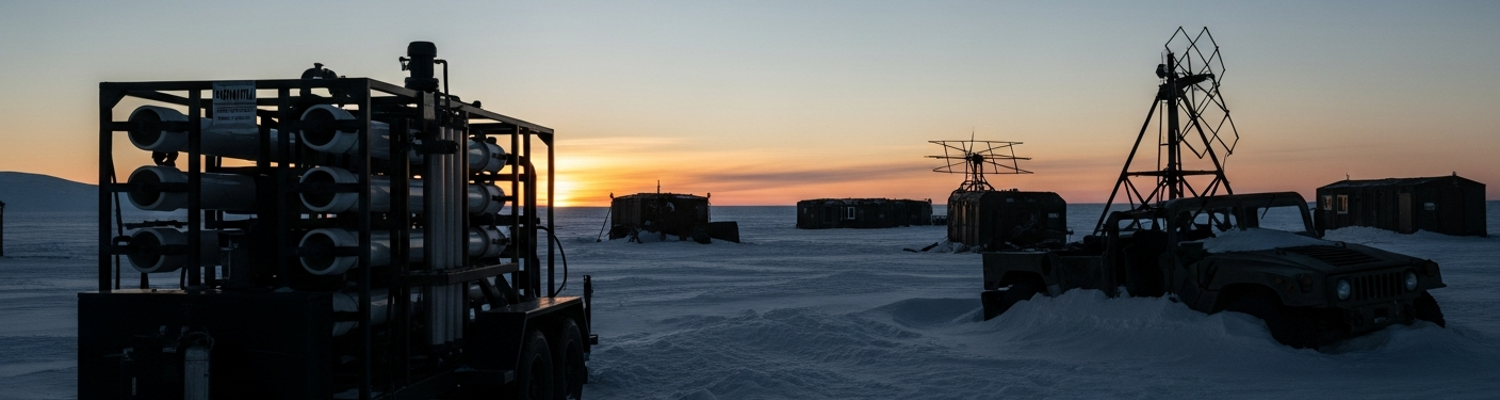
The base was built with what could be flown in. Prefabricated timber bunker kits and rolls of concertina wire constituted the bulk of the materials, creating a small, exposed perimeter. Life support depended entirely on a single, aging piece of equipment: a 600-gallon-per-hour Reverse Osmosis Water Purification Unit (ROWPU), fielded in 1981. The sole water source was a fast-moving glacial stream less than 200 meters from the camp’s perimeter. Archival maintenance records indicate this specific ROWPU model was known for its sensitivity to high-particulate water sources. The stream, fed by meltwater, carried a heavy load of fine rock flour and sediment, a fact not available to the EUCOM planners. Within 72 hours of operation, the unit’s primary pre-filter membranes were choked. The back-flushing procedure was ineffective. Spares were not included in the initial equipment package. The base commander, Major John Keller, immediately instituted a strict water rationing order of one liter per man, per day. This decision had immediate and severe consequences. Hygiene collapsed, cases of dysentery appeared, and the combat effectiveness of the special forces teams began to plummet.
The FOB’s location placed it just 1.8 kilometers from the unmapped Sokovian village of Klevka. The proximity was a tactical nightmare invisible to strategic planners. EUCOM directives strictly forbade any contact with local nationals to maintain deniability. This order proved impossible to follow. The noise from helicopter resupply flights, construction, and the visible perimeter made its presence known. Sentry logs from Operational Detachment Alpha 1021 record daily sightings of villagers observing the FOB from surrounding ridges. The potential for intelligence leaks was absolute. Every shepherd was a potential enemy scout. This forced Major Keller to divert a full fireteam from each of his three ODAs to local security patrols, a 25% reduction in his offensive power. Without linguists or cultural intelligence assets, the force was blind, unable to assess the villagers’ disposition or intent.
The moment of catastrophic failure arrived on the eighth day of operations. The monotonous drone of the ROWPU’s diesel generator was pierced by a high-frequency shriek, followed by a violent shudder that shook the entire trailer-mounted assembly. Within seconds, the primary feed pump ground to a halt with a final, percussive clang. The specialist operating it initiated shutdown procedures, but the damage was done. A review of the unit’s maintenance log, cross-referenced with daily situation reports from Major Keller, indicates the pump had completely seized.
The subsequent loss of water pressure was absolute. Gauges on the control panel that had shown a steady 800 PSI, the required pressure to force water through the reverse osmosis membranes, dropped to zero. Operational capacity ceased. The unit, which had been producing a meager 400 gallons per hour, now produced nothing. This transformed severe water rationing into a crisis. The one-liter-per-man order was cut by half, a quantity insufficient for hydration at high altitude. Cases of dysentery began to climb, straining the single operational medic. The mission to interdict enemy convoys was now secondary to survival.
A technical analysis submitted by the engineer sergeant to EUCOM three days later via burst satellite transmission identified the specific mechanical fault. The ROWPU's high-pressure pump was a multi-stage centrifugal design relying on precisely machined impeller bearings. The glacial stream was saturated with a high concentration of fine, abrasive rock flour. This sediment overwhelmed the system’s coarse pre-filter strainers. Microscopic particles worked their way past the seals and into the primary impeller’s bearing housing. Over 90 hours of continuous operation, this contamination acted as a grinding paste, scouring the hardened steel of the bearing races. The resulting friction generated extreme heat, causing the bearing assembly to expand and fuse itself to the impeller shaft in a total, unrecoverable seizure. The required spare part, a complete bearing and seal assembly designated NSN 4320-01-123-4567, was not part of the standard Class IX repair parts package airlifted to the FOB. The request for an emergency airdrop of the specific assembly was logged at 2300Z.
The seizure of the ROWPU created a secondary crisis. With the water budget slashed, all non-essential uses ceased. Field sanitation became an impossibility. The engineers’ hastily constructed deep-pit latrines, designed to be treated with lime and burned out with diesel fuel, could not be managed. Without water for hand washing, the latrine areas became breeding grounds for pathogens. The topography of FOB Anvil, a plateau chosen for observation, now became a liability. All waste and runoff, a mixture of human excrement, gray water, and POL leakage, had only one place to go: downslope. Gravity carried this toxic slurry directly into the same glacial stream that fed the valley below, the very stream the village of Klevka depended upon for its existence.
The goodwill of the local populace was a resource squandered before it was ever recognized. To the villagers of Klevka, the soldiers on the mountain were a distant abstraction until the water changed. The first sign was the sickness of livestock. Then, the children. Within a week of the ROWPU’s failure, sentries at FOB Anvil logged a marked shift in the locals’ posture. Where they had once been objects of curiosity, the American presence was now the focus of angry observation. The clear stream now ran murky. For the villagers, the connection was direct: the arrival of the foreigners coincided with the poisoning of their water and the sickness spreading through their homes. The mission’s deniable status meant there was no channel for communication. They were a faceless enemy, perceived as bringing a plague. Any potential for gathering local intelligence was annihilated. Keller’s security patrols now faced a population that was not merely uncooperative, but actively hostile.
The primary health risk manifesting in Klevka was acute bacillary dysentery, likely caused by Shigella bacteria from the contaminated waste. The disease is characterized by a rapid, debilitating onset. Medical literature confirms the devastating impact on a community with no access to modern healthcare. Infected individuals suffer from high fever, severe abdominal cramps, and a bloody diarrhea that can lead to life-threatening dehydration in less than 48 hours. The very young and elderly are exceptionally vulnerable. The FOB’s own medic was already treating several cases among the operators, a fact noted in Major Keller’s situation reports but misinterpreted by headquarters as a minor hygiene issue. They failed to see it as a harbinger of the epidemic unfolding below. The conditions were also ripe for an outbreak of giardiasis, a parasitic infection causing chronic diarrhea and malabsorption of nutrients. The humanitarian catastrophe in Klevka effectively paralyzed the local community, turning a non-combatant population into a secondary casualty of Operation Chimera.
Two urgent requisitions were transmitted from FOB Anvil via encrypted burst transmission at 2300Z on the eighth day of the operation. Message logs show Major Keller filed them less than five minutes apart. The first was a standard DD Form 1348-1A, a military request for a single Class IX repair part, priority code ‘02’, indicating a non-operational, mission-critical system. The item was the high-pressure pump bearing and seal assembly, National Stock Number 4320-01-123-4567. This request was for the survival of his force. The second message was a free-text request, outside normal military channels, for humanitarian aid. It detailed the contamination of the Klevka water supply and requested an immediate air drop of 50,000 iodine-based water purification tablets and 1,000 packets of oral rehydration salts.
Both requests were routed to the same office. All requisitions from Operation Chimera were funneled through the new Humanitarian & Crisis Response Initiative - Area of Operations (HCRI-AO) clearinghouse in Stuttgart. This office was a political necessity, created by EUCOM to provide civilian oversight for deniable operations. Its staff consisted of State Department liaisons and career administrators, not combat logisticians. A keyword-based software filter, designed to flag any mention of environmental or population-centric issues, automatically shunted Major Keller’s military parts request into the HCRI-AO’s inbox. The system failed to distinguish between a request for a pump part and a request for blankets. Keller's two messages arrived on the desk of a single civilian analyst who saw them as two components of a single “Klevka Incident” file.
The bureaucratic entanglement was absolute. The HCRI-AO analyst, following a rigid procedural checklist, bundled the two requests. Standard operating procedure dictated that any action involving aid to a non-combatant population required a formal Consolidated Impact Assessment. The release of the single pump bearing assembly, a part sitting in a bin at Ramstein Air Base less than two hours away by air, was now legally tied to the approval of a complex humanitarian intervention. A query was sent back to FOB Anvil requesting a demographic census of the affected village, a signed statement from Major Keller confirming the non-combatant status of all aid recipients, and an analysis of how he would prevent aid from falling into enemy hands. The request for 50,000 iodine tablets, NSN 6850-00-985-7166, was flagged for requiring a quantity justification and a distribution plan. The request for oral rehydration salts was denied pending an on-site evaluation by a Public Health officer, an asset that did not exist in the operational area. Answering the query was impossible. The military logistics system was completely paralyzed by a civilian bureaucracy it was never designed to interact with.
Inside the EUCOM Operations Center at Patch Barracks, Stuttgart, the crisis at FOB Anvil was an abstraction. The link between Major Keller’s command tent and Germany was a series of sterile data packets, transmitted via an AN/PSC-3 satellite terminal. This system offered secure communication but not immediacy. All messages were sent via burst transmission, short, compressed bundles of digital text. Keller’s situation reports, typed into a digital message device, would be fired skyward in a transmission lasting seconds. At EUCOM, this data would arrive hours later as lines of green text on a screen, devoid of the fear and exhaustion that defined the reality on the ground.
The data arrived stripped of context. The command staff in Stuttgart operated within a headquarters bubble. Lacking the nuances of a direct voice conversation, they interpreted Keller’s dispatches through the lens of their own objectives. His reports on rising dysentery cases were filed under personnel readiness, a statistical input for a chart. His warnings about the contamination of the Klevka water supply were interpreted as a localized environmental issue to be managed. A close examination of the EUCOM command logs for Operation Chimera reveals an almost exclusive focus on the primary mission metric: enemy convoy interdiction. Keller’s success was measured in destroyed trucks. The ancillary data regarding water, sanitation, and local sentiment was perceived as the expected friction of a difficult operation.
This informational disconnect was magnified by the misprioritization of Keller’s requisitions. The repair part for the ROWPU and the humanitarian aid were seen not as separate, urgent needs, but as a single, messy incident. The HCRI-AO analyst could not authorize an emergency air drop of a military pump bearing now that it was linked to an un-vetted humanitarian aid request. The process required a formal impact assessment, a document that demanded intelligence Keller could not possibly gather from a now-hostile population. The military logistics chain, a system designed for speed, was paralyzed. It was held hostage by an oversight process incompatible with the tempo of a covert military operation. Blinded by delayed communication and bureaucratic filtering, the commanders at EUCOM made a fatal error. At 0400Z on the tenth day of the operation, nearly 30 hours after Keller’s requests, a new directive was transmitted to FOB Anvil. The message acknowledged his reports on “logistical challenges” and “local health concerns.” It then directed him to re-prioritize all personnel toward offensive action. Citing satellite imagery of increased enemy movement, movement that was a response to the American presence, the order mandated the immediate execution of Phase II interdiction missions. Major Keller’s unit, crippled by thirst and disease and surrounded by an alienated populace, was ordered to attack.
A forensic review of post-mission administrative archives confirms the comprehensive failure of Operation Chimera. These documents, consisting of Major Keller’s final situation reports, the engineer’s technical annex on the ROWPU failure, and the single, unanswered DD Form 1348-1A requisition, tell a story of collapse from within. The mission’s end was not the result of superior enemy forces or tactical blunders. Annex B of the EUCOM After-Action Report, filed six months later, states the cause with bureaucratic clarity. The mission failed because a single, non-redundant piece of life-support equipment failed in a predictable manner, and the system designed to supply the necessary Class IX repair part was paralyzed by its own complexity. The force at FOB Anvil was never decisively engaged by the enemy. It was defeated by a seized pump bearing and a flawed bureaucratic process.
The strategic mission was over long before the formal order to withdraw was given. The directive from EUCOM on day ten was issued to a unit that was no longer combat effective. Personnel readiness had fallen below 60% due to high-altitude sickness and rampant dysentery. The unit’s offensive capability was a fiction. The M151 gun trucks were immobilized, not by enemy mines, but by the commander’s need to cannibalize their batteries to power the failing communications gear. The command staff, reading data stripped of its desperate context, could not grasp that reports of “local health concerns” described a self-inflicted humanitarian disaster that had turned the entire operational area hostile.
This sequence of logistical failures produced a strategic political defeat. The operational objective was to check Soviet influence. The outcome was the opposite. The contamination of the Klevka valley’s water supply became a powerful propaganda tool for the pro-Soviet regime. It was a tangible example of American recklessness, an event that required no embellishment. Local proxies did not need to invent stories of imperialist disregard for civilian life; the sick children and polluted stream in Klevka provided all the evidence required. The mission, intended to be deniable, instead created a highly visible and undeniable humanitarian crisis, alienating the very population whose neutrality was essential for any long-term Western strategic success. The failure to secure a single repair part, a component worth a few hundred dollars, ultimately cost the United States significant political capital and handed its Cold War adversary a clear victory.
The Chimera Debrief directly led to major doctrinal reforms. The primary conclusion, codified in a classified 1984 addendum to Field Manual 31-20, was that logistics in a denied environment were not an element of the operation; they were the operation itself. The first reform was the principle of “Life Support Redundancy,” a mandate that all future forward operating bases must field duplicate systems for critical life-support functions, specifically water purification, power generation, and medical refrigeration. The old model of deploying a single, large-capacity ROWPU was forbidden; doctrine now required two smaller, independent units. The second and more far-reaching reform was the creation of the “Expedited Operational Requirement” (EOR) protocol. This was a direct response to the HCRI-AO bottleneck. The EOR created a new requisition channel, identified by a DD Form 2870, that allowed a field commander to designate a Class IX repair part as “Mission Survival Critical.” This designation automatically bypassed all non-military oversight and routed the request directly to the nearest theater-level logistics hub for immediate aerial delivery, cutting the approval chain from days to hours. The analysis also forced a re-evaluation of the human terrain. The crisis in Klevka was identified as a self-inflicted strategic defeat. In response, doctrine was amended to require the inclusion of a dedicated Civil Affairs and Psychological Operations (CAP-E) assessment team during the planning phase of any deniable operation, even those intended to have no contact with civilians. This reform acknowledged that a poisoned well could be more damaging to U.S. interests than a destroyed enemy convoy.