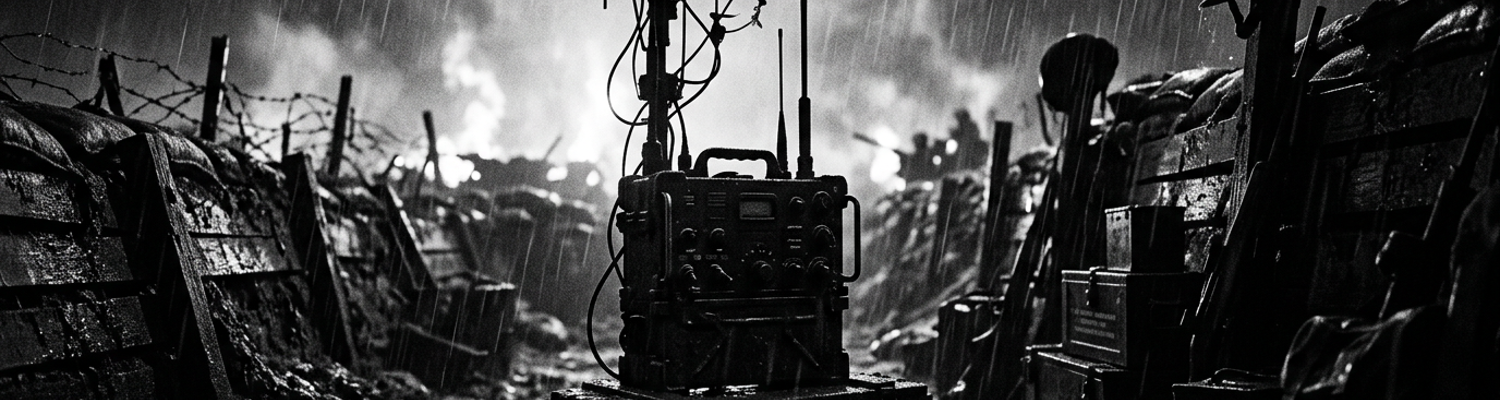

Vosges Topography and Forward Intercept Deployment
A garbled high-frequency transmission on October 18, 1944, signaled an immediate structural failure along the Meurthe River line. Net Control from Forward Team Baker reported a bunker collapse at coordinate nine-six-two-four following a heavy mortar barrage. All frequency monitoring halted. Personnel evacuated the position. Archival evidence shows that when Lieutenant General Alexander Patch drove the U.S. Seventh Army into northeastern France, VI Corps encountered highly restrictive defensive ground. Major General Lucian Truscott directed his infantry divisions toward the Meurthe River. Elements of the German Nineteenth Army occupied pre-sighted artillery positions on the commanding heights. High sandstone ridges rose steeply above Saint-Dié and Bruyères. Dense spruce forests covered these elevations. Forward observers could not sight targets through the timber.
Relentless downpours transformed dirt logging tracks into deep mud pits.
These conditions snapped the drive axles of two-and-a-half-ton supply trucks. M4 Sherman tanks stalled in river bottomlands. Patch ordered his corps commanders to maintain offensive momentum across the swollen Meurthe without pausing for consolidation. Thick mountain mist blinded the advancing infantry units. They pushed into narrow defiles without direct artillery support. The mineral-rich granite massifs deflected high-frequency tactical radio links between command posts. Intercept teams had to scale those same cliffs on foot with their machinery strapped to their backs. A close review of operational logs indicates that mobile radio intelligence detachments from the 117th Signal Radio Intelligence Company could not operate their heavy SCR-399 radio vans along the collapsed cliff routes. Intercept personnel dismantled their electronic arrays. They hand-carried fifty-pound BC-342 and BC-312 receivers up steep ravines. Antenna coils and heavy wet-cell batteries followed into shallow earthen pits.
The men dug these positions by hand.
Heavy autumn downpours rapidly turned those positions into standing pools of freezing water. Unshored soil walls collapsed inward under the weight of wet clay beneath fragile overhead tarps. Sediment buried sensitive vacuum tubes. Moisture seeped into metal chassis to ground electrical circuits. This destroyed copper terminal lugs before operators could record entire enemy Morse code groups. Saturated pine logs dripped filthy runoff directly onto raw paper pads. Graphite pencil markings liquefied into illegible smears. Tactical intercept records dissolved before runners could carry them to division headquarters. Physical misery evolved into cognitive breakdown. Soldiers sat curled on damp ammunition boxes for thirty-six hours at a time. They pressed rubberized HS-30 earphones against their skulls. They attempted to isolate faint German Morse signals from deafening atmospheric static.
Carbon monoxide hazards barred the use of gasoline stoves within the dugouts.
Exhaust-vented PE-75 generators remained outside. Crews endured near-freezing temperatures in waterlogged wool uniforms. Trench foot developed rapidly. Up on the ridges, German artillery observers targeted American radio emissions. High-explosive tree-bursts showered the open trenches with razor-sharp wooden splinters. Continuous sensory overload eroded the analytical faculties of the personnel. Seasoned intercept technicians misread standard Wehrmacht routing indicators. Extreme cold stiffened the operators fingers during the final stages of the October push. They could no longer adjust receiver tuning dials. The forward listening post at Saint-Dié ceased operations entirely on October 22.
Joint Cryptanalytic Operations and French Liaison
Late in October 1944, the 117th Signal Radio Intelligence Company pushed a specialized operations cell south toward Remiremont. This unit linked directly with the intelligence section of the French First Army. Major General Lucian Truscott required joint coverage across the boundary dividing the U.S. VI Corps from French II Corps. German Nineteenth Army elements repeatedly shifted forces across the mountain spine in this sector. Captain Robert Myers led the American detachment into a stone farmhouse outside Rupt-sur-Moselle. He met French liaison officers assigned by General Jean de Lattre de Tassigny. French cryptanalysts brought captured German signal books. They possessed extensive familiarity with Wehrmacht operating procedures in Alsace. The Americans supplied mobile SCR-399 transmitter trucks and arrays of Hallicrafters receivers. Direct teleprinter links connected the farmhouse to Seventh Army G-2 at Épinal.
Both teams crammed their equipment into unheated back rooms.
Damp stone walls conducted winter frost. The men worked under blackout blankets that trapped kerosene fumes and tobacco smoke. Continuous sixty-hour operational shifts pushed both teams past the threshold of coherent analysis. The primary tactical assignment involved establishing a coordinated intercept net to capture low-level Wehrmacht tactical ciphers. German infantry units defending the mountain passes around Gérardmer relied on the Rasterschlüssel 44 cipher. This manual sheet-based transposition system protected battalion-level orders for twenty-four hours. Intercept operators paired American BC-342 receivers with French-operated British Marconi CR-100 sets. They attempted to sweep identical high-frequency channels between 2.5 and 6 megacycles. German signalers transmitted five-letter code groups detailing ammunition shortages or planned artillery strikes. American and French direction-finding stations had to triangulate the transmission source within four minutes.
Mobile SCR-555 direction finders operated on bare sandstone outcrops at Le Valtin.
These units worked in tandem with French goniometric loops deployed along the ridge lines near Bussang. Sleet storms froze the rotating directional antennas. Rough mountain terrain split the radio ground waves. Bearings diverged by as much as twenty degrees. Static filled the headsets. The noise drowned out the German operators before bearings could be confirmed. Procedural differences between the two military organizations created immediate friction. The 117th Signal Radio Intelligence Company relied on U.S. War Department doctrine. They routed all raw intercepts through divisional signal centers using standardized SIGABA encryption devices. French liaison personnel adhered to traditional Deuxième Bureau protocols. They demanded that decrypted operational data pass through their own army command post at Luxeuil-les-Bains for manual evaluation.
Language barriers exacerbated the mechanical friction.
American analysts struggled to read handwritten French traffic logs. These documents employed unfamiliar continental notation for radio frequencies and call signs. Decoded German messages underwent double translation. Analysts shifted the text from German military terminology into French and then into English. An exhausted American sergeant misread a French liaison note regarding a German counterattack order near the Col de la Schlucht. He confused the German term for assault gun platoon with a routine motorized supply convoy. The translation error stalled warning transmissions for two full hours. Operational logs confirm that grid coordination failures nearly caused a friendly fire incident during the defense of the Clefcy valley on November 3. French liaison teams used the modified Lambert III military projection. Seventh Army field units plotted artillery targets on the British Modified System grid. Cryptanalysts from the 117th intercepted an unencoded Wehrmacht emergency radio broadcast from the German 716th Infantry Division. The message specified a concentration of heavy mortars at grid square four-seven-eight-one. The French duty officer plotted those numbers directly onto a Lambert chart. This shifted the identified enemy firing position twelve kilometers south of its true location near Plainfaing. American artillery battalions bombarded an unoccupied spruce forest for six hours.
Quartermaster Supply Paralysis and Battery Depletion
Seventh Army Quartermaster distribution depots at Épinal and Vesoul exhausted their inventories of BA-48 dry batteries by November 1944. Forward listening outposts from the 117th Signal Radio Intelligence Company relied entirely on these multi-cell zinc-carbon packs. The batteries ran the tube filaments and high-voltage plate circuits in portable intercept receivers. Cold rain and persistent mountain frost accelerated chemical decay inside the cardboard-cased batteries. Internal cell voltages dropped from the required 135 volts down to sub-seventy levels within four hours of continuous operation. Supply convoys hauling replacement stocks from the port of Marseille remained stranded three hundred miles south. Secondary rail tracks across the Rhone Valley washed out during the autumn storms. New packs failed to arrive at division supply points near Rambervillers.
Technical sergeants broke open degraded casings.
They stripped viable individual cells from the ruined packs. They wired these cells together with friction tape and scavenged field wire. These field-modified battery banks generated erratic direct-current output. The unstable voltage introduced heavy background hum into operator headsets. This noise completely masked the 40-watt transmissions of German field units operating east of Baccarat. Seventh Army G-2 recorded on November 8 that eight of the twelve forward monitoring positions along the Meurthe lacked battery power. They could not run their receivers for more than two hours per shift. Forward intercept nets collapsed into total silence once the depleted cells stopped delivering plate voltage. An equally severe crisis affected the heavier equipment of the mobile intercept stations. The 117th Signal Radio Intelligence Company operated motorized monitoring sections mounted in modified two-and-a-half-ton trucks.
Each truck contained high-frequency direction-finding loops and multiple BC-342 receivers.
Skid-mounted PE-75 field generators powered these arrays. These single-cylinder four-stroke engines required a steady supply of 80-octane motor gasoline. They produced 2500 watts of alternating current. Seventh Army G-4 issued emergency orders as VI Corps launched its drive toward the Saint-Dié defile. Logistics officers diverted ninety percent of all forward gasoline deliveries directly to the M4 Sherman tanks of the 753rd Tank Battalion. Signal detachments parked in muddy clearings near Bruyères received a daily ration of only five gallons of low-grade fuel per generator. Running engines in sub-freezing mountain dampness required rich fuel-air mixtures. This doubled fuel consumption. Heavy carbon deposits fouled spark plugs every twelve operating hours. Captain Myers ordered technicians to shut down monitoring vans for eighteen hours a day. This preserved fuel for prioritized night intercept watches.
Generator shutoffs severed power to the heated crystals inside frequency calibrators.
Receiver frequencies drifted across thirty kilocycles as the equipment cooled. This blinded cryptanalysts to rapid changes in German Eighteenth SS Corps radio frequencies. Mechanics drained contaminated residue from truck fuel tanks to keep a single generator running through the night. Environmental destruction of raw paper records created a concurrent breakdown inside the cryptanalytic sections. Analysts working in wet dugouts manually recorded complex five-letter German code groups. They aligned and manipulated these groups using standardized War Department cipher worksheets. Heavy rain poured through degraded shelter halves. Condensation ran down the uninsulated walls of mobile truck shelters. Desk surfaces and stationery boxes soaked through. Standard mimeographed grid paper absorbed atmospheric moisture. The wood-pulp sheets softened into fragile pulp.
Pencil lead ripped straight through the damp paper fibers.
Wet-ink carbon paper bled across entire decryption grids. This destroyed character alignment. Exhausted cryptanalysts attempted to salvage waterlogged traffic sheets. They dried them over the exhaust pipes of idling trucks. Smoky kerosene heaters scorched the paper into illegible ash. The German 708th Volksgrenadier Division adjusted its Rasterschlüssel 44 transposition matrices on November 11. Analysts at the Saint-Dié collection post could not reconstruct the column permutations. Forty-eight consecutive message intercept sheets fused into a single block of decayed paper. Seventh Army G-2 received only four readable deciphered transcripts from the entire sector during the subsequent seventy-two hours.
Auditory Fatigue and Prolonged Static Interception
Severe personnel shortages within the 117th Signal Radio Intelligence Company forced technical commanders to extend monitoring watches well beyond standard doctrine by early November 1944. Seventh Army intelligence officers faced an expanding frontline along the Vosges foothills. This demanded continuous interception across dozens of shifting German frequencies. Company supervisors ordered soldiers into consecutive thirty-six-hour continuous headphone shifts. They lacked sufficient numbers of qualified Morse interceptors to maintain twenty-four-hour radio surveillance. Radio operators sat pinned to wooden crates inside drafty radio trucks near Bruyères. Their heads wedged tightly between hard rubber HS-30 headset cups. The steel headband springs exerted continuous mechanical pressure against the temporal bones. Severe tissue swelling developed. Open sores and localized ear canal infections formed where the rubber pressed against wet skin.
Sleep deprivation degraded fine motor coordination after the twentieth consecutive hour.
Shift supervisors handed out standard-issue benzedrine sulfate tablets. The stimulants kept the men awake. They also produced severe finger tremors and spatial disorientation. Operators attempted to manipulate sensitive receiver dials with shaking hands. Relief details never arrived to break the watch. The physical strain worsened when operators attempted to isolate the low-level tactical radio nets of German Army Group G. General Hermann Balck relied on low-power fifteen-watt and thirty-watt field transmitters. These units operated between 2800 and 5200 kilocycles. They coordinated the defensive withdrawals of the German Nineteenth Army. Freezing autumn rainstorms generated high-voltage atmospheric static across the sandstone ridges around Saint-Dié. This flooded high-frequency channels with continuous electrical noise.
Intercept technicians turned their radio-frequency gain knobs to maximum limits.
They tried to extract faint Morse signals from the background roar. Electrical crackle entered the human auditory canal at volumes exceeding eighty decibels without pause. Listening to the uninterrupted noise produced acute acoustic trauma. Severe headaches and cognitive disorientation followed. Technicians rapidly lost the physiological capacity to separate real telegraphic code tones from auditory hallucinations. Their exhausted nervous systems created phantom signals. Men recorded long sequences of nonexistent Morse code on blank log sheets. They filled pages with random letters that cryptanalysts spent hours trying to decode. The physical environment of the intercept dugouts amplified the auditory damage. Mud walls offered no acoustic dampening. The constant drone of the PE-75 generators outside bled through the soil.
Operators stuffed raw cotton into their ears beneath the headsets.
This provided minimal relief from the static bursts. The benzedrine sulfate increased their sensitivity to high-frequency sounds. Every lightning strike across the Meurthe Valley registered as a physical blow to the eardrums. A close review of operational logs from November 12 details the medical evacuation of three intercept operators from Forward Detachment Alpha. Medical officers diagnosed all three men with severe acoustic shock and nervous exhaustion. One operator had torn the headset from his skull and smashed the BC-342 receiver chassis with an entrenching tool. He claimed the static was speaking to him in German. The remaining operators absorbed the workload of the evacuated men. Shift lengths extended to forty hours. The quality of intercepted traffic plummeted. Operators missed critical routing indicators. They failed to record the preamble codes that identified the transmitting German units. The entire intercept net degraded into a collection of fragmented, useless data points.
Cumulative Combat Fatigue and Operator Breakdown
Cognitive collapse produced immediate tactical intelligence failures near the Raon-l'Étape sector in mid-November. An intercept specialist in Forward Detachment Charlie monitored the 2900 kilocycle band on November 14. He intercepted an urgent unencrypted tactical movement order transmitted by the German 708th Volksgrenadier Division. The message directed four assault guns to reposition toward the road to Baccarat. Severe brain fatigue slowed the soldier's motor reflexes. He could not write down the incoming twenty-word-per-minute transmission. His hand ceased moving across the grid sheet. Half of the German coordinate numbers remained unrecorded. The disoriented operator placed the incomplete worksheet face down beside his receiver chassis. He collapsed unconscious across the folding table.
Two hours elapsed before a relief technician discovered the unlogged message.
The relief operator deciphered the destination coordinates. German assault guns had already completed their road march through the defile. They surprised and overran the forward outposts of the 71st Infantry Regiment. This specific failure triggered a command review of the 117th Signal Radio Intelligence Company operations. Seventh Army G-2 officers arrived at the forward dugouts on November 16. They found intercept operators suffering from severe malnutrition and chronic dehydration. The men refused to leave their receivers to eat cold field rations. They feared missing a critical transmission during the brief absence. Supervisors found operators staring blankly at static-filled frequency bands. The men exhibited the classic symptoms of advanced combat fatigue. Their eyes remained fixed on the glowing vacuum tubes.
They did not respond to verbal commands.
Medical personnel noted that the operators possessed a resting heart rate exceeding one hundred beats per minute. The constant influx of benzedrine sulfate and caffeine masked the physical collapse of their bodies. When medical officers confiscated the stimulants, the operators experienced severe withdrawal symptoms. Muscle cramps and intense lethargy grounded entire intercept shifts. Captain Myers requested immediate rotation for his forward detachments. Division command denied the request. No trained replacements existed within the European Theater of Operations. The specialized nature of Morse code interception required months of stateside training. The existing personnel had to remain on the line. They returned to the waterlogged dugouts.
They strapped the HS-30 headsets back onto their infected ears.
The German Nineteenth Army continued to transmit tactical orders across the high-frequency spectrum. The operators resumed their attempts to pull signal from the noise. The physical deterioration of the equipment matched the biological deterioration of the men. Receiver dials slipped off their calibration marks. Antenna wires corroded in the freezing rain. The 117th Signal Radio Intelligence Company operated at less than thirty percent efficiency by the end of November. The unit recorded thousands of hours of static. They logged thousands of incomplete code groups. The Seventh Army advanced through the Vosges passes without reliable signals intelligence. Infantry battalions walked blindly into German artillery traps. The radio receivers in the rear echelon dugouts hummed with empty static.