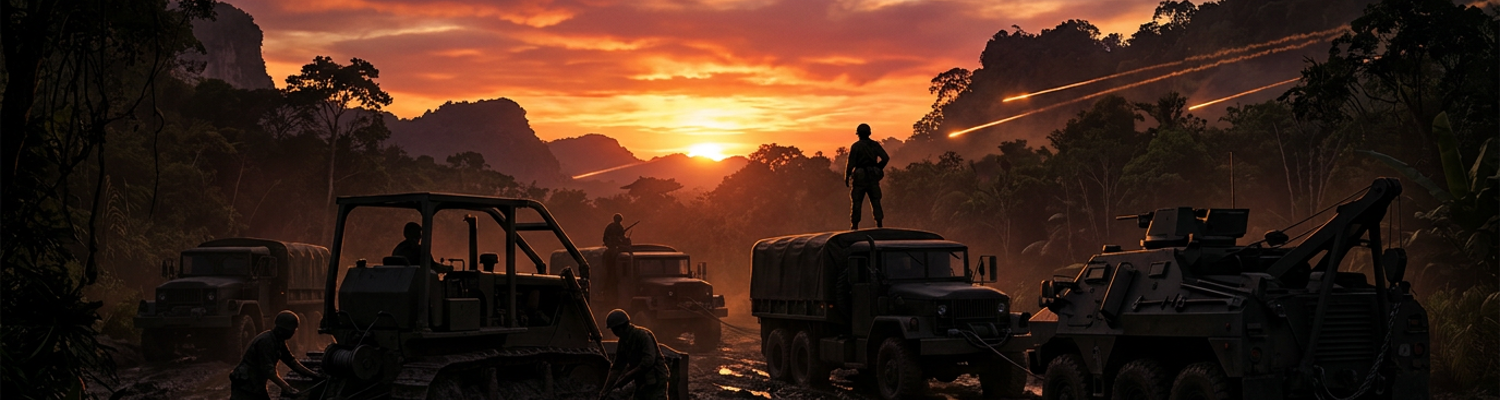

Terrain Challenges Across the Dien Ban Corridor
Silt accumulated knee-deep across the low flatlands of the Dien Ban corridor as seasonal water drained down from the western mountains into Quang Nam Province. Extreme tropical heat and thick humidity rapidly deteriorated wooden construction materials and caused heavy metal tools to rust within days of field storage. Flat expanses of wet rice paddies covered miles of the river delta, broken only by narrow dirt berms and shallow irrigation channels that offered little solid footing for mechanized equipment. Standing water hid submerged tree stumps, loose rock clusters, and pockets of saturated clay that easily sucked the tracks off crawler tractors and bogged down supply trucks. These fragile earthen dikes frequently washed out whenever water levels rose, cutting off rural hamlets from regional supply lines and isolating villages from allied support.
Seventh Engineer Battalion detachments deployed across these fractured routes to support the 1st Marine Division during pacification operations throughout Quang Nam Province in early 1970. Marine engineers transported motorized graders, dump trucks, and timber piles into the district to rebuild rural roads and restore access to local marketplaces. Operators repeatedly reinforced earthen retaining walls with sandbags and compacted crushed rock into the soft mud so heavy vehicles could cross without sliding into flooded paddies. Constant friction in the steering gears, hydraulic leaks caused by grit, and overheated engines plagued the heavy equipment during long work shifts under direct sunlight. Mechanics worked in open pits alongside the roadways to swap out damaged radiator hoses and weld broken blade arms back onto their tractors. Mechanics wiped grease from their hands and signaled the lead security vehicles to roll forward across the newly compacted dirt.
Viet Cong insurgents targeted these exposed traffic corridors by establishing systematic interdiction networks along the waterways and road shoulders. Hidden marksmen directed persistent sniper fire from distant tree lines at bridge building crews and unarmored earthmover operators working in the open. Insurgents also buried salvaged artillery shells and mortar rounds as command-detonated mines along canal crossings and narrow paddy dikes where repair vehicles were forced to slow down. Blast concussions routinely shattered the steel linkages of heavy graders, threw treads off bulldozers, and gouged deep craters into freshly compacted roadbeds. Sweeping parties equipped with handheld metal detectors walked ahead of every construction column to inspect the soft shoulders, but thick vegetation and spent shrapnel constantly slowed their clearance sweeps.
Armor plating salvaged from wrecked vehicles was welded directly over tractor cabs by maintenance crews trying to protect drivers from shrapnel and sniper rounds during these slow clearance runs. Drivers peered through narrow vision slits cut into scrap steel plates as they pushed forward into damaged canal banks to drop culvert pipes into place. Security riflemen took up sandbagged fighting positions on both sides of every creek crossing, returning fire toward surrounding foliage while engineers poured gravel into blast craters. Squad leaders established perimeter wire and staged timber trestles along the waterlines so bridge construction could continue without halting during ambush attempts. Riggers bolted heavy timbers together by hand beneath tractor winches, anchoring the framework deep into the creek bed before the falling tide exposed the bank foundations. Work crews finished bolting the wooden deck planks into the foundation beams and cleared the first supply truck across the newly reinforced canal crossing just before darkness arrived.
Supply Chain Deficits and Material Shortages
Cargo manifests carried by the arriving truck confirmed that rear supply depots held almost no heavy construction lumber or prefabricated drainage components for the forward platoons. Seventh Engineer Battalion detachments working throughout the Dien Ban corridor faced chronic supply deficits in Class IV barrier and construction materials, specifically heavy construction timber and corrugated culvert piping needed for tactical drainage. Every span across the local canal system had exhausted the unit stockpile of three-inch deck planks and twelve-by-twelve support beams, leaving the engineers with nothing to shore up soft bridge abutments. Saturated mud along the roadway margins demanded deep, reinforced channels to divert monsoon water away from the roadbeds, but the complete absence of corrugated steel pipe caused drainage ditches to collapse inward under their own weight. Unchanneled runoff backed up against freshly packed dirt embankments, softening the soil and threatening to wash out the newly opened road within hours of heavy vehicle traffic. Engineers scavenged empty fifty-five-gallon fuel drums from nearby artillery firebases and cut out both ends of the steel cylinders with oxyacetylene torches to fashion crude substitute drainage pipes.
Welders fused these steel drums together into twenty-foot drainage tubes and rolled them directly into the muddy road cuts where factory-built corrugated metal culverts should have gone. These field improvisations became mandatory because logistical interdiction along supply routes from Da Nang depots stranded forward engineering detachments without standard replacement materials. Convoys of five-ton trucks attempting to haul structural lumber south along Route 1 repeatedly encountered command-detonated mines, sniper ambushes, and destroyed bridge bypasses that halted vehicle columns for hours at a time. Shrapnel damage and blown tires regularly forced supply trucks to abandon their cargo runs and turn back to the Force Logistic Command depots, cutting off the forward units from regular deliveries of nails, steel drift pins, and replacement bridge stringers. Division logisticians diverted what little Class IV material reached the sector toward fortified artillery positions and airbase perimeter defenses, leaving rural civic action roads at the bottom of the regional supply priority list. Field commanders responded by directing the engineering platoons to dismantle destroyed French colonial buildings and salvage structural metal to bridge the remaining washouts along the transit corridor.
Sledgehammers smashed against crumbling masonry as Marines knocked down ruined brick villas near the district headquarters to recover hand-hewn hardwood beams. Working parties used pickaxes and crowbars to pry bent narrow-gauge railroad tracks out of abandoned plantation tram lines, hauling the heavy steel rails on dump trucks to serve as makeshift bridge stringers. Mechanics trimmed the twisted rails with gasoline-powered rescue saws and drilled fresh anchor holes through dense ironwood rafters using hand braces after electric drill bits dulled against the cured grain. Riggers layered scrap metal landing mats and salvaged telephone poles across the railroad rails to form sturdy deck surfaces capable of supporting armored personnel carriers and loaded dump trucks. Combat engineers packed crushed brick rubble around the scavenged culvert drums to stabilize the trench walls before dump trucks spread fresh laterite soil over the crossing. Squad leaders inspected these improvised crossings twice a day, measuring bank erosion with marked wooden stakes to ensure the scavenged foundations held fast against the rising river current.
Fortification Engineering for Platoon Outposts
Stakes driven into the creek banks marked the only passable routes leading deeper into contested Dien Ban territory, where isolated Combined Action Platoon compounds waited for critical defense fortifications. Combined Action Platoon outposts placed small squads of Marines alongside local South Vietnamese Popular Forces militiamen inside rural hamlets, living directly among the civilian population miles away from major allied bases. Insurgent squads systematically targeted these remote compounds with night mortar barrages, sniper harassment, and ground probes, exploiting fragile bamboo fences and rotting sandbags that offered little protection against incoming fire. Combat engineers visiting the hamlets found defensive perimeters sagging from constant rain, with drainage ditches backing up into sleeping pits and unreinforced dirt parapets collapsing into nearby garden plots. Supply depots back at Da Nang could not provide factory-built steel bunkers, corrugated shelter arches, or prefabricated timber kits because higher-priority airfields and division cantonments absorbed all available construction stocks. Combat engineers grabbed axes and machetes, walking outside the compound wire to harvest whatever structural materials they could find growing in the nearby tree lines.
Axe blades swung against wild stands of thick bamboo and native palm groves outside the hamlet gates as work crews gathered indigenous materials to construct protective revetments. Marines and Popular Forces troops lashed dense rows of green bamboo stalks together with scavenged telephone wire, driving the vertical posts deep into the wet earth to build double-walled retaining frames. Local militiamen showed the engineers how to interlace split bamboo into flexible wattling that absorbed shockwaves without splintering into lethal shards. Working parties filled the wide gaps between these wooden frames with heavy river clay mixed with chopped rice straw, pounding the damp mixture flat with wood mallets to form sturdy earthen revetments that cured hard under the tropical sun. Empty wooden ammunition crates, salvaged tin roofing panels, and discarded ration boxes were stacked along the inner trench faces to keep the clay walls from sliding into fighting holes during sudden downpours. Marines tested the cured clay walls by firing test rounds into the exterior face, watching the dense earthen mixture absorb the bullets without cracking.
Mortar fragments clattering against the freshly packed revetments showed that wall protection alone could not shield the garrison from plunging fire. Engineers hauled felled coconut palm logs into the compound on hand-carried litters, laying staggered tiers of thick tree trunks across bunker ceiling frames to absorb direct rocket impacts. Troops stretched salvaged plastic poncho liners and discarded tarpaulins between the log layers to shed torrential rainwater before moisture could weaken the supporting beams. Working parties placed layers of woven bamboo mats over the waterproofed logs to catch loose debris, then topped the structure with crushed laterite soil and multiple courses of sandbags filled with paddy dirt. Sappers probing the perimeter at night encountered reinforced fighting bunkers with baffled entryways and narrow firing slits that provided overlapping fields of fire across every avenue of approach through the surrounding paddies. Squad leaders checked the timber roof supports with plumb bobs, anchoring the foundation posts with drift bolts before positioning machine guns inside the completed bunker.
Field Repairs and Mechanical Recovery
Machine gunners opened fire from these newly built bunker embrasures to suppress snipers targeting Caterpillar D7E crawler tractors that were clearing rubble along the road. Seventh Engineer Battalion work parties depended entirely on these thirty-ton crawler tractors to carve bypasses, fill blast craters, and push earthen berms into place across the paddies. Operating these heavy earthmovers in the Dien Ban corridor resulted in high mechanical attrition because insurgents systematically salted the roadway margins and ditch lines with buried box mines and artillery shells rigged with pressure fuses. Buried explosives frequently detonated directly beneath dozer tracks or under the heavy front blades, blowing track grousers into the brush, bending steel push arms, and shattering roller frames. Concussions from these blasts cracked cast-iron belly pans and tore engine cooling fans from their belts, leaving almost every Caterpillar D7E in the forward detachment hobbled by persistent mechanical breakdowns and leaking fluids.
Mechanics could not summon heavy equipment recovery support to extract these damaged machines because five-ton wreckers tipped over whenever they attempted to negotiate the narrow, mined paddy dikes. Armored recovery vehicles remained stationed far to the north at Da Nang or were assigned to armored cavalry units along Route 1, leaving the combat engineers completely on their own when an earthmover struck an explosive. Abandoning a disabled dozer meant losing an irreplaceable construction asset to enemy scavengers or allowing insurgents to pack the engine compartment with plastic explosives overnight. Maintenance crews responded by riding directly behind the earthmovers in sandbagged utility trucks, carrying cutting torches, sledgehammers, and tool chests to fix blast damage right where the vehicle stopped. When a detonation immobilized a crawler tractor, mechanics ran forward through surrounding rice water and crawled beneath the mangled suspension, using heavy steel drift punches to hammer sheared track pins out of split track links while riflemen returned fire over their heads.
Shrapnel tore through high-pressure hydraulic conduits during these blasts, dumping gallons of pressurized fluid into the soil and leaving the steel dozer blades pinned flat against the dirt. Without working hydraulic pressure to lift the front blade, a tractor could not move, creating a massive road block that halted the entire engineering convoy under hostile fire. Forward detachments carried no factory-made replacement hoses, forcing maintenance crews to execute improvised on-site repairs on the punctured hydraulic lines while pinned down behind the tractor tracks. Mechanics used hacksaws to cut away the frayed steel-wire braiding and mangled rubber around each puncture, evening out the severed hose ends with hand files. Crews forced threaded brass compression sleeves and scavenged pipe couplings into the severed conduit lines, clamping steel band collars tightly around the joints and binding the assembly with heavy-gauge safety wire to prevent the splices from blowing apart under working pressure. Hand pumps drawn from tool bins forced replacement fluid back into the reservoir until the dual lift cylinders regained pressure and raised the heavy blade off the ground.
Tractor operators pulled master clutch levers to test the spliced lines against the weight of the raised blade as dirt clods kicked up by incoming rounds bounced off the armored cab. The patched hydraulic circuit held the line pressure, allowing the operator to shift the transmission into reverse and back the damaged machine out of the smoking blast crater. Mechanics gathered their tools from the muddy ditch and climbed into the trailing utility truck, keeping their eyes on the leaking seals to ensure the field splices did not blow out as the crawler tractor pivoted. Squad leaders waved the lead security vehicle forward, guiding the limping dozer into the center of the convoy so the platoon could resume road clearance toward the next canal crossing.
Airfield Matting and Route Stabilization
Trucks in the clearance column braked hard at the edge of the canal as crumbling berms gave way beneath their front tires. Saturated clay sloughed off the roadway shoulders in thick sheets, threatening to slide the entire roadbed into the muddy water before vehicles could reach the crossing. Combat engineers solved the structural failure by scavenging salvaged AM2 aluminum airfield matting and perforated steel planking from damaged helicopter pads near Da Nang to reinforce the unstable canal berms and road beds. Marines hauled the heavy, hollow-ribbed aluminum planks out of utility beds by hand, laying them crosswise over the soupy mud and hammering the interlocking edge joints together with steel drift pins and eight-pound sledges. The wide aluminum panels distributed heavy vehicle weights over broad areas of wet soil, preventing loaded trucks from digging deep ruts into the road surface. Work crews also drove perforated steel planking vertically into the sliding canal slopes like miniature bulkheads, backing the metal walls with soil-filled sandbags and iron reinforcement rods to stop the banks from caving into the water.
Iron rods anchored the bank, but surging tidal currents in the canal battered the floating pontoon assemblies stationed across the primary water gap. Swelling runoff twisted the hollow steel pontoon sections out of alignment, shearing connection pins and threatening to sever the critical tactical supply corridor used by forward infantry battalions. Engineers waded chest-deep into the swift, muddy water to carry out emergency stabilization on the shifting pontoon units before the entire floating bridge broke apart. Mechanics wrapped heavy wire rope around the shifting pontoon corners, hauling the floats back into square using hand-operated come-alongs and locking the steel connection ears with threaded turnbuckles. Snipers fired into the crossing from dense bamboo stands along the opposite bank, chipping paint off the steel hulls, but Marine welders stood their ground and used portable gas torches to patch cracked seams while a ditch pump drained floodwater out of punctured compartments.
Pumps emptied the flooded steel compartments, restoring buoyancy to the pontoon deck just as the first infantry supply trucks lined up along the reinforced approach. Engineers laid extra sections of scavenged AM2 aluminum matting directly across the wooden transition ramps to smooth out the rough transition between the muddy bank and the floating bridge. Heavy five-ton cargo trucks carrying artillery shells, small-arms ammunition, and medical crates rolled forward over the metal deck, flexing the pontoon joints into the brown current without rupturing the newly welded seams. Combat engineers stationed along both riverbanks watched the anchor cables stretch under the moving tonnage, using hand wrenches to tighten cable clamps whenever the river current pushed the floating bridge out of alignment. Radio operators sent immediate word to forward infantry command posts that the tactical supply corridor was open for heavy military traffic once again. Squad leaders posted bridge guards with sandbags around the cable winches, preparing the maintenance crew to inspect the interlocking mat seams after the next supply convoy passed.
Water Point Restoration and Hamlet Infrastructure
Trucks clearing the bridgehead rolled west into contested pacification hamlets where Seventh Engineer Battalion detachments unloaded truck-mounted drilling rigs to drill tube wells and rehabilitate broken potable water distribution points. Civilians living across the Dien Ban lowlands relied on open, shallow brick wells that floodwaters and river silt regularly fouled with bacteria and stagnant runoff. Contaminated surface water spread dysentery and parasitic illnesses through farming hamlets, undermining allied pacification programs designed to secure local loyalty. Combat engineers recognized that digging standard surface pits provided only temporary relief because surface drainage repeatedly polluted the shallow water table. Drilling crews backed five-ton trucks carrying rotary drilling assemblies into hamlet commons, rigging heavy drive shafts and water swivels to bore narrow, deep shafts through packed clay into clean aquifers below forty feet. Operators raised the drilling masts with hydraulic winches, locking the steel outriggers into timber footing pads to keep the heavy drilling machinery level in soft mud.
Mud bubbled around the spinning rotary bits as drill operators forced high-pressure water down the drill stem to flush ground clay and river gravel up to the surface. Crews worked with hand wrenches to thread twelve-foot sections of two-inch galvanized steel casing pipe into the deepening boreholes as soon as the drill bit struck water-bearing sand strata. Engineers lowered brass slotted sand screens and foot valves down the center of the casing pipe, creating sealed tube wells that prevented fine silt from clogging the intake lines. Soldiers and Marines mixed dry cement with river sand inside wheelbarrows, pouring thick concrete aprons around every wellhead to prevent muddy surface water from seeping back down into the clean water column. Mechanics bolted heavy cast-iron hand pumps onto the threaded pipe collars, testing the leather piston seals by pumping the steel handles until cold, clear water surged into wooden buckets. Hamlet elders gathered around the concrete slabs to inspect the working water points, testing the output while children carried five-gallon water cans back to family thatch huts.
Huts clustered around these new water points often concealed embedded local guerrilla elements who tracked every engineering movement across the hamlet perimeter. Conducting civic infrastructure projects directly among the civilian population forced Marines to handle delicate public relations while maintaining strict combat perimeter security against sudden insurgent attacks. Guerrilla spotters mixed freely with villagers carrying water jars, gathering intelligence on engineer work schedules and searching for blind spots in the defensive perimeter. Security squads deployed around the wellhead could not seal off the area completely without alienating the very civilians the civic action mission aimed to win over. Squad leaders positioned riflemen in sandbagged fighting holes along nearby treelines, placing automatic rifle teams behind low garden walls to cover every foot trail leading into the hamlet plaza. Marines inspected incoming tool crates and pipe bundles for booby traps, keeping their weapons loaded and chambered while assisting drilling crews with heavy casing wrenches.
Wrenches clicked against the steel pipe collars as engineers tightened the final discharge fittings, working under the watchful eyes of security riflemen scanning the hedgerows. Riflemen spotted suspicious figures retreating into bamboo stands along the outer tree line whenever security patrols shifted position to inspect drainage runoff ditches. Patrols checked perimeter culverts and surrounding footpaths twice each afternoon, using bayonets and magnetic mine detectors to locate buried command-detonated explosives planted near civic gathering spots. Engineers ignored sniper harassment from distant treelines, finishing the concrete drainage channels that carried excess pump spillage away from nearby homes into regional irrigation canals. Team leaders handed replacement gaskets, spare pump leathers, and pipe wrenches directly to village maintenance committees so local residents could repair the water points after the Marines departed. Convoy commanders formed the utility trucks and security gun jeeps into a tight marching column, preparing to move the drilling detachment to the next contested hamlet along the riverbank.
Headquarters Critiques of Pacification Programs
Gun jeeps braked to a sudden halt along the riverbank as radio operators received urgent orders from battalion headquarters to hold the drilling column in place. Seventh Engineer Battalion officers were voicing intense operational pushback against the continuous diversion of technical troops into insecure rural hamlets. Field commanders pointed out that combat engineers had trained for heavy assault breaching, minefield clearing, and tactical bridge construction, yet high-level pacification plans routinely scattered them across contested farm settlements without dedicated infantry security. Sending irreplaceable water-drilling rigs and heavy dump trucks into remote villages forced engineering detachments to provide their own local defense, pulling trained mechanics and machine operators away from their technical duties to stand guard in shallow roadside foxholes. Enemy snipers took advantage of these static construction sites by firing into open machinery bays, wounding equipment operators and damaging high-pressure hydraulic lines that could not be repaired in the field. Field officers drafted urgent radio messages back to division headquarters, demanding that engineering squads be pulled from the village drainage ditches and returned to the primary supply corridors.
Documents filed by Marine officers on April 21, 1970, captured this deep operational pushback over the strategic misdirection of engineering assets. Battalion commanders told visiting military historians that pacification planners treated Marine engineers like cheap construction labor, ordering them into exposed villages where territorial militia units routinely failed to provide adequate perimeter defense. These records detailed how commanders objected to risking expensive Caterpillar earthmovers and specialized technicians on poorly coordinated civic action tasks while major tactical roads remained unpaved and vulnerable to enemy interdiction. Operating heavy machinery in unfortified village commons gave local guerrilla spotters ample time to track work schedules, locate equipment staging areas, and bury heavy command-detonated explosives along the withdrawal routes. Enemy sappers exploited these scattered deployments, slipping past the thinned security lines to plant explosive charges beneath the wooden bridge pilings along the primary combat corridors.
Bridge spans along major tactical highways sat unrepaired because specialized maintenance platoons were scattered across small hamlets clearing village ditches. Staff officers examining the field reviews noted that civic infrastructure projects created a fragile impression of progress that collapsed as soon as the Marine convoys departed. Insurgent squads regularly slipped into the hamlets after dark to destroy newly installed hand pumps, sabotage concrete well aprons, and intimidate the local councils that had accepted allied help. Frontline commanders argued that committing combat engineers to civic works in areas without permanent allied garrisons wasted vital resources that belonged in direct support of combat operations. Infantry battalions stranded at swollen water crossings dropped their heavy packs into the mud, waiting for hours while the delayed clearance teams slowly worked their way up the contested highway.
Radiomen at the forward district command post copied fresh operational directives that sharply restricted engineer work detachments to projects with direct military value. Company commanders immediately used these instructions to recall exposed engineering squads from outlying hamlets and reassign them to fortified combat outposts along the river. Riggers secured the rotary drill masts onto their transport beds, using heavy logging chains and load binders to lock the heavy machinery in place before mounting machine guns on the truck cabs. Mechanics collected their pipe wrenches and tool chests from the muddy roadside, stowing the gear inside steel utility lockers to prevent water damage. Squad leaders loaded fresh magazines into their rifles and waved the vehicles into a tight defensive formation, turning the column back toward the contested highway bridgehead. Drivers engaged their front-wheel drives and accelerated into the gravel roadbed, steering the heavy trucks toward damaged culvert crossings that needed emergency tactical repairs.
Engineering Attrition and Resource Allocation
Gravel spun from spinning dual tires as the trucks pulled up to an isolated culvert bypass situated well outside the protective umbrella of friendly artillery batteries. Seventh Engineer Battalion detachments assigned to these rural repair sites operated in small, static details of six to ten men, working for days at fixed crossroads without dedicated infantry screens. Insurgents watched the predictable work schedules and targeted these isolated clusters with command-detonated landmines, rifle-grenade volleys, and accurate sniper fire from concealed tree lines. Combat engineer casualty figures climbed sharply because these small work parties lacked the heavy crew-served weapons needed to suppress organized ambushes, and their remote locations placed them beyond the immediate range of battalion mortar tracks and quick-reaction forces. Field corpsmen struggled to stabilize wounded Marines in open trenches while team leaders radioed distant fire direction centers, only to learn that intervening ridge lines and extreme ranges prevented artillery batteries from dropping defensive barrages around the contested perimeter.
Stretcher teams loaded wounded operators into utility trucks as company officers calculated the mounting tactical cost of dispersing their trained workforce across dozens of unprotected project sites. Operating in small, stationary groups turned skilled earthmover drivers, bridge mechanics, and demolition men into static targets who suffered higher casualty rates than many conventional infantry squads sweeping through the same river valleys. Technical specialists spent long hours pinned down behind tractor tracks or kneeling in water-filled roadside ditches instead of running equipment, bleeding away irreplaceable mechanical talent that could not be replaced by incoming general drafts from the training bases. Squad leaders patched fragmented teams together using whatever junior Marines remained on their feet, cross-training equipment operators as perimeter riflemen and assigning grease guns to heavy equipment mechanics so the work parties could defend their own tool trailers. Company commanders typed out emergency casualty reports on field typewriters, handing the paper dispatches to radio operators for immediate transmission back to the division command posts.
Command posts at higher headquarters continued to measure counterinsurgency success through rigid statistical scorecards, creating intense institutional tension between top-down civic action metrics and the baseline operational survivability of frontline engineer detachments. Staff officers in Da Nang demanded weekly quotas showing hundreds of meters of widened farm roads, dozens of restored drainage pipes, and completed market foundations to satisfy pacification progress charts for military assistance command reviewers. Field commanders pointed out that chasing these arbitrary construction numbers forced engineering platoons into exposed hamlets where local militias offered zero security, effectively trading the lives of trained Marines for minor civic improvements that enemy sappers destroyed within hours of completion. Frontline officers argued that preserving the core combat strength of their heavy equipment companies had to take priority over public relations figures, especially when frontline combat units were screaming for mine clearance teams and assault bridges along critical tactical movement corridors. Engineer officers slammed their fists against the wooden map boards during battalion staff meetings, refusing to send another bare work party into the hamlets without dedicated air cover or organic artillery support.
Staff planners reacted to the worsening casualty reports by redrawing project maps and setting strict limits on where engineering details could operate without attached infantry companies. Battalion operations officers canceled scattered hamlet improvement quotas and consolidated surviving work parties into fortified strongpoints positioned within the direct coverage fans of friendly ten-five-millimeter howitzer batteries. Mechanics welded heavier steel deflectors onto the undercarriages of their remaining utility trucks and loaded sandbags over the fuel tanks to help convoys survive mine strikes along the transit routes. Squad leaders gathered their remaining men around the lead tractor, issued fresh belts of machine gun ammunition to the cab gunners, and locked the equipment trailers to the tow pintles. Drivers climbed back into their armored tractor seats, engaged the main drive clutches, and guided the heavy work convoy down the river road toward the relative safety of the forward infantry firebase.