
The 1916 Cavalry Drill Regulations described a world of military precision. The text detailed formations and battlefield actions with clean geometry, prescribing how units should form, move, and communicate. It envisioned horse and rider operating in a system of disciplined control. The operational image was one of well-supplied troopers executing patrols with confidence across a defined landscape. The truth waiting for Army units deployed along the nearly 2,000-mile U.S.-Mexico border in 1920 was a different matter entirely. It was a trooper whose horse was lame from traversing rock-strewn arroyos, whose government-issued equipment was a mismatched collection from different eras, and who found himself isolated for weeks in a vast, unforgiving desert that cared little for doctrinal elegance.
The prevailing narrative of border security was a fiction shaped by newspaper serials and nascent motion pictures. The American public consumed stories of cavalrymen on spirited chargers in a clear-cut contest against disorganized bandits. A review of archival evidence (NARA Record Group 94) paints a different picture. The U.S. Army on the border, including elements of the 8th Cavalry Regiment, was a constabulary force stretched to its breaking point. Instead of storybook villains, they faced smugglers moving everything from liquor to opium, revolutionaries crossing to secure arms, and ordinary people seeking to cross a largely unmarked line. The equipment was far from heroic. While the Springfield 1903 rifle was a capable weapon, much of the remaining gear was worn out from service in the Great War. Troopers often had to provide their own horses, with the government merely supplying oats and hay. A single cavalry brigade might be tasked with patrolling a nine-hundred-mile front, scattered across dozens of tiny, unsupported outposts.
An analysis of the 1920 border quagmire requires a forensic examination of the mundane, often embarrassing, records of the operation itself. Supply requisitions, unit morning reports, maintenance logs, and court-martial proceedings are prioritized over breathless newspaper articles. This granular, fact-based analysis reveals the operational friction that defined the mission. A newspaper might report a successful skirmish, but a review of operational logs would show the victory was achieved at huge cost, perhaps involving the expenditure of thousands of rounds to chase off a few individuals, resulting in heat casualties among the troopers and broken-down equipment. Army patrols were often intermittent and irregular. The Bureau of Immigration had largely abandoned its own patrol activities by 1920 due to a lack of resources. Military units filled the gap, but their primary mission was military training, not law enforcement, creating a confused command structure and thankless duty.
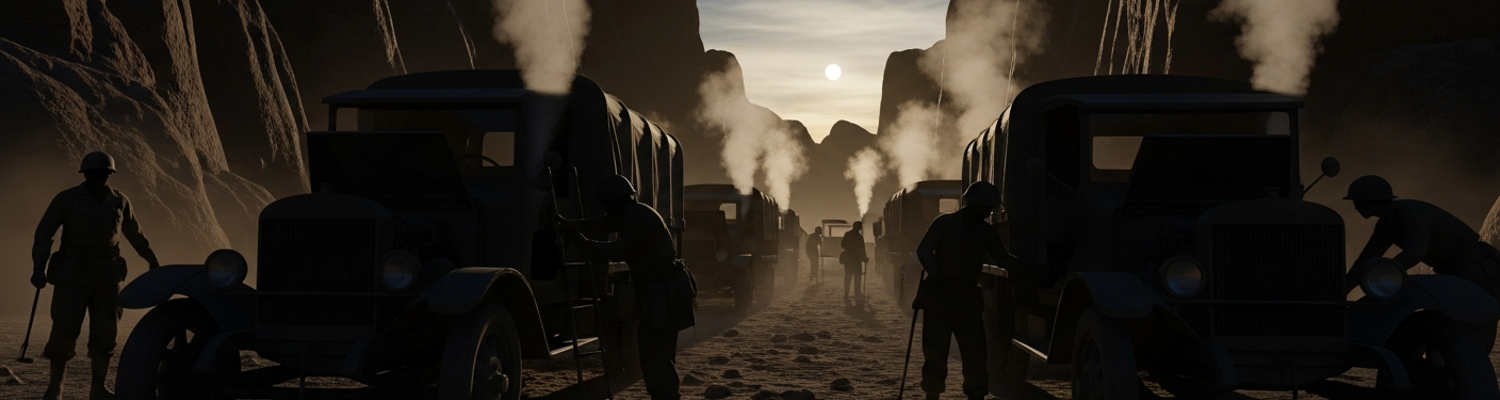
The operation against smugglers at Whiskey Pass in the Chiricahua Mountains was predicated on a logistical chain that proved entirely theoretical. Elements of the 8th Cavalry Regiment, dismounted and operating as infantry, were deployed based on intelligence indicating a significant opium shipment would be moving north. The plan depended on motorized support from the Quartermaster Corps, utilizing war-surplus Liberty trucks to transport troops and supplies to a forward interdiction point. This was a catastrophic miscalculation. These vehicles, designed for the cooler, muddier conditions of the Western Front, were wholly unsuited for the high temperatures and primitive trails of the region.
Almost immediately, the mechanical support of the operation fractured. The Liberty trucks, with their inefficient thermo-siphon cooling systems, began to overheat within hours of leaving their garrison. Maintenance logs from the period detail a litany of failures common to early combustion engines in extreme heat. Radiators boiled over, fuel vaporized in the lines, and constant tire failures occurred on the sharp, rocky ground. Unit reports describe a halting, agonizingly slow advance as trucks were forced to stop repeatedly, their crews waiting for engines to cool enough to take on more water. Eventually, the convoy ground to a complete halt miles short of its objective. This forced the cavalrymen to proceed on a forced march under a brutal sun, carrying their gear and limited water. The failure of the trucks dictated the terms of the engagement before it even began, ensuring the troops arrived at Whiskey Pass exhausted, dehydrated, and with no logistical support.
This physical exhaustion was compounded by a failure of their primary automatic weapon. The troops carried the M1918 Browning Automatic Rifle, a weapon that had earned a reputation in the mud of France. The fine, alkaline dust of the desert presented a different challenge. Operational reports indicate that during the ensuing firefight, the BARs began to fail. The weapon’s open-bolt design and the tight tolerances of its machining proved susceptible to jamming from the pervasive sand. The M1918’s fixed barrel design meant that under sustained fire, the barrel would overheat rapidly. This excessive heat, combined with fouling from dust, caused extractors to fail and cartridges to jam in the chamber. Troopers who were supposed to be providing a steady base of fire were instead forced to frantically clear stoppages while under fire from smugglers using simpler, more reliable firearms.
The tactical failure became a humanitarian disaster with the realization that the targeted caravan was not solely comprised of armed smugglers. Caught up in the movement along the trail was a column of starving Mexican civilians. A decade of revolution, political instability, and drought had devastated northern Mexico, creating a massive and desperate exodus of people heading north. These refugees, seeking food and safety, traveled the same remote corridors as the smugglers, often mingling with them for protection or by coincidence. From the American positions, the distinction was impossible to make. The engagement at Whiskey Pass became a chaotic, one-sided battle where soldiers, struggling with failing equipment, fired into a group that included unarmed men, women, and children. The opium was never seized. The smugglers largely melted away, leaving the Army to confront the bloody consequences of its flawed intelligence and mechanical breakdowns.
The logistical apparatus intended to support the Army’s border outposts was built on a foundation of repurposed and exhausted World War I surplus. A review of operational logs reveals that units like the 8th Cavalry were issued equipment designed for the temperate battlefields of France, not the extreme heat and abrasive grit of the desert-alpine environment. Heavy wool M1912 service coats, adequate for a European winter, became instruments of heat exhaustion under the border sun. Leather harnesses and saddles, stored for years, dried out and cracked, snapping under the strain of pulling supply wagons or carrying troopers over rough terrain. The mechanical backbone of the supply columns, the war-surplus Liberty trucks, proved especially unsuited for the task. Supplying a remote mountain outpost became a Sisyphean task, with Quartermaster mule trains often being the only viable method, yet even these were slow and limited in capacity, needing almost as many supplies for themselves in forage as they could carry for the troops.
Chronic and debilitating shortages of water and medical supplies became a defining feature of life in the desert garrisons. A man in such heat requires at least a gallon of water per day just to remain functional, and a working mule requires far more. Securing and transporting this quantity was a logistical nightmare. Medical logs from the period show a constant battle against dehydration, heatstroke, and dysentery from contaminated water sources. Medical officers assigned to border posts filed repeated, desperate requests for supplies that rarely arrived in sufficient quantities. Quinine for treating malaria, a persistent threat in some river valleys, was frequently unavailable. Field sanitation was abysmal, leading to outbreaks of disease that could incapacitate an entire platoon. The few medical supplies that did arrive, such as bandages and basic surgical tools, were often leftovers from the Great War, poorly packaged and sometimes compromised by years of storage. A simple leg fracture from a fall, easily treatable elsewhere, could become a life-threatening event in an isolated outpost.
This state of affairs on the ground stood in contrast to the picture of efficiency presented in official Quartermaster Corps reports filed to Washington. Archival evidence shows a clear discrepancy between high-level summaries and unit-level reality. A division-level report might state that a certain outpost received its authorized rations, and on paper, this was true. The report, however, would fail to mention that the delivered bacon was rancid, the flour was infested with weevils, and the canned goods had burst from heat and fermentation during their long journey. These reports measured success in terms of requisitions filled and tonnage moved, metrics that had little connection to the actual usability of the supplies. A supply column’s delivery of 500 horseshoes would be logged as a success, even if morning reports from the receiving cavalry troop showed they were the wrong size for their animals, rendering them useless lumps of metal. This bureaucratic disconnect created a dangerous fiction, allowing senior commanders to believe their troops were adequately supplied while troopers on the front lines were forced to barter with locals or go without.
Signal Corps records from the border patrol era reveal a force grappling with systemic equipment failure. The Army of 1920 relied heavily on wired field telephones, such as the EE-5, and telegraphic service buzzers like the Model 1914. These systems, proven in the static warfare of Europe, were disastrously ill-suited to the mobile, dispersed operations in the desert. Insulated field wire, spooled out from mule-drawn carts or by hand, cracked and degraded under the intense solar radiation and constant abrasion against rock and cactus. A patrol might spend hours laying a line back to its outpost only to have it go dead, the break somewhere in miles of exposed wire baking under the sun. The dry air also created severe static electricity problems, rendering transmissions unintelligible. The hand-cranked magneto generators and dry-cell batteries that powered these devices were not designed for extreme heat, which sapped their power and shortened their operational life.
Units fell back on visual signaling.
Heliographs, which use mirrors to flash sunlight, were a 19th-century technology still in official use, but they were dependent on a clear day and a direct line of sight, a rare combination in mountainous terrain. At night or in haze, they were useless. The entire communications apparatus, the nerve system of command and control, was being systematically dismantled not by an enemy, but by the environment itself.
The problems extended to basic survival. Water purification doctrine centered on the Lyster bag, a 36-gallon canvas sack designed to be suspended from a tripod where water could be treated with calcium hypochlorite. The bag’s porous canvas was intended to sweat, a process of evaporation that would cool the contents. In the dust-choked borderlands, this became a catastrophic flaw. The damp outer surface of the bag attracted and trapped airborne grit, which would then contaminate the spigots used to fill canteens. Morning reports from field medical officers document persistent outbreaks of dysentery directly linked to these contaminated bags. Keeping the bags sterile as doctrine demanded was impossible when every gust of wind carried a fresh layer of fine, abrasive dust.
Footwear was another point of failure. Troopers were issued the M1917 or M1918 “Pershing” trench boot, a heavy leather design with a multi-layered sole studded with hobnails. These boots were engineered for the mud and cold of the Western Front. On the sun-baked rocks of the border, they became instruments of torture. The hobnails, designed to grip mud, offered poor traction on smooth rock, leading to frequent slips and falls. The metal nails conducted the intense ground heat directly into the soles of the troopers' feet. The thick, multi-layered leather construction, meant to keep water out, also prevented sweat from escaping, effectively cooking the soldiers' feet. Unit medical logs show a constant stream of troopers incapacitated by severe blisters, heat injuries to the feet, and sprained ankles caused by unstable footwear on broken ground.
Disease was the most effective enemy on the border. Army medical logs from the period reveal a force being degraded by sicknesses born of the environment and poor sanitation. For infantrymen operating out of isolated desert posts, malaria and dysentery were constant threats. The fevers and debilitating intestinal distress these diseases caused could incapacitate an entire platoon faster than any skirmish. Medical reports document soldiers presenting with cycles of violent chills followed by raging fevers, or with dysentery so severe it left them too weak to stand. These were grinding, chronic conditions that sapped a unit’s strength over weeks. Quinine, the standard treatment for malaria, was a frequently requested but seldom adequately supplied item. Recovery was a slow and uncertain process.
The treacherous mountain passes that defined the operational area presented the same lethal hazards to soldiers and the civilians fleeing the devastation of the Mexican Revolution. For dismounted cavalry patrols and the columns of refugees alike, travel through these corridors was a high-stakes gamble. The terrain was a constant danger. Narrow trails crumbled underfoot, sending men and pack animals falling down steep ravines. A sudden rockslide could erase a section of a trail. Flash floods could turn a dry arroyo into a deadly torrent in minutes. The act of movement was an exhausting ordeal on steep, rocky ground at high altitude, leading to falls and injuries that were life-threatening in such remote locations. For a soldier weakened by dysentery or a civilian family depleted by starvation, a sprained ankle was not a minor inconvenience but a potential death sentence.
American patrols, already strained by disease, failing equipment, and a broken supply chain, frequently encountered columns of displaced Mexican civilians. A decade of revolutionary violence had pushed hundreds of thousands of people to flee north, seeking safety and food. These refugees traveled the same smugglers' trails. From a distance, a dusty column of people moving through a mountain pass was an ambiguous target. The Army, sent to interdict smugglers, was instead confronted with a humanitarian catastrophe it was wholly unequipped to handle. There are no detailed records of soldiers providing aid, because they had none to give. Their own water and medical supplies were critically low. A patrol might pass a group of refugees one day, only for a different patrol to find them days later, succumbed to thirst or a sudden mountain storm. The military mission and the civilian plight became entangled in a landscape that was hostile to all.
The operational and logistical collapse of 1920 was a powerful demonstration that a conventional army was the wrong instrument for policing the border. The War Department wanted its forces training for large-scale combat, not chasing smugglers through canyons in a thankless, resource-draining constabulary mission. This failure became a direct catalyst for change. Archival records show an institutional desire to shed the mission, paving the way for the Labor Appropriation Act of 1924, which officially established the U.S. Border Patrol. This new, civilian agency was placed under the Department of Labor, specifically chartered to secure the borders between official points of entry. It was a clear separation of the military’s warfighting function from the law enforcement needs of immigration and customs control. With an initial force of just 450 patrol inspectors, the new service professionalized the role, making border security their primary and sole mission.
A review of after-action reports and summaries sent to Washington reveals a concerted effort to sanitize the failures of the 1920 operations. The chaotic engagement at Whiskey Pass, with its civilian casualties and equipment breakdowns, was not documented as a tactical disaster. Unit logs were massaged into high-level summaries that spoke of engagements with hostile forces while omitting the failure of the Browning Automatic Rifles and Liberty trucks. The true causes of mission failure, the environmental incompatibility of World War I surplus equipment, were buried in low-level maintenance reports that were never elevated to operational summaries. These sanitized histories focused on metrics that created an illusion of activity, such as miles patrolled or territory covered, rather than on actual results. There was no mention of the opium that was never seized or the smugglers who escaped. This bureaucratic self-preservation ensured that no senior careers were jeopardized by an embarrassing truth: the Army had been defeated not by an enemy, but by its own flawed logistics and the unforgiving desert.
The experience provided a clear, brutal education in the specific requirements of desert warfare: the need for reliable air-cooled engines, specialized water-handling procedures, and equipment hardened against dust and heat. While some of these technical points informed interwar experimentation, the larger strategic lessons were discarded. A close examination of Army strategic planning in the following years shows a deliberate pivot away from the complexities of low-intensity conflict and back toward preparation for a conventional war with another major power. The hard-won knowledge of constabulary duties, intelligence-led operations in complex terrain, and the challenges of operating amidst a civilian population was allowed to atrophy. The 1920 fiasco was a preview of 20th-century asymmetrical warfare, but the institution filed the experience away as an anomaly, a distraction from its real purpose. It was a willful institutional amnesia that ensured these same painful lessons would have to be learned again.