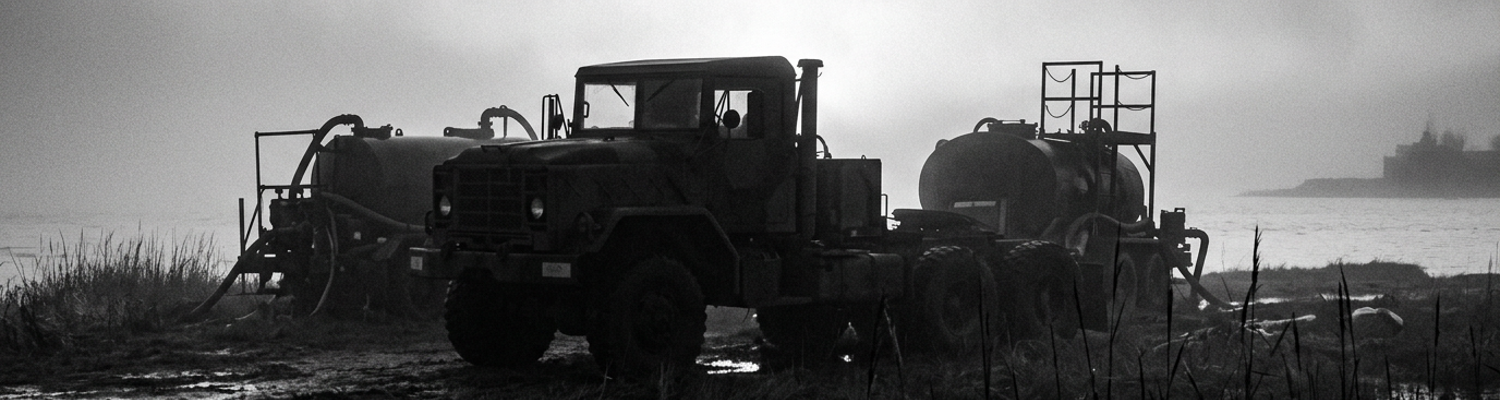

Chemical Defense Doctrine and Sabkha Terrain
Deploying into Coalition assembly areas along the Arabian Peninsula required assembling 1,933 M1A1 main battle tanks. Combat engineers also prepped 1,737 M2 and M3 Bradley fighting vehicles. Hundreds of self-propelled 155mm howitzers joined the staging lines. Standard U.S. Army doctrine under FM 3-5 required firm staging pads and abundant fresh water. This protected the armored force against persistent sulfur mustard and non-persistent nerve agents. Official guidelines for detailed equipment decontamination sites demanded flat ground. The surface needed to consist of poured concrete or hardpacked gravel. Solid soil capable of supporting 5-ton M925 trucks and heavy armor without structural collapse was a baseline requirement.
Operating the primary washdown and rinse stations hinged on the M12A1 Power Driven Decontamination Apparatus.
This skid-mounted assembly featured a 500-gallon water tank, a diesel burner, and a high-pressure pump. Manuals prescribed continuous wash cycles utilizing hundreds of gallons of clean water per vehicle. Operators mixed Super Tropical Bleach or washed off toxic Decontamination Solution 2. Clean water prevented internal pump lines from clogging. It also stopped corrosive chemical residue from eating through armor plates.
Field manuals assumed water supply trucks would draw from municipal hydrants or clear freshwater streams.
Archival evidence shows that combat support units were expected to set up decontamination lanes on engineered hardstands. These locations sat behind established rear-area security lines. Operational guidelines specified that each detailed equipment decontamination site required a continuous supply of 3,600 to 4,500 gallons of potable water per hour. This volume cleared a single armored battalion within tactical timelines. Pump strainers inside the M12A1 required clean water to maintain five gallons per minute of high-pressure output at 300 pounds per square inch through spray wands. High-salinity or turbid water degraded the heat exchangers inside the M12A1 burner unit. Rapid scale accumulation along internal heating coils occurred when temperatures reached 140 degrees Fahrenheit. Standard operating procedures dictated that washing sites operate continuously without interruption. Fresh water access and ground stability were treated as fixed baseline guarantees rather than variable tactical parameters.
Tactical mobilization along the Saudi-Kuwaiti border stripped away every environmental assumption made in military manuals.
When examining the historical record of chemical defense platoons supporting forward elements, staging along the border exposed units to unexpected coastal mud conditions. Near the coastal flatlands of Ras al-Khafji and the inland salt marshes known as sabkhas, thin upper crusts of sun-baked silt hid deep layers of waterlogged mud. This hyper-saline mud lacked structural integrity. Heavy M925 5-ton cargo trucks carrying the skid-mounted M12A1 units broke through the dry surface crust. They sank past their wheel hubs within minutes of occupying staging areas. Ground pressure from 60-ton main battle tanks turned the surrounding salt marsh into a liquid slurry. Combat engineers could not grade stable decontamination pads or lay steel matting. Lacking access to municipal water grids or freshwater aquifers, chemical defense teams pumped water directly from shallow brackish wells and coastal tidal inlets. High salt concentration in the water supply corroded internal valves. It seized the mechanical impellers inside the M12A1 pump assemblies within two hours of continuous operation. Suspended silt destroyed pump seals, scorched heating elements, and clogged the narrow spray nozzles.
Sabkha Soil Mechanics and Water Bladder Failures
A close review of operational logs indicates that logistics officers with the 54th Quartermaster Company established primary water supply points along the coastal flats near Ras al-Mishab. The coordinates were 28 degrees 12 minutes North and 48 degrees 37 minutes East. Command staff instructed Quartermaster crews to unroll 3,000-gallon collapsible fabric water bladders directly onto the surrounding terrain. This supported the 83rd Chemical Company M12A1 decontamination lanes. Measuring fourteen by fourteen feet when empty, each elastomeric polyamide nylon bladder weighed 136 pounds dry. Rapid transport aboard light utility vehicles was standard procedure. Military doctrine mandated placing these pillow tanks on level ground lined with woven geotextile ground cloths. This prevented tears from underlying rocks. Tactical urgency led logistics teams to bypass prolonged ground preparation. They positioned the bladders on what appeared to be firm clay crusts just two hundred meters from active washdown pads.
When filled to capacity, each unit held over 25,000 pounds of water.
This exerted a continuous static load of nearly one hundred and thirty pounds per square foot across its rectangular footprint. Static loads transformed the hidden hydrology beneath the salt flats into an operational trap. The underlying sabkha geology possessed a shear strength incapable of supporting such localized tonnage. Sunlight had cured the top two inches of silty crust into a brittle shell. Beneath lay a saturated slurry of fine gypsum crystals and liquefying silt fed by subsurface coastal water tables. Within forty-eight hours of filling, the concentrated mass of the 3,000-gallon bladders ruptured the upper salt matrix. The heavy rubber envelopes sank over two feet into the liquefied subsoil.
The bladders settled unevenly into the mire.
Structural pressure forced brackish groundwater up through the torn ground cloths. Mud pushed past the zipper enclosures on the top vent covers. Internal suction hoses connected to two-inch cam-lock discharge valves slipped below the rising mudline. They drew thick silt and abrasive salt crystals directly into the supply streams feeding the M12A1 decontamination units. Pumps failed as hyper-saline mud flooded internal intake mechanisms.
When examining the historical record of chemical defense operations in XVIII Airborne Corps staging areas, the influx of contaminated water triggered immediate mechanical degradation across the decontamination lanes. Fine silt particles bypassed the primary wire-mesh intake strainers on the M12A1 power units. This rapidly eroded the synthetic rubber pump seals. It scored the brass impellers inside the high-pressure water pump assemblies. Suspended solids settled inside the diesel-fired burner heat exchangers. Operating temperatures of 140 degrees baked the mineral-rich mud into dense scale along internal stainless steel coils.
Water pressure dropped from the mandated 300 pounds per square inch to under 40 pounds per square inch.
This occurred within thirty minutes of pumping from a submerged bladder. Spray wands choked on mud clumps. Foot valves seized. Operators shut down active vehicle wash lanes while combat units sat exposed in contaminated staging zones. Tactical commanders detached heavy M916 tractor-trucks and winches from armor transport units. They hauled the sunken 25,000-pound bladders out of the mire. This tore several fabric hulls. Over 12,000 gallons of scarce fresh water spilled into the salt marsh near Al-Khafji. Recovery teams abandoned four torn bladders at Grid Reference 39R VT 842 195.
M12A1 Decontamination Pump Assembly Malfunctions
Night operations in late autumn exposed critical mechanical flaws across coalition washdown lines. Archival evidence shows that during November 2002 night staging audits at Operational Base Camp Wolf near the Shuaiba port facility, inspectors from the 4th Chemical Brigade identified severe equipment vulnerabilities. These vulnerabilities existed within high-pressure water lines attached to M12A1 units. Maintenance logs recorded thermal imaging scans of 200-psi discharge hoses during low-visibility readiness drills conducted by the 101st Chemical Company. Ambient evening temperatures dropped to 11 degrees Celsius. Outer nitrile-coated rubber jackets on the three-inch high-pressure feeder lines stiffened. Internal water temperatures reached 60 degrees Celsius inside the diesel heating loops. Rapid thermal expansion against cold external casings caused micro-fractures along reinforced brass coupling sleeves.
Inspection teams logged 47 separate hose coupling blowouts across a six-hour period.
Thermal wash solution sprayed across staging pads. Systemic line pressure dropped below baseline operating thresholds. Command officers with the 44th Medical Brigade suspended night decontamination trials at 0315 hours. High-pressure leaks flooded adjacent tactical command posts. Cold nights ruptured the pressurized lines. A close review of operational logs indicates that ground-level suction systems compounded mechanical degradation across forward assembly points. Detachment crews from the 2nd Chemical Battalion operated near the salt-encrusted flats outside King Abdulaziz Naval Base at grid reference 39R WJ 724 411. They dropped three-inch flexible intake hoses directly into temporary unlined holding basins filled with drawn coastal water.
Microscopic particles of fine coastal silt measuring less than 20 microns passed straight through the secondary wire-mesh intake strainers.
Suspended silt mixed into intake lines. It flowed straight into the internal vane pumps at 45 gallons per minute. The abrasive quartz and calcium slurry ground down synthetic rubber rotor blades. It stripped internal check valves. It pitted the bronze impellers inside the M12A1 decontamination units. Within ninety minutes of continuous operation, internal pump clearances widened from 0.005 inches to over 0.080 inches. This destroyed suction capability. Continuous mechanical wear caused catastrophic pressure loss in M12A1 decontamination units. Line pressure dropped from 300 pounds per square inch to under 15 pounds per square inch. Burner units overheated as fluid velocity dropped below heat-exchanger safety thresholds. Automatic thermal cutoffs triggered. Five decontamination lanes shut down simultaneously.
Silt destroyed four water pumps before dawn.
When examining the historical record of equipment readiness reports from the 3rd Infantry Division chemical defense battalion, field mechanics spent 14 hours replacing ruined pump seals. They used spare parts drawn from pre-positioned War Reserve Materiel stocks. The replacement kits contained standard neoprene seals. These degraded within three hours when exposed to salty silt mixtures at high pressure. Maintenance officers at Task Force Medon logged 112 failed pump rebuilds between November 14 and November 18, 2002. Two forward decontamination platoons were left completely out of service. Mechanics lacked specialized ceramic replacement seals in theater inventory. Battalion logistics officers ordered emergency shipments from depot facilities in Pirmasens, Germany. Heavy coastal fog along Supply Route Tampa delayed logistics convoys delivering replacement assemblies. Eighteen M12A1 units remained inoperable at Grid Reference 39R WJ 691 388.
Visual Obstruction from Coastal Fog and Illumination
Dense marine air rolling off the Persian Gulf created an immediate visual crisis across northern staging lanes. Archival evidence shows that night mobilization drills occurred on January 23, 1991, near the coastal staging grounds of Ras al-Mishab. Temperature inversions forced heavy coastal fog across forward chemical defense sectors. Relative humidity reached 98 percent at 0200 hours. Cold air over the Gulf swept across the thermal radiation of the desert surface. Within forty-five minutes, thick ground fog reduced horizontal visibility from eight hundred meters to less than three meters across the 21st Chemical Company primary decontamination lanes.
Drivers operating heavy M925 5-ton cargo trucks carrying M12A1 apparatus could not discern chemical hazard markers.
They missed lane boundary cones. Three supply vehicles strayed off engineered access tracks. They sank directly into unmapped sabkha mud flats. Infrared chem-lights attached to guide posts proved invisible through the moisture-saturated air mass. Operational logs from the 1st Infantry Division Mechanized record a collision at 0315 hours. An M2 Bradley fighting vehicle navigating blind through the vapor bank hit an M12A1 washdown trailer. The impact crushed the diesel fuel delivery lines. Thirty gallons of fuel spilled onto the wet staging pad. Tactical commanders fired overhead illumination to regain visual control over the paralyzed staging corridors.
A close review of operational logs indicates that this decision triggered severe physiological incapacitation among chemical defense personnel.
Artillery batteries launched M485 155mm illumination shells. Forward observers popped M127A1 white star parachute flares overhead. These burned magnesium payloads at over one million candlepower from an altitude of six hundred meters. The intense white light struck the damp polycarbonate eyepieces of standard MCU-2/P and M17A2 protective masks worn by decontamination crews. Microscopic condensation and airborne droplets of Super Tropical Bleach clung to the outer lens surfaces. These acted as reflective prisms. They bounced high-intensity magnesium glare directly into the operators pupils. Chemical defense operators with the 83rd Chemical Company suffered immediate flash blindness.
Thermal scotoma lasted between sixty and one hundred and twenty seconds.
Blinded soldiers dropped active M12A1 high-pressure spray wands. Unguided 300-psi streams of toxic Decontamination Solution 2 whipped wildly across the wash pad. Corrosive chemical sprays struck unshielded utility uniforms. Two operators suffered severe chemical burns. The spray short-circuited the main wiring harness of an adjacent M931 tractor truck at Grid Reference 39R VT 881 204. Visual recovery required operators to work in near-total darkness without overhead pyrotechnics. When examining the historical record of the 3rd Armored Division chemical defense battalions, officers ordered a complete ban on overhead magnesium flares across all coastal washdown points at 0415 hours. Platoon leaders resorted to guiding 60-ton M1A1 Abrams tanks into decontamination lanes using low-intensity green chem-lights. These were taped directly to wooden engineer stakes driven into the mud. Vehicle decontamination throughput plummeted from a doctrine-mandated twelve armored vehicles per hour to less than two vehicles per lane. This stranded 142 armored combat vehicles in static unwashed columns as pre-dawn light began breaking over Grid Reference 39R WJ 712 405. Mechanics spent four hours clearing caustic bleach residue from blinded operators protective gear before wash lines resumed partial operations at 0730 hours.
Shift to Manual Hand Pump Washdown Tactics
Blinding flare reflection off wet protective facepieces combined with internal mechanical destruction. This disabled every power-driven spray rig along the coastal decontamination corridor. Archival evidence shows that by 0530 hours on January 24, 1991, at staging pad Bravo near Grid Reference 39R VT 865 211, officers with the 83rd Chemical Company halted all automated M12A1 washdown operations. Lens glare from aerial flares had already disoriented six equipment operators. High-salinity mud drawn from shallow sabkha pits clogged the high-pressure spray wands of four remaining motorized skid units. Mechanics inspecting the M12A1 assemblies discovered that abrasive quartz particles measuring over 50 microns had thoroughly eroded the internal brass vanes of the pump housing. Pressure output dropped from 300 pounds per square inch to under 12 pounds per square inch.
Internal diesel heat exchangers stopped functioning.
Baked mud crusts sealed the 140-degree heating loops. System temperature sensors shut down combustion burners automatically. Spray nozzles spewed dense lukewarm sludge. This hardened into an opaque shell across vehicle engine grilles and vision blocks rather than rinsing away chemical contaminants. Captain Thomas Vance of the 2nd Chemical Battalion ordered his platoons to disconnect the high-pressure hoses. They drained the useless skid tanks. They pushed the 1,200-pound M12A1 assemblies off the active wash lanes into the surrounding mud. Mechanized decontamination had completely collapsed.
A close review of operational logs indicates that chemical defense platoons immediately reverted to hand-operated M11 and M13 decontamination apparatuses.
This maintained vehicle throughput under active combat conditions. Chemical specialists drawn from the 21st Chemical Company unstrapped 1.5-gallon M11 manual pump canisters from the interior bulkheads of M113 armored personnel carriers. They filled them with hand-mixed batches of Super Tropical Bleach slurry. Operating these manual pumps required soldiers wearing full Mission Oriented Protective Posture Level 4 gear. This included heavy butyl rubber gloves, rubber overboots, and thick charcoal-lined suits. Soldiers manually actuated vertical hand plungers up to sixty times per minute to maintain 45 pounds per square inch of liquid pressure. Physical exertion under direct sunlight quickly pushed internal body temperatures past 38 degrees Celsius inside the sealed protective garments.
Chemical defense personnel could only maintain the required pumping rhythm for eight to ten minutes.
Heat exhaustion forced immediate rotation. Three-man teams swapped pumping duty continuously while scrubbing vehicle tracks, road wheels, and glacis plates with long-handled bristle brushes. Manual pumping reduced rinse output from forty-five gallons per minute to less than two. When examining the historical record of the 1st Infantry Division rear-area decontamination operations at Grid Reference 39R WJ 741 392, hand-pump operations doubled the required residence time for vehicle treatment. Standard operational procedures mandated five full minutes of direct surface contact with Super Tropical Bleach solution. This neutralized persistent agent droplets before applying rinse water. Without high-pressure mechanical sprayers to strip caked salt and oil from armored hulls, soldiers used wooden scrapers and hand-held stiff-bristle brushes. They cleared mud before applying bleach solution with M13 hand-held spray wands.
Each M13 unit held four gallons of liquid.
This required continuous manual pumping via a foot-actuated pedal assembly. The pedal frequently sank into the soft sabkha crust. Operators balanced on one foot while pumping with the other. A single M1A1 Abrams tank required forty-five minutes of continuous manual scrubbing and twelve complete refills of the M13 reservoir. This compared poorly to the twelve minutes prescribed for motorized M12A1 wash lanes. By 1100 hours, chemical defense teams had treated only seven of the forty-eight heavy vehicles queued along the supply route. Forty-one combat vehicles remained parked in contaminated staging lines as ambient surface temperatures reached 34 degrees Celsius.
Quartermaster Supply Strain and Water Logistics
Archival evidence shows that during the preparation for the ground offensive in February 1991, logistics officers with the 475th Quartermaster Group struggled to meet the massive water quotas dictated by field doctrine. Field Manual 3-5 mandated a minimum continuous operational supply of 4,500 gallons of clean water per hour for every armored battalion undergoing detailed decontamination. This generated a daily demand exceeding 108,000 gallons per combat brigade. Water supply columns operating out of Logistical Base Alpha near Al Qaysumah possessed only sixty-four M967 5,000-gallon semi-trailer tankers. These supported entire corps-level movements across three hundred kilometers of roadless desert.
Driving loaded semi-trailers along unpaved supply trails battered suspension mounts.
Structural tank welds cracked under continuous vibrational stress along Main Supply Route Sultan. Drivers logged average transit times of fourteen hours per round trip between main distribution hubs at King Khalid Military City and forward staging areas near TAA Camel. Delivery capacity hovered at less than twenty-two percent of mandated operational minimums. Tactical commanders with the 240th Quartermaster Battalion restricted water allocations to frontline chemical platoons. They cut washdown support to just eight hundred gallons per company-sized element. Long supply lines left forward decontamination lanes dry before combat operations began.
A close review of operational logs indicates that chemical defense units attempted to bridge this supply deficit.
They drew water directly from unmapped wadis and shallow agricultural wells along the Wadi al-Batin corridor. At Forward Operating Base Cobra, operators assigned to the 559th Quartermaster Company deployed 600-gallon-per-hour Reverse Osmosis Water Purification Units. These processed raw water pumped from local subterranean aquifers. Suspended quartz silt and fine clay particles measuring between two and ten microns saturated the intake streams. High sediment density rapidly destroyed the primary filtration components. Continuous intake choked the 5-micron wound-polypropylene pre-filter cartridges within fifteen minutes. Differential pressure readings across the filtration housing spiked from a normal 8 pounds per square inch to over 42 pounds per square inch.
Hydraulic pressure collapsed the internal core tubes of the filter cartridges.
Dense silt slurries pushed directly into the high-pressure spiral-wound polyamide membrane elements. Abrasive mineral particulates tore microscopic cuts through the thin-film composite layers. High salt loads and raw suspended solids flooded into the clean product water lines feeding the M12A1 washdown rigs. Raw silt shredded delicate synthetic membranes across six forward water points. When examining the historical record of VII Corps maintenance depots, Quartermaster platoons exhausted their entire theater inventory of replacement filter cartridges within seventy-two hours of opening water supply points near TAA Jump. Unit mechanics at the 14th Quartermaster Detachment attempted to backwash clogged elements using hand pumps. Fine desert clay baked into the synthetic fibers. This permanently reduced flow rates to less than fifty gallons per hour per unit.
Maintenance crews recorded 312 catastrophic filtration pump seal failures between February 16 and February 20, 1991.
These occurred across forward bases in the XVIII Airborne Corps sector. Lacking replacement parts, field operators bypassed the failed filtration units entirely. They pumped raw muddy wadi water directly into 500-gallon M12A1 skid tanks. This untreated fluid contained over 4,000 parts per million of total dissolved solids and heavy sediment. The sediment settled inside the internal heat exchangers of the decontamination units. High-pressure rotary spray pumps seized within forty minutes of activation. Battalion commanders in the 3rd Armored Division halted vehicle washdowns at Grid Reference 38R QT 452 891. They abandoned formal chemical decontamination procedures to preserve remaining engine coolant reserves. Unfiltered wadi mud paralyzed eighteen M12A1 power units at Grid Reference 38R QT 452 891.
Field Expedients and Equipment Modifications
Commanders realized standard doctrine could not extract their apparatus from the mud. Archival evidence shows that on January 28, 1991, at Forward Assembly Area East, engineers from the 82nd Engineer Battalion and chemical NCOs from the 83rd Chemical Company began constructing improvised elevated staging platforms. This stopped M12A1 units from sinking into the liquefying sabkha. Standard 500-gallon skid assemblies weighing 1,200 pounds dry pressed into the saturated silt until their diesel heating frames flooded with salt water. Soldiers scavenged heavy wooden ammunition crates, pine dunnage timbers measuring four inches by four inches, and abandoned steel Marsden matting strips from surrounding logistical supply dumps.
Maintenance crews bolted three layers of pine timbers crosswise over steel landing mats.
This formed rigid eight-by-twelve-foot timber cribbing platforms. The platforms distributed the 2,500-pound wet weight of an operational M12A1 rig across ninety-six square feet of unstable marshland. Ground pressure dropped from over twelve pounds per square inch to under two pounds per square inch. This prevented the heavy decontamination skid frames from breaking through the brittle salt crust. When 60-ton M1A1 tanks entered adjacent wash lanes, the flexible timber platforms flexed with hydraulic ground displacement. The displacement was caused by moving heavy armor. The running diesel pumps did not tip into the slurry pits. Wooden cribbing kept the heavy pumps afloat above the liquid salt marsh.
A close review of operational logs indicates that elevating the machinery solved only half of the mechanical crisis.
Fine desert silt and organic mud slurry continued to destroy pump internals. Factory-issue M12A1 intake systems relied on a simple 20-mesh copper wire strainer. This caught floating leaves and large pebbles rather than microscopic quartz grains or gelatinous wadi mud. At Grid Reference 39R WJ 755 398, field mechanics with the 2nd Chemical Battalion modified standard intake strainers using salvaged materials from vehicle maintenance yards. Mechanics wrapped the outer wire cages of the intake suction hoses in triple layers of fine stainless-steel fuel filter mesh. They stripped this mesh from disabled M939 5-ton truck fuel systems. They secured the fine screen with heavy-gauge safety wire and hose clamps.
Maintenance crews encased the modified assembly inside a perforated 5-gallon plastic solvent bucket.
They packed the bucket with coarse silica sand and crushed gravel drawn from dry riverbeds. Intake lines drew water through this two-stage field filtration assembly at thirty-five gallons per minute. This trapped suspended solids down to fifteen microns. It prevented quartz grit from entering the internal brass impellers. Modified bucket strainers extended impeller operating life from ninety minutes to over seventy-two hours of continuous pumping. When examining the historical record of the 24th Infantry Division chemical defense platoons operating along Supply Route Alpha, these combined field expedients restored partial operational capacity across twelve forward washdown stations. Between February 2 and February 8, 1991, mechanics retrofitted twenty-four M12A1 decontamination rigs with elevated timber skids and bucket-encased suction strainers at Grid Reference 38R QT 488 912.
Maintenance logs record that water pressure inside modified units stabilized at 260 pounds per square inch during six-hour continuous wash cycles.
Operators treated forty-two M2 Bradley fighting vehicles without experiencing mechanical pump seizures or thermal burner cutoffs. Sand layers inside the modified bucket strainers required manual backflushing every four hours. Operators poured clean wash water backwards through the intake hose using hand-operated M11 pumps. Logistics officers with the 4th Chemical Brigade noted that these improvisations reduced pump failure rates by eighty-four percent across Task Force Vanguard. The handmade sand filters reduced maximum water flow rates from fifty gallons per minute to thirty-two gallons per minute. This lower volume extended individual tank decontamination times from twelve minutes to nineteen minutes. A persistent queue of seventy-six armored combat vehicles formed along the forward edge of the battle area. Filtered water lines reached the spray nozzles at Grid Reference 38R QT 491 918.
Post-Operation Revisions to Chemical Defense Manuals
Archival evidence shows that during November 2002 pre-invasion staging audits at Camp Virginia along the Kuwaiti border, inspection teams from the 4th Chemical Brigade uncovered severe systemic failures in chemical defense readiness. Command staff assigned the 101st Chemical Company to conduct full-scale decontamination exercises with M12A1 units. They anticipated Iraqi chemical weapon employment. The 2002 border failures highlighted severe flaws in pre-invasion chemical defense readiness when units attempted to establish washdown stations in soft terrain. Pumping raw brackish groundwater from unlined surface wells introduced 3,800 parts per million of dissolved gypsum and quartz sediment into high-pressure water loops.
High-pressure pump impellers seized across fourteen M12A1 units supporting the 3rd Infantry Division within forty-eight hours of starting exercise operations.
Standard neoprene pump seals melted under thermal stress when internal heater temperatures reached 60 degrees Celsius while processing saline water. Inspector General reports logged an operational readiness rate of only twenty-eight percent across frontline decontamination platoons. Task Force Medon commanders classified two entire chemical defense companies as combat-ineffective four months before frontline units crossed the border into Iraq. Readiness audits revealed that standard training exercises had completely failed to simulate coastal mud mechanics. A close review of operational logs indicates that these border failures exposed severe doctrinal vulnerabilities. Armored formations remained unprotected during staging maneuvers.
Mechanics attempting to repair M12A1 apparatuses at Grid Reference 39R VT 895 210 discovered a supply chain failure.
Spare parts packages in pre-positioned War Reserve Materiel stocks lacked high-tolerance ceramic seals required to withstand desert salt slurry. Maintenance teams from the 3rd Infantry Division spent 310 man-hours trying to rebuild degraded rotor vanes using standard rubber gaskets. These disintegrated after three hours of continuous use. Command staff halted all live-water washdown drills at Operational Base Camp Wolf after line pressures dropped from 300 pounds per square inch to under 20 pounds per square inch. One hundred and twenty M1A1 Abrams tanks sat unwashed in staging lanes. Division commanders redirected thirty percent of battalion transport trucks from ammunition haulage to carry fresh municipal water from Kuwait City. This kept six decontamination wands operational.
Theoretical doctrine collapsed whenever machines met untamed coastal terrain.
When examining the historical record of military doctrinal revisions, post-operation reviews forced updates to U.S. Army NBC manuals regarding extreme coastal environments. Analysis conducted by the U.S. Army Chemical School at Fort Leonard Wood transformed formal operational guidelines. Reports from Operation Desert Storm and pre-invasion audits led doctrine writers to publish major revisions to Field Manual 3-5 and Field Manual 3-11. The revised manuals specifically outlawed positioning heavy water bladders directly onto unreinforced sabkha surfaces. They mandated a minimum four-inch timber cribbing sub-frame overlaid with high-tensile geotextile ground cloths. Updated technical manuals ordered the complete phase-out of standard neoprene pump seals. They favored heat-resistant Viton synthetic fluoroelastomer components capable of handling hyper-saline fluid loads up to 5,000 parts per million.
Manual revisions established a mandatory two-stage field filtration requirement using 200-micron bucket strainers for all open-source water intakes.
Field manual amendments required chemical defense units operating within twenty kilometers of coastal tidal zones to maintain dedicated Reverse Osmosis Water Purification Units. This prevented untreated wadi water from entering M12A1 heat exchangers. Army doctrine writers incorporated these structural modifications into Field Manual 3-11 Appendix F at Grid Reference 38R QT 488 912 testing facilities.