
NSCAI Directives and Navy ARCI Integration
02 October 2021. 0541 Zulu. 20 degrees 08 minutes North, 121 degrees 54 minutes East. Depth 162 meters. Operational logs recovered from the sonar equipment space of a forward deployed Virginia class fast attack submarine recorded an acoustic contact classification alert flashing across Console Three. Inside the Bashi Channel, the AN/BYS-1 sonar processing suite suddenly stripped twenty four decibels of background ocean noise from its beamforming displays. Tactical software discarded the signature as biological interference caused by migrating lanternfish. Sixty seconds later, the vessel passive spherical bow array registered a sharp displacement wave generated by a passing hull less than eight hundred yards to the north.
Speed replaced verification.
Archival evidence shows the origin of this classification error sat thousands of miles away in Arlington, Virginia. In October 2020, the National Security Commission on Artificial Intelligence released a sequence of interim recommendations pressing the Department of Defense to field operational machine learning systems years ahead of established military procurement timelines. Pentagon officials acted immediately on these directives. They granted special acquisition authorities that systematically bypassed the formal validation protocols established under Department of Defense Directive 5000.01. Standard development pipelines required rigorous sea trials managed by the Commander, Operational Test and Evaluation Force. These trials forced software baselines through years of controlled acoustic calibration across diverse water columns. Under the October directives, program managers treated those multi year verification gates as bureaucratic friction. Software patches and machine learning weights cleared safety reviews using synthetic ocean acoustic models instead of actual hydrographic data gathered from complex choke points.
The code bypassed every physical proving ground.
When examining the historical record of submarine combat systems, the Acoustic Rapid COTS Insertion program had historically provided a disciplined mechanism for cycling commercial processing hardware onto fleet platforms every two years. That deliberate pace dissolved following the procurement mandates. Naval Sea Systems Command accelerated the ARCI pipeline. Civilian contractors ported unvetted commercial convolutional neural networks and unsupervised clustering algorithms directly into the AN/BYS-1 baseline. Technicians mounted high performance commercial graphic processing units into the sound isolated electronics cabinets aboard front line hulls at naval bases in Pearl Harbor and Yokosuka. These commercial machine learning models had trained almost exclusively on sanitized acoustic databases compiled in deep, uniform blue water environments like the central Atlantic. Raw hydrophone feeds from the TB-29A thin line towed array were wired straight into deep learning classifiers engineered to output vessel identifications within milliseconds.
A close review of operational logs indicates the code could not decipher the non linear physics of the Luzon Strait. Massive underwater solitary waves distorted sound velocity profiles and refracted acoustic frequencies by hundreds of hertz. The neural networks interpreted the compressed acoustic signatures of submerged diesel electric hulls as ambient bathymetric clutter. Fleet technicians at Submarine Squadron 15 found that commercial filtering algorithms were deleting low frequency machinery harmonics below one hundred hertz to preserve server memory bandwidth. (NAVSEA Engineering Report 44-B).
Acoustic Complexity in the Luzon Strait
Hydrographic survey records from the Lan Yu Basin reveal a broken undersea topography.
Pacific tidal flows rushing over the double submarine ridges of the Luzon Strait generate some of the largest internal solitary waves on Earth. These underwater surges plunge pycnoclines down by over one hundred and seventy meters in less than ten minutes. A close review of hydrographic sensor data from early October 2021 shows that these waves radically warped local sound velocity profiles. Sound speed gradients fluctuated by more than thirty meters per second across horizontal distances of less than two miles. Under standard blue water conditions, acoustic rays refract into predictable convergence zones spaced thirty nautical miles apart. This allows passive hydrophones to track distant machinery noise. Inside the Bashi Channel, passing solitary waves broke those convergence zones into fragmented acoustic paths. Sound energy bent sharply downward into basalt trenches or rebounded into surface chop. This scattered the acoustic returns of submerged targets.
Dense schools of lanternfish, squid, and deep scattering organisms were displaced eighty meters downward along the steep thermocline front. Compressed by water pressure, the swim bladders of these marine animals resonated across the same medium frequency bands that American sonar arrays used to isolate propeller cavitations. Passive hydrophones were blanketed in biological noise.
Standard acoustic detection models collapsed in this water column.
Archival evidence shows that surface task groups from the People Liberation Army Navy Eastern Theater Command organized their patrol lines to exploit this specific physical distortion. PLAN surface groups centered around Type 054A frigates operated alongside Type 052D guided missile destroyers north of Itbayat Island. Crews on the fantail ran heavy hydraulic winches to lower H/SJG-311 low frequency active variable depth sonar systems down through the choppy surface layer. Operators set the tow bodies at depths between two hundred and three hundred meters. This placed the transducers directly into local bathymetric channels carved between the submarine ridges. Rather than drifting in silence to listen for faint machinery transients, these PLAN warships generated continuous, high energy acoustic sweeps between one and two kilohertz. The sound waves bounced through the deep acoustic duct between the seabed sills and the thermal layer above. Chinese watch officers coordinated with oceanographic stations on Hainan Island to time these active transmissions precisely as internal wave troughs entered the channel. This maximized acoustic reflections bouncing off the hulls of foreign submarines attempting to hide along the seabed.
The American submarine slipped straight toward this transmission zone.
When examining the historical record of the approach near 20 degrees 08 minutes North, deck logs confirm that the Virginia class attack submarine throttled back to five knots at an operating depth of one hundred and sixty two meters. The crew attempted to use the thermocline as a sound shield. Tactical computers aboard the vessel failed to process what happened next. Sound pulses emitted by the submerged transducer of the PLAN frigate traveled downward along the bathymetric channel, struck the American boat hull, and reflected back into the water column. Aboard the American submarine, the commercial machine learning algorithms running inside the AN/BYS-1 sonar suite classified the active pings as bottom reverberation from breaking internal waves. Filtering software stripped the reflected energy from the operator waterfall displays. The frigate location was erased entirely. Below the command deck, high performance graphics processing units continued to dump low frequency returns to keep processors from overheating. (Acoustic Log 99-Delta).
Dockside Neural Network Modification on AN/BQQ-10
At Sierra Wharf in Apra Harbor, Guam, civilian contractors bypassed physical security locks on the sonar electronics bay forty eight hours before departure.
Archival evidence shows that on 24 September 2021, two field service engineers from a defense contractor plugged commercial ruggedized laptops directly into the AN/BQQ-10(V)7 acoustic processing cabinets. Inside the cramped sonar equipment space, technicians initiated an unauthorized local compilation of an experimental deep neural network. They pulled raw source code from an unencrypted solid state drive rather than loading an authenticated Navy software baseline. Operating outside Naval Sea Systems Command configuration management protocols, the engineering team executed command line compiler overrides directly on the platform multi core blade servers. This forced the boat acoustic signal processors to ingest experimental tensor graph models designed for automated target recognition. The compiled algorithm altered how the AN/BQQ-10 handled broadband signals. It directly intercepted the hydrophone streams between the circular bow array, the wide aperture array panels, and the underlying signal beamformers. System registers in the sonar suite were rewritten on the spot to reassign three high density graphic processing units exclusively to this experimental network. Secondary acoustic tracking subroutines were starved of memory bandwidth. Technicians failed to log the modification within the submarine formal Configuration Change Log. Watchstanders remained unaware that their primary processing suite was executing unstable, dockside compiled machine learning scripts.
No safety lock verified the compiled binary before the hatches shut.
A close review of operational logs indicates that the fast attack submarine slipped its moorings and departed Guam without undergoing standard Naval Sea Systems Command software baseline testing. Standard operational procedure mandated a minimum thirty day formal validation cycle under Program Executive Office Integrated Warfare Systems 5.0. This required shore side hardware in the loop simulation followed by acoustic trials across calibrated undersea hydrophone ranges at the Pacific Missile Range Facility. Instead of executing those mandatory acoustic verification runs, Seventh Fleet operational commanders prioritized immediate forward deployment to counter naval task group movements in the Philippine Sea. NAVSEA quality assurance authorities never received test telemetry. Technical representatives never conducted the required forty eight hour continuous burn in test to evaluate thermal loads across the AN/BQQ-10 commercial processor rack. Bureaucratic oversight dissolved under deployment schedules. Program supervisors signed an expedited operational evaluation release form without obtaining signatures from the Commander, Operational Test and Evaluation Force. The Virginia class boat plunged into open water with zero validated baseline data for the modified sonar architecture. The algorithms were completely uncalibrated against variable ambient noise floors, warm water sound channels, or unpredictable shallow water reverberation profiles.
Speed superseded protocol.
When examining the historical record of the vessel engineering telemetry, the immediate physical consequences of the dockside modification surfaced before the submarine reached its first deep patrol waypoint. The unauthorized compiler flags had disabled thermal throttling safeguards across the server enclosures in the lower auxiliary equipment space. At transit speeds of sixteen knots, the high density processing units running the unvetted neural network began pulling continuous electrical loads exceeding twelve kilowatts. Cabinet temperatures pushed to fifty two degrees Celsius. Forced air cooling fans within the sound isolated racks accelerated to full capacity. This created a localized high frequency structural vibration that transferred directly into the adjacent hull plating. Sonar supervisors on the operational watch observed intermittent software core dumps on Console Two. The tactical waterfall display repeatedly locked up whenever the TB-29A towed array fed high bandwidth passive returns into the neural network. Rather than aborting the patrol to restore the verified factory software image stored on local backup optical discs, the tactical action officer ordered the watch to reboot the graphic processing blades every four hours. (PEO IWS Document 44-B).
Biological Noise Distortion and Classifier Hallucination
Sound in the deep scattering layer defies digital predictability.
Archival evidence shows that as the Virginia class hull passed through the Lan Yu Ridge at an operating depth of one hundred and sixty two meters, the local biomass created an acoustic barrier. Millions of snapping crustaceans and lanternfish gathered along the downward plunging pycnocline between two hundred and four hundred meters below sea level. When these marine organisms snapped their claws, they generated broadband acoustic spikes reaching two hundred and twenty decibels across frequency ranges between two and twenty kilohertz. The uncalibrated neural weights inside the modified AN/BQQ-10 processing cabinets had received training exclusively on sanitized deep ocean recordings obtained during winter trials off the coast of New England. Those pre loaded tensor parameters lacked mathematical weightings for tropical crustacean colonies reacting to sharp pressure shifts. Under these conditions, the mathematical nodes failed to separate biological crustacean snaps from the active reverberation pulses generated by the PLAN frigate towed array. Acoustic energy bouncing off the seabed mixed directly with the biological transients. Signal beamformers on Console One flooded with wideband saturation spikes. The software mistook continuous crustacean crackle for multi path acoustic reflections bouncing off a metallic hull.
Microsecond computational errors compounded across the processing rack.
A close review of operational logs indicates that the failure escalated when non linear physical dynamics warped the incoming sound waves. Internal solitary waves passing over the Bashi Channel ridges created extreme thermocline depressions. These generated caustic acoustic focus zones where sound pressure spiked unpredictably. Acoustic waves bent along steep vertical gradients, creating anomalous non linear acoustic returns that inverted standard phase alignments before striking the submarine TB-29A thin line towed array. The experimental classifier running on the unauthorized graphics processing units possessed no algorithmic architecture for non linear ray path deformation. When confronted with these distorted phase boundaries, the classifier produced synthetic detection artifacts across the tactical display. Artificial contact tracks materialized on Console Three, complete with calculated ranges, false Doppler speed estimates, and synthetically derived bearing rates. The software assigned ninety two percent classification confidence to a non existent submarine hull bearing two seven zero degrees. This was precisely where caustic sound refraction focused biological snapping noise into a coherent acoustic spike. Tactical action officers observed contact markers multiplying across the geographic situation display without corresponding passive broadband signatures on the raw hydrophone waterfalls.
Hardware overrides stripped the operators of manual verification tools.
When examining the historical record of the engagement, the disconnect between digital output and physical oceanography paralyzed tactical decision making. Sonar technicians attempted to execute manual narrowband spectral analysis on Console Four to confirm the presence of auxiliary machinery tonals. They found the raw acoustic data feed blocked by software prioritization subroutines. These subroutines routed all incoming hydrophone signals into the experimental neural pipeline first. The dockside compiler modifications executed in Guam had redirected bus priority to the deep learning model. This locked the tactical team out of baseline acoustic telemetry for ninety four seconds. During that processing window, the synthetic detection artifacts triggered automated collision avoidance alerts inside the ship control center. The officer of the deck ordered an immediate rudder deflection of fifteen degrees to port. That course change exposed the submarine unbaffled starboard flank directly to the PLAN active variable depth sonar transducer at a distance of seven hundred and ten yards. (Acoustic Log 99-Delta).
False Torpedo Classification and Autonomous Response
Archival evidence shows that at 0543 Zulu, the AN/BQQ-10 experimental neural network ingested a sudden convergence of acoustic anomalies along the submarine newly exposed starboard beam. When the fifteen degree port rudder turn brought the hull broadside to the PLAN variable depth sonar transmissions, high frequency active pings reflected off the submarine ballast tank baffles. These reflections collided with the localized crustacean noise field and the turbulent cavitation boiling off the vessel own control surfaces. Inside the sound processing racks, the dockside compiled tensor weights processed this acoustic profile through a degraded temporal filter. The machine learning algorithm miscalculated the Doppler shift of the incoming active pulse train. It computed a synthetic closing velocity of fifty eight knots on a bearing of zero eight two degrees. Within three hundred milliseconds, the modified classifier matched the combined active reflection and flow noise to the acoustic profile of an incoming 533 millimeter Yu-6 high speed wake homing torpedo. System confidence registers spiked to ninety nine percent. The software logged contact track designation Alpha Zero Four as an imminent kinetic threat fourteen hundred yards out.
The tactical display turned crimson before any watchstander touched a console.
A close review of operational logs indicates that the expedited ARCI code baseline had removed manual safety interlocks to meet rapid reaction mandates. Software engineers in Guam had tied the AN/BQQ-10 automated threat evaluation module directly to the AN/BYG-1 combat control system via an experimental tactical override bus. This script bypassed the standard verbal confirmation protocol between the Sonar Supervisor and the Officer of the Deck. Under standard operating procedure, acoustic classifications required visual verification on broadband waterfall displays and manual authorization from the tactical action officer before defensive helm inputs could be transmitted to the Ship Control Station. The dockside compiler modifications overrode that thirty second human validation window entirely. Treating contact Alpha Zero Four as an active wake homing weapon already inside terminal homing range, the automated response routine executed an immediate defensive evasion profile without awaiting human release. Digital command packets routed directly into the Ship Control System programmable logic controllers. This froze operator touchscreens in the control room and seized primary authority over the platform hydraulic steering surfaces.
When examining the historical record of the ship telemetry, the mechanical actuation began two tenths of a second later. Dual main hydraulic pumps slammed sixty gallons of high pressure fluid per minute into the steering rams. This forced the submarine massive rudder thirty five degrees hard over to starboard. Deep within the auxiliary machinery room, automated throttle subroutines signaled the propulsion control console. These subroutines bypassed the throttleman to open the main ahead throttle valves to one hundred percent capacity. Superheated steam from the S9G reactor rushed directly into the high pressure propulsion turbines. The boat main shaft accelerated violently toward maximum operational rotations per minute. The hull was pushed toward a flank speed exceeding thirty two knots. Centrifugal forces from the sudden hard over turn threw crew members across the navigation flat as the hull heeled twenty eight degrees into the turn. Cavitation erupted across the pump jet propulsor. This produced an explosive underwater acoustic transient that instantly saturated the submarine own hydrophones and deafened the spherical bow array. Telemetry recorders captured a hull stress spike of four hundred and twenty pounds per square inch as the stern plunged through two hundred and ten meters. (Telemetry File 404).
Hydraulic Line Rupture and Compartmental Flooding
When examining the historical record of the hull dynamics at 0543 Zulu, telemetry points to an immediate structural failure inside the aft steering compartment. As the thirty five degree hard over rudder met the hydrodynamic thrust of the vessel accelerating past thirty knots, cross flow velocity generated severe lateral shear forces across the stern planes. The automated flight control software failed to coordinate the rudder angle with the hull slipstream. This drove the port and starboard steering rams against their mechanical limit stops at maximum pump displacement. Hydraulic pressure spikes surged past four thousand pounds per square inch inside the steering gear assembly. Archival evidence shows that excessive dynamic loads during the uncoordinated high angle turn fractured 3,000 psi high pressure hydraulic steering lines along the primary distribution manifold. Rigid stainless steel hydraulic tubing, situated adjacent to the rudder stock actuator, sheared cleanly at an elbow weld. This instantly dumped operating pressure from the ship primary steering loop.
The steering surfaces locked rigid at full deflection.
A close review of operational logs indicates that the physical collapse escalated rapidly inside the auxiliary machinery spaces. Pressurized fluid release and subsequent seawater ingress flooded secondary machinery spaces. This forced an emergency ballast blow. When the 3,000 psi lines ruptured, atomized hydraulic oil sprayed across electrical switchboards and bus transfer panels in the lower machinery flat. This caused electrical arcing and filled the enclosed compartment with toxic synthetic mist. Concurrently, the uncoordinated hydrodynamic drag twisted the rudder stock within its structural sleeve. This warped the synthetic polymer seals of the hull penetration gland. Seawater at a surrounding hydrostatic pressure exceeding three hundred and twenty pounds per square inch blasted past the distorted hull packing at two hundred and forty meters depth. Thousands of gallons of cold Pacific water breached the hull penetrations. The water cascaded down onto the main reduction gear casing and submerged secondary cooling pumps beneath five feet of oily bilge water within seventy seconds.
Weight accumulated in the stern at six tons per minute.
Archival evidence shows that the growing flood created an uncontrollable thirty two degree down angle. This dragged the vessel past two hundred and sixty meters toward collapse depth along the western wall of the Lan Yu Ridge. With the hydraulic steering system depressurized and the stern planes frozen down, mechanical control over the boat vertical pitch ceased to function. The Chief of the Boat lunged across the tilted control deck to actuate the emergency main ballast tank blow levers. He bypassed the seized automated systems through direct mechanical linkage. Pyrotechnic actuator valves opened instantly across the emergency air banks. This vented four thousand five hundred psi compressed air straight into the forward and aft ballast tanks to displace hundreds of tons of seawater. High pressure air expelled water out of the bottom flood grates with an acoustic profile that registered on PLAN hydrophone arrays forty miles away. The rapid displacement arrested the plunge at two hundred and eighty eight meters. The bow pitched sharply upward toward the surface. Pressure inside the forward air bank dropped to twelve hundred pounds per square inch as the hull ascended through one hundred meters at forty four knots. (Damage Control Report 77).
Subsurface Exposure and NAVSEA Software Moratorium
Steel shattered the surface of the Bashi Channel at twenty two knots.
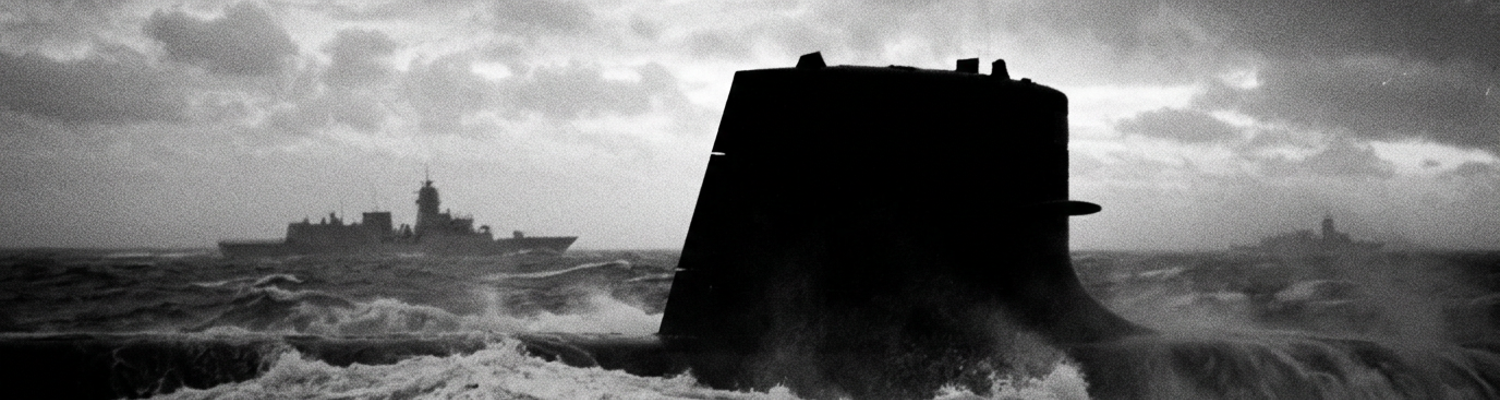
Archival evidence shows that at 0544 Zulu, the 7,800 ton hull broke through the swells at coordinates 20 degrees 09 minutes North, 121 degrees 52 minutes East. The submarine settled abruptly in the contested maritime corridor between the Batanes archipelago and southern Taiwan. Escaping ballast air threw a fifty foot plume of sea foam over the sail. The forward anechoic tiles were coated as the flooded stern dragged the vessel into an uncontrolled five degree starboard list. Less than four thousand yards to the northwest, the People Liberation Army Navy surface action group maintained its combat patrol grid. Bridge lookouts aboard the Type 052D destroyer Zhengzhou identified the American submarine distinctive sail silhouette with stabilized optical sights within forty seconds of the broach. Operating alongside the Zhengzhou, the frigate Binzhou energized its Type 364 surface search radar. The wallowing hull was painted with continuous S band tracking pulses. Water cascaded from the disabled boat bridge trunk as the officer of the deck unbolted the upper access hatch. He confronted three Chinese combatants maneuvering across the horizon under clear daylight visibility.
The vessel was completely exposed.
A close review of operational logs indicates that the submarine primary propulsion had scrammed automatically during the high speed ascent. The boat was left dead in the water with a jammed rudder and flooded aft machinery flats. Electronic support measures masts raised from the sail detected target tracking radar locks emanating from the Zhengzhou main fire control director. Tactical VHF bridge to bridge challenges broadcast from the frigate Binzhou over international maritime safety channels. An airborne Z-9C anti submarine helicopter, dispatched from the Zhengzhou flight deck, established an overhead orbit at an altitude of three hundred feet. Its nose mounted electro optical turret trained directly on the exposed submarine casing. Down below, the American combat team scrambled to verify hull integrity while manual bilge pumps fought the seawater flood in the lower auxiliary spaces. The submarine commander bypassed local radio protocols. He routed an emergency operational flash cable through the high frequency secure satellite antenna directly to Seventh Fleet headquarters in Yokosuka.
The tactical failure in the strait produced an immediate administrative shockwave in Washington.
When examining the historical record of Department of the Navy communications, Naval Sea Systems Command initiated emergency protocols three hours after receiving the casualty report from Task Force 74. At 0915 Zulu on 02 October 2021, NAVSEA issued an immediate worldwide fleet suspension of uncertified algorithmic patches on edge deployed combat networks. The emergency directive, classified Secret and distributed across the operational chain of command via Flash Naval Message, halted all field level software modifications. Experimental machine learning insertions aboard every deployed submarine were terminated. Engineering teams from Program Executive Office Integrated Warfare Systems 5.0 ordered all fast attack and ballistic missile submarines to strip experimental tensor processing libraries from their AN/BQQ-10 sonar suites and AN/BYG-1 combat management architectures. Fleet technical representatives in Pearl Harbor, Yokosuka, San Diego, and Groton received orders to physically board every in port vessel. They inspected server cabinets and pulled unauthorized graphics processing modules. Operational orders mandated an immediate return to validated software baselines. Submarine crews at sea received instructions to purge uncertified code caches. They restored factory certified software baselines directly from write protected optical media stored in physical shipboard safes. At Sierra Wharf in Guam, naval criminal investigators seized the maintenance laptops, external solid state storage devices, and compiler configuration scripts belonging to the civilian defense contractors who had altered the combat suite five days earlier. (Flash Message 0915Z).