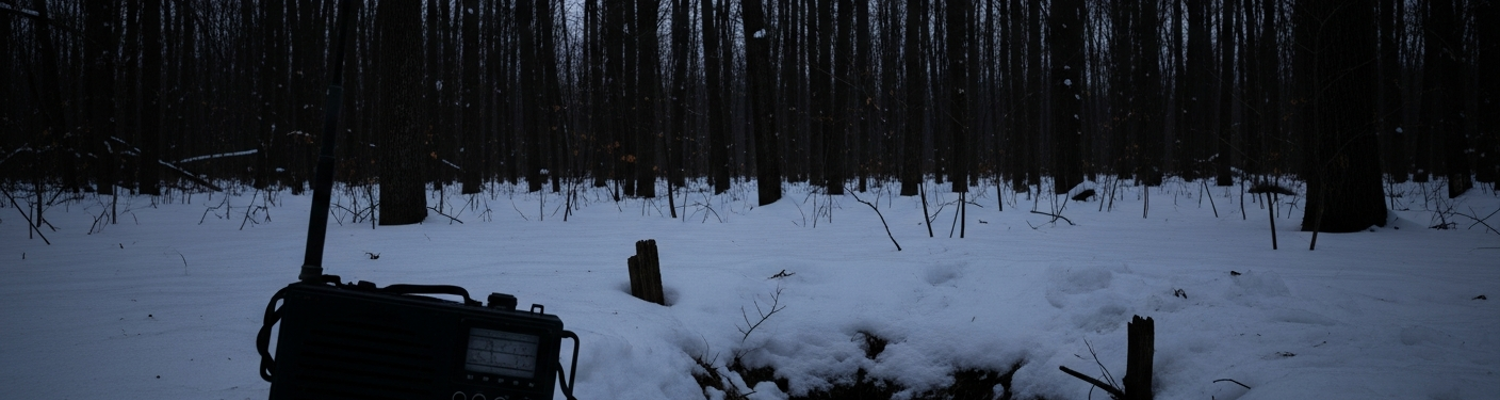

Deep Penetration Doctrine in the Hürtgen Forest
The mission profile was aggressive by design. Forward Observer Teams, or FOTs, were not meant to accompany the leading edge of an infantry assault. A close review of U.S. First Army operational logs (Record Group 407, NARA) from the fall of 1944 indicates artillery commanders tasked these specialized teams with deep-penetration assignments.
A single team was a small footprint. An officer, a radio operator, and several enlisted men for security.
Their objective was to infiltrate German lines, establishing a covert observation post several kilometers ahead of the main American force. From these positions, they could direct the fire of 105mm and 155mm artillery battalions. The targets were not just frontline trenches but high-value rear-echelon assets: command posts, supply depots, and troop concentrations. The entire concept depended on the team’s radio, most often the SCR-610. This set, with its PE-117 power unit and heavy CS-79 battery case, was the sole connection to the guns miles away. Operational plans for these missions allocated a standard loadout of batteries, based on a predictable rate of use derived from combat in the open terrain of France.
This planning assumption was a fatal miscalculation.
The operational context was the Hürtgen Forest, a 54-square-mile patch of dense woodland on the German-Belgian border. American forces, including the 9th and later the 28th Infantry Divisions, began to push into this area in September 1944. German soldiers called it the Grüne Hölle. The Green Hell. The terrain consisted of tightly packed fir trees rising over one hundred feet, creating a canopy that blotted out the sun and turned the forest floor into a perpetual, damp gloom. Steep ravines, rocky hills, and thick undergrowth made movement difficult. Constant autumn rain turned the few paths into rivers of mud, negating American advantages in armor and mobility. This environment was actively hostile to radio communications. The SCR-610’s FM signal, with a reliable five-mile range in open country, was severely attenuated by the towering, moisture-laden trees. Archival evidence shows FOTs were forced to operate their transmitters at maximum power for extended periods just to establish a connection. This drained their BA-40 batteries at a ruinous rate. A power supply planned to last for days was often exhausted in a matter of hours.
Deployment of these teams into the Hürtgen began as part of the broader offensive in September and October 1944. It became a battle of attrition for units like the 28th Infantry Division by November. The initial attacks by the 28th’s 112th Infantry Regiment toward Vossenack and Schmidt on November 2nd depended on the fire missions called in by these observer teams. The supply chain was not prepared for the unique demands of this battlefield. Pre-packaged battery supplies were insufficient. Getting new ones to the forward teams was a tactical puzzle. Ground resupply meant sending men on foot through the mine-laden forest, often under direct fire from German patrols who knew the terrain. The same dense tree cover that crippled radio signals also made air-dropping supplies a highly inaccurate affair. Artillery after-action reports from field artillery battalions like the 229th and 107th show a recurring pattern: a team would go deep, establish communication, direct a few effective fire missions, and then, abruptly, go silent.
The 72-Hour Logistical Mandate
A U.S. Army logistical doctrine predicated on a 72-hour combat load was fundamentally sound for a force on the offensive. Planners assumed that within three days of sustained combat, a given unit would either be relieved, withdrawn, or resupplied as the advance continued. This concept had proven itself during the rapid breakout and pursuit across France. By late 1944, the underlying assumptions had collapsed. The 72-hour window became a theoretical abstraction, completely detached from the conditions at the front. The static, grinding warfare in places like the Hürtgen Forest and the Ardennes meant units were fixed in place for weeks, not days. The autumn weather turned roads into impassable rivers of mud. The subsequent winter brought deep snow and freezing temperatures, which dramatically increased the consumption of fuel, batteries, and cold-weather gear.
The Quartermaster Corps was stretched to its breaking point. After the extraordinary success of the Red Ball Express, which officially ended in November 1944, Allied supply lines became a victim of their own rapid advance. The distance from the functioning ports in Normandy and the recently opened port of Antwerp to the front lines was immense. The European rail network, heavily damaged by pre-invasion bombing, was not yet fully restored. A single box of ammunition or a case of radio batteries had to be unloaded from ships, transferred to depots, loaded onto trains, moved hundreds of miles to a railhead, offloaded onto trucks, driven over poor and congested roads to a divisional supply point, and then broken down for final delivery to a forward battalion. Each step was a point of failure. A review of operational logs shows a system choked with competing priorities and insufficient transport. Shortages of artillery ammunition, winter clothing, and vehicle parts became endemic. For the men on the line, this translated into a persistent deficit, where the expectation of resupply within 72 hours was replaced by the hard knowledge that it might not come at all.
This systemic failure had its most pronounced expression with the arrival of the 106th Infantry Division in the Ardennes. The “Golden Lions” were a green division, committed to the front for the first time on December 11, 1944. They took over what was considered a quiet sector in the Schnee Eifel from the veteran 2nd Infantry Division. The division was spread dangerously thin, covering a 21-mile front. Its organic artillery, including the 589th Field Artillery Battalion, arrived low on ammunition, having been assured they would be fully stocked upon reaching the front. It was a promise the strained supply lines could not keep. The Forward Observer Teams of the 589th, tasked with directing fire for the 422nd and 423rd Infantry Regiments, deployed into their positions with standard issue equipment. This included SCR-300 “walkie-talkie” radios whose BA-70 batteries had a life of about 20-25 hours of continuous use.
On December 16, 1944, the German offensive erupted. The FOTs of the 589th were immediately engulfed. These small teams were the eyes of the artillery, but their radios quickly became useless. The intense need for communication drained batteries at an accelerated rate. With no resupply possible through the German onslaught, they went silent. Without artillery support, the infantry positions were blinded. Within 72 hours, the exact window their supplies were meant to cover, the 422nd and 423rd Infantry Regiments, along with the bulk of the 589th Field Artillery Battalion, were surrounded and forced to surrender in one of the largest battlefield capitulations in U.S. Army history. The remnants of the 589th, under Major Arthur Parker, managed to fight their way out and form a heroic, temporary defense at a crossroads, but the battalion as an effective fighting force had been destroyed.
Incompatible Inter-Service Communication Protocols
An examination of operational records from the autumn of 1944 reveals a communications architecture on the verge of collapse. It was plagued by a combination of environmental hostility, enemy action, and institutional incompatibility. The problem of persistent radio interference was an active, debilitating force. In the dense, perpetually damp confines of the Hürtgen Forest, the laws of physics worked against Allied signalmen. The U.S. Army’s primary man-portable field radio, the SCR-300, and the artillery’s SCR-610 operated on Frequency Modulation (FM) in the Very High Frequency (VHF) band. This technology, chosen for its clarity and resistance to static, had a fatal weakness: its signal required a near-direct line of sight. The towering, moisture-laden fir trees and the deep, winding ravines of the Hürtgen absorbed and scattered these VHF signals. The radios’ typical three-to-five-mile range was reduced to less than a mile in some documented cases. Signal Corps after-action reports detail how FOTs were forced to constantly seek higher ground, exposing themselves to enemy fire, just to transmit a single fire mission. German forces compounded this issue, proving adept at monitoring the undisciplined radio traffic of new American units and using the transmissions to target command posts and artillery observers with unnerving accuracy.
This physical degradation of radio signals was magnified by a rigid and flawed communication protocol structure between the Army Ground Forces and the U.S. Army Air Forces (USAAF). The systems were incompatible by design. An Army FOT from a unit like the 28th Infantry Division could not directly contact a flight of P-47 Thunderbolts circling overhead. The FOT’s SCR-300 or SCR-610 operated using FM in the 20-48 MHz range. The aircraft radios, typically SCR-522s, operated using AM in the much higher 100-156 MHz VHF band. They were, electronically speaking, inhabitants of different worlds. A request for close air support had to embark on a perilous, multi-stage journey. The FOT first had to raise its own artillery battalion headquarters. From there, the request was relayed by field telephone or another radio link up the chain of command to regiment, then to division. At the divisional level, an Air Support Party, if present and its own equipment was functional, would then transmit the request over its own separate radio net to a tactical air control center. This center would finally vector the aircraft to the target. Each step in this cumbersome process introduced delays and the potential for error.
These overlapping failures of physics and bureaucracy found their most tragic expression in the experiences of elite units like the Army’s Ranger Battalions. The 2nd Ranger Battalion was employed as a specialized shock force in the Hürtgen, tasked with seizing objectives like Hill 400 in December 1944. These were units designed to operate with speed and autonomy. Yet, their operational effectiveness was tethered to the same fragile communication lines. When the Rangers of the 2nd Battalion relieved elements of the 5th Armored Division and assaulted Hill 400, they carried SCR-300 radios. Once engaged in the close-quarters fighting on the hill’s slopes, they were subject to the same signal degradation and battery depletion that crippled the regular infantry divisions. Their isolation was absolute. Cut off by German counter-attacks and intense artillery fire that repeatedly severed their wire communications, their radios were their only link. Unable to directly coordinate with air support and lacking the robust communication channels of a larger formation, they were forced to rely on their own integral firepower. The Rangers’ success in taking and holding the hill for a time was a testament to their training, not the support they received.
Ardennes Weather and Aerial Resupply Failures
The weather that descended upon the Ardennes in December 1944 was a weapon. It was a pervasive combination of fog, freezing rain, and deep snow that dismantled military operations. A review of operational logs shows that from the opening of the German offensive on December 16th, a thick, persistent fog grounded the Allied air forces. This was the vulnerability the German plan depended on. For the forward observer teams and the infantry they supported, the conditions were ruinous. Temperatures hovered around freezing, but the high humidity and precipitation made it a damp, penetrating cold. Soldiers lived in water-logged foxholes, unable to dry out. This led to an epidemic of trench foot and frostbite cases that crippled combat effectiveness. Some estimates of cold-weather injuries reached over 15,000. The constant moisture fouled equipment, particularly the electronics of radios. Snow and mud bogged down all vehicular movement, turning supply roads into impassable quagmires.
This was a logistical disaster.
The environmental conditions made aerial resupply, the only hope for encircled units like the 101st Airborne Division at Bastogne, a near-impossibility for the first week of the siege. The IX Troop Carrier Command’s C-47 Skytrain transports were dependent on visual navigation and drop zone identification. In the Ardennes, a blanket of low stratus clouds and ground fog reduced visibility to zero. It was impossible for pilots to find, let alone accurately drop supplies into, a small, snow-covered perimeter. A brief break in the weather occurred on December 23rd. Archival mission reports show that even with Pathfinder teams on the ground using Eureka radar beacons to guide the planes, the drops were fraught with peril. The C-47s, unarmored and unarmed, had to fly low and slow through concentrated German flak. Many drops were misdirected by the chaotic conditions. Bundles of supplies fell into German-held territory, inadvertently resupplying the besiegers. While the resupply of Bastogne is often cited as a success, with 241 aircraft delivering 144 tons on one day, this was only possible during a short window of clear weather. Before and after this break, from December 18th to the 22nd and again after the 27th, the sky was closed.
The specific nature of the shortages on the ground was severe. There was an acute lack of what the Quartermaster Corps designated as 'Continental' supplies, items specifically suited for the European winter. This included winter clothing and rations. Soldiers were forced to subsist for extended periods on the 'Continental' K-ration, a lightweight meal designed for short-duration use. It was calorically and nutritionally insufficient for sustained combat in freezing conditions, leading to rapid weight loss. Worse still was the shortage of medical supplies. The 101st Airborne’s primary medical unit had been captured early in the battle, leaving the defenders of Bastogne with almost no surgeons or equipment. The air drops brought in some materiel, but the demand for blood plasma, morphine syrettes, sulfa powder, and basic bandages far outstripped the supply. Without these items, treatable wounds became death sentences.
The Physical and Psychological Toll on Observers
For the Forward Observer Teams operating deep within the Hürtgen Forest and later the Ardennes, existence was reduced to a primal state of cold and hunger. The physical toll was relentless. A review of medical records from late 1944 shows a dramatic spike in non-battle injuries, specifically trench foot and frostbite. In some units like the 328th Infantry Regiment, these resulted in more evacuations than combat wounds. The environment was the primary antagonist. Soldiers lived for weeks in waterlogged foxholes, their leather service shoes and wool socks perpetually soaked in near-freezing mud and snow. This constant exposure led to trench foot, a condition where tissue begins to die from constricted blood flow, and in the sub-zero temperatures of the Ardennes, outright frostbite. For the small, isolated observer teams, the ability to simply stay dry or get warm was a forgotten luxury.
This physical decay was accelerated by a severe caloric deficit. The standard-issue K-ration, providing roughly 2,830 calories, fell far short of the estimated 5,000 to 6,000 calories required for a soldier to function in sustained, sub-freezing combat. Observers and their security elements were literally starving, their bodies consuming their own muscle mass to generate heat. This perpetual hunger was a tactical impediment, leading to lethargy, weakness, and a diminished capacity for the intense concentration their job demanded.
The futility of repeated supply requests became a uniquely corrosive element of the observers’ experience. An FOT from an artillery battalion like the 589th would meticulously follow protocol. The radio operator would transmit a request for critical BA-40 or BA-70 batteries, for medical supplies like morphine syrettes, or simply for more K-rations. This request, a faint signal pushed through a forest canopy that absorbed radio waves, was often the beginning of a long, silent wait. The supply chain was broken. Even if the request reached battalion headquarters, the required items were often unavailable at the divisional level. If they were available, getting them forward was another challenge. Ground resupply parties faced mine-laden terrain under the eyes of German patrols. Aerial resupply was rendered almost useless by the persistent fog. On the rare clear days, drops were inaccurate. For the men on the ground, the cycle of request and silence became a form of torture.
This created a profound sense of abandonment. The radio, their only connection to the vast machinery of the U.S. Army, became a source of despair. The cumulative psychological toll on the radio operators was immense. These men carried the operational life of the team on their backs. They were the sole conduit for the fire missions that protected the team and the sole voice for calling for aid. The pressure was enormous. German forces specifically trained snipers and artillery to target radio operators. The operator lived with the knowledge that the sound of his own voice could bring death from above. When the batteries died and his calls for resupply went unanswered, the silence that followed was deafening. It was a confirmation of their isolation. After-action interviews document the rise of what was then termed “combat fatigue,” a condition of complete mental and physical exhaustion where soldiers became disconnected and unable to function. For the radio operator, this manifested as a deep-seated apathy and hopelessness.
Morale Decay and Thresholds of Insubordination
By the third week of December 1944, the cumulative effect of continuous combat, systemic supply failures, and extreme physical hardship had pushed frontline units past their breaking point. A review of operational logs from units like the 28th Infantry Division, which had been savaged in the Hürtgen Forest and then redeployed directly into the path of the Ardennes Offensive, reveals a precipitous decline in combat effectiveness. Morale was not just low; it was disintegrating. This was a psychological collapse born from a sense of total abandonment. For a forward observer team, huddled in a frozen foxhole, the silence of a dead radio was a confirmation that their connection to the army was severed. The physical decay from cold and hunger amplified this despair. Soldiers subsisting on the grossly inadequate K-ration were in a state of slow starvation. The psychological impact of seeing comrades lose limbs to frostbite or die from wounds that would have been treatable with basic medical supplies created an atmosphere of hopelessness.
This breakdown drove soldiers to acts of desperation. Foraging for sustenance became a common, unsanctioned activity. For an isolated Forward Observer Team whose rations had expired days or weeks earlier, this was not a choice but a necessity. Archival accounts detail small groups of men leaving their defensive positions under the cover of darkness or fog to scavenge nearby Belgian farmsteads. They searched for anything edible: frozen potatoes or turnips dug from the hardened earth, a stray chicken, or sacks of grain stored in a barn. These were not casual acts. Leaving a designated post, especially during a major German offensive, was a severe breach of protocol that exposed the entire unit to infiltration. The gnawing hunger and the belief that no official resupply was coming made the risk acceptable.
By late December, this erosion of discipline tipped toward insubordination. One specific incident, detailed in the heavily redacted logs of the 229th Field Artillery Battalion, attached to the 28th Infantry Division, illustrates the breaking point. On December 22, 1944, near the crossroads town of St. Vith, a Forward Observer Team designated Keystone 7 was ordered to abandon its relatively secure position in a stone farmhouse cellar and advance 800 meters to a more exposed ridge. The team, led by a first lieutenant, had been in position for six days, their K-rations exhausted for the last three. Their SCR-610 radio was down to its last functioning battery, which the operator was conserving for only the most urgent transmissions. The lieutenant, after acknowledging the order, transmitted a refusal. He stated that his team was physically incapable of advancing due to malnutrition and early-stage frostbite, and that occupying the new position without a resupply of batteries would render them operationally useless. His refusal was not an act of cowardice but a statement of tactical fact. The battalion headquarters, facing similar crises across its front, did not court-martial the officer; the incident was simply buried in the operational record.