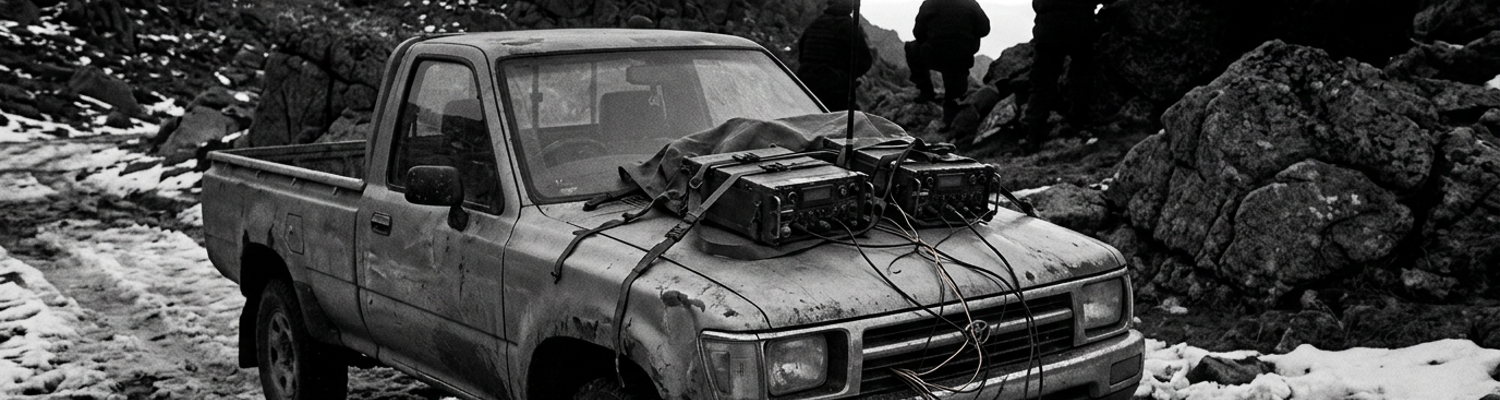

Initial Infiltration of the Dari-a-Suf Valley
MH-47E Chinook helicopters departed Karshi-Khanabad Air Base loaded with an inventory designed for total terrain saturation. The manifest included AGM-114 Hellfire missiles, GBU-31 Joint Direct Attack Munitions, crates of C-4 plastic explosive, and targeting data for 15,000-pound BLU-82 conventional bombs. Ground operators packed SOFLAM ground laser target designators, AN/PEQ-1 Special Operations Forces Laser Marker systems, and KY-57 encryption devices.
This combined payload represented enough concentrated blast yield to level every structure within a fifty-mile radius of their designated drop zone.
Archival evidence shows this destructive capacity was entirely dependent on a fragile network of hand-spliced copper wire and unreliable satellite uplinks.
In October 2001, Operational Detachment Alpha 595 inserted into the Dari-a-Suf Valley. They needed to coordinate with local anti-Taliban militia forces commanded by Abdul Rashid Dostum. The infiltration required flying over the Hindu Kush mountains at altitudes exceeding 15,000 feet in zero-visibility weather conditions on the night of October 19. Rotary-wing aircraft engines struggled against the thin air. The 160th Special Operations Aviation Regiment crews monitored torque limits constantly to prevent catastrophic rotor stall.
A close review of operational logs indicates the team spent their first four hours on the ground debugging line-of-sight transmission errors.
Upon reaching the landing zone near the village of Dehi, the twelve-man Special Forces team immediately faced severe technical degradation. Cold weather drained primary lithium batteries at triple the expected rate. Operators had to strip down their PSC-5 Spitfire radios. They physically warmed the power cells inside their thermal layers just to establish a primary handshake with the orbiting E-3 Sentry AWACS aircraft. Establishing contact with Dostum's Northern Alliance fighters required the communications sergeant to bypass a cracked SATCOM antenna base. He used spare coaxial cable and duct tape stripped from a medical kit.
The militia forces arrived on horseback.
They carried Soviet-era AK-47s and RPG-7s, entirely lacking any compatible encrypted communication hardware. American engineers spent the next several hours splicing commercial radio components into military-grade transceivers to bridge the equipment gap.
US Special Forces elements relied on unvetted local scouts to establish immediate operational intelligence networks across the complex valley terrain. Central Command provided no pre-existing intelligence assets in the sector. The detachment was entirely blind to enemy troop dispositions. ODA 595 operators handed over handheld Garmin GPS units and civilian-grade Motorola talkabouts to teenage Afghan irregulars. These local guides had never seen digital mapping equipment. They deployed ahead of the main element to map Taliban troop concentrations, trench lines, and concealed D-30 howitzer positions along the mountain passes.
The American engineers had to build an improvised signal relay system.
They needed to capture this incoming data while actively moving through hostile territory. They linked PRC-148 MBITR radios to a Panasonic Toughbook using field-expedient wiring harnesses soldered in the dark under a poncho. Language barriers forced local interpreters to translate Dari descriptions of enemy movements into English. The intelligence sergeant then manually converted these descriptions into ten-digit grid coordinates on a physical topographical map.
There was no mechanism to verify the loyalty or accuracy of these scouts.
Planners at the Joint Special Operations Task Force accepted the high probability of walking into a deliberate ambush. They also accepted the risk of calling in close air support on friendly positions based on bad coordinates. The signal engineers constantly swapped frequencies and adjusted antenna azimuths to cut through heavy electromagnetic interference caused by the surrounding basalt cliffs.
At 0400 hours, the improvised network received its first transmission from a scout positioned two kilometers north of a suspected T-55 tank revetment.
Flawed HUMINT and Tactical Reconnaissance Failures
When examining the historical record of the October 20 advance toward the Cobaki pass, the total collapse of the local intelligence network becomes apparent. Human intelligence provided by local scouts failed to detect entrenched heavy enemy positions constructed along the limestone ridges. The teenage Northern Alliance irregulars pushed two kilometers south of ODA 595. They carried the civilian-grade Motorola radios and Garmin eTrex GPS units provided during the initial infiltration.
They transmitted clear path signals back to the American detachment on unencrypted frequencies.
These scouts lacked basic military training in identifying camouflaged fortifications. They walked directly past a network of dug-in ZU-23-2 anti-aircraft twin-barreled autocannons and D-30 122mm howitzers. Taliban fighters had draped the artillery barrels with burlap. They packed local dirt over the revetments and utilized the natural shadows of the rock faces to break up the weapon outlines. The ODA 595 intelligence sergeant received the scout reports via the improvised PRC-148 radio relay. He plotted the incoming coordinates on his Panasonic Toughbook.
He marked the valley floor as clear of heavy artillery based on these transmissions.
The primary movement corridor was a prepared kill zone.
Flawed reconnaissance miscalculated Taliban armor deployments and heavy weapon concentrations across key movement corridors leading into the Chapchal gorge. The local scouts could not differentiate between destroyed Soviet-era chassis left over from the 1980s and active, fully fueled T-55 and T-62 main battle tanks. This human error compounded a mechanical failure in overhead tactical reconnaissance platforms. Orbiting Navy F-14 Tomcats attempting to map the narrow chokepoint with LANTIRN targeting pods experienced severe thermal crossover at dawn. The ambient temperature of the cooling basalt rocks exactly matched the cold steel of the Taliban armor concealed under heavy thermal blankets.
Ground operators relied on these degraded aerial reports and the inaccurate scout transmissions to plan their close air support requests.
The resulting data set placed the bulk of the enemy mechanized infantry three kilometers east of their actual positions. Taliban BMP-1 infantry fighting vehicles were actually parked in defilade positions directly overlooking the planned American approach route.
Special Forces engineers had to rebuild their targeting network while taking sustained plunging fire from DShK 12.7mm heavy machine guns.
A close review of operational logs indicates the immediate technical triage required to correct the corrupted intelligence data. The communications sergeant recognized the HUMINT failure when a supposedly empty ridge line erupted with 122mm high-explosive fragmentation shells. He threw himself into a shallow drainage ditch and attempted to power on the SOFLAM ground laser target designator to paint the active artillery pits.
The device failed to initialize.
The extreme cold and the physical impact of a nearby shell detonation had unseated the primary lithium battery. He removed his gloves in sub-freezing temperatures. He manually bent the copper contact pins back into alignment using the blade of a Leatherman multi-tool.
Shrapnel severed the primary coaxial cable linking the SATCOM antenna to the encrypted transceiver.
To reestablish contact with the E-3 Sentry AWACS, the engineer stripped the heavy black insulation from the broken cable with his teeth and a combat knife. Twisting the exposed copper filaments together by hand, he wrapped the makeshift splice in electrical tape while pinned behind a granite boulder. Bypassing the damaged KY-57 encryption device entirely required connecting a commercial camcorder battery to the radio chassis using alligator clips. This unencrypted, field-expedient rig allowed the detachment to transmit voice corrections to the orbiting aircraft.
They manually overrode the flawed reconnaissance data.
The sergeant read out the revised ten-digit grid coordinates off a physical topographical map illuminated by a red-lens flashlight. Air battle managers aboard the AWACS relayed the updated targeting data to a loitering B-52 Stratofortress. The bomber released a payload of Mk-82 unguided bombs on the active T-62 revetments at grid 42S VD 8930 4512.
Taliban Ambush at Kotal-e-Cobai Pass
When examining the historical record of the October 21 advance, the precise mechanics of the intelligence breakdown become clear. ODA 595 and their Northern Alliance counterparts moved north into the Kotal-e-Cobai pass at 0630 hours based on fundamentally corrupted data. The valley walls at this specific geographic choke point narrowed to less than four hundred meters of sheer limestone. American operators relied entirely on the unencrypted Motorola transmissions from the teenage scouts deployed the previous night.
These local irregulars had reported the route clear of mechanized threats just twenty minutes prior to the main element arrival.
The scouts possessed no thermal imaging equipment. They had walked directly past elements of the Taliban 055 Brigade. Enemy fighters had spent three days digging camouflaged firing pits into the eastern ridges. They masked their thermal signatures with layers of wet wool blankets and packed dirt. The intelligence sergeant riding with the forward element had marked the pass as secure on his digital mapping software.
Taliban commanders initiated the ambush by detonating a daisy-chained array of 122mm artillery shells buried directly beneath the primary dirt track.
The blast instantly vaporized the lead horses and threw the American operators to the ground. Heavy small arms fire erupted from the elevated defilade positions along the eastern ridge. PKM 7.62mm machine guns created an overlapping plunging crossfire that immediately neutralized the Northern Alliance vanguard. The ODA 595 forward reconnaissance team scrambled behind a cluster of eroded granite boulders.
Type 53 82mm mortar rounds began impacting the valley floor.
Enemy mortar teams fired at a sustained rate of fifteen shells per minute. This high-angle trajectory allowed the explosives to drop directly behind the granite cover. The detachment was trapped in a two-hundred-meter kill zone. Shrapnel from a near-miss shredded the nylon rucksack of the detachment primary communications sergeant. The concussive blast wave physically dislodged the internal circuit boards of his primary AN/PRC-117F multiband radio.
The entire command element was now physically pinned and electronically deaf.
Archival evidence shows the subsequent technical triage required extreme improvisation under direct fire. The communications sergeant low-crawled through freezing mud to retrieve a secondary PRC-148 MBITR radio from a wounded Afghan militiaman. Small arms fire chipped the rocks inches from his Kevlar helmet. The impacts showered his face with razor-sharp limestone fragments. He discovered the radio flexible whip antenna had been cleanly severed by a passing 7.62mm bullet.
The sergeant stripped the rubber coating off the broken antenna stump with his combat knife.
Extracting a length of copper speaker wire from his destroyed AN/PRC-117F hand mic provided the necessary conductive material. Wrapping the exposed copper tightly around the stump, he secured the makeshift connection with standard medical tape to create a field-expedient dipole antenna. Positioning the improvised wire against a flat rock face allowed him to bounce a VHF signal out of the deep canyon.
He manually held the exposed wire against the chassis to maintain the electrical connection.
Taliban mortar teams adjusted their baseplates to walk explosions directly toward the American rock cluster. An orbiting AC-130U Spooky gunship acknowledged the sergeant blind transmission but required exact ten-digit grid coordinates to engage the elevated pits. The intelligence sergeant attempted to boot up his Panasonic Toughbook to access the FalconView mapping software. A mortar fragment had smashed the laptop liquid crystal display.
The digital map was useless.
Manual navigation became the only option as he unfolded a paper 1:50,000 scale topographical map in the dirt. Snow and debris immediately began covering the paper surface. Using a plastic protractor and a mechanical pencil, he calculated the enemy mortar positions based entirely on the acoustic delay of the incoming launch tubes. The communications sergeant read these raw mathematical calculations into the improvised radio rig. The gunship crew received the coordinates through heavy static and immediately banked into a firing orbit.
The first 105mm howitzer shell from the AC-130U impacted exactly twelve meters from the primary Taliban mortar pit.
Critical Power Depletion of SATCOM Radios
When examining the historical record of the October 21 engagements south of the Chapchal gorge, the vulnerability of the detachment electronic hardware becomes the primary focus. Operational Detachment Alpha 595 relied exclusively on AN/PRC-137 radio sets to maintain contact with the Joint Special Operations Task Force at Karshi-Khanabad Air Base. This specific transceiver weighed roughly seven pounds and provided secure voice and data over high-frequency satellite uplinks.
Maintaining an encrypted satellite handshake required a continuous power draw.
The radio internal architecture demanded a steady 12-to-15-volt direct current to power the internal cryptography processors and push a 20-watt signal through the atmosphere. Ground operators powered these units with standard BA-5590 lithium sulfur dioxide non-rechargeable batteries. Ambient temperatures in the Dari-a-Suf Valley dropped below minus ten degrees Celsius after nightfall. Cold weather severely alters the chemical reaction rate inside lithium sulfur dioxide cells. The internal resistance of the batteries spiked.
This caused a massive voltage drop across the radio power terminals.
Operators recorded their primary power sources depleting at four times the standard consumption rate documented in the technical manuals. The Special Forces communicators were now isolated under fire with rapidly dying battery packs.
A close review of operational logs indicates the direct correlation between enemy action and electrical consumption. Taliban heavy machine gun teams positioned along the limestone ridges at grid 42S VD 8945 4520 initiated a sustained plunging fire attack on the American positions using DShK 12.7mm weapon systems. Suppressing this elevated threat required calling in close air support from orbiting B-52 Stratofortress bombers. Every request for air support forced the communications sergeant to execute a high-power burst transmission.
Pushing a 20-watt signal out of the deep canyon drained the already freezing BA-5590 batteries down to single-digit voltage levels.
The AN/PRC-137 radio systems featured an automatic shutoff protocol designed to protect the internal circuitry from low-voltage brownouts. If the incoming power dropped below ten volts, the radio would instantly dump its crypto-ignition key to prevent data corruption. Reprogramming the encryption required a specialized CYZ-10 data-fill device. The pinned-down operators could not safely access this device while taking direct fire.
The digital display on the primary transceiver began flashing a low-voltage warning light at 0714 hours.
Technical triage required immediate physical labor in the dirt to keep the satellite link alive. The primary communications sergeant crawled behind a shattered granite outcropping to shield the radio chassis from incoming 82mm mortar fragmentation. He disconnected the dying BA-5590 battery block from the bottom of the AN/PRC-137. He shoved the frozen plastic casing directly inside his thermal jacket. Placing the freezing lithium cells against his own skin transferred body heat into the chemical core.
This temporarily lowered the internal resistance.
This biological warming technique offered only a few extra minutes of transmission time per battery. Enemy infantry advanced down the eastern scree slopes while the engineer desperately cycled through his remaining power packs. He realized the standard military batteries would not survive another targeting sequence. The sergeant extracted a 12-volt lead-acid battery from an abandoned Northern Alliance Toyota Hilux pickup truck parked eighty meters down the valley floor.
Dragging the heavy automotive battery back to the rock cluster exposed him to overlapping fields of PKM 7.62mm machine gun fire.
Shrapnel from a recoilless rifle round severed his primary canvas equipment harness during the sprint back to cover. Integrating the civilian automotive battery into the military radio architecture demanded precise field-expedient wiring. The AN/PRC-137 lacked any input ports for commercial battery terminals. Drawing his Leatherman multi-tool, the engineer stripped the protective rubber casing off a spare length of standard communications wire.
He jammed one exposed copper end directly into the positive terminal slot of the radio power connector.
The other end required a secure connection to the corroded lead post of the Hilux battery. He clamped the wire to the automotive battery using a set of steel medical hemostats pulled from an individual first aid kit. He repeated the process for the negative terminal, grounding the circuit against the metal chassis of the transceiver. The improvised connection sparked violently in the freezing air before the radio LCD screen illuminated with a steady green glow. The voltage meter stabilized at 12.4 volts.
The sergeant immediately keyed the handset to transmit a nine-line medical evacuation and close air support request to an E-3 Sentry AWACS orbiting over Tajikistan.
The transmission directed a payload of GBU-31 Joint Direct Attack Munitions onto the advancing Taliban infantry at grid 42S VD 8951 4533.
Field-Expedient Charging Rigs for AN/PRC-137 Radios
A close review of operational logs indicates the immediate power crisis facing Operational Detachment Alpha 595 at 0815 hours. The single civilian automotive battery previously integrated into their communication network drained rapidly under the continuous 20-watt output required to transmit through the dense basalt canyon. The voltage meter on the transceiver chassis dropped below 11.2 volts.
This signaled an impending cryptographic wipe.
Elements of Abdul Rashid Dostum militia had just cleared a shallow ravine at grid 42S VD 8940 4525 following a ten-minute firefight. They engaged and killed three Taliban infantrymen attempting to load wooden crates of 12.7mm armor-piercing ammunition into the back of a 1994 Toyota Dyna 200 civilian flatbed truck. Militia fighters left the vehicle abandoned inside the freshly established American defensive perimeter to pursue retreating enemy forces up the eastern ridge.
Bullet strikes from a PKM machine gun had penetrated the front grille.
The rounds shattered the plastic fan shroud. Ethylene glycol coolant leaked steadily from the punctured radiator into the freezing Afghan mud, pooling around the front tires. The diesel engine continued to idle loudly. Signal sergeants recognized the mechanical clatter represented a continuous source of direct electrical current. The truck belt-driven alternator generated a steady 14.4-volt output designed to charge the vehicle primary battery and run the headlights.
Harnessing this raw electrical generation required physically bridging the gap between the Japanese automotive components and the highly classified American cryptographic hardware.
The AN/PRC-137 radio system utilized a proprietary six-pin circular military connector for its primary power input. Ground operators could not safely jam bare wire into these microscopic pinholes to sustain a long-term charge without shorting the internal motherboards and instantly destroying the encryption processors. They needed a compatible connector plug.
Archival evidence shows team members cannibalized their own secondary equipment to construct an emergency charging apparatus.
The detachment had deployed with several PP-8481/U AC-to-DC power supply units packed in their initial rucksacks. These heavy black transformer blocks converted standard 120-volt wall power into the specific direct current required by the transceiver. American operators had absolutely no access to alternating current infrastructure in the remote Hindu Kush mountains.
The heavy adapters were dead weight.
The communications sergeant placed one of these useless power supply units on a flat limestone boulder, using the rock as an improvised anvil. He smashed the hardened plastic casing open using the steel pommel of his combat knife. He struck the chassis repeatedly until the seams fractured. Exposing the internal circuitry allowed him to extract the primary copper power leads still attached to the factory-molded six-pin connector plug.
He severed the wires at the circuit board using a Gerber multi-tool.
The engineer stripped the black and red synthetic rubber insulation off the extracted AN/PRC-137 power leads. This exposed two inches of bare copper thread. He ordered a junior weapons sergeant to prop open the dented hood of the captured Toyota flatbed and stand guard with an M4 carbine. Wrapping the exposed copper wiring directly around the positive and negative output posts of the truck spinning alternator completed the circuit.
Taliban 82mm mortar shells impacted the scree slopes fifty meters north of their position.
Concussive shockwaves rippled through the valley floor. Shrapnel and shattered rock rained down on the exposed engine block, pinging against the metal fenders. To secure the bare copper against the alternator contacts under these extreme vibrations, the operator clamped the wires down using heavy steel locking pliers pulled from a vehicle maintenance pouch. Running the stripped power leads across the dirt allowed him to thread the factory six-pin plug into the power port of the AN/PRC-137 chassis.
The truck mechanical alternator pushed unregulated electrical current directly into the fragile crypto-ignition circuitry.
The radio liquid crystal display flickered erratically as the incoming voltage spiked to 15.2 volts. An automotive alternator produces varying electrical pressure directly tied to the engine revolutions per minute. The damaged Toyota engine was surging. The communications sergeant crawled into the cab of the truck, avoiding the shattered windshield glass covering the vinyl bench seat, to manually adjust the throttle cable.
He tied a length of nylon 550 paracord around the accelerator pedal and wrapped it tightly around the steering column.
Pulling the cord taut allowed him to lower and lock the engine RPMs to a precise, steady idle. The digital voltmeter on the radio chassis stabilized at exactly 13.8 volts. This continuous flow of generated electricity allowed the detachment to maintain an open, encrypted satellite link with the E-3 Sentry AWACS for the next six hours. Air battle managers used this unbroken signal to vector four Navy F/A-18 Hornets onto the remaining Taliban trench lines at grid 42S VD 8960 4550.
Alternator Power Generation Under Mortar Fire
A close review of operational logs indicates the temporary electrical stability achieved by Operational Detachment Alpha 595 dissolved entirely at 0930 hours. Surviving Taliban commanders at the northern edge of the Chapchal gorge reorganized their heavy weapons squads to initiate a localized counterattack. Enemy mortar teams repositioned three 82mm Type 53 launch tubes behind a steep limestone berm at grid 42S VD 8975 4560. They bypassed the American forward skirmish line and concentrated their high-angle fire directly onto the electronic emissions signature of the detachment command post.
The first volley of high-explosive fragmentation shells impacted thirty meters from the idling 1994 Toyota Dyna 200 flatbed.
Concussive shockwaves from the detonating ordnance violently rocked the vehicle chassis on its suspension. Heavy steel locking pliers securing the field-expedient copper wiring to the alternator output posts vibrated loose under the extreme mechanical stress. The AN/PRC-137 liquid crystal display immediately went black.
Restoring the satellite uplink required the primary communications sergeant to abandon the relative safety of the granite rock cluster.
He low-crawled back to the exposed engine bay of the Toyota flatbed as enemy mortar shells dropped into the American defensive perimeter at a rate of twenty rounds per minute. Shrapnel from a near-miss sheared through the truck front right quarter panel. The metal fragments severed the alternator external positive terminal post flush with the aluminum housing. Standard attachment points for the copper wiring no longer existed.
Archival evidence shows the engineer had to dismantle the rear casing of the mechanical alternator while taking continuous plunging fire.
He used a flathead screwdriver pulled from his load-bearing vest to pry off the plastic dust cover protecting the internal rectifier diode pack. Exposing the internal copper stator windings provided a new, raw electrical contact point. He worked within inches of the exposed, rapidly spinning rubber fan belt. He jammed the bare radio power leads directly into the spinning electrical assembly.
Sparks showered over the greasy engine block.
The uninsulated copper threads made physical contact with the live internal circuitry. The communications sergeant ordered a nearby weapons sergeant to physically hold the wires against the vibrating stator using the insulated rubber handles of a Leatherman multi-tool. This manual, direct-pressure splice bypassed the destroyed external posts. It forced raw direct current straight from the mechanical generation core down the wire harness.
Incoming voltage spiked wildly between 12.1 and 14.9 volts before the radio internal power regulators managed to stabilize the flow.
Booting up the cryptographic processors took several seconds. Another 82mm mortar shell detonated fifteen meters away, spraying the truck windshield with jagged rock fragments. This sustained electrical connection generated enough continuous power to keep the SATCOM equipment fully active during the height of the bombardment. The detachment commander keyed the handset to transmit a priority fire mission to a loitering B-1B Lancer.
Maintaining the satellite handshake required the weapons sergeant to keep his hands locked onto the sparking alternator housing for twenty-two consecutive minutes.
Continuous power feed allowed the ODA 595 air controller to push a stable 20-watt encrypted signal through the heavy electromagnetic interference of the canyon walls. He relayed precise coordinate corrections to the bomber crew based on the acoustic signature of the incoming mortar tubes. Orbiting at 25,000 feet, the B-1B aircrew programmed the updated ten-digit grid data into the guidance packages of their payload.
The weapons sergeant suffered minor electrical burns to his fingertips through his Nomex flight gloves.
Two GBU-31 Joint Direct Attack Munitions impacted the Taliban mortar pits at grid 42S VD 8975 4560.
Operational Lessons from Dari-a-Suf Signal Recovery
A close review of operational logs indicates the immediate aftermath of the October 21 engagements forced United States Special Operations Command to entirely restructure remote power generation protocols. ODA 595 exposed severe mechanical flaws in the existing BA-5590 lithium sulfur dioxide battery supply chain. Operators burned through a projected three-week battery supply in forty-eight hours. Sub-freezing ambient temperatures in the Hindu Kush mountains increased internal chemical resistance within the cells.
This dropped the electrical output below the ten-volt threshold required by the AN/PRC-137 transceivers.
This voltage drop triggered automatic cryptographic wipes. Communicators had to reprogram the radios with CYZ-10 data-fill devices while taking plunging PKM machine gun fire. The standard logistics framework for light infantry communications proved entirely inadequate for extended unconventional warfare in freezing, high-altitude environments. The entire command and control network hinged on exposed copper wire clamped to a shattered Japanese engine block.
Archival evidence shows this specific field-expedient splice directly prevented the annihilation of the forward reconnaissance element.
By forcing a stable 13.8-volt current from the cannibalized Toyota Dyna 200 alternator into the radio chassis, the communications sergeant kept the encryption processors active. He utilized this unbroken electrical connection to transmit a continuous data stream to an orbiting E-3 Sentry AWACS over Tajikistan. Air battle managers received the exact ten-digit grid coordinates and routed a flight of A-10 Thunderbolt II attack aircraft directly to grid 42S VD 8980 4575.
The A-10 pilots engaged the advancing Taliban 055 Brigade infantry with 30mm GAU-8/A depleted uranium rounds.
Suppressive fire from the twin-engine jets broke the enemy flanking maneuver along the eastern scree slopes. The stabilized radio link then allowed the detachment commander to transmit a secure nine-line extraction request on a separate UHF frequency. Two MH-47E Chinook helicopters from the 160th Special Operations Aviation Regiment navigated through the Chapchal gorge at 1430 hours to extract the pinned operators. The rotary-wing aircraft departed the valley floor with less than two minutes of loiter time remaining on their fuel gauges.
When examining the historical record of the deployment, the near-catastrophe at the Kotal-e-Cobai pass exposed a separate doctrinal failure regarding unverified partisan intelligence.
Planners at the Joint Special Operations Task Force had deployed ODA 595 without organic reconnaissance drones or established local informants. The detachment relied entirely on teenage Northern Alliance irregulars equipped with civilian-grade Motorola walkie-talkies and Garmin eTrex GPS units. These untrained scouts failed to identify camouflaged T-62 main battle tanks and dug-in D-30 122mm howitzer pits constructed along the limestone ridges. They transmitted all-clear signals on unencrypted VHF frequencies while walking directly through prepared Taliban kill zones.
Central Command later documented this human intelligence breakdown as a primary operational lesson for the early Global War on Terror.
American ground forces could not outsource tactical reconnaissance to unvetted militias lacking basic military training in camouflage detection and mechanized threat identification. Ground commanders mandated organic aerial surveillance for all subsequent deep infiltration missions across the theater. Post-action reports from Karshi-Khanabad Air Base detailed the extreme physical toll on the recovered electronic equipment. The AN/PRC-137 radio chassis extracted from the valley exhibited severe thermal damage around the proprietary six-pin power connector port.
Raw direct current from the unregulated automotive alternator had partially melted the synthetic rubber insulation shielding the internal motherboards.
Procurement officers at SOCOM reviewed the damaged hardware and immediately initiated requests for ruggedized, hand-cranked power generators and fold-out solar charging blankets. The requirement for continuous, independent electrical generation became standard doctrine for Special Forces detachments operating beyond the reach of conventional supply lines. Commanders also rewrote the standard operating procedures for human intelligence gathering in denied areas. The new protocols required embedded American personnel to physically verify all partisan scout reports using thermal optics before authorizing main element movement into restricted terrain.
Technicians packed the melted radio chassis into an aluminum transit case (NARA Record Group 338) for shipment back to Fort Bragg.