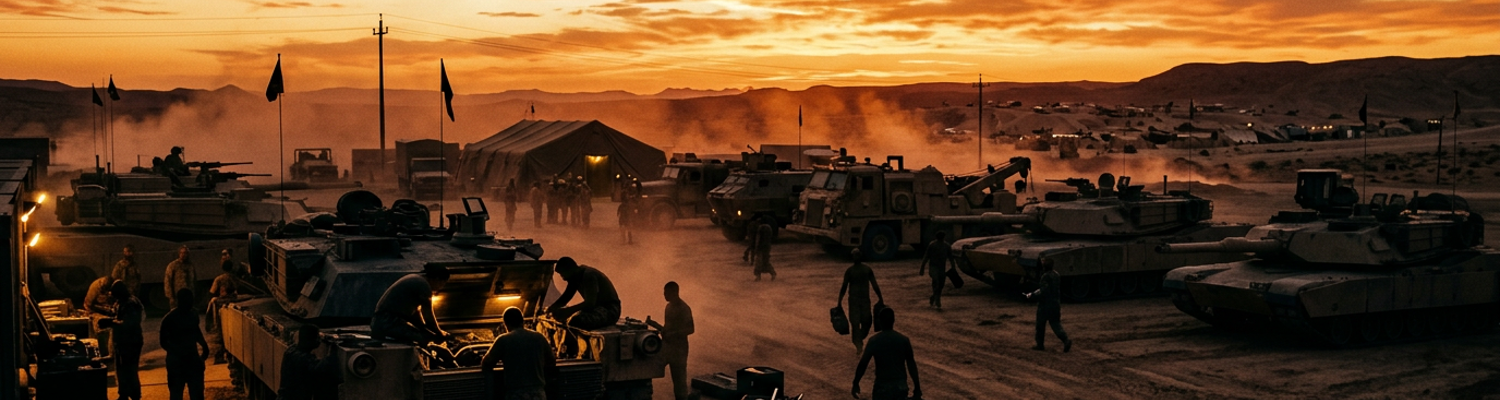

Fiscal Austerity and Operations Account Reductions
Turbine air filters on M1A1 Abrams main battle tanks clogged with fine silica dust during routine desert runs across the Kuwaiti training areas. The powdery sand bypassed standard precleaners within forty operating hours, choking the air intake systems and triggering automatic engine shutdowns across the motor pools of Camp Doha. The Balanced Budget Act of 1997 mandated discretionary spending caps that severely constricted Army Operations and Maintenance accounts, cutting off the funding needed to rush spare filters into the theater. Soldiers assigned to maintenance companies worked sixteen-hour shifts in hangar bays where ambient temperatures reached over one hundred and ten degrees Fahrenheit, trying to restore contaminated components with dwindling supplies. Exhausted mechanics submerged ruined filter packs in metal basins of solvent to wash out the packed dirt by hand, watching the delicate paper fibers dissolve under the stiff bristles of their cleaning brushes.
Paper fibers from the ruined filters floated in the solvent tubs because supply clerks could not order replacement parts through normal logistics channels. The 1997 archiving of the Office of Management and Budget Central Budget Management System data files recorded the direct contraction of depot maintenance allocations for forward deployed armor fleets, confirming that financial cutbacks had reached the front lines. Heavy repair facilities back in the United States slowed their overhaul schedules for tank components, which dried up shipments of remanufactured parts to prepositioned stocks in the Persian Gulf. Disappointment turned into chronic anxiety as soldiers watched requisition forms come back stamped with indefinite delays, knowing that their combat readiness ratings were plummeting every week. Tank commanders threw broken spanners against the hull armor in fury after spending entire nights pulling wiring harnesses from dead hulls without restoring a single vehicle to combat readiness.
Wiring harnesses stripped from dead hulls cracked and shorted out when crews forced them into baking engine compartments, causing electrical fires that destroyed delicate digital displays. This constant cannibalization of vehicles forced armor crews to perform double the required labor, dismantling one tank to assemble another and then repeating the entire procedure when the replacement parts also failed. Sleep deprivation quickly degraded the physical coordination of the soldiers, resulting in crushed fingers, severe heat exhaustion, and repeated mistakes during complex hydraulic repairs. Junior officers pleaded with battalion leadership for relief, but commanders possessed no authority to override the budget restrictions and could only demand that soldiers work longer hours. Sergeants marked nonoperational tanks with red spray paint and ordered trembling, heat-sick soldiers back into the sun to strip track sections from disabled vehicles.
Steel track pins jammed inside worn rubber bushings as soldiers swung twenty-pound sledgehammers against the frozen links in the afternoon glare. Every missed hammer strike chipped the concrete pads and drained the remaining physical stamina of the crews, who had gone weeks without a full night of sleep. Battalion leaders monitored the growing maintenance backlog on operations room status boards, noting that over thirty percent of the prepositioned fleet sat completely immobilized. Command staff canceled all upcoming personnel rotations to keep every available soldier assigned to the motor pool work details, deepening the sense of isolation and hopelessness across the ranks. Armor officers filed emergency deficiency reports through logistics channels, while crews loaded damaged road wheels onto flatbed trailers to haul them toward salvage yards behind the base perimeter.
Operation Intrinsic Action and Prepositioned Stock Failures
Flatbed trailers dumped the cracked steel rims beside the perimeter fence while fresh soldiers stepped into the blinding heat to begin Operation Intrinsic Action. Deploying armored battalion task forces to Kuwait relied on prepositioned heavy armor from Army Prepositioned Stocks-5 at Camp Doha. Successive rotational cycles without depot-level rebuilds left prepositioned hulls with severe unreplaced component wear prior to theater draw operations. Incoming tankers walked down the staging ramps expecting combat-ready tanks, but found scorched vehicles covered in hydraulic oil stains, warped engine deck plates, and slipping transmission linkages. Crews discovered that previous units had driven these machines through punishing desert live-fire drills for months without any deep factory refurbishments, leaving steering cross-drives loose and main gun recoil cylinders leaking fluid into the turret baskets. Soldiers grabbed socket wrenches and scrambled into dark, suffocating driver compartments to test frozen brake pedals before the afternoon briefing.
Mechanics hammered those frozen brake linkages with heavy brass drifts, trying to loosen the rusted pivot points before the company commander arrived. Men who had just endured a sixteen-hour flight found themselves wrestling corroded metal under a one-hundred-degree sun instead of reviewing tactical plans. Sleepless tank commanders stood over open hatches and watched young gunners vomit from heat sickness while trying to align worn turret traverse gears by hand. Battalion leadership demanded that every company validate its equipment within seventy-two hours, setting off a continuous cycle of frantic troubleshooting that shattered the nerves of the crews. Battalion maintenance officers marked dozens of failed brake cylinders on clipboards and ordered crews to scavenge functional valves from dead hulls parked in the reserve yard.
Valves pulled from those reserve hulls leaked fluid immediately because high warehouse temperatures had degraded their internal rubber seals over years of outdoor storage. Anger flared across the bays as soldiers worked thirty hours without sleep, shouting at stubborn fittings and dropping heavy tools onto the steel floorplates. Sustained sleep deprivation and continuous physical strain eroded the emotional stability of seasoned noncommissioned officers, who began snapping at their subordinates and weeping from sheer exhaustion behind the supply sheds. Senior medical staff recognized that the human element of the task force had reached a dangerous breaking point, noting delayed reaction times, glassy eyes, and severe hand tremors that made delicate repair work nearly impossible. Squad leaders finally pulled shaking gunners away from stripped engine compartments and ordered them to drink warm canteen water under the shadow of the warehouse eaves.
Gunners swallowed the metallic-tasting water in silence while company commanders gathered near the motor pool gates to confront brigade logistics staff. Company commanders stated that pushing troops past their physical limits could not compensate for unaddressed depot-level wear across the entire prepositioned fleet. Brigade leaders refused to alter the deployment timeline, citing intelligence reports of Iraqi mechanized units maneuvering near the northern border. Command staff instead instructed crews to bypass noncritical safety checks, secure leaking fluid lines with safety wire, and jump-start dead turbine starters using auxiliary power cables. Tankers climbed back onto the blistering steel armor, engaged the ignition switches, and rolled the shuddering M1A1 tanks toward the desert assembly areas with red warning lights flashing across their instrument panels.
Environmental Wear on AGT1500 Turbine Engines
Tracks threw up billowing plumes of pulverized earth as the armored columns rolled past the assembly markers and fanned out across the open terrain of the Udairi Range. Talc-fine desert dust on the Udairi Range infiltrated engine intakes and chronically choked AGT1500 gas turbine air filters. The powdery dust was small enough to pass directly through the initial swirl-tube particle separators, forming thick crusts inside the intake ducting within minutes of high-speed movement. Drivers watched their digital engine gauges fluctuate erratically as airflow dropped and combustion temperatures climbed beyond safe operating parameters. Choked turbines sputtered, lost torque, and stalled mid-stride, forcing entire platoons to halt in exposed desert kill zones while crews struggled to restart suffocating engines. Tank commanders jumped down into the blinding haze with pry bars to rip open the rear deck plates.
Latches snapped as soldiers forced open the rear deck plates to expose the baking filter boxes to the desert air. Heavy filter packs came out caked in gray silt that poured across the engine bays and coated the uniforms of the crews. Soldiers beat the clogged filter frames against track skirts and used portable compressed-air wands to blast out the packed dirt, filling the air with blinding clouds of silica that stung their eyes and coated their throats. Constant field cleaning ruptured the paper barrier media, allowing unprocessed grit to bypass the filtration seals entirely and enter the high-pressure compressor stages. Tankers cursed openly while wiping abrasive grit from their sweating faces, realizing that their hours of desperate field maintenance were only accelerating the destruction of the engines. Drivers slammed the intake grates shut and reengaged their starters to drag the coughing tanks back into formation.
Turbine engines groaned under the renewed strain as microscopic sand entered the combustion chambers at full throttle. Accelerated erosion of turbine blades and recurrent airflow choking crippled baseline operational readiness across M1A1 Abrams combat teams. The abrasive particles sandblasted the leading edges of the compressor vanes, stripping away protective coatings and grinding down the precision-machined metal until the blades lost their aerodynamic lift. Engines lost up to twenty percent of their rated horsepower within several days, preventing the heavy vehicles from climbing basic sand berms or keeping pace with tactical formations. Tactical operations centers logged readiness rates that dropped below sixty percent, leaving combat commanders with fragmented platoons that could not execute their assigned live-fire maneuvers. Officers scribbled red diagonal lines across their tactical status charts as tank after tank dropped out of the battle line.
Tanks sat stranded in the blowing sand while overheated turbines triggered automatic emergency cutoffs and filled the crew compartments with electrical burning odors. Tank commanders ordered their crews to dismount and prepare recovery tow bars in the middle of active firing lanes, exposing exhausted soldiers to the open sun and drifting sandstorms. Chronic mechanical failure and endless physical labor pushed the tank crews past their psychological breaking point, turning confident armor teams into nervous, demoralized work details that dreaded every movement order. Sergeants shouted at trembling drivers who sat motionless in their hatches, paralyzed by the stress of driving vehicles that could die without warning during a real engagement. Maintenance teams rigged heavy steel hoist cables to the lifting eyes of the ruined power packs and hauled them toward the repair line.
Parts Cannibalization and Exhaustive Maintenance Shifts
Cranes lowered the scorched engine blocks onto heavy wooden cribbing across the repair bays. Forward mechanized maintenance crews worked seventy-hour weekly shifts in ambient temperatures exceeding one hundred and twenty degrees Fahrenheit to pull the ruined assemblies apart before the next tactical run. Metal tools blistered the bare palms of soldiers who had already labored twelve hours without a meal break. Salt rings caked the stiff cloth of their desert uniforms while dehydration produced severe muscle cramps and headaches that standard pain medication could not relieve. Mechanics stumbled between vehicle chassis in a state of chronic mental fog, frequently dropping socket wrenches onto the concrete pads and forgetting which bolts they had already torqued down. Sergeants watched their junior soldiers sway on their feet from cumulative exhaustion as spare parts requisitions stalled indefinitely inside the depot computer networks.
Computer screens in the supply offices flashed backorder notifications for hundreds of critical components that had no projected delivery dates to Kuwait. Persistent supply chain deficits forced units into uncontrolled parts cannibalization to maintain minimum mission-capable rates for M1A1 tanks and Bradley fighting vehicles. Maintenance sergeants designated specific hulls as cannibalization points, stripping usable road wheels, track pins, and electrical relays to keep combat platoons operational on paper. Bradley fighting vehicles surrendered their turret drive motors, fire suppression sensors, and dual-feed ammunition feeder mechanisms to sustain sister hulls scheduled for live-fire ranges. M1A1 Abrams hulls parked near the revetments lost their primary cross-drives, hydraulic pumps, and fire control electronic boards to round-the-clock repair crews. Motor pool officers spent their predawn hours shuffling serial numbers on status charts to hide the rapid accumulation of hollowed-out armored shells from brigade inspectors.
Hulls picked clean of components lined the back edge of the compound, presenting a daily visual reminder of wasted labor that eroded the morale of the mechanics. Soldiers experienced intense personal frustration every time leadership ordered them to unbolt a working fuel control unit from a vehicle they had spent twenty uninterrupted hours assembling. Repetitive cycles of installing, removing, and reinstalling the same hot metal parts doubled the workload while wiping out any sense of operational progress. Arguments erupted over misplaced hand tools, stripped bolt threads, and conflicting repair priorities issued by sleep-deprived warrant officers. Specialists collapsed onto grease-soaked work mats behind row upon row of open Bradley engine compartments, overcome by unrelenting heat, burning diesel fuel fumes, and deep physical degradation. Supervisors watched the basic technical competence of their squads deteriorate alongside their emotional stability, as exhausted men stared blankly at technical manuals without understanding the written diagnostic steps.
Mechanics committed dangerous assembly mistakes in the fading light of the evening shifts, cross-threading delicate fuel fittings and stripping hydraulic connectors on front-line combat vehicles. Hand tremors and slowed motor reflexes caused soldiers to drop heavy steel access plates directly onto their own feet and crush their fingers between unyielding track links. Medical personnel at the base aid station treated dozens of mechanics for heat stroke, fractured bones, and acute psychological collapse, yet command staff returned every ambulatory soldier straight back to the repair line. Armored vehicle crews walked into the motor pool past midnight to inspect their assigned hulls, only to find civilian-contracted lowboy trailers loading partially cannibalized Bradleys for emergency transport to rear-echelon repair depots. Tank commanders climbed into the remaining operational turrets, pulled manual override levers to check turret traverse speeds, and watched the motor pool gates swing open for the dawn tactical run.
Medical Treatment of Heat Illness and Dermatitis
Tracks clattered through the perimeter gates, leaving behind dozens of maintenance soldiers who dropped their tools and collapsed across the unshaded concrete pads. Frontline combat medics managed escalating caseloads of severe heat exhaustion and dehydration in motor pools lacking thermal mitigation infrastructure. The open-sided maintenance hangars contained no industrial fans, cooling misters, or shade extensions, allowing radiant surface temperatures on vehicle hulls to climb past one hundred and forty degrees. Medics rushed between rows of jacked-up tanks with chilled saline bags, ripping open field litters and stripping soaked uniforms off soldiers who could no longer produce sweat. Disoriented specialists vomited into drainage troughs and spoke incoherently as body temperatures surged above one hundred and four degrees. Orderlies packed chemical ice compresses into armpits and groins while forcing oral rehydration salts down the throats of soldiers whose hands shook with uncontrollable muscle spasms.
Petroleum lubricants and caustic hydraulic fluids soaked through torn cloth to strip the protective natural oils from bare skin under the desert sun. Sustained contact with petroleum lubricants and caustic hydraulic fluids under extreme heat caused widespread chemical fluid dermatitis among armor mechanics. Red, blistering rashes spread across forearms, chests, and inner thighs where synthetic work uniforms trapped oily residue against sweat-softened flesh. Leaking fire-resistant hydraulic fluid ate through rubberized gloves, causing the skin on mechanics fingers to crack open in deep, bleeding fissures that accumulated abrasive silica dust. Soldiers screamed when hot engine wash splashed onto open sores, yet they wrapped their arms in oily rags and picked up their tools again because work quotas never paused. Toxic fluid vapors mixed with heavy grease fumes inside the closed turret compartments, leaving troops dizzy and sick to their stomachs as chemical burns ate into their necks and wrists.
Medics set up folding cots in crowded aid station tents to treat skin lesions and flush burning chemicals from blistered eyes. Medical officers applied topical steroid creams and wrapped sterile gauze over raw forearms, but the heavy dressings unraveled within minutes as sweat poured down the arms of working mechanics. Dirt blew into the open wounds during outdoor shifts, triggering painful bacterial infections that swelled soldiers elbows and lymph nodes until basic arm movement caused intense agony. Sick call logs filled with hundreds of identical entries documenting weeping eczema, heat rash, and severe contact dermatitis across every tank company. Platoon sergeants repeatedly pulled recuperating soldiers off their recovery cots, ordering men with heavily bandaged hands to climb back into hot driver compartments and turn stubborn filter bolts. Traumatized soldiers broke down in tears in the aid station latrines, torn between the physical torment of corrosive chemical exposure and the relentless pressure to keep broken tanks running.
Battalion surgeons warned company commanders that the human workforce was disintegrating faster than the armored hulls they were assigned to repair. Command staff ignored medical evacuation requests for nonambulatory heat casualties, directing triage personnel to administer rapid intravenous fluid infusions on the shop floor and send patients straight back to work details. Medics pushed plastic catheters directly through scarred, swollen skin on the back of soldiers hands, hanging liter bags of lactated Ringers solution from tank tow hooks so mechanics could hydrate while torqueing road wheel nuts. Depleted soldiers stood in dazed silence beneath the hanging fluid bags, their bandaged fingers dripping saline and hydraulic oil as fresh recovery convoys pulled another line of stalled combat vehicles into the repair bays.
Cumulative Psychological Fatigue in Kuwait Deployment Cycles
Steel tow cables dragged the newly arrived tanks onto the grease-slicked concrete, forcing sustainment soldiers to unhook their intravenous needles and pick up hand tools again. Unrelenting operational tempos combined with unyielding environmental hostility accelerated acute psychological erosion across sustainment personnel. Day after day of nonstop sixteen-hour repair rotations under blinding sunlight and scorching desert winds stripped away emotional resilience, leaving technicians numb and unresponsive to routine orders. Mechanics stared vacantly at open engine decks, unable to process the arrival of yet another broken platoon while their own bodies remained racked with chills, nausea, and untreated skin infections. Squad leaders shouted instructions that went unacknowledged as junior soldiers stood frozen in place, paralyzed by the sheer repetition of an endless maintenance backlog. Maintenance sergeants physically guided soldiers hands to the correct socket sets, forcing men to begin unbolting damaged armor plates before the recovery crews unhooked the next vehicle.
Wrenches slipped repeatedly from shaking hands as technicians struggled to align drive sockets with heat-fused bolt heads. Chronic sleep deprivation and the constant threat of mechanical failure degraded cognitive performance and unit morale to a near-breaking point. Soldiers operating on two to three hours of broken sleep inside sweltering tent billets suffered severe memory lapses, misplacing technical manuals, reading pressure gauges backwards, and forgetting basic safety protocols around high-pressure hydraulic lines. Tank crews lived in persistent dread that an engine blowout or a locked steering cross-drive would strand them in open desert during border defense scrambles, creating intense anticipatory anxiety that ruined their few opportunities to rest. Combat vehicle commanders pacing the barracks floor argued bitterly over which crews would have to take crippled hulls back onto the live-fire lanes. Sleep-deprived mechanics reacted to minor schedule changes with sudden bursts of anger or silent panic, throwing tools across the hangar and walking out into the dust to escape the oppressive noise of turbine test stands.
Sergeants intercepted dazed soldiers wandering near the wire perimeter and marched them directly to unit aid tents for behavioral evaluations. Medical officers noted that soldiers exhibited classic symptoms of combat stress reaction despite never taking direct enemy fire, displaying flat facial expressions, uncontrollable weeping, and physical tremors caused by continuous logistical exhaustion. Unit chaplains and mental health specialists reported an overwhelming surge in personnel seeking relief from deep feelings of helplessness, as troops felt trapped between unreachable readiness quotas and a supply system that could not deliver working parts. Junior officers recognized that the human breaking point had arrived, as experienced armor sergeants openly questioned command priorities and refused to sign off on maintenance forms for unsafe tanks. Command teams confiscated personal weapons from several distraught crew members who expressed intentions to harm themselves rather than climb back into suffocating turret compartments.
Padlocks snapped shut on armory racks as battalion leaders implemented mandatory buddy-watch systems inside the living quarters to monitor soldiers exhibiting severe depressive symptoms. Task force commanders refused to scale back training cycles or halt tactical movements toward the northern border, insisting that the strategic deterrence mission against Iraqi forces outweighed individual psychological breakdowns. Staff officers redistributed the remaining functional mechanics into emergency night shifts, combining fractured squads to ensure at least one supervised work team manned the motor pool around the clock. Mechanics with bandaged hands and glazed eyes climbed back onto the fender skirts of M1A1 tanks under portable floodlights, tightening fuel clamps and wiping hydraulic fluid from cracked hulls as the next dawn inspection approached.