
Sanananda Track Casualty Toll and Attrition
By January 1943, the 32nd Infantry Division logged 10,986 battle and disease casualties.
A close review of operational logs indicates that Allied reconnaissance completely miscalculated the enemy strength defending the Sanananda-Giruwa defensive complex in November 1942. General Douglas MacArthur's headquarters estimated fewer than two thousand surviving Japanese troops held the coastal pocket. Frontline units discovered over five thousand combat-ready imperial soldiers entrenched within interlocking, log-reinforced bunkers across the trail.
Elements of the Japanese 144th and 41st Infantry Regiments held fortified high ground. They outnumbered the depleted lead battalions of the 32nd Infantry Division nearly three to one at the main points of contact. Every probe toward the coast ran straight into prepared fields of fire supported by concentrated heavy machine guns, mountain artillery, and mortars. The forward rifle companies faced superior enemy numbers dug into high-ground islands within an unmapped coastal swamp.
Reinforcements only expanded the casualty list.
When examining the historical record of the 32nd Infantry Division, tactical attrition merged rapidly with an uncontrolled medical crisis. By December 1942, the 126th and 128th Infantry Regiments were losing five men to clinical illness for every soldier wounded by hostile small-arms fire. Archival casualty returns from the division surgeon confirm that over seventy-five percent of the force suffered from acute falciparum malaria. This was complicated by unchecked outbreaks of bacillary dysentery and scrub typhus.
Daily company strengths disintegrated.
Rifle companies that entered the campaign with 170 active personnel shrank down to 20 or 30 emaciated soldiers unable to lift five-gallon water cans. Men collapsed in their weapon pits from four-day fevers reaching 104 degrees Fahrenheit. Jungle rot dissolved the skin on soldiers' feet and inner thighs. Trivial abrasions turned into ulcerated wounds that exposed muscle tissue within seventy-two hours. Field doctors had zero replacement uniforms to issue. Fever-wracked men shivered in contaminated, feces-stained fatigues.
The environment disabled the division completely.
Field Manual Evacuation Doctrine Collapse
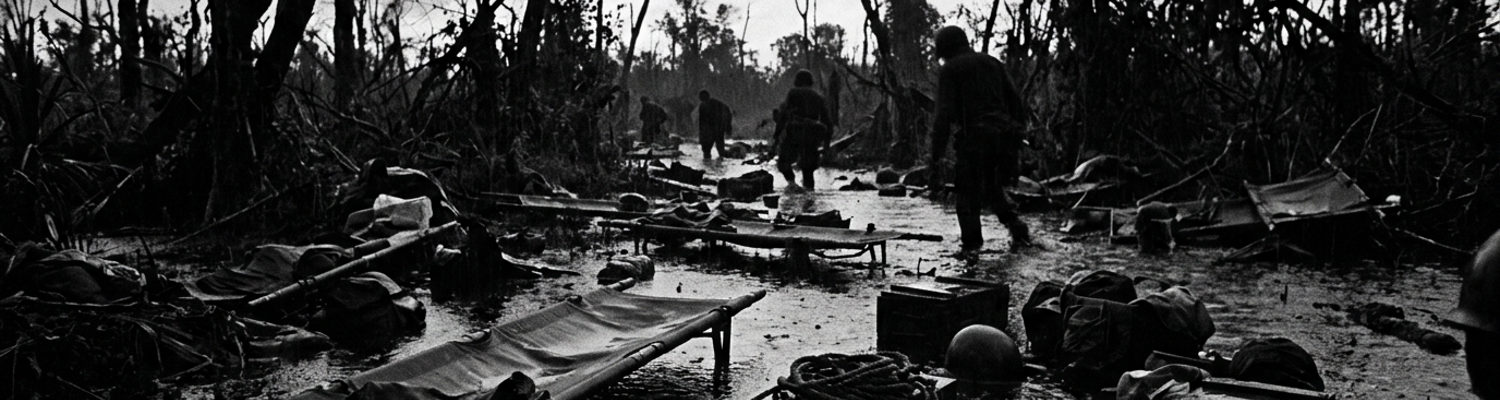
Medical logs from the 107th Medical Battalion demonstrate that standard doctrine collapsed because dry terrain simply did not exist. Along the Sanananda Track, the water table sat less than six inches below the surface of the mud. Any excavated trench or triage pit immediately filled with foul, stagnant ground water. Aid station personnel attempting to set up pyramidal tents south of the Soputa junction found their canvas cots sinking into knee-deep mire under the weight of incoming casualties.
Water destroyed medical supplies before staff could administer them.
Archival evidence shows that the War Department designed Field Manual 8-10, Medical Service of Field Units, around an industrialized, temperate theater featuring established road infrastructure. The manual mandated a rigid, stepwise medical ladder. Company aid men initiated basic triage at the point of injury. They fed casualties back to a battalion aid station situated roughly 400 to 800 yards behind the front line. From that station, personnel assigned to the division medical regiment loaded wounded soldiers into three-quarter-ton Dodge WC-54 motor ambulances or two-wheeled litter carts.
These vehicles operated along an organized ambulance shuttle relay. They moved non-ambulatory patients rearward across surveyed roads to division collecting stations and clearing hospitals. The doctrine relied completely on rolling wheels and uninterrupted mechanical flow. Field Manual 8-10 calculated casualty transit times under the operational assumption that rearward evacuation took minutes or a few hours. This allowed field surgeons to prioritize initial wound debridement, hemorrhage control, and rapid transport before systemic infection set in.
The Sanananda Track contained zero roads.
When examining the historical record of the 126th Infantry Regiment, standard wheeled evacuation gear proved useless within yards of leaving the trailheads north of Soputa. Medical detachments attempted to deploy standard M1939 two-wheeled litter carriers to haul casualties through the coastal swamp. The equipment failed immediately. Narrow rubber tires sank past their hubs into chest-deep black mangrove slime. Thick, fibrous silt jammed the axle assemblies. Hidden three feet beneath the stagnant surface water, dense networks of mangrove roots and submerged ironwood snags locked the carrier spokes. This snapped wooden crossbars and tipped litters sideways.
Orderlies found themselves neck-deep in foul swamp water.
They fought suction that pulled the combat boots off their feet while trying to keep delirious casualties from drowning. Carrying a single non-ambulatory wounded soldier over two miles required eight exhausted infantrymen alternating in twenty-minute shifts. This turned an evacuation doctrinal cycle calculated in minutes into a grueling fourteen-hour crawl. Forward battalion aid stations along the track lost all operational mobility within forty-eight hours of the initial clashes near the Japanese bunker complex known as the Triangle.
The forward medical pipeline stopped completely.
At the 1st Battalion aid post established south of the enemy perimeter, field medical officers set up canvas tarpaulins across rotting log cribs over swamp water. Litter squads could not move casualties rearward through the waterlogged jungle. Wounded soldiers accumulated directly at the front line. Over seventy critical litter cases swamped the post by the second morning of combat. Doctrine specified that a battalion station function merely as a sorting and dressing station, holding no patient longer than a few hours. Medical officers had to perform complex field debridements, manage systemic shock, and administer dwindling units of plasma while Japanese 70-millimeter Type 92 battalion guns and concealed snipers pounded their position.
Japanese Coconut-Log Bunkers and Enfilade Fire
When examining the historical record of the 163rd and 126th Infantry Regiments around the Sanananda front, Japanese defensive works defied every conventional direct-fire weapon in the Allied inventory. Imperial Japanese Army engineers and naval construction troops erected dozens of pillboxes by sinking heavy timber revetments into the rare patches of dry soil along the trail. Construction crews laid three to five alternating tiers of green coconut logs. Each log measured 12 to 18 inches in diameter. Workers bound them with heavy steel drift pins.
Across the roof decking, workers laid salvaged industrial narrow-gauge railway steel from nearby rubber plantations. They dumped three to six feet of packed coastal clay, river gravel, and waterlogged silt over the superstructure. Spongy fibers inside the green coconut wood absorbed direct explosions without shearing. The internal fighting bays remained completely intact. Allied 37-millimeter anti-tank guns firing high-explosive shells merely gouged the outer mud shell. Standard 25-pounder artillery fragmentation rounds detonated harmlessly against the top earthen berms.
Standard field munitions failed to pierce the timber roofs.
Archival evidence shows that these strongpoints were arranged in mutually supporting clusters rather than isolated outposts. They centered on the natural bottleneck known as the Triangle. Each position housed a Type 92 heavy machine gun firing 7.7-millimeter semi-rimmed ammunition from thirty-round metal strips. These were accompanied by Type 11 and Type 96 Nambu light machine guns. Japanese gunners cut firing apertures mere inches above the swamp water. They concealed the low horizontal embrasures behind living jungle creepers and wild sugarcane.
Engineers aligned these slits to fire across the front of adjacent bunkers rather than straight ahead. Any Allied patrol advancing directly toward an identified position stepped into grazing enfilade fire from an invisible bunker forty yards to the flank. Heavy 7.7-millimeter rounds skimmed four inches above the mud. They cut through swamp reeds in continuous cross patterns that severed leg bones and pinned advancing rifle companies beneath the surface of the stagnant water.
Soldiers could not locate the source of the fire.
Flash hiders and dense root networks masked the muzzle blast. A close review of operational logs indicates that Allied company commanders attempted to bypass these grazing fire lanes by digging forward sap trenches toward the enemy embrasures under cover of darkness. American and Australian infantrymen used entrenching shovels and steel helmets to carve narrow approach ditches eighteen inches wide through the mangrove peat. The plan fell apart as soon as digging reached six inches. Subterranean water flooded the channels and collapsed the soft mud walls.
Japanese observers stationed in nearby banyan trees registered every yard of these approach ditches. Type 89 50-millimeter heavy grenade dischargers dropped fragmentation shells vertically into the narrow ditches. Type 99 snipers fired directly down the length of the open sap heads. Wounded infantrymen could not turn around inside the muddy channels. They were trapped in place as water rose over their chests. Litter squads attempting to extract casualties were systematically cut down by pre-aimed machine gun sweeps across the trench parapets.
By dusk on December 19, third-battalion litter bearers abandoned forty-two wounded men in flooded approach ditches along the trail.
Severed Casualty Clearing Stations and Air Links
Archival evidence shows that Imperial Japanese Army infiltration squads exploited unmapped swamp corridors to bypass Allied forward companies entirely. Small combat patrols drawn from the Japanese 144th Infantry Regiment slipped through chest-deep sago swamps north of Soputa under cover of torrential night rains. These raiding teams established concealed roadblocks across the narrow footpaths connecting frontline aid stations with the 2/4th Australian Casualty Clearing Station.
Japanese soldiers severed field telephone wires. They threw fragmentation grenades into tented supply depots and set up Type 96 light machine guns on elevated root mounds. Medical officers at the clearing station found themselves surrounded on three sides. They ran out of sterile saline while treating bullet wounds under direct small-arms fire. Stretcher cases stacked on canvas cots absorbed stray 6.5-millimeter rounds passing clean through the canvas tent walls.
Surgeons traded scalpel handles for M1911 sidearms when infiltration parties rushed the triage perimeter.
A close review of operational logs indicates that Japanese snipers systematically dismantled the evacuation route running from Soputa back toward the landing strip at Popondetta. Marksmen concealed themselves forty feet up in the spreading crowns of ficus and banyan trees. They tied themselves to trunk limbs using hemp rope and palm cordage. Using Type 99 Arisaka rifles firing 7.7-millimeter rounds charged with smokeless powder, these hidden riflemen produced no visible muzzle flash to give away their positions.
Indigenous Papuan carriers marching in two-man and four-man teams collapsed onto the wet corduroy logs as sniper bullets struck them through the neck and torso. Litters tipped sideways into the morass. Immobilized casualties with splinted femur fractures were thrown into foul, standing water. Several drowned before unarmed bearers could pull them free. American infantry squads sent to flush the canopy could not spot the shooters through the dense vine cover. Entire litter columns halted for six to twelve hours in exposed swamps.
The primary footpath to Popondetta became an unpassable target range.
When examining the historical record of air evacuation, the pipeline connecting coastal Papuan dirt strips to base hospitals across the Coral Sea broke down under severe operational bottlenecks. Douglas C-47 transports from the 374th Troop Carrier Group struggled against blinding equatorial storm fronts towering over the 13,000-foot peaks of the Owen Stanley Range. Torrential downpours regularly turned the unpaved runways at Dobodura and Popondetta into impassable liquid mud. Hundreds of critical trauma cases were stranded in sweltering tin-roofed dispersal huts for days.
Air transport priorities favored northbound shipments of mortar rounds, dry rations, and fresh infantry over southbound casualty flights. Open surgical wounds remained unattended in ninety-degree humidity. Pathogens thrived in this sodden environment. Clostridium welchii bacteria multiplied beneath saturated field dressings. Simple compound fractures turned into foul, gas-distended necrosis within forty-eight hours.
Field surgeons at Port Moresby lacked the sulfonamide supplies and surgical capacity to treat the swelling wave of systemic sepsis. Orderly teams loaded putrefying, delirious men onto long-range transport aircraft heading south toward Queensland. Records from the 42nd General Hospital in Townsville show that over twenty percent of arriving orthopedic casualties required immediate guillotine amputations to halt advancing gangrene.
Medical Battalion Field Adaptations and Triage
A close review of operational logs indicates that the 107th Medical Battalion systematically stripped down its field inventory within four days of engagement along the Sanananda Track. Standard-issue folding litters buckled under the physical drag of the New Guinea swamp. Built with rigid ash poles and heavy duck canvas, the porous material absorbed gallons of water. This doubled the dead weight of each litter while rot quickly unraveled the load-bearing seams. Forward collecting officers discarded the rigid frames along the trailside south of the Triangle.
Medical detachments sent squads into the adjacent jungle to fell straight-trunked mangrove saplings and wild ironwood branches with combat machetes. Orderlies stripped off the bark. They tied two six-foot poles together using thick jungle vines, WD-1/TT field telephone wire, and torn webbing straps. To cradle the wounded soldier, litter teams slid standard-issue M1938 shelter-halves over the timber poles, securing the canvas with brass grommets. Sometimes they threaded rough burlap grain sacks end-to-end along the wood.
These improvised stretchers had flexibility.
Bearers could bend the frame around tight tree bases and drag casualties over half-submerged roots without snapping the structural timber. Regulation field gear proved lethal when equipment weight pulled carriers down into the bottomless silt. Archival evidence shows that casualty transport fell almost entirely upon indigenous Papuan stretcher squads organized through the Australian New Guinea Administrative Unit (ANGAU). Operating in shifts of four to eight men, these carriers hauled non-ambulatory casualties across five miles of track submerged beneath stagnant, waist-deep black morasses.
Canopy-level Japanese spotters regularly directed indirect fire into these known evacuation channels. Heavy Type 97 81-millimeter infantry mortars and Type 98 50-millimeter weapons dropped high-explosive rounds into the thick sago swamp. The blasts shredded the overhead foliage and showered the water with iron fragments. Shockwaves from mortar impacts detonating in the mud ruptured eardrums and knocked bearers off their footing into the stagnant water.
Papuan carriers held the sapling litters high above their shoulders.
They kept splinted compound fractures and open chest wounds clear of the foul swamp surface. Without weapons or defensive cover, the teams pushed steadily through the knee-deep mud. They absorbed continuous shrapnel wounds and sniper fire while securing litter patients against the sucking pull of the swamp floor. Evacuation teams required ten hours of continuous hauling to move a single litter patient three miles rearward to the Soputa aid clearing station.
When examining the historical record of forward surgical care, company aid men operated inside flooded ground dugouts carved into the trail shoulders. Battalion surgeons dug three-foot pits into the damp earth. They lined the interior walls with split palm logs and earth-filled sandbags to stop the revetments from sliding into the operational bay. Subterranean water seeped relentlessly through the dirt floors. Orderlies bailed foul liquid with discarded ration tins throughout surgical procedures.
Medical officers placed patients on elevated log cribs to keep wound dressings dry while performing emergency debridement. Using scalpels dulled by bone contact, surgeons sliced away blackened, necrotic muscle and excised ragged skin borders contaminated with swamp peat and clothing fibers. To combat severe hypovolemic shock, doctors suspended cans of dried plasma from overhead palm roots with wire loops. They dripped reconstituted fluid into collapsed veins by the flicker of pocket flashlights.
By the end of December, the 107th Medical Battalion exhausted its sterile water reserves. Surgeons washed surgical instruments in iodine-treated puddle runoff.
Systemic Supply Failures and Doctrinal Reassessment
A close review of operational logs indicates that standard packaging destroyed more medical material than Japanese artillery along the Sanananda Track. United States Army medical procurement shipped dried blood plasma kits, sulfanilamide packets, and surgical field dressings packed inside pasteboard boxes and wax-treated paper sleeves. Continuous tropical downpours and waist-deep swamp water dissolved these cellulose containers within minutes of unloading at forward trailheads north of Soputa.
In hundreds of commercial-grade cardboard cartons dropped without parachutes from C-47 transports, double-ended glass intravenous ampoules shattered against the mud or sank into subterranean peat. Saturated paper wrappers on compressed gauze bandages wicked stagnant swamp water directly into the cotton fibers. This infused supposedly sterile dressings with anaerobic pathogens and fecal bacteria. Crystalline sulfanilamide and sulfadiazine powders absorbed ambient humidity through unsealed foil envelopes. They congealed into damp, insoluble cakes that orderlies could not dust across shrapnel perforations.
Intravenous delivery tubing made of unvulcanized natural rubber rotted, split, or clogged with fungal growth.
Aid men could not reconstitute dried plasma flakes using contaminated distilled water flasks. Moisture converted front-line medical crates into contaminated waste. Archival evidence shows that endemic tropical diseases systematically stripped American infantrymen of the physiological reserve required to survive simple trauma. Along the Giruwa coastal approaches, soldiers fought while hosting concurrent infections of Plasmodium falciparum malaria, mite-borne Orientia tsutsugamushi scrub typhus, and Shiga-type bacillary dysentery.
Strains of Anopheles punctulatus mosquitoes breeding in flooded bomb craters drove clinical malaria rates above eighty percent across the 126th and 128th Infantry Regiments. The parasitic destruction of red blood cells dropped average frontline hemoglobin levels below eight grams per deciliter. This left infantrymen in persistent, sub-clinical anemic hypoxia. When dysentery bacilli triggered twenty to thirty daily evacuations of blood and mucosal tissue, the resulting hypovolemia drained extracellular fluids and depleted potassium reserves.
Minor trauma rapidly became fatal.
When examining the historical record of 32nd Division casualties, wounds that carried a five percent mortality rate in temperate operational zones became fatal within eighteen hours at Sanananda. Scrub typhus produced systemic perivascular inflammation and acute myocarditis. Minor blood loss threw fever-weakened hearts into irreversible peripheral vascular collapse. Dehydrated soldiers could not mount an immune response against opportunistic Clostridium and Streptococcus bacteria introduced by swamp water coating their skin.
Field surgeons noted that basic lacerations failed to form granulation tissue. Chronic protein starvation and vitamin deficiencies halted cellular repair entirely. Surgical incisions split open along suture lines under the slightest tension, exposing abdominal viscera to fly infestations.
Archival evidence shows that the disaster at Sanananda forced the War Department to discard its road-dependent medical doctrine and reengineer the entire Pacific supply apparatus. The Office of the Surgeon General abandoned commercial paper packaging. They ordered all pharmaceuticals, bandages, and surgical equipment destined for tropical deployment sealed in vulcanized rubber bags, paraffin-dipped cartons, and hermetically soldered five-gallon steel drums. Front-line supply commands replaced the failed ambulance-shuttle system with twenty-five-man Portable Surgical Hospitals designed to march on foot directly behind lead combat companies.
These agile surgical teams operated within five hundred yards of contact. They established four-table operating stations atop cleared jungle knolls to debride wounds and initiate whole-blood transfusions before systemic shock became terminal. Quartermaster depots issued dimethyl phthalate repellent to halt scrub typhus mites. They established strict supervised daily regimens of quinacrine hydrochloride atabrine tablets and replaced canvas litters with rot-resistant nylon frames. By July 12, 1943, the United States Army Medical Department mandated that no combat casualty in the South West Pacific Area would face primary wound closure before achieving air evacuation to stabilized surgical bases.