
A Landscape of Human Ruin
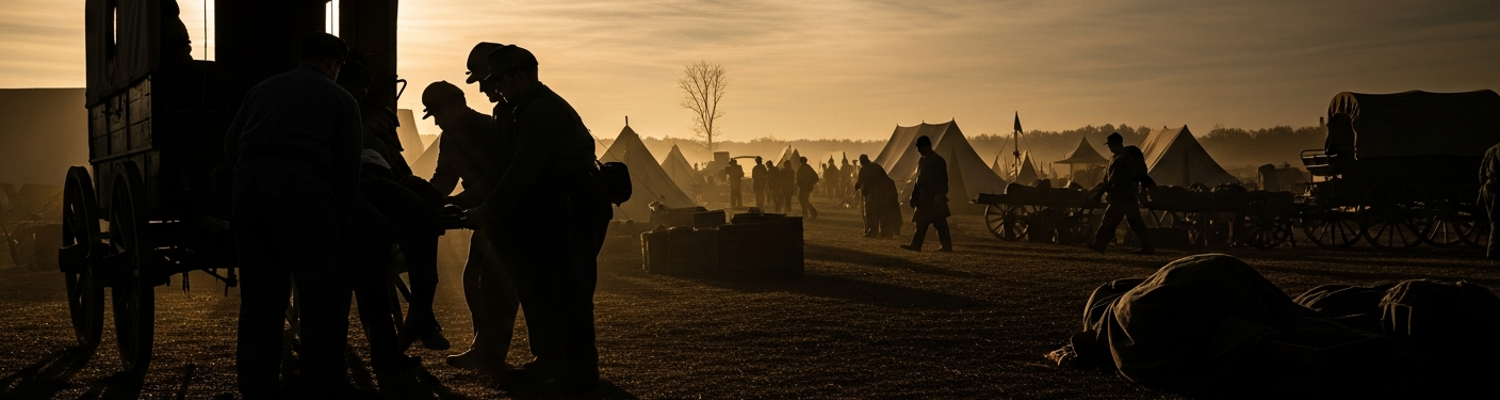
The Army of the Potomac secured its victory on July 3, 1863, but the ground it held was a landscape of human ruin. As Robert E. Lee’s battered Army of Northern Virginia began its retreat south, Major General George G. Meade’s forces confronted a logistical and humanitarian cataclysm. The three days of brutal combat produced a combined casualty count approaching 51,000 men. For the Union, the cost was approximately 23,049 soldiers killed, wounded, or missing. Of these, 3,155 were dead on the field and another 14,529 were wounded. The Union army also became the unwilling caretaker for 6,802 wounded Confederates left behind, adding to the immense burden. This mass of dead and suffering humanity descended upon the small borough of Gettysburg, a town with a civilian population of just 2,400 people.
The immediate aftermath was organized chaos. The summer air grew heavy with the stench of decomposition as thousands of bodies, both human and animal, lay under the oppressive July sun. An estimated 5,000 horses and mules also perished, their bloated carcasses adding to the urgent sanitation problem and posing a significant threat of disease. Details of exhausted Union soldiers were assigned the grim task of burial. They interred their own comrades first in shallow, hastily marked graves across the battlefield, a job so psychologically taxing that many survivors recorded their dread in their diaries. The task was overwhelming, straining the army’s available manpower and the psychological endurance of the men. Every available structure in and around the town transformed into a makeshift hospital. Private homes, barns, churches like the Christ Lutheran Church, and public buildings like Pennsylvania College became surgical theaters and recovery wards. The McPherson Barn and the Daniel Lady Farm, sites of intense fighting, became critical, if gruesome, centers of medical care. This sudden, massive demand for shelter, food, water, and medical attention placed an immediate and crushing weight on the Union Army’s command structure, from Meade down to his corps and division leaders. Civilian relief organizations, including the U.S. Christian Commission and the U.S. Sanitary Commission, rushed to the scene, providing invaluable support but also adding to the logistical complexity on the ground.
The Quartermaster's War
The responsibility for supplying the army and managing this crisis fell to the Quartermaster and Medical departments. Quartermaster General Montgomery C. Meigs, a tireless and brilliant organizer in Washington, had adeptly managed the army’s supply lines during the rapid march north. His department now faced the dual challenge of sustaining Meade’s army for a potential pursuit of Lee while also funneling massive quantities of humanitarian aid to Gettysburg. The army's chief quartermaster, Brigadier General Rufus Ingalls, had made the critical command decision to keep the main supply trains 25 miles to the rear at Westminster, Maryland. This choice kept the roads clear for combat troops moving to the battle. While tactically sound, it meant that in the battle’s wake, everything from medical supplies and tents to food and forage had to be brought forward over a limited and strained road network.
The army itself was exhausted. Soldiers and animals were worn out from forced marches and three days of intense fighting. Ingalls’ logisticians worked around the clock to move thousands of tons of supplies. The single-track Western Maryland Railroad line to Westminster became the primary artery, but from there, everything depended on wagon trains navigating roads choked with military traffic and churned into mud by summer storms. The decision by Meade’s leadership to prioritize the movement of combat troops before the battle now necessitated an equally urgent, and far more complex, logistical push to deal with its consequences. This effort demonstrated the vital leadership of the army’s supply officers. They prevented a complete collapse of the support system upon which both the wounded and the healthy depended, coordinating the flow of hardtack, salted meat, ammunition, and, most urgently, medical necessities like lint, bandages, chloroform, and opium.
An Ambulance Corps Forged in Crisis
Into this environment of suffering stepped Major Jonathan Letterman, the Medical Director of the Army of the Potomac. A year prior, following the disastrous medical response at the Second Battle of Bull Run, Letterman had received authority from army leadership to completely overhaul its medical services. Gettysburg was the ultimate test of his system. He had established a dedicated Ambulance Corps with trained stretcher-bearers and drivers, ending the dangerous practice of pulling combat soldiers from the ranks to evacuate the wounded. On August 2, 1862, General George B. McClellan had issued General Orders 147, officially creating the corps based on Letterman’s detailed design, which allocated a specific number of ambulances and personnel to each regiment.
Letterman’s plan was built on a three-tiered evacuation process. First, regimental aid stations were established directly on or near the battlefield, where assistant surgeons applied initial bandages and tourniquets. From there, the new ambulance wagons, designed for a smoother ride, transported the wounded to division-level field hospitals. These were typically located in barns or houses just beyond the range of enemy artillery, where emergency surgery was performed. The final tier consisted of large general hospitals far from the battlefield for long-term care. At Gettysburg, the Union army had over 650 medical officers present for duty. These surgeons and their staff worked relentlessly, often for days without sleep. The system proved its worth. Despite the sheer volume of casualties, the Ambulance Corps cleared all wounded from within Union lines by the morning of July 5th, a stark contrast to previous engagements where men lay suffering on the field for days.
Surgeons performed amputations, the most common treatment for limbs shattered by the large-caliber Minié balls, with practiced speed. The procedure itself was quick, but the lack of sterile technique meant that post-operative infection was rampant. Diseases like pyemia and gangrene were often more lethal than the original wound. To consolidate the sprawling network of over 150 makeshift hospitals and improve care, Letterman directed the establishment of a massive, centralized general hospital east of town along the York Pike. Known as Camp Letterman, this tent hospital opened in late July. It was a city unto itself, with specialized wards, kitchens, and sanitation systems. This key leadership decision allowed for the pooling of scarce resources, more systematic treatment, and better hygiene, ultimately saving thousands of lives. Camp Letterman cared for over 20,000 Union and Confederate soldiers before it closed in November 1863, a testament to the effectiveness of centralized military medical planning.
A Final Resting Place on Cemetery Hill
The sight of thousands of Union dead buried in scattered, inadequate graves across the battlefield spurred another critical leadership initiative. The temporary burials were not a permanent solution. Rains washed away the shallow soil, exposing remains, and local farmers needed to reclaim their fields for the fall planting. A prominent Gettysburg attorney, David Wills, recognized the need for a proper, dignified resting place for the Union soldiers. Acting as a special agent for Pennsylvania Governor Andrew Curtin, Wills spearheaded the movement to create a national cemetery. This was a novel concept. The federal government had only passed legislation authorizing the purchase of land for national cemeteries in July 1862, a program placed under the authority of Quartermaster General Meigs, but its implementation was still in its infancy.
Wills purchased 17 acres on Cemetery Hill, a key portion of the Union battle line, and secured the cooperation of 18 northern states to fund the project. He hired landscape architect William Saunders to design the grounds. Saunders created a plan noted for its simplicity and powerful egalitarian message. He arranged the graves in semi-circular rows organized by state, with simple granite markers for each soldier. Officers and enlisted men were buried side by side, a design that emphasized their common sacrifice for the Union. The process of re-interment began on October 27, 1863. Under the supervision of a local man named Samuel Weaver, workers exhumed the bodies from their battlefield graves. Weaver personally inspected every set of remains to ensure all effects and identifying information were collected before reburial in a proper coffin, a meticulous and emotionally draining task. By March 1864, the remains of 3,512 Union soldiers had been moved to the new cemetery. The project culminated on November 19, 1863, with a dedication ceremony. It was Wills who invited President Abraham Lincoln to deliver “a few appropriate remarks,” which became the immortal Gettysburg Address. The creation of the Soldiers' National Cemetery, driven by local and state leadership, established a powerful precedent. It cemented the federal government’s responsibility for honoring its military dead and created the foundational model for the national cemetery system that would expand across the country.