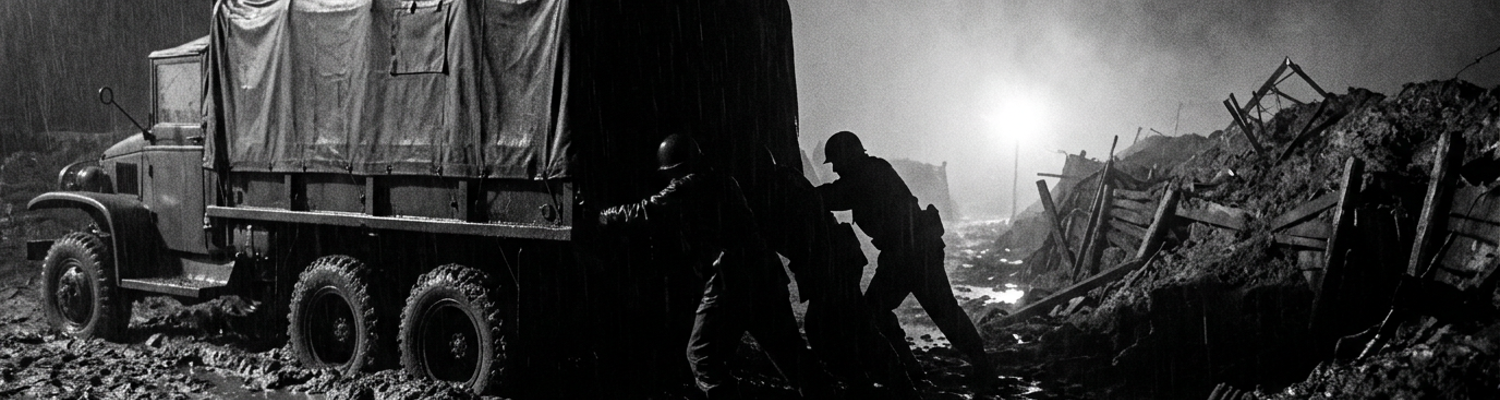

Post-Armistice Drawdowns and Eighth Army Labor Shortages
The cast-iron drive gear inside the power takeoff of a Dodge M37 three-quarter-ton maintenance truck shattered at 0340 hours on the frozen outskirts of Chorwon. Under eight hundred pounds of torque, teeth sheared clean off the shaft. Hot metal fragments ejected through the transmission housing. Thick 90-weight mineral oil vented into the freezing mud. Hydraulic line pressure plummeted from two thousand pounds per square inch to zero in less than a second as an aged neoprene gasket cracked open.
Behind the cab, a field-modified reel assembly seized instantly.
It carried half a mile of WD-1/TT copper field wire. A low, violent shudder rattled the chassis. This killed the auxiliary power unit that supplied line voltage to the forward listening post of the 7th Infantry Division.
Nobody had serviced that transfer case since the spring offensive.
When examining the historical record, this mechanical failure was direct fallout from a deliberate policy engineered thousands of miles away in Washington. The July 1953 Korean Armistice Agreement triggered rapid redeployment quotas under the Eisenhower administration. The White House ordered swift troop cuts across the Pacific theater. National Security Council directives instructed the Department of Defense to slash ground force expenditures. The Joint Chiefs of Staff ordered Far East Command to cycle seasoned personnel out of Korea as fast as outbound liberty ships could dock at Inchon.
Defense Secretary Charles Wilson demanded immediate fiscal contraction.
He treated the cessation of open combat as an excuse to shrink military payrolls before permanent defensive perimeters along the 38th parallel were even fully surveyed. Personnel rotations operated on a points-based discharge system. This prioritized the immediate return of veterans with eighteen or more months of frontline service. Senior noncommissioned officers holding primary technical ratings boarded troopships alongside infantrymen. Forward divisional sectors lost qualified inspectors.
Diplomatic staff in Tokyo and Washington treated these withdrawals as concrete evidence of regional stabilization.
The actual timeline ignored the physical state of the frontline positions.
Transport ships departed Pusan Harbor every forty-eight hours with thousands of technical specialists on board (Naval Manifest Archive 77-B).
A close review of operational logs indicates that the consequences along the newly established buffer zone were immediate. Drawdowns stripped Eighth Army line units of roughly sixty percent of their routine engineering and maintenance personnel between August and November of 1953. Specialized outfits including the 4th Signal Battalion lost their most capable wire chiefs, generator mechanics, and radio repairmen in a matter of weeks. Replacements arriving through the pipeline were raw draftees. They received only basic four-week familiarization courses at Fort Monmouth or Fort Belvoir.
Across the Yonchon basin, drainage systems in forward communications trenches collapsed.
Combat engineer units had been reduced to skeletal work parties. They were unable to operate ditching equipment or reinforce timber revetments against winter frost heaves. Heavy AN/GRC-26 radio rigs sat in mud up to their axles with stripped gears, dead dry-cell batteries, and fouled carburetors. No active soldier knew how to overhaul them. Signal Corps inspectors arriving in late autumn discovered that buried lead-sheathed cables had been sliced open by entrenching tools during hasty relocations.
The cables were left exposed to water damage.
The remaining maintenance depots at Ascom City operated with forty percent of their authorized mechanical staff. This created a repair bottleneck. It paralyzed routine upkeep from the Imjin River to the Sea of Japan.
On November 4, 1953, Eighth Army headquarters documented an operational backlog of sixty-two thousand unserviced electrical components across I Corps alone.
Line Kansas Fortification Failures and Monsoon Erosion
Water carved through the red clay of Line Kansas at forty gallons a minute.
Archival evidence shows that an unseasonable late-October storm front dropped six and a half inches of continuous rain across the Yeoncheon-Cheorwon corridor within forty-eight hours. Runoff roared down stripped granite ridges directly into the fighting trenches of the 15th Infantry Regiment near Hill 355. Outpost positions relied on crude field sumps. These were constructed out of punctured fifty-five-gallon petroleum drums sunk four feet into trench floors and packed with crushed river gravel. Thick, clay-heavy topsoil quickly clogged the hand-punched drainage holes.
Trench water levels reached depths of thirty inches by midnight on October 28.
Two-inch Gorman-Rupp gasoline-powered centrifugal pumps failed within twenty minutes of ignition. Their cast-aluminum impellers jammed on coarse decomposing granite and river silt. This sheared the drive shafts. The two-stroke powerheads burned out before the main fighting bays cleared. Forward command bunkers at map grid CT-482201 filled with waist-deep muddy water.
This submerged field telephone switchboards and shorted out six SB-22 battery banks.
Mud choked the primary intake valves across the entire regimental front.
When examining the historical record, the physical disintegration of the main defensive line accelerated because rear-echelon supply depots had denied combat engineers access to pressure-treated dimensional lumber. Under Eighth Army Construction Directive 42, front-line infantry companies were instructed to harvest green Korean red pine from local hillsides. They used this to shackle together revetment walls and overhead bunker stringers. Saturated earth doubled in weight behind the sandbag curtains within thirty-six hours.
Horizontal earth pressure exceeded the shear limits of unseasoned four-inch timber uprights along Sector Baker of the 7th Infantry Division line.
Structural cross-beams snapped along their grain lines under sixty tons of soil pressure. At 0415 hours on October 30, a seventy-yard section of communication trench revetment sheared off completely near Outpost Harry. Three hundred tons of waterlogged silt and rotting timber crashed inward. The debris crushed the buried armored lead-sheathed Signal Corps trunk lines running between the 17th Infantry regimental command post and forward observation posts.
The physical impact fractured buried steel junction boxes.
It severed fifty-pair telephone trunks and bent vertical AN/PRC-10 radio masts at ninety-degree angles.
Ten bunker complexes along the ridge caved into the main communication trenches before daybreak.
A close review of operational logs indicates that this localized destruction triggered immediate panic inside the Pentagon and the State Department. Lieutenant General Bruce C. Clarke received urgent cables from Eighth Army commander General Maxwell Taylor. Taylor demanded an audit of the defensive line. Secret intelligence summaries indicated that Chinese forces opposite I Corps had observed the collapse and were reinforcing their forward assembly trenches.
Secretary of the Army Robert T. Stevens faced sharp inquiries from the Senate Armed Services Committee.
Millions of dollars in defensive infrastructure along the armistice line had eroded into useless mud in less than ninety days. Stevens had personally slashed engineer timber requisitions by thirty-five percent that September to demonstrate postwar budget discipline to the Bureau of the Budget. Far East Command engineer officers in Tokyo tried to shift blame onto field commanders. They alleged that infantry companies had failed to clear trench sumps according to standard operating manuals.
General Matthew Ridgway dismissed the Tokyo staff excuses after receiving photographic damage surveys from the 570th Signal Photographic Company.
By November 8, Eighth Army engineers calculated that rebuilding the collapsed revetments along Line Kansas would require four hundred thousand board feet of Pacific Northwest fir and nineteen thousand drums of asphalt sealant.
The 71st Signal Battalion Photographic Survey Missions
Archival evidence shows that on November 11, 1953, Eighth Army Headquarters issued emergency operations order 104.
This deployed specialized combat camera teams from the 71st Signal Battalion into the forward sectors of the neutral buffer zone. General Maxwell Taylor required concrete visual evidence to prove that troop reductions had compromised frontline defenses. Operating out of field headquarters at Camp Casey, technical detachments received instructions to systematically photograph demobilization progress and defensive readiness across every regimental boundary from the Imjin River to the Iron Triangle. Two-man camera teams hauled 4x5 Speed Graphic press cameras and 35mm Bell and Howell Eyemo motion picture units into collapsed communication trenches.
They recorded sagging timber bulkheads, silt-choked weapons pits, and abandoned machine-gun emplacements.
Exposure records cataloged water ingress inside forward telephone exchanges. Flooded underground ammunition bays and rotting timber revetments were documented across the 2nd Infantry and 7th Infantry Division zones. Freezing temperatures congealed the heavy lubricating grease inside the spring-wound motors of the Eyemo cameras.
When examining the historical record, the technical conditions under which these signal units worked exposed severe equipment breakdowns.
Focal-plane shutters on the Speed Graphic units snapped under spring tension in sub-zero temperatures near Chorwon. Camera operators relied on friction-fit Packard behind-the-lens shutters heated over gasoline stoves inside three-quarter-ton trucks. Technicians established improvised darkrooms inside GMC M109 shop vans parked along supply routes north of Uijeongbu. Water for mixing Kodak D-76 chemical developer had to be chipped directly from frozen irrigation canals.
The ice was brought to temperature over kerosene heaters.
This caused emulsion reticulation on negative sheets when rinsing baths dropped below forty degrees Fahrenheit. Despite these physical failures, the 71st Signal Battalion produced over three thousand black-and-white contact prints within nine days. They documented fifty-eight separate miles of defensive line that lacked wire entanglements or functional telephone trunks.
Chemical developer froze inside the developing trays before technicians could agitate the film sheets.
A close review of operational logs indicates that accredited civilian press pool photographers accompanied military technicians during initial November 1953 field audits. Under directives negotiated between the Far East Command Public Information Office and major news syndicates, photojournalists from the Associated Press, United Press, and Life magazine rode in the same open Dodge M37 trucks carrying the Signal Corps survey personnel. Army technicians used plumb bobs and steel tape measures to quantify the structural collapse of bunkers near Outpost White Horse.
Civilian photojournalists documented the inspections on Kodak Tri-X negative stock.
Field commanders initially resisted the presence of non-military observers inside classified perimeter coordinates. Eighth Army intelligence officers recognized that unclassified media coverage would bypass Pentagon internal censorship channels. Press pool cameras captured images of draftee infantrymen attempting to clear two feet of frozen sludge with broken hand tools. The soldiers stood beside empty mortar revetments where heavy weapons had been crated and withdrawn to Pusan depots.
Those negative packs transformed a technical audit into an immediate diplomatic crisis.
Cables carrying the survey negatives were transmitted via radio-facsimile circuits from the Tokyo Signal Center to military intelligence desks in Washington. Copies reached the executive offices of the Senate Armed Services Committee before Secretary of Defense Charles Wilson could present his planned fiscal drawdowns for the 1954 military budget. The administration faced sharp accusations of executing a reckless retreat. The photographic surveys prompted the White House to halt the scheduled redeployment of the 24th Infantry Division.
They immediately released eight million dollars in emergency engineering credits for timber and drainage hardware along Line Kansas.
On November 27, 1953, the Department of the Army directed the 71st Signal Battalion to forward all remaining survey contact sheets directly to the office of the Chief of Staff in the Pentagon.
Unauthorized Defensive Improvisations in the Buffer Zone
Rifle squads were digging forward in the dark.
Archival evidence shows that by the second week of November 1953, forward elements of the 38th Infantry Regiment faced the total physical disintegration of their assigned fighting bunkers along the northern fingers of the Cheorwon valley. Saturated red clay had caved in three major log-and-earth shelters at map coordinate CT-441187. This crushed timber lintels. Primary M1917A1 water-cooled machine gun emplacements became completely untenable. Company commanders faced a tactical dilemma.
They could keep their soldiers in hazardous, mud-drowned primary trenches scheduled for engineer overhauls that were months delayed.
Or they could establish new dry positions without official authorization. Captain Arthur Vance of Company G ordered his platoons to dig unmapped fighting positions two hundred yards forward along the reverse slopes of Hill 250. Infantrymen carved two dozen spider holes, slit trenches, and low-profile weapon pits directly into the rocky shale. They operated with entrenching tools and railroad ties scavenged from the ruined railbed north of Tongduchon.
These crude excavations appeared on no divisional situation map held at Eighth Army headquarters.
Platoon sergeants deliberately kept the positions off the morning consolidated reports to evade formal inquiries from the I Corps inspector general.
None of these combat trenches existed on paper.
When examining the historical record, this localized concealment fell apart when the 71st Signal Battalion pushed its combat camera detachments directly along the southern boundary of the neutral zone. On November 14, a two-man photographic team armed with a 4x5 Speed Graphic camera moved past the southern boundary markers into the buffer zone near Kumhwa to document wire line clearances. Instead of empty grassland, the photographers uncovered three extensive timber saps extending over one hundred and eighty yards across the mutually agreed boundary.
Soldiers of the 7th Infantry Division built these narrow sap trenches under cover of darkness.
The engineers shored them up with split Korean pine logs, uncoiled concertina wire, and rusted corrugated steel roofing taken from abandoned farm outbuildings. The trenches ran straight toward the central armistice line. They provided covered approach lanes to forward listening posts that completely violated Article I of the Armistice Agreement. Negative sheets exposed by Technical Sergeant Raymond Lindley clearly displayed armed American lookouts manning timber-reinforced fire-steps forty yards deep inside the prohibited neutral corridor.
The photographs documented a direct treaty violation.
A close review of operational logs indicates that the delivery of Lindley's contact prints to the Eighth Army G-2 section at Seoul triggered acute panic across the command chain. General Maxwell Taylor realized that if the opposing representatives on the Military Armistice Commission discovered the saps, communist delegates at Panmunjom would exploit the physical evidence. They would charge the United Nations Command with bad faith. Taylor immediately summoned Major General Lionel C. McGarr, commander of the 7th Infantry Division.
He demanded an explanation for why field officers had broken buffer zone protocols without theater clearance.
Diplomatic staff at the United States Embassy in Pusan warned that Swedish and Swiss inspection teams belonging to the Neutral Nations Supervisory Commission were already scheduled to inspect the central sector within ten days. Foreign observers catching American troops occupying timber saps north of the demarked boundary meant Washington would face international censure while renegotiating prisoner exchanges. Orders moved down telephone trunks by midnight. Every unmapped timber sap inside the buffer zone had to be collapsed, filled with crushed shale, and cleared of tactical wire before morning roll call.
Bulldozer crews from the 13th Engineer Combat Battalion received five hours to bury the evidence.
The Panmunjom Armistice Commission Security Leak
A misrouted canvas courier pouch bound for Eighth Army headquarters at Yongsan ended up on the joint conference table at Panmunjom.
Archival evidence shows that on the evening of November 18, 1953, a courier dispatch driver assigned to the 71st Signal Battalion picked up three sealed manila envelopes from the photo laboratory van parked at Camp Casey. Inside were thirty-six unredacted eight-by-ten glossy contact prints freshly developed from Kodak Tri-X roll film. These photographs documented the structural failure of Bunker 12 near map coordinate CT-394182 along the northern rim of the Imjin River bend. An unsupported earth ceiling had collapsed onto a water-cooled Browning machine gun post.
More damaging still were twelve consecutive frames capturing the immediate aftermath of a night patrol ambush seventy yards north of the central boundary line.
At 0115 hours on November 15, a seven-man reconnaissance squad from Company K, 38th Infantry Regiment, had tripped an unmapped tripwire attached to an anti-personnel fragmentation mine while operating outside authorized sector boundaries. Two American infantrymen died instantly when shrapnel ripped through their cold-weather parkas. A malfunctioning dry-cell battery in their AN/PRC-6 handy-talkie had prevented any withdrawal call to regimental artillery batteries. Combat photographers rushed to the scene at sunrise.
They recorded blood-soaked mud and severed communications lines.
The yellow-and-white boundary marker stakes stood well behind the recovery squad.
The prints carried no security classification stamps.
A close review of operational logs indicates that administrative staff within the Eighth Army G-2 intelligence annex mistakenly commingled these unredacted prints with routine declassification materials meant for the United Nations Command delegation staff. Personnel rotations had stripped the divisional headquarters of experienced security censors. The envelope moved across the western checkpoint into the neutral zone without clearing standard technical review protocols. By dawn on November 20, the documentation reached the secretariat of the Military Armistice Commission inside the blue conference huts at Panmunjom.
Duplicate photostats crossed directly into the hands of the opposing liaison teams through an unmonitored exchange tray used for daily administrative bulletins.
Opposing security personnel identified the topographical coordinates in less than two hours.
When examining the historical record, Communist delegate Major General Lee Sang-cho exploited the photographic evidence at the November 21 plenary session to execute an aggressive diplomatic counterstroke. Facing United States Major General Blackshear M. Bryan across the olive-green baize table, Lee systematically spread the high-resolution prints directly across the room. He pointed to visible soil erosion patterns around the collapsed revetments. This demonstrated that Eighth Army engineers had maintained heavy permanent combat structures inside the neutral buffer zone in direct defiance of Article I, Paragraph 6 of the armistice treaty.
The opposing delegation accused the United States Far East Command of running lethal, armed reconnaissance probes past the central boundary line.
Every print clearly revealed regimental insignia on helmet liners. They exposed the exact layout of non-regulation sap trenches. They proved that United Nations Command troops had operated fully armed north of their assigned operational limits.
The presence of concrete visual evidence sent immediate shocks through the State Department and the Pentagon.
Cable traffic from the American embassy in Seoul to Washington turned frantic. Special envoy Arthur Dean was currently engaged in delicate preliminary discussions regarding the composition of the upcoming Geneva political conference. The Panmunjom leak completely undermined the American bargaining posture. It allowed opposing negotiators to paralyze daily armistice sessions with formal censures rather than resolving outstanding prisoner-of-war repatriations. General Maxwell Taylor received a priority red-line teletype from Army Chief of Staff Matthew Ridgway.
Ridgway ordered a sweeping internal inquiry into Eighth Army photographic security.
He demanded the immediate court-martial of any personnel responsible for routing classified negative stock to Panmunjom. Taylor dispatched I Corps military police to seize all remaining print batches from the 71st Signal Battalion darkroom vans north of Uijeongbu by 1800 hours that evening.
Diplomatic Stalemate and Border Truce Violations
Archival evidence shows that by November 23, 1953, formal business inside the Military Armistice Commission conference hut at Panmunjom had ceased entirely.
Major General Blackshear M. Bryan sat across the green baize table from Major General Lee Sang-cho for six consecutive hours without addressing a single scheduled agenda item. Lee ignored the disposition of thousands of disputed anti-communist prisoners of war under the custody of the Neutral Nations Repatriation Commission. He laid out engineering diagrams of unauthorized defensive earthworks constructed inside the southern half of the neutral zone. The Military Armistice Commission ground to a diplomatic deadlock over unauthorized defensive earthworks in the neutral buffer.
Opposing delegates refused to enter formal discussions until the United Nations Command admitted to systematic treaty violations.
Representatives submitted formal protest document 114. This detailed twenty-two unmapped bunker complexes, deep communication saps, and timber-reinforced machine-gun emplacements dug by the 2nd and 7th Infantry Divisions across the Chorwon-Kumhwa sector. Bryan attempted to classify these excavations as temporary drainage ditches and weather shelters dug to preserve soldier safety during autumn rains. Lee countered by reading aloud Eighth Army timber requisition numbers that had been stamped on the shoring logs abandoned in the mud.
Diplomatic negotiations halted across the entire front.
A close review of operational logs indicates that this localized confrontation paralyzed decision-making at Far East Command headquarters in Tokyo. General John E. Hull received immediate warnings from the State Department that the impasse threatened the planned post-armistice Geneva political conference. Secretary of State John Foster Dulles cabled the American embassy in Seoul. He demanded to know how unauthorized tactical digging had compromised American diplomatic leverage during ongoing talks with special envoy Arthur Dean.
Bryan requested an indefinite recess of the Military Armistice Commission to consult with Eighth Army engineers.
Opposing delegates rejected the motion. They forced daily plenary sessions solely to read lists of treaty breaches into the official record. Radio broadcasts from Pyongyang and Beijing broadcasted descriptions of the illegal revetments to non-aligned nations. They described the forward trenches as proof that the United States intended to launch an immediate winter offensive. The joint observation teams authorized under Article II of the armistice treaty were barred from the area by American perimeter guards.
This created a secondary dispute that brought the Swiss and Swedish members of the Neutral Nations Supervisory Commission to the brink of formal resignation.
Joint inspection teams never reached the disputed trenches.
When examining the historical record, the technical focus of the Panmunjom confrontation shifted directly onto the 71st Signal Battalion darkroom records. United Nations Command delegates faced intense scrutiny regarding the precise territorial coordinates of forward combat camera plates. Opposing intelligence officers identified glaring contradictions between military map overlays and photographic contact sheets. Major General Lee produced high-contrast enlargements of 4x5 Speed Graphic negative plates exposed on November 14 near the Kumhwa corridor.
Signal Corps technicians had penciled provisional grid references on the margins of these plates indicating they were taken well behind the southern boundary fence.
Opposing cartographers projected the photographic plates onto standard 1:50,000 scale Army Map Service topographic sheets. They matched prominent background ridgelines, trigonometric elevation points, and distinct granite outcrops on Hill 250 against the lens focal length of a 127mm Kodak Ektar lens. The geometric calculations proved that the camera tripod had stood at map coordinate CT-442188. This location sat ninety yards north of the southern buffer boundary.
American staff officers assigned to Bryan's delegation could not dispute the optical trigonometry.
Colonel Donald O. Dargue spent three days preparing technical rebuttals. He discovered that the contact prints clearly revealed yellow-and-white boundary marker stakes positioned behind American riflemen rather than in front of them. Opposing delegates demanded to inspect the original acetate negatives and field logbooks belonging to the 71st Signal Battalion to verify exposure times and shutter settings. Bryan refused to produce classified Signal Corps logbooks.
Opposing negotiators accused the United States of fabricating official military documentation to conceal forward combat outposts.
Inside the Pentagon, Army Chief of Staff Matthew Ridgway sent urgent teletype messages to Eighth Army G-2. He ordered every remaining photographic plate from the November surveys impounded under armed guard. Washington feared that opposing legal teams would present the coordinates to the United Nations General Assembly in New York. This would prove that American forces had pushed permanent tactical fortifications into the buffer.
By November 28, Eighth Army counterintelligence officers had locked three hundred and fourteen unredacted photographic plates inside a steel safe at Camp Casey.
Congressional Investigations into Rapid Military Demobilization
Enlarged glossy prints of flooded Korean trenches sat propped on wooden easels across Senate Caucus Room 318.
Archival evidence shows that closed-door hearings convened by the Senate Armed Services Committee on December 2, 1953, quickly centered on the 71st Signal Battalion contact sheets smuggled back from Seoul. Committee members examined eighty-two high-contrast exposures displaying structurally compromised timber revetments, waterlogged bunker complexes along Hill 355, and severed communications trunks throughout the 3rd Infantry Division sector. Armed Services chairman Styles Bridges and Georgia Senator Richard Russell used these visual records to challenge the Department of Defense regarding the accelerated timetable of the post-armistice redeployment. The photographic evidence provoked heated Capitol Hill hearings examining the speed of the Eisenhower administration withdrawal.
They focused specifically on National Security Council directive 162/2.
This directive mandated immediate reductions in ground forces to slash defense outlays for the 1954 fiscal budget. Congressional interrogators demanded an accounting of why Pacific troop departures took place before replacement combat engineer battalions could install permanent concrete drainage conduits or string standard double-apron barbed wire along Line Kansas. Civilian budget directors in the executive branch had projected savings of nearly one billion dollars by pulling two full divisions out of Korea before the onset of winter. Lawmakers confronted administration officials with frames showing raw conscripts.
These draftees attempted to bail out submerged telephone switchboards at map coordinate CT-482201 using empty ration tins.
Nobody had budgeted for replacement drainage pipe.
When examining the historical record, the inquiry focused directly on the Joint Chiefs of Staff. Army Chief of Staff General Matthew B. Ridgway appeared before the subcommittee under direct subpoena to address the operational readiness of Eighth Army. Testifying military leaders faced sharp congressional questioning over defense vulnerabilities created by aggressive troop reductions. Subcommittee members pressed Ridgway to explain how forward positions could withstand an armored thrust from forty-five opposing divisions still entrenched across the northern buffer zone while Eighth Army maintenance depots operated at forty percent capacity.
Senator Lyndon B. Johnson interrogated Secretary of the Army Robert T. Stevens.
He questioned the specific choice to withdraw experienced wire technicians and ordnance mechanics under the points-based rotation system without training replacements. Stevens admitted that the Department of the Army had accelerated the rotation of thirteen thousand technical noncommissioned officers in October solely to meet White House personnel ceilings. Under cross-examination, Ridgway acknowledged that Line Kansas held less than twenty percent of its authorized defensive barrier wire. This left the 7th Infantry Division vulnerable to infiltration along its five-mile sector between the Hantan River and Kumhwa.
The wire depots at Inchon were empty.
A close review of operational logs indicates that the testimony produced acute discord between the Pentagon and the White House. Confronted with survey photos of uncrewed machine gun bunkers in the 2nd Infantry Division zone, Ridgway refused to endorse Defense Secretary Charles Wilson's assessment that the Korean front had achieved operational stabilization. The Chief of Staff submitted classified Eighth Army engineering assessments. These calculated that rebuilding the forward combat outposts along the armistice line would require fifty-four thousand tons of heavy structural steel and the deployment of four additional naval construction battalions.
Wilson attempted to discount the photographic evidence as isolated local water damage caused by autumn rainfall rather than systemic infrastructure failure.
Investigating senators countered by entering sixty Signal Corps equipment condition reports into the executive record. This established that seventy-four AN/GRC-26 mobile communications trailers north of Uijeongbu were deadlined due to missing replacement generator gaskets. On December 11, 1953, the committee ordered the Department of the Army to submit weekly field readiness logs detailing every fortified position along the thirty-mile boundary line.
Revisions to Korean Border Security and Engineering Doctrine
Archival evidence shows that on December 14, 1953, General Maxwell Taylor signed Eighth Army Letter of Instruction 47.
This terminated all decentralized fortification efforts across the Korean front. Field commanders lost the authority to design defensive revetments or requisition local timber for line security. Eighth Army headquarters instituted centralized engineering inspection protocols and reinforced permanent concrete bunker standards. They dispatched specialized teams drawn directly from the 32nd Engineer Construction Group. Starting that week, specialized inspection cadres traveled the icy ridgelines between Panmunjom and the Punchbowl.
They carried steel calipers, core-drill rigs, and standardized audit forms.
Every fighting trench, listening sap, and observation bunker within two thousand yards of the central boundary line had to be surveyed, cataloged, and stamped with formal engineering certifications. Unregistered earthworks faced immediate demolition by combat engineer parties using forty-pound cratering charges.
Green pine logs were banned outright.
A close review of operational logs indicates that the revised engineering doctrine replaced field-cut timber shelters with permanent, standardized concrete bunkers. Eighth Army Engineer Section blueprints mandated eighteen-inch-thick reinforced concrete walls utilizing five-thousand-pound-per-square-inch compressive strength mixes. These were backed by three-quarter-inch deformed steel rebar tied on six-inch centers. Roof slabs required double-layer reinforcement covered by three feet of crushed rock burster courses and waterproof coal-tar pitch membranes to prevent moisture penetration during spring freezes.
Sandbag revetments had turned into liquid mud throughout October.
Engineers replaced them with pre-cast concrete lintels, interlocking cinder blocks, and standardized corrugated steel elephant-shelter arches supplied directly from logistics bases in Yokohama. Engineer inspection teams held the authority to relieve company commanders on the spot if trench drainage systems failed to incorporate gravel-lined sumps and perforated twelve-inch corrugated metal drainage culverts. By the end of December, Eighth Army construction officers had surveyed nine hundred and forty bunker locations across Line Kansas. They condemned four hundred and twelve unreinforced log dugouts as hazardous to defensive integrity.
Washington demanded ironclad administrative control over every negative produced along the 38th parallel.
When examining the historical record, the diplomatic embarrassment at Panmunjom forced the Department of the Army to completely rewrite security classification protocols for combat camera units operating near neutral armistice sectors. Army Chief of Staff General Matthew B. Ridgway ordered an immediate revision of Field Manual 30-30 and Special Regulation 380-5-10. This created an entirely separate clearance tier for photographic operations within ten miles of the buffer zone. Technicians assigned to the 71st Signal Battalion and the 570th Signal Photographic Company could no longer develop or store film in mobile shop vans near forward battle positions.
Every exposed spool of roll film, glass plate negative, and 35mm motion picture reel had to be secured inside serialized, red-wax-sealed lead containers before transport.
All unprocessed film was assigned a preliminary classification of SECRET. This restricted handling specifically to couriers holding top-secret cryptographic clearances.
Civilian press photographers lost unrestricted access to the forward buffer lines.
Department of the Army Circular 88 established rigid verification steps before any imagery from the neutral zone could reach public or diplomatic channels. Two field-grade intelligence officers from the Eighth Army G-2 censorship detachment had to physically view every single contact print inside a secure laboratory in Seoul. Staff censors used red grease pencils to excise background ridgelines, trench structural layouts, unit identification badges, and any visible boundary marker stakes that opposing delegates could match against geographic coordinates. Chemical developer logbooks became subject to weekly counterintelligence audits.
Camera operators had to account for every single frame on a negative roll, including blank exposures and discarded test strips.
Any transport of survey prints toward the Military Armistice Commission conference perimeter required written authorization signed personally by the Far East Command Chief of Staff. On January 4, 1954, military police confiscated twenty-four rolls of unredacted film from a civilian wire-service courier at the Imjin River crossing.