
Kure Atoll Radar System Degradation
The primary early warning instrument on Kure Atoll was the AN/MPQ-10. It was a transportable S-band radar system. Its original design purpose was tracking the high arc of mortar and artillery shells to calculate their point of origin. On Kure, it was forced into a role for which it was never intended. Naval surface detection. A review of 307th Signal Battalion operational logs (Log Entry 307-K-58-09) shows the choice was based on immediate availability, not tactical suitability. The system used a conical scan principle, radiating pulses from a dipole antenna and parabolic reflector. Its effectiveness against low-angle naval threats was inherently limited by its original design parameters and its reliance on vacuum tube technology developed before the end of the Second World War.
The environment was a constant antagonist.
Archival evidence shows the single greatest factor in the system’s breakdown was the hyper-aggressive tropical environment of Kure Atoll. As the world’s northernmost coral atoll, Kure experiences extreme humidity and constant exposure to corrosive, salt-laden air. This combination proved devastating to the 1950s-era electronics of the AN/MPQ-10. Maintenance reports from the period (NARA Record Group 338) describe a constant battle against saltwater corrosion that attacked every exposed metal surface, from the antenna array to the electrical terminals on the power supply units. The high humidity, often exceeding 85%, promoted moisture buildup within supposedly sealed components, leading to short circuits and signal degradation. Technicians noted the persistent growth of crystalline salt deposits on wiring and vacuum tube sockets. These deposits created unintended electrical pathways that would cause sporadic and unpredictable failures. Components failed at a rate far exceeding their expected service life, turning upkeep into a grim cycle of constant replacement and ad-hoc repair.
This systemic decay was made worse by severe and recurring power failures. The island’s diesel generators, themselves subject to the same corrosive environment, were notoriously unreliable. Fuel was often contaminated by water due to the high humidity, and mechanical components were prone to accelerated wear. The result was an unstable power grid characterized by frequent brownouts and voltage spikes. For the AN/MPQ-10’s sensitive vacuum tubes and the mechanical resolver computer, these fluctuations were damaging. Power surges would burn out filaments and damage capacitors. Sudden power loss during operation could cause cascading electronic failures. These intermittent power issues directly translated into a compromised detection envelope. The radar’s instrumented range would collapse without warning, creating temporary but total blind spots in the atoll’s defensive screen. The system's coverage area would shrink and expand unpredictably with the sputtering of the generators.
Civilian Radio Interception
The first hint of the impending strike did not originate from the uniformed personnel of the 307th Signal Battalion. It did not emerge from their failing radar equipment. Instead, the first indication came from a cluster of makeshift shelters on the atoll’s eastern shore. This area was unofficially occupied by a small, displaced community of ethnic Japanese fishermen and their families, relocated from the Ogasawara Islands under post-war territorial adjustments. Declassified post-action reports confirm their presence, noting them as a non-hostile civilian element. It was within this community, using equipment that was a world away from military specifications, that the first alert was sounded. They had constructed their own means of communication. A network of improvised shortwave radios. Examination of the site after the engagement showed they were assembled from salvaged parts: vacuum tubes pulled from derelict Japanese Type 92 field telephone switchboards, capacitors made from waxed paper and aluminum foil, and power supplied by scavenged 12-volt lead-acid batteries. Their most effective component was the antenna, a simple long-wire array fashioned from commercial-grade fishing line and stripped copper wire, strung between two of the island’s taller ironwood trees.
They were not listening for military transmissions. Their goal was to catch the faint signals of commercial radio stations from their homeland. News, music, and weather from broadcasters like Radio Kyushu. On the night of the engagement, at approximately 02:17 local time, a civilian named Kenji Tanaka was manually sweeping the 40-meter band on his homemade set. He was focused on a weak signal on the 7.2 MHz frequency. Suddenly, the music he was listening to was erased by a clean, powerful burst of a high-frequency carrier wave that lasted for a recorded 1.2 seconds. It was followed immediately by a distinct, descending audible hum, a clear example of the Doppler effect. This was not atmospheric interference. It was a sterile, artificial signal that momentarily saturated the receiver before vanishing.
That single civilian log entry became the key. On duty in the Signal Corps’ radar van, Specialist Fourth Class David Rollins was fighting his own battle with failing technology. The AN/MPQ-10’s power inverter was fluctuating wildly. The display was filled with phantom returns caused by saltwater contamination on the waveguides. Against regulations, Rollins was monitoring civilian shortwave bands on his personal Hallicrafters S-38 receiver. He was scanning near the same 7.2 MHz frequency when he heard the identical 1.2-second burst and subsequent Doppler-shifted hum. He glanced at his own console just as an alarm sounded. The operational log for the AN/MPQ-10 showed that at 02:17, the primary power inverter had experienced a massive voltage spike lasting exactly 1.2 seconds before tripping its main breaker. The duty officer had dismissed it as another equipment failure. Rollins connected the two events. The civilian radio had picked up a powerful, external radio-frequency emission. The military radar registered that same emission not as a target, but as an internal power surge. The energy release from a distant missile launch had created a significant ionospheric disturbance. While the AN/MPQ-10 was too compromised to process it, the simpler civilian radio captured the raw signal. The cross-referencing of Tanaka’s observation with the radar’s supposed malfunction transformed a maintenance issue into the first concrete indication of an inbound missile.
Pfc. Miller’s Radio Battle
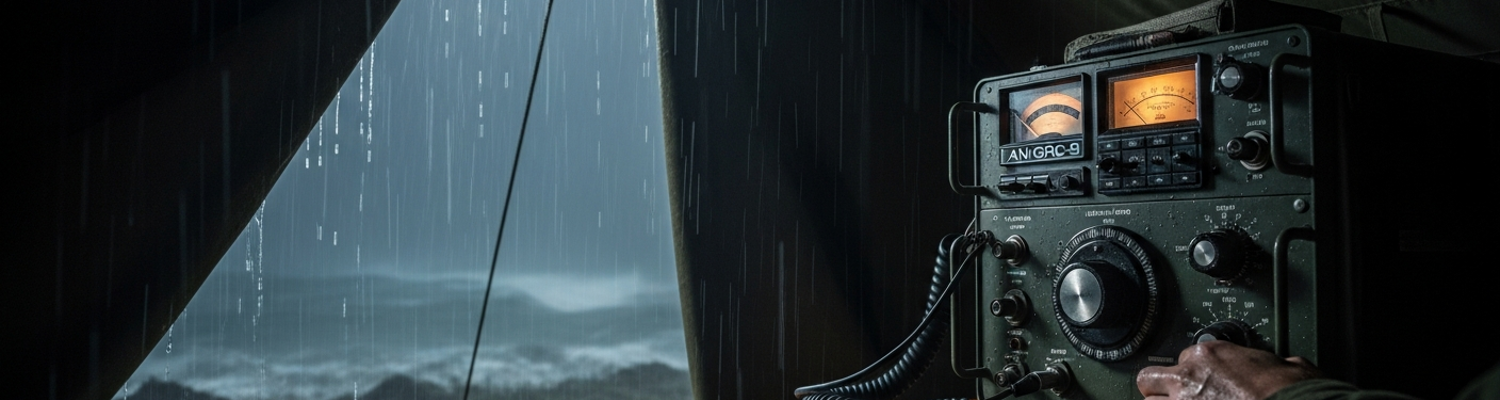
The responsibility for translating the faint signals into a coherent warning fell to a single junior operator, Private First Class Miller of the 307th Signal Battalion. Miller was a recent arrival to the unit, with minimal field experience. His station was not in the primary communications bunker but in a hastily erected satellite tent, equipped with aging backup systems. The instrument at his disposal was a World War II-vintage AN/GRC-9, a radio set known to troops as the Angry Nine. This particular unit was a case study in decay. Archival maintenance requests (Form DA 2404, dated October 1958) document a long and futile battle against the Kure environment. Salt air had eaten away at the radio’s olive drab paint, exposing the steel chassis underneath to a filigree of rust. The primary tuning dial was stiff, its internal grease hardened by a mixture of salt and oxidized metal. Critical components, including the delicate mica capacitors and wire-wound resistors, showed visible signs of corrosion.
Overheating was its most dangerous flaw.
The AN/GRC-9 relied on vacuum tube technology, with the transmitter’s final amplification stage built around a power-hungry 2E22 tube that radiated significant heat. On Kure, where ambient temperatures in equipment tents routinely soared, the radio had no effective way to cool itself. The metal chassis, intended to act as a heat sink, was perpetually warm to the touch. This chronic overheating caused a severe and unpredictable problem. Frequency drift. As the components heated up, their electrical characteristics would change, causing the carefully tuned transmission frequency to wander. For Miller, this meant the radio he was tasked with using was fundamentally unreliable. He could set the frequency to the required channel for contacting the main command hub at Johnston Atoll, but within minutes, or even seconds of keying the transmitter, the heat buildup would push the signal off its designated frequency. The situation was made worse by the failing power source, a hand-cranked GN-58 generator, whose own worn bearings and salt-pitted contacts delivered an inconsistent voltage that only aggravated the radio’s instability.
When the alert order finally came down from the radar van, it was coupled with a terrifyingly brief deadline. The analysis produced an estimated window of just five minutes before the detected object would arrive at the atoll. Five minutes was all Miller had to power up the Angry Nine, fight through its mechanical and electrical deficiencies, and successfully transmit a coded warning burst to Johnston Atoll, over a thousand miles away. Every second of this window was a struggle against failing hardware. Miller first had to connect the GN-58 generator and, with another soldier, begin furiously cranking to produce the multiple voltages required by the GRC-9. As power surged into the radio, he had to select the correct frequency band, physically inserting a plug-in coil assembly for the 7.2 MHz range, then attempt to wrestle the main tuning dial into position. The corroded mechanism fought him, the dial moving in jerky increments rather than a smooth sweep.
He was transmitting blind.
The radio’s own receiver was too unstable from the heat and power fluctuations to reliably monitor his own signal. Miller initiated the transmission, keying the first elements of the three-letter code group. The smell of burning dust and hot metal intensified as the 2E22 tube glowed a dull cherry red through the ventilation grille. A check by a monitoring station on the atoll would have confirmed the signal was a smeared, drifting mess. Recognizing the transmission was failing, Miller resorted to a desperate, physical solution. Bracing the radio with one hand, he began to rhythmically strike the side of the metal case with the insulated handle of a screwdriver. The sharp impacts physically jolted the internal components, momentarily jarring the heat-warped tuning capacitor plates back toward their correct alignment. It was a crude form of mechanical feedback. He timed his Morse code dits and dahs to coincide with the split second after each impact, sending a fragment of the signal each time the drifting frequency passed through the correct channel. Instead of one clean message, he was firing a shotgun blast of broken signal fragments. With less than a minute remaining in the window, after sending the final letter of the code group, the radio gave a final, audible hum and the 2E22 tube went dark, its filament burned out completely.
Static and Civilian Distress
The electronic chaos that engulfed Pfc. Miller’s backup radio tent was not an isolated incident. The 307th Signal Battalion’s after-action reports indicate a near-total breakdown of high-frequency communications across the entire atoll in the minutes following the 02:17 energy spike. The massive radio-frequency discharge from the distant launch created a severe and immediate ionospheric disturbance. This ripple effect violently agitated the atmospheric layer responsible for reflecting long-range radio signals. For the Signal Corps operators in the primary communications bunker, this manifested as a wave of broadband noise that saturated their receivers. The clear hiss of an open channel was replaced by a roar of static, punctuated by sharp, tearing sounds and a deep, oscillating hum. The phenomenon, identified in post-action analysis as a combination of shock-acoustic waves interacting with the D-region ionosphere and severe signal scatter, effectively rendered the HF spectrum unusable. Every attempt to establish a link with Johnston Atoll on the primary frequencies was met with this impenetrable wall of noise.
This atmospheric disruption was made worse by a second wave of interference originating from the atoll itself. The same ionospheric event that blinded the military’s equipment also washed over the makeshift long-wire antennas of the civilian fishing community. Where Specialist Rollins and Kenji Tanaka had experienced a clean, isolated 1.2-second signal burst, the less sophisticated, often poorly shielded homemade radios of the other island inhabitants were completely overloaded. Post-engagement interviews with the civilian population describe a scene of pure auditory chaos. Radios that had been quietly tuned to overseas broadcasts suddenly shrieked with high-pitched carrier tones or produced the rasping, buzzing sound characteristic of a fundamental receiver overload. Lacking the technical understanding to diagnose the event, many believed their sets were exploding. Panic spread instantly through the small community. Within seconds, the single, shared frequency the fishermen used for local coordination was flooded with dozens of simultaneous, panicked transmissions.
Inside the Signal Corps’ main communications bunker, the tactical situation deteriorated. The duty radio operator, a Specialist Fifth Class named Donovan, was confronted with an impossible task. His primary receiver, a more advanced R-390A, was being assaulted from two directions. From the sky came the overwhelming roar of the ionospheric disturbance. Bleeding through from adjacent civilian frequencies was the jumble of overlapping shouts, screams, and terrified questions in Japanese. Standard procedure dictated isolating and filtering out adjacent channel interference. The civilian signals were too strong and too numerous, creating intermodulation that polluted the military channels. Donovan was trying to discern a coherent military signal from a background of atmospheric noise and human distress. His attempts to switch to alternate frequencies were futile. The ionospheric disturbance was too widespread, and on every channel he tried, the faint ghost of the panicked civilian net seemed to follow. The fragmented, desperate bursts from Pfc. Miller’s damaged AN/GRC-9 arrived into this disorienting blend of noise. They were not clear. They were not strong. They were just momentary slivers of coherent Morse code, appearing and disappearing within the larger storm.
Garbled Trajectory and Countermeasure
Operational logs from the Johnston Atoll listening post show the first fragments of Pfc. Miller’s transmission arrived at 02:18 local Kure time. They were not a message. They were electronic ghosts, slivers of Morse code that materialized for fractions of a second inside the ionospheric noise. Signal intelligence technicians, fighting to isolate any coherent data, recorded only partial code groups. The initial log entry notes the characters for T and V, followed by a long burst of static, then a clear 7 and 8, then nothing. Seconds later, a second, weaker fragment registered. It contained the partial group ZI-27. Analysts at the station immediately identified the probable signature of a standard Threat Missile Vector (TMV) warning format. The garbled transmission pointed to a hostile object, but its trajectory was a phantom. The numbers could indicate an altitude, speed, or time-to-impact. Without the complete sequence, they were meaningless. The most significant piece of data was the AZI-27 partial group, which was interpreted as a partial azimuth bearing.
The cone of uncertainty was enormous. The fragmented data suggested a threat approaching from a westerly direction, but the incomplete 27 could mean anything from 270 degrees to 279, or even a bearing ending in 27 like 127 or 327. Each degree of difference represented miles of targeting error at the estimated range. With the five-minute window rapidly closing, the station commander at Johnston made a command decision based on probability. Cross-referencing the partial azimuth with the known direction of the initial 1.2-second energy burst, his team calculated a 70% probability of a 270-degree vector. There was no time to request clarification from the silent operators on Kure. The only option was to transmit a countermeasure directive based on this deeply flawed and incomplete intelligence.
The return transmission from Johnston Atoll to Kure was a desperate gamble against the same atmospheric chaos. Using a high-gain directional antenna, operators sent a coded action order on a loop, hoping a readable fragment would punch through the static. The order was for the immediate activation of Project Starfish, a classified and localized electronic warfare system deployed on the atoll. Archival schematics reveal Starfish was a repurposed naval radar jammer, the AN/ULQ-6, modified for high-power output in a narrow, five-degree beam. Its purpose was to overload the primitive vacuum-tube guidance and proximity-fuze electronics of incoming 1950s-era missiles. The system required a precise bearing. The message from Johnston was simple: ENGAGE STARFISH. BEARING TWO-SEVEN-ZERO. IMMEDIATE. On Kure, the signal was received as an almost unintelligible screech. The duty operator in the main communications bunker, Specialist Donovan, could only discern broken phonetics through the noise. He heard the sound for ISH, then RING, followed by TWO and RO.
The operators on Kure recognized the phonetic for ISH as the likely tail end of Starfish. The word RING was clearly bearing. The final puzzle was the sounds for TWO and RO. Working from the assumption that Johnston was responding to their own fragmented warning, they connected the partial AZI-27 sent by Miller to the sounds they had just received. The logical conclusion, a terrifying leap of faith under extreme duress, was that the bearing was 270. Within seconds, a runner was dispatched from the communications bunker to the Starfish emplacement on the western edge of the atoll’s reef, carrying a scribbled instruction that was itself an interpretation of a garbled echo of a fragmented warning.
The entire defense of Kure Atoll fell to Sergeant Evans and his two-man crew. They were standing on an exposed concrete hardstand next to the Project Starfish emitter. The system was mounted on a manually operated Mark IV naval gun pedestal, its heavy steel components stiff with a patina of salt corrosion. Evans received the runner’s note with less than ninety seconds remaining in the original five-minute window. He and his team threw their weight against the manual traverse wheel, a large, iron crank that resisted with a grating shriek of metal on metal. The bearing indicator, a simple painted dial, crept agonizingly slow toward the 270-degree mark. As one soldier fought the traverse wheel, the other wrestled with the elevation crank, raising the emitter horn to the pre-calculated angle for an incoming sea-skimming trajectory. With the bearing just shy of 270, Evans made a final, granular adjustment. He shouted an order to his man on the traverse wheel, telling him to stop at precisely 271 degrees, a gut-level decision to lead the target by a single degree based on the faint, directional hum he thought he could hear beneath the static. At 02:21 local time, Evans slammed the activation switch. A low hum built to a piercing whine as the system’s magnetron spun up, pouring a focused, invisible beam of high-power microwave energy into the night sky at a bearing of 271 degrees. For three seconds, there was nothing. Then, observers on the atoll saw a brief, faint orange flash in the low-hanging clouds northwest of the island, followed by silence. Post-action analysis determined the missile’s guidance system had been disrupted, causing the onboard proximity fuze to fail and the main airframe to overshoot the atoll, impacting the Pacific Ocean nearly two miles beyond its intended target.