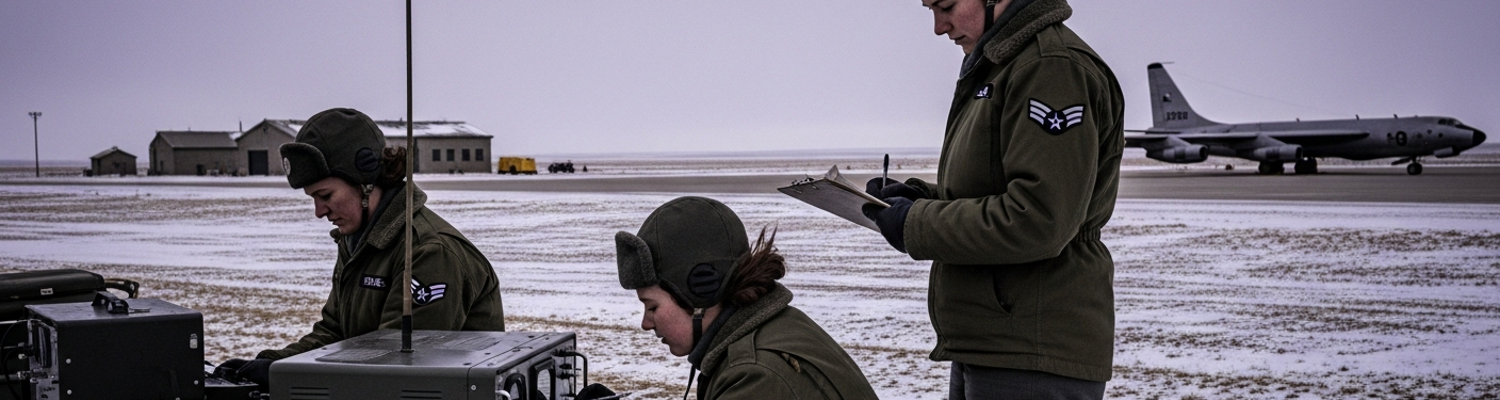

In the shadow of a global war and on the cusp of a new atomic age, the United States reshaped its military establishment. The National Security Act of 1947 severed the air arm from the Army, creating an independent U.S. Air Force, a service born of technology and strategic bombing doctrine. Less than a year later, another foundational shift occurred, one quieter but no less significant. On June 12, 1948, President Harry S. Truman signed Public Law 625, the Women's Armed Services Integration Act. This legislation created a permanent, regular component for women in the armed forces. For the nascent Air Force, this was an opportunity. Unburdened by the long-standing traditions of the Army and Navy, the Air Force leadership, particularly its second Chief of Staff, General Hoyt S. Vandenberg, saw a pragmatic path to securing skilled personnel for the technical demands of the Cold War. The establishment of the Women in the Air Force, or WAF, program was not an act of social engineering. It was a calculated decision rooted in the operational realities of a burgeoning global standoff with the Soviet Union.
The legislative battle for the Women's Armed Services Integration Act was a direct consequence of the post-World War II demobilization. The exemplary service of approximately 350,000 women in auxiliary corps like the Women's Army Corps (WAC) and the Navy's WAVES presented a conundrum for military planners. Their wartime contributions were undeniable, yet the concept of women as a permanent fixture in the peacetime military met with deep-seated cultural and political resistance. Opponents in Congress, such as House Armed Services Committee chairman Walter G. Andrews and the powerful Georgian Carl Vinson, initially fought to relegate women to reserve status only. They argued that a permanent female contingent would erode the masculine identity of the armed forces and create logistical complications. Their arguments reflected a broader societal anxiety about preserving traditional gender roles after the disruptions of the war. However, influential military leaders, including General Dwight D. Eisenhower, countered from a position of stark practicality. They understood that the complexity of a modern, global military required a steady source of intelligent, capable people, a pool that was needlessly halved by excluding women. The Air Force, facing a mandate to build a technologically superior force capable of projecting power across continents, was particularly keen. General Vandenberg, who became Chief of Staff on April 30, 1948, was a key proponent, viewing skilled women as a solution to projected manpower shortfalls in critical technical and administrative fields. The Act, as finally passed, was a hard-fought compromise. It granted women permanent status but imposed severe restrictions. A cap limited the number of women to 2% of the total force in each service. For the Air Force, this meant an initial ceiling of 300 officers and 4,000 enlisted women. The law also established separate promotion lists and placed firm ceilings on the highest ranks women could achieve, effectively barring them from flag officer positions. Critically, it codified combat exclusion clauses, prohibiting women from serving on aircraft or ships engaged in combat missions. It also contained stringent rules regarding dependents, which made continued service difficult for married women and nearly impossible for mothers. Despite these limitations, the Act was a landmark. It cracked open the door to a military career, transforming female service from a temporary wartime measure into a permanent professional option.
The Air Force acted with notable speed. On July 8, 1948, the very first day women were authorized to enlist, Staff Sergeant Esther McGowin Blake raised her hand and took the oath in the office of Major John T. Heston, commander of the new WAF Training Program. A widow who had served in the Army Air Forces during World War II after her pilot son was shot down over Europe, Blake’s enlistment was a powerful symbol. Her motivation during the war had been to free a man for combat duty. Her re-enlistment into the permanent Air Force signaled a new era where female service was an end in itself. She, along with eleven other women who transferred from the Army, became the charter members of the WAF. Basic training for the first WAF recruits began that fall at Lackland Air Force Base in San Antonio, Texas. The 3700th WAF Basic Training Squadron was activated under the command of Captain Frances A. Rumer. The initial environment was challenging. The women were housed in temporary barracks and subjected to a system still figuring itself out. Uniforms, designed by the New York firm of Hattie Carnegie, were often ill-fitting and impractical, made of heavy wool unsuited to the Texas heat. Yet the Air Force, as a new service, proved more adaptable than its sister branches. While the Army and Navy maintained entirely separate command structures and administrative corps for their female components, the Air Force made a pivotal decision. It allowed WAFs to be commanded by male or female officers, provided the unit did not require a rated (flying) officer. This seemingly minor distinction fostered a greater degree of integration from the outset, placing men and women in the same reporting chains and work environments. Initial assignments for WAF personnel were concentrated in traditionally female occupations: clerical, administrative, communications, and medical fields. This was a pragmatic choice, filling essential support roles. It also, however, reinforced societal stereotypes and created friction. Many male airmen, unaccustomed to seeing women in uniform on their bases, viewed the WAFs with skepticism, questioning their competence and their place in a military environment. Early WAFs faced a constant, unspoken pressure to prove their worth. They had to demonstrate not just proficiency in their jobs, but a resilience to the often-hostile climate. Each woman’s performance was scrutinized, their successes and failures reflecting on the entire program.
The outbreak of the Korean War in June 1950 drastically altered the landscape for the WAF program. The rapid mobilization and deployment of forces to the Korean peninsula created significant manpower shortages stateside and in support commands globally. The Pentagon’s need for personnel to fill critical roles suddenly outweighed institutional reluctance. The number of women serving on active duty in the Air Force surged, nearly tripling from around 3,600 to over 9,600 by 1952. The Pentagon did not deploy WAFs to the Korean combat zone, but their contribution was immediate and substantial. They took over thousands of positions in supply depots, communication centers, and administrative headquarters, directly enabling male personnel to be sent to the front. WAFs serving in Japan, the Philippines, and Guam worked in direct support of the war effort, managing logistics, processing casualty reports, and handling intelligence traffic. The Korean War validated the core argument for women’s integration. WAFs served in increasingly technical roles, including air traffic control, weather forecasting, parachute rigging, and intelligence photo analysis. Their performance in these demanding jobs demonstrated that their capabilities extended far beyond the initial clerical assignments. This operational success began to erode the skepticism within the male-dominated command structure. The Air Force, more so than the Army or Navy, was a technocracy. It valued competence and results. The demonstrated skill of WAF personnel during a major conflict provided undeniable evidence of their value. This period of intense operational tempo forced a level of inter-service cooperation, but also highlighted different philosophies. The Air Force’s relatively faster integration of women into a wider variety of non-combat roles stood in contrast to the more rigid structures of the older services, cementing its reputation as the most progressive branch on gender issues at the time.
The performance of the WAFs during the Korean War set the stage for decades of gradual, hard-won progress. The Cold War’s long twilight demanded a large, professional, and technically proficient military, and women had proven they were essential to that equation. Throughout the 1950s and 1960s, career fields for WAFs steadily expanded. Their presence became normalized across Air Force bases worldwide, from the continental United States to outposts in Europe and the Pacific. A significant legal barrier fell in 1967 when President Lyndon B. Johnson signed Public Law 90-130. This legislation removed the 2% cap on female personnel and lifted the restrictions on promotions to general officer ranks. This was a direct result of two decades of consistent performance and the advocacy of leaders who had risen through the WAF ranks. The most prominent of these was Jeanne M. Holm. A veteran of the Women’s Army Auxiliary Corps, Holm transferred to the Air Force in 1948 and became the Director of the WAF in 1965. During her tenure, she was a relentless force for change. She methodically dismantled discriminatory policies, opened up nearly all non-combat career fields to women, and pushed for their admission into ROTC and officer training programs on an equal footing with men. Her efforts culminated in her promotion to Brigadier General on July 16, 1971, making her the first female general in the Air Force. She was promoted again to Major General in 1973, the first woman in any U.S. service to hold that rank. Holm’s career embodied the success of the WAF program. Her rise was proof that women could lead at the highest levels. The logical endpoint of this progress was the dissolution of the WAF program itself. By the mid-1970s, the idea of a separate corps for women had become an anachronism, a barrier to true equality. In 1976, the Air Force officially disbanded the WAF and began accepting women on an equal basis with men, fully integrating them into the main force structure. The same year, the U.S. Air Force Academy admitted its first female cadets. The WAF program, born of necessity and constrained by compromise, had successfully argued for its own obsolescence. It served as the critical, transitional framework that allowed thousands of women to demonstrate their value, challenge prejudices, and fundamentally reshape the United States Air Force into a more capable and equitable institution.