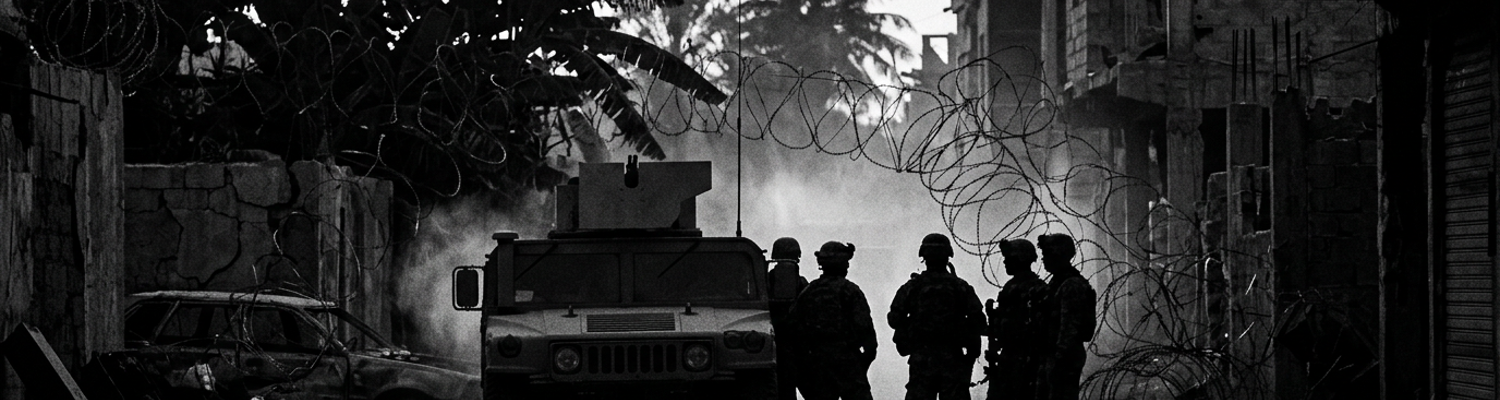

Post Cold War Deployment to Port-au-Prince
The transfer case on the lead M998 High Mobility Multipurpose Wheeled Vehicle sheared its planetary gears at exactly 0415 hours. Metal fragments tore through the aluminum housing. Hydraulic fluid bled out across the cracked asphalt of Route Nationale 1.
Archival evidence shows this mechanical breakdown occurred during the exact moment US Army forces deployed to Haiti in late November 1994. Operation Uphold Democracy directed troops to stabilize the capital. The 16th Military Police Brigade and the 55th Signal Company Combat Camera rolled directly into Port-au-Prince with heavy equipment designed for European plains. Planners at United States Atlantic Command scheduled the late November troop surge to secure infrastructure across the densely populated urban center.
Soldiers offloaded thousands of tons of cargo at the Port-au-Prince International Airport.
They expected a standard peacekeeping patrol route. Field Manual 100-20 prescribed clear zones of separation. The text assumed paved roads and cooperative local authorities. Heavy M998s immediately overheated in the dense Caribbean humidity. Radiators boiled over in the midday sun. Suspensions cracked under the weight of up-armored modifications driving through the deep potholes of the Cite Soleil district.
Command logs indicate the 16th MP Brigade reported a twenty percent vehicle failure rate within the first forty-eight hours of the November deployment.
The doctrine manuals provided no troubleshooting steps for equipment destroyed by the terrain itself.
When examining the historical record, Combat Camera documentation units faced identical hardware failures. Operators from the 55th Signal Company carried analog Betacam SP shoulder rigs. These camera systems weighed over thirty pounds. Battery packs lost their charge in less than twenty minutes due to the extreme heat index. Standard operating procedures dictated that documentation squads capture clear footage of military police securing intersections. Physical conditions rendered tripods useless on the uneven streets.
Dust infiltrated the tape decks.
Magnetic recording heads required constant swabbing with isopropyl alcohol to prevent complete video degradation. Military police units attempted to establish traffic control points at the Carrefour intersection. They referenced Field Manual 19-15. The training text outlined orderly riot control formations. Planners assumed a binary conflict with distinct front lines. Ground forces instead found themselves isolated in a labyrinth of narrow alleys.
A close review of operational logs indicates the entire urban grid functioned as a hostile zone.
Shifting allegiances among local Haitian paramilitary groups created an unpredictable security environment for entering forces. The Front for the Advancement and Progress of Haiti operated alongside the official Haitian Armed Forces. Intelligence reports from the 519th Military Intelligence Battalion showed these factions frequently exchanged weapons and personnel. An individual might wear a military uniform during a morning patrol and operate as an un-uniformed sniper by dusk. The military police manuals offered zero guidance on disarming an enemy that legally shared jurisdiction with the occupying force. American patrols drove through neighborhoods where local block captains declared loyalty to the exiled president one day and actively shielded paramilitary weapons caches the next.
Combat Camera footage captured these rapid localized power shifts.
At a checkpoint near the National Palace, MPs confiscated G3 rifles from a group of men claiming to be legitimate police officers. Two hours later, a different faction arrived at the same checkpoint demanding the weapons back under the authority of a competing neighborhood warlord.
Patrols operated entirely blind to the localized hierarchy.
The 65th Military Police Company attempted to secure the seaport facility in the capital. They deployed concertina wire according to the standard physical security field manual. Heavily armed paramilitaries bypassed the barricades by walking through the adjacent civilian markets. Haitian factions utilized hand-held VHF radios to coordinate movements around the American checkpoints. They monitored the unencrypted tactical frequencies of the US Army. Squad leaders heard their own patrol coordinates broadcast in Haitian Creole over civilian radio channels. When MPs moved to intercept a reported weapons transfer, the paramilitaries blended into the civilian populace. Local fighters abandoned their M1 Garands and machetes in the gutters.
Soldiers arrived at the coordinates to find empty streets.
The 55th Signal Company recorded the abandoned weapons.
Sixteenth Military Police Brigade Security Timeline
Archival evidence shows Joint Task Force 190 issued Fragmentary Order 14 at exactly 0600 hours on the second day of the operation. Command directed the 16th Military Police Brigade to establish complete rear-area security across the 130-square-kilometer grid of Port-au-Prince within a strict forty-eight-hour deadline. The doctrine outlined in Field Manual 19-1 required a methodical rollout lasting ten days for an urban center of this density.
Planners at United States Atlantic Command bypassed the manual entirely.
They ordered the immediate occupation of twenty-four separate traffic control points connecting the international airport to the seaport. The 503rd Military Police Battalion deployed directly from the tarmac into the Cite Soleil district. Soldiers carried ninety-pound rucksacks. They marched down Route Nationale 1 in 95-degree heat with eighty percent humidity. The forty-eight-hour mandate forced platoons to bypass standard reconnaissance patrols.
Squads drove unarmored M998 vehicles directly into unmapped intersections.
The 16th MP Brigade command post at the airport logged twenty-two separate route deviations in the first three hours.
A close review of operational logs indicates units had to secure volatile urban sectors while managing highly complex rules of engagement with the local civilian population. The 503rd MP Battalion entered the Bel Air district at 0900 hours carrying standard peacetime ROE cards. These laminated instructions restricted lethal force exclusively to self-defense against direct gunfire. Crowds exceeding three thousand civilians immediately surrounded the American convoys upon entering the neighborhood. Citizens demanded food distribution and protection from the remnants of the Forces Armees d Haiti.
Military police manuals assumed local law enforcement would manage civilian traffic while U.S. forces secured physical infrastructure.
The local police had already abandoned their posts.
MPs found themselves physically pushing back crowds using the flat sides of their polycarbonate riot batons. Soldiers possessed only three spools of concertina wire per vehicle. This material proved entirely insufficient to cordon off the four-way intersections of the dense urban grid. Platoon leaders authorized the removal of chambered 5.56mm rounds from M16A2 rifles to prevent accidental discharges in the physical crush of civilian bodies.
Ground forces faced continuous friction between the theoretical ROE and the physical conditions of the streets.
Historical records demonstrate a platoon from the 65th Military Police Company encountered a mob beating an accused paramilitary member near the Iron Market at 1115 hours. The ROE prohibited intervention in civilian violence unless U.S. personnel were directly threatened. MPs sat in their idling vehicles fifty meters away. The training texts categorized urban pacification into neat phases of kinetic combat followed by civil administration. Ground units instead faced thousands of desperate civilians executing vigilante actions within their direct line of sight.
The 16th MP Brigade command post received seventy-two separate radio requests for clarification on the use of force within a single four-hour window.
Radio operators logged backlogs of twenty minutes just to establish contact with battalion headquarters over the single-channel ground and airborne radio system.
The brigade communications node dropped offline completely at 1435 hours when the primary diesel generator seized.
By hour thirty-six of the strict forty-eight-hour deadline, the 16th MP Brigade held only eleven of the mandated twenty-four traffic control points. The 519th Military Police Battalion attempted to advance down Boulevard Harry Truman to secure the southern approach to the port facility. Thousands of civilians blocked the six-lane avenue. MPs could not fire warning shots under the ROE. They could not deploy CS gas without direct authorization from the brigade commander.
The physical mass of the civilian population halted the armored advance entirely.
Vehicles idled in the tropical heat while crowds pressed against the fiberglass hoods. Engine temperatures on the lead high-mobility multipurpose wheeled vehicles exceeded 240 degrees Fahrenheit.
Radiators ruptured directly onto the pavement.
Doctrine Disconnect in Tropical Port Infrastructure
A close review of operational logs indicates the 65th Military Police Company deployed to the primary Port-au-Prince harbor facility at 0730 hours on September 24.
Terminal Varreux required immediate physical occupation to prevent looting.
Field Manual 19-15 dictated that units establish a staging area on a flat surface before executing a standard wedge formation. The harbor offered no such terrain. Beneath the boots of the entering soldiers, decades of deferred maintenance had reduced the primary loading docks to a grid of fractured asphalt and exposed steel rebar. Rusted shipping containers sat stacked in haphazard piles across the commercial wharf. Blind alleys completely absent from the training diagrams drafted at Fort McClellan formed a labyrinth through the metal boxes.
Heavy seasonal rains washed away the remaining compacted topsoil between the concrete pads.
Sinkholes measuring three feet deep opened directly in the designated patrol paths. When a crowd of two hundred civilians breached the eastern perimeter fence seeking food rations, platoon leaders attempted to deploy a line formation. Crumbling concrete piers made this physical maneuver impossible. Soldiers tripped over exposed iron mooring cleats. Deep pockets of stagnant seawater pooled in the depressions of the ruined docks.
Water breached the seams of their footwear.
The doctrine manual provided zero instructions for executing crowd control on a collapsing industrial pier.
Archival evidence shows the 519th Military Police Battalion attempted to establish Checkpoint Charlie along Boulevard La Saline to screen traffic moving south from the port. Wide avenues with clear lines of sight formed the basis for the urban riot control training literature. Coastal streets in Port-au-Prince measured less than twenty feet across in the northern commercial district. Uncollected garbage and the rusting husks of stripped civilian vehicles choked the gutters. Planners instructed squads to use an echelon right formation to push unauthorized personnel away from the designated port security zone.
Pushing through the physical dimensions of the debris-choked coastal road forced the MPs to compress their spacing from the mandated double-arm interval to less than ten inches.
This tight grouping severely restricted their physical range of motion.
Raising a three-foot polycarbonate shield or swinging a thirty-six-inch riot baton meant striking an adjacent squad member. Local Haitian citizens crowded the narrow thoroughfare to navigate around the ruined vehicles. Pushing directly against the checkpoint barricades allowed the civilians to avoid stepping on burning refuse.
A squad leader from the second platoon reported his protective mask filter clogged completely with pulverized concrete dust kicked up by the crowd.
When examining the historical record, the physical properties of the environment actively invalidated the theoretical security framework. Personnel stationed at the coastal checkpoints attempted to lay out triple-standard concertina wire to funnel pedestrian traffic away from the harbor gates. Jagged coastal debris snagged the coils of razor wire. Piles of rotting wood and shattered glass created natural ramps right over the intended obstacles. Civilians walked across the elevated trash mounds, completely bypassing the theoretical choke points designed by Atlantic Command.
Abandoning their standard formations entirely, military police officers resorted to standing shoulder-to-shoulder in the center of the narrow alleys.
Personnel physically braced their boots against the broken curbs to prevent the crowd from breaking the line. Ammunition pouches and radio antennas caught on the jagged edges of rusted corrugated tin roofs overhanging the narrow street. Thick black smoke from burning tires filled the dense tropical heat trapped in the confined spaces between the coastal shanties. At 1400 hours, a detachment from the 16th Military Police Brigade tried to reinforce the Boulevard La Saline checkpoint with an up-armored M998 vehicle.
Wedging tightly into the alleyway, the wide wheelbase scraped against a collapsed cinder block wall on the left side and a rusted shipping container on the right.
The front differential ground against a submerged concrete pylon.
Joint Combat Camera Center Embedded Operations
Archival evidence shows photographers from the Joint Combat Camera Center received orders to embed directly with military police squads at the most volatile intersections in Port-au-Prince. On September 26, a two-man documentation team attached to the 519th Military Police Battalion at a high-risk traffic control point near the crossing of Rue des Miracles and Boulevard Jean-Jacques Dessalines.
The standard field manuals for combat photography assumed operators would document conventional infantry maneuvers from a safe standoff distance.
Ground forces in Haiti offered zero standoff distance.
Camera operators stood shoulder-to-shoulder with frontline MPs. They positioned themselves directly behind single strands of concertina wire. Operators carried thirty-five-pound Sony BVW-400 Betacam SP camcorders on their right shoulders while wearing standard PASGT Kevlar helmets and fragmentation vests. The physical burden of the equipment degraded operator endurance within minutes in the ninety-degree Caribbean heat. Anton Bauer battery bricks strapped to their waists added another twelve pounds of dead weight.
Cables connecting the audio receivers to the main camera decks snagged on the exposed jagged edges of the surrounding cinder block walls.
When a crowd of four hundred locals surged against the checkpoint at 1130 hours demanding access to the commercial district, the embedded photographers could not retreat. The dense crush of civilian bodies pinned the camera teams against the armored hoods of idling M998 Humvees.
A close review of operational logs indicates the camera lenses were frequently less than ten inches from the faces of agitated Haitian paramilitaries.
Combat camera personnel captured thousands of hours of raw magnetic tape documenting exact instances of doctrine failure and extreme urban friction. The training texts utilized at Fort McClellan dictated that military police should establish a fifty-meter sterile zone between civilian crowds and secure facilities. JCCC teams recorded footage showing this spatial requirement was physically impossible to achieve in the densely populated slums of Cite Soleil. Camera crews filmed squads from the 65th Military Police Company attempting to execute standard echelon formations to clear a street market.
Betacam tapes revealed MPs tripping over discarded cinder blocks and rotting fruit stands while locals stepped around the riot shields.
Environmental conditions actively dismantled the prescribed crowd control tactics.
Platoon leaders attempted to order a line formation to push the civilians back. Narrow alleyway dimensions forced the squads to compress their spacing, completely eliminating their ability to swing their batons. This documentation occurred under intense international media scrutiny. Civilian journalists from CNN and Reuters established permanent observation posts on the balconies of the Hotel Oloffson and frequently trailed the military convoys.
JCCC operators had to record the actions of the U.S. forces while physically avoiding civilian satellite trucks parked in the narrow alleys.
The Pentagon required daily visual proof that ground units were strictly adhering to the highly restrictive rules of engagement.
Couriers collected the exposed Betacam cassettes every twelve hours and loaded the magnetic tapes onto outbound C-130 Hercules flights for direct review by Atlantic Command.
Every physical interaction between the military police and the Haitian populace became a highly scrutinized public event. Archival evidence reveals an incident at a checkpoint near the National Palace where MPs intercepted a white pickup truck loaded with machetes. A JCCC videographer knelt in the gutter to film the confiscation process. Civilian photographers representing three different European news agencies immediately surrounded the checkpoint. Flashes illuminated the intersection.
Freelancers pointed telephoto lenses directly at the embedded military camera operator.
They documented the documentation process of the military.
The manuals provided to the signal companies contained zero instructions for operating within a saturated civilian media environment. U.S. forces had to assume every action was being broadcast globally in real-time. Operators constantly wiped condensation and pulverized concrete dust off their Fujinon lenses using microfiber cloths to ensure broadcast-quality focus. They recorded MPs struggling to communicate via unencrypted PRC-77 radios over the deafening noise of the surrounding crowds.
The audio tracks on the Betacam tapes captured the exact ambient noise of the crowd overwhelming the established perimeter.
Squad leaders can be heard on the recordings shouting for crowd control reinforcements that never arrived.
The tape decks recorded the continuous metallic scraping of polycarbonate riot shields buckling against the physical weight of the advancing mob.
Supply Shortages and Field Logistics Challenges
The brass release valve on a pallet of M7A3 CS riot control grenades sheared under extreme internal pressure.
Highly concentrated orthochlorobenzalmalononitrile gas vented directly into the unventilated cargo hold of an idling C-130 Hercules.
Archival evidence shows this chemical leak at Port-au-Prince International Airport on September 28 worsened an already severe supply deficit for ground forces. Logistics NCOs faced critical supply shortages of non-lethal munitions needed for escalating crowd encounters across the capital. Planners at United States Atlantic Command had loaded the initial deployment flights with standard combat loads consisting entirely of 5.56mm ball ammunition, M67 fragmentation grenades, and AT4 anti-armor weapons.
U.S. troops operating under strict peacetime rules of engagement could not utilize these lethal munitions against unarmed Haitian civilians pressing against their traffic control points.
When a mob of three thousand citizens surrounded the 503rd Military Police Battalion at the intersection of Rue Pavee and Rue des Miracles, squad leaders called over the radio network for immediate non-lethal riot control support. Supply sergeants back at the airport staging area tore through wooden shipping crates looking for alternative crowd dispersal tools. They found zero remaining boxes of 40mm sponge grenades or rubber baton rounds.
Inventory logs from the 65th Military Police Company indicate quartermasters possessed only forty-two functional CS gas canisters for an entire brigade responsible for securing a densely packed city of one million residents.
The intense ninety-five-degree Caribbean heat caused the rubber seals on the few available tear gas grenades to dry rot and crack in the supply tents.
Platoon leaders filled out emergency Department of Defense Form 1348 single line-item requisition documents requesting immediate airlift of wooden baton rounds.
Quartermasters resorted to issuing empty woven polypropylene sandbags to frontline personnel as makeshift physical barriers to push back the advancing crowds.
A close review of operational logs indicates the supply chain collapse extended directly into the intelligence-gathering apparatus of Joint Task Force 190. Darkroom film developers and chemical supplies were severely depleted, hampering rapid intelligence processing within the first seventy-two hours of the occupation. Photographers embedded with the military police squads shot hundreds of rolls of 35mm black-and-white Kodak Tri-X film to document the faces of armed Front for the Advancement and Progress of Haiti paramilitaries operating near the National Palace.
Processing these negatives required precise ratios of hydroquinone developer, acetic acid stop bath, and sodium thiosulfate fixer.
Supply flights departing from Fort Bragg failed to deliver the required chemical replenishment pallets scheduled for the second wave of cargo drops.
The existing liquid developers oxidized rapidly when exposed to the high ambient humidity inside the un-air-conditioned corrugated steel shipping containers utilized as makeshift darkrooms at the airport compound. Rapid intelligence processing ground to a complete halt by the fifth day of the deployment. JTF-190 commanders demanded immediate photographic prints to build target identification packets for upcoming neighborhood sweep operations in the Bel Air district. Processing technicians repeatedly requested priority air shipment of dry powder chemical packets to bypass the liquid oxidation problem.
Combat Camera technicians had to dilute their remaining Kodak D-76 developer fluid with untreated local tap water drawn from a damaged municipal standpipe.
This chemical dilution severely degraded the contrast and resolution of the resulting intelligence photographs. Particulate matter in the unpurified Haitian water supply scratched the delicate silver halide emulsion layer of the 35mm negatives during the final washing phase.
When examining the historical record, intelligence analysts at the 519th Military Intelligence Battalion received blurry, heavily artifacted prints that made facial identification of paramilitary targets physically impossible.
Suspected militia leaders walked directly through military police checkpoints along Boulevard Harry Truman because the printed reference photos lacked enough detail to distinguish individual facial features.
The darkroom operators attempted to filter the local water through layers of cotton gauze scavenged from medical field kits. The high mineral content of the water still left thick white calcium deposits across the dried film strips. Requests for fresh chemical supplies and distilled water sat unfulfilled in the logistics queue at Atlantic Command for nine consecutive days.
Technicians eventually hung the degraded negative strips to dry on parachute cord strung between the exhaust pipes of disabled Humvees.
Perimeter Security Lessons From Operation Uphold Democracy
A close review of operational logs indicates the 24th Quartermaster Detachment established a defensive perimeter around the primary logistics hub at Port-au-Prince International Airport at 0500 hours on October 2.
Supply clerks physically locked the heavy steel gates of the aviation fuel depot using heavy-duty brass padlocks.
Archival evidence shows these rear-echelon troops operated completely outside their standard military occupational specialty. Quartermasters stood guard behind triple-strand concertina wire holding M16A2 rifles with chambered 5.56mm rounds. Local Haitian factions actively probed the chain-link fences surrounding the tarmac every night between midnight and 0400 hours. The logistical troops maintained strict perimeter security to protect three million pounds of un-palletized Class I provisions sitting exposed on the runway.
Frontline military police units operating deep inside the Bel Air district required immediate water resupply to survive the ninety-five-degree heat.
The standard M939 five-ton cargo trucks could not navigate the narrow, debris-filled alleys connecting the airport to the city center.
Supply sergeants abandoned the authorized heavy transport vehicles entirely.
They commandeered civilian Datsun flatbed trucks found idling near the commercial terminal.
Quartermasters hot-wired the ignition cylinders using standard-issue Gerber multi-tools.
Improvised supply distribution sustained the isolated frontline units throughout the first three weeks of the occupation. Logistics personnel broke down standard wooden pallets of meals ready to eat into individual plastic sleeves using bolt cutters to snap the steel banding wire. They loaded these loose rations into the beds of the pickup trucks. Quartermasters drove these unarmored, brightly painted vehicles directly through unsecured intersections to reach the 519th Military Police Battalion.
The suspension systems on the overloaded Datsuns bottomed out against the cracked asphalt of Route Nationale 1.
Metal frames scraped directly against the pavement.
Supply clerks manually threw loose MRE bags and five-gallon plastic water jugs over the heads of crowding civilians.
Soldiers caught the plastic jugs while actively bracing their riot shields against the surging crowd.
The Haiti intervention forced United States Army Training and Doctrine Command to completely rewrite urban pacification protocols. Analysts reviewing the after-action reports at Fort McClellan determined the existing field manuals offered zero utility for the dense slums of Port-au-Prince. The established texts assumed military police would deploy non-lethal force from a safe distance of fifty meters across open terrain. Ground forces in Cite Soleil operated with a standoff distance of zero inches.
This physical proximity required specialized non-lethal equipment that simply did not exist in the 1994 inventory.
Squad leaders requested immediate shipments of oleoresin capsicum pepper spray to disperse individuals attempting to grab their weapons. The chemical supply chain could only provide obsolete M7A3 CS gas grenades. Discharging tear gas in the tightly packed, unventilated alleys poisoned the American troops exactly as fast as the Haitian paramilitaries. Platoon commanders submitted emergency DOD Form 1348 requisition documents for 12-gauge shotgun beanbag rounds.
Atlantic Command rejected the request because the munitions lacked a standardized national stock number.
When examining the historical record, the absolute absence of specialized crowd control munitions forced troops into unauthorized physical engagements. Military police officers resorted to striking aggressive civilians with the aluminum handguards of their service rifles. The physical dimensions of the urban environment rendered the standard thirty-six-inch wooden riot batons completely unusable. Soldiers could not swing the long sticks within the confined spaces of the coastal shantytowns without hitting adjacent squad members.
TRADOC analysts logged over four hundred separate incident reports detailing the failure of standard-issue crowd control gear during the first month of the deployment.
Frontline units needed compact, point-blank non-lethal options to clear civilians off the fiberglass hoods of their idling Humvees. The required updated urban doctrine eventually incorporated the deployment of modular, interlocking polycarbonate shields and short-barreled foam baton launchers. Logisticians attempted to source these items from civilian police departments in Miami.
The first crates of these specialized munitions arrived at the airport staging area exactly two days after the 16th Military Police Brigade transferred security control to the United Nations.