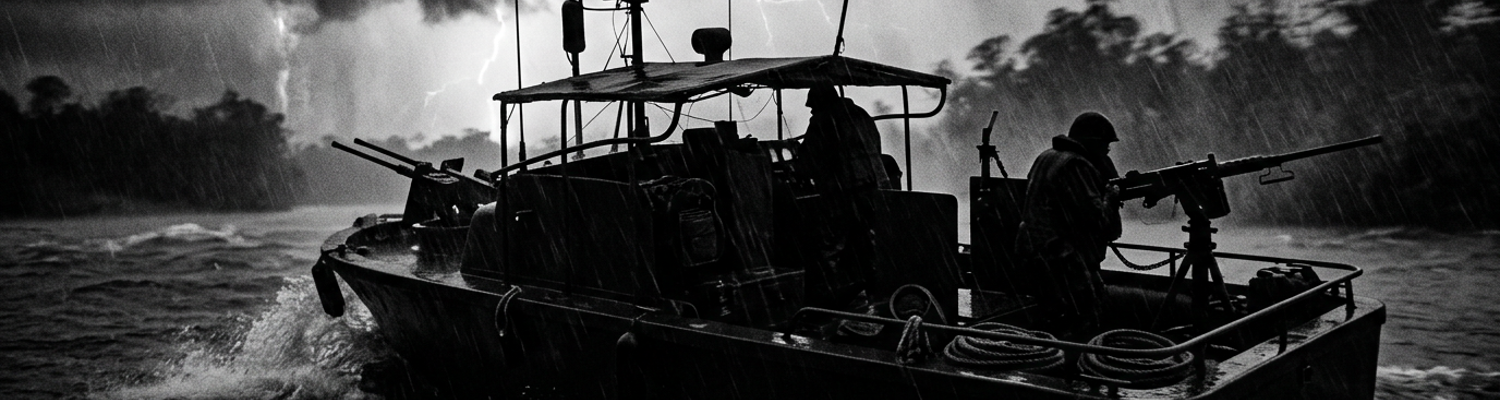

Pre-Typhoon Riverine Deployment and Mechanical Vulnerabilities
Archival records indicate that commanders at Binh Thuy Air Base received a seventy-two-hour mandate to secure seventy miles of the Bassac River before Typhoon Kate made landfall. The meteorological clock started ticking at 0400 hours on October 15. Rear Admiral Norvell G. Ward directed Task Force 116 to deploy units into the primary distributary channels. Operations officers calculated fuel burn rates, tidal charts, and enemy ambush probabilities within a three-hour planning window.
Barometric pressure dropped rapidly across the delta.
The impending storm surge threatened to raise water levels by eight feet and flood the primary staging areas. Sector commanders ordered all available assets to establish blocking positions at major river intersections. The objective was intercepting Viet Cong supply sampans before the typhoon grounded all close air support. Helicopters from the Seawolves detachment were already grounded due to high crosswinds.
The operation commenced with zero margin for mechanical error.
Post-action reports detail that the deployment of U.S. Navy Patrol Boat River craft along the Bassac River exposed severe equipment vulnerabilities. The thirty-one-foot Mark I PBRs relied on twin Detroit Diesel 6V53N engines paired with Jacuzzi 14J water jet pumps for propulsion. These jet drives inhaled dense mats of water hyacinths and thick river mud near coordinates 10 01 N 105 46 E. Engines overheated within minutes when debris blocked the cooling water intakes.
Sailors leaned over the fiberglass transoms to manually clear the impellers with specialized hooks.
They took small arms fire from the dense Nipa palm foliage lining the banks while exposed. Command decisions from River Patrol Squadron 5 ordered crews to maintain a speed of twenty-five knots to outrun rocket-propelled grenades. Running at maximum RPMs caused the ceramic seals inside the water pumps to crack under the extreme pressure. The quarter-inch fiberglass hulls offered no ballistic protection against armor-piercing rounds. Crews relied on heavy ceramic armor plates bolted exclusively around the coxswain station and the forward gun tub. Forward gunners operated twin M2HB .50 caliber machine guns that frequently suffered from double-feed malfunctions due to the high humidity swelling the ammunition belts.
Gunners mates stripped jammed weapon systems on slick decks.
Embedded within these four-man crews were enlisted sailors from the Pacific Fleet Combat Camera Group. Documenting riverine operations required personnel to operate heavy mechanical equipment while fully exposed to hostile action. Photographers Mates carried spring-wound Bell and Howell 70-DR 16mm motion picture cameras and heavy metal Nikon F 35mm still cameras.
They hand-cranked the motion picture cameras after every twenty-two seconds of footage.
Changing one-hundred-foot spools of Kodak Tri-X reversal film meant opening the camera body in direct rain. Saltwater spray and river water instantly degraded the film emulsion. Photographers lacked waterproof housings for their primary lenses and relied on makeshift solutions to keep their gear functional.
Neoprene weather seals dissolved rapidly in the tropical heat.
Archival footage from the Bassac River patrols exhibits heavy grain and light leaks caused by water penetrating the film magazines. The Navy Photographic Center in Washington demanded continuous coverage of Operation Game Warden for tactical analysis. Combat photographers wrapped their metal camera bodies in standard-issue olive drab towels and plastic ration bags to prevent corrosion from the brackish water. When the PBRs executed high-speed turns to evade incoming mortar rounds, the photographers braced themselves against the radar mast with one arm. They manually adjusted aperture rings and focus distances with their free hand while the boat slammed into two-foot river swells. A standard combat loadout included twenty rolls of film stuffed into canvas ammunition pouches.
The brass film canisters oxidized within hours of exposure to the riverine environment.
Upon returning to Binh Thuy, these technicians developed the exposed negatives in mobile darkrooms using chemical baths contaminated by the rising floodwaters.
Meteorological Impact and Hydrological Clashes
Meteorological data from the Joint Typhoon Warning Center confirms that Typhoon Kate struck the Mekong Delta on October 28, 1970. The storm system made direct landfall at coordinates 9.18 N, 105.15 E near the Ca Mau Peninsula before tracking northwest across the primary river networks. Sustained surface winds reached ninety-five knots.
Gusts exceeded one hundred and ten knots.
Barometric pressure plummeted to 972 millibars within a four-hour window. This drew a ten-foot storm surge from the South China Sea directly into the shallow coastal estuaries. Base commanders at the Dong Tam naval facility watched early warning radar screens white out completely from heavy precipitation clutter at 0630 hours. High-frequency communication antennas snapped off their concrete moorings. The physical infrastructure supporting the riverine fleets sustained immediate damage. Corrugated steel roofs tore away from the maintenance sheds and crashed into the drydocks.
Power grids across the entire IV Corps Tactical Zone failed simultaneously at 0714 hours.
Navigation logs demonstrate River Division 535 patrol boats faced high-surf conditions on swollen waterways as the tidal surge pushed inland. These units operated near the mouth of the Co Chien River when the ocean swell collided with millions of gallons of downstream floodwater. The resulting hydrological clash generated chaotic, multidirectional waves exceeding eight feet in height within the confined river channels. Standard operating procedures dictated that the thirty-one-foot Mark II PBRs avoid operating in sea states above four feet.
Not by choice. By direct order.
Coxswains physically wrestled the helms to keep their fiberglass bows pointed directly into the oncoming swells to prevent capsizing. The twin Detroit Diesel 6V53N engines operated at maximum RPMs just to maintain steerageway against the twelve-knot opposing currents. Heavy brown water smashed against the flat transoms and flooded the engine compartments faster than the mechanical bilge pumps could expel it.
Heavy seawater repeatedly breached the forward gun tubs and submerged the ammunition lockers.
Enlisted combat photographers assigned to document River Division 535 operations fought for survival alongside the boat crews. Operating heavy Bell and Howell 70-DR cameras required two hands, leaving the photographers completely unanchored on the slick, pitching decks. The high-surf conditions threw the ninety-pound camera equipment boxes across the coxswain flat. Uprooted Nipa palms and entire submerged tree trunks swept down the waterways at high velocities. They struck the quarter-inch fiberglass hulls with thousands of pounds of kinetic force. When a submerged log struck a PBR port side, the impact sheared the protective grating off the Jacuzzi 14J water jet intakes. The jet drives instantly sucked in heavy debris and mud.
Port engine temperature gauges spiked past two hundred and forty degrees Fahrenheit.
Mechanics crawled into the flooded bilges with heavy wrenches to manually clear the intake grates while the boat rolled violently at forty-degree angles.
Saltwater intrusion shorted out the alternator belts and disabled the primary PRC-77 radio transmitters.
Without radio contact, the isolated units of River Division 535 relied entirely on dead reckoning navigation through the blinding rain. Visibility dropped to less than fifteen yards. The forward gunners strapped themselves to the mounts of their twin M2HB .50 caliber machine guns using heavy nylon cargo straps to avoid being washed overboard. Rainwater filled the open barrels of the weapons. The crews threw their heavy ceramic body armor plates onto the deck to lower the center of gravity and provide emergency ballast against the shifting floodwaters. A continuous stream of river debris slammed into the starboard hydro-jet deflectors.
Steering nozzles bent three degrees off their factory alignment.
Equipment Degradation Under Monsoon Conditions
Supply manifests from October 1970 reveal that personnel from the Pacific Fleet Combat Camera Group attached to River Division 535 attempted to document the tactical chaos near coordinates 9 45 N 105 30 E. Precipitation from Typhoon Kate drove horizontally across the Bassac River at ninety-five knots. This intense deluge reduced visual range to less than ten yards. Forward gunners could not see the riverbanks. Photographers Mates standing on the aft engine covers of the Mark II PBRs found their viewfinders completely useless. The optical glass on their Bell and Howell 70-DR 16mm motion picture cameras immediately fogged over as the ambient temperature dropped and relative humidity spiked to one hundred percent.
Rainwater forced its way into the unsealed objective lenses.
The internal lens elements separated as the optical cement dissolved under the continuous saltwater barrage. Technicians attempted to wipe the glass clear using standard-issue olive drab towels. The cloth was already saturated with brackish river water and diesel fuel.
Every wipe smeared a thick layer of oily residue across the optics.
Engineering assessments from Binh Thuy Air Base show that mechanical equipment degradation accelerated rapidly within the first hour of the storm surge. The titanium foil shutter curtains inside the Nikon F 35mm still cameras bent and jammed in their tracks when heavy water drops struck the exposed focal plane. Photographers manually cranked the film advance levers. The internal gears seized as river silt bypassed the standard rubber O-rings. Command directives from the Navy Photographic Center required visual confirmation of Viet Cong bunker complexes destroyed along the shoreline (NARA Record Group 338). Fulfilling this order meant leaning out over the gunwales while the thirty-one-foot boats pitched violently in the eight-foot swells. The operators held the heavy metal camera bodies steady without the use of tripods or stabilizing mounts. Salinity from the ocean surge corroded the brass aperture rings within twenty minutes of exposure. The internal spring mechanisms responsible for returning the camera mirrors to their resting positions rusted solid.
Focus helicoids locked permanently in place.
Frontline documentation teams lacked dedicated waterproof housings. Naval procurement offices in Saigon prioritized heavy-duty Plexiglas underwater casings for SEAL teams and explosive ordnance disposal units. Combat photographers assigned to the riverine patrols received only thin plastic bags and rubber bands to protect their primary recording devices. These makeshift barriers tore instantly when snagged on the sharp edges of the PBR radar masts or the M2HB machine gun mounts. The neoprene weather seals installed on the camera backs compressed and failed under the extreme barometric pressure shifts of the typhoon. Water bypassed the locking mechanisms and flooded the film compartments.
Saltwater instantly stripped the chemical emulsion from the acetate base.
Film preservation during the heavy rainfall presented an insurmountable mechanical challenge for the enlisted camera crews. The Bell and Howell motion picture cameras required the operator to manually load one-hundred-foot spools of Kodak Tri-X reversal film after every three minutes of continuous shooting. Changing these spools required opening the camera body completely. Photographers crouched inside the flooded coxswain flat and attempted to shield the open cameras with their own bodies. Wind-driven rain ricocheted off the fiberglass deck and coated the raw film stock in abrasive grit. Drops of river water falling onto the unspooled film caused the layers of silver halide crystals to swell and detach from the backing. Once exposed, the technicians sealed the wet film inside standard brass canisters. They stuffed these containers into surplus .50 caliber ammunition cans lined with damp poncho liners. The high ambient temperature inside the metal boxes caused the wet film layers to fuse into a solid block of plastic before the boats even returned to the Dong Tam naval facility. Base commanders ordered all exposed film processed immediately to locate shifting enemy artillery positions. Mobile darkroom technicians later attempted to salvage the fused footage using highly concentrated developer baths. Floodwaters had already breached the base water purification tanks.
Darkroom personnel mixed their processing chemicals using river water contaminated with raw sewage and aviation fuel.
Night Patrols and Optical Distortion
A close review of operational logs indicates that Task Force 116 units operating near coordinates 9 52 N 105 35 E encountered severe visibility degradation during night patrols. Command directives from Binh Thuy ordered PBR crews to continuously deploy Mk 24 parachute illumination flares from their 81mm mortar tubes to expose Viet Cong Main Force movement along the Bassac River banks. Typhoon Kate disrupted this standard operating procedure completely. Sustained ninety-five-knot winds caught the silk parachutes instantly upon deployment. The flares blew horizontally across the water surface at an altitude of less than fifty feet. Two million candlepower of magnesium light reflected directly off the dense sheets of horizontal rain. This created an impenetrable white-out effect that destroyed the natural night vision of the forward gunners. Viet Cong ambush elements from the 306th Local Force Battalion capitalized on this optical distortion. Enemy gunners positioned DShK 12.7mm heavy machine guns behind thick earthen berms and synchronized their firing sequences with the flare bursts. The intense magnesium glare completely masked the muzzle flashes of the hostile weapons. U.S. Navy sailors firing twin M2HB .50 caliber machine guns had no visual reference points to return fire.
Tracers disappeared into the illuminated precipitation.
Coxswains steered blindly into the ambush kill zones as the blinding white light saturated their retinas.
Evasion tactics attempted during these ambushes precipitated catastrophic mechanical failures within the PBR propulsion systems. The thirty-one-foot fiberglass boats relied on Jacuzzi 14J water jet pumps driven by twin Detroit Diesel 6V53N engines to execute high-speed turns. Floodwaters from the typhoon surge had ripped thousands of tons of Nipa palm fronds, submerged logs, and heavy clay from the riverbanks. As the coxswains pushed the throttles to maximum RPMs to escape the masked enemy fire, the resulting suction vortex pulled this dense debris directly into the primary intake grates. The protective metal screens sheared off under the kinetic force of the waterlogged timber. Thick river mud and shredded vegetation bypassed the secondary filters and packed tightly around the main bronze impellers. Without a continuous flow of water to cool the systems, the internal engine temperatures spiked past two hundred and sixty degrees Fahrenheit in less than forty seconds. The extreme heat warping the cylinder heads caused the engine blocks to seize completely. Enginemen crawled over the aft deck under heavy hostile fire to access the clean-out ports.
They used heavy steel pry bars to manually gouge compacted mud out of the jet nozzles.
Operating with disabled propulsion systems left the patrols adrift in the twelve-knot opposing currents. Command decisions from River Squadron 5 required functioning boats to attach heavy nylon towlines to the disabled craft while still receiving armor-piercing rounds from the obscured shoreline. The sudden loss of forward momentum caused the PBRs to roll heavily in the eight-foot swells. Water rushed over the low transoms and flooded the engine compartments, submerging the cracked ceramic seals of the water pumps. Enlisted combat photographers assigned to these specific patrols attempted to document the mechanical triage. Photographers Mates braced their legs against the flooded gunwales to stabilize their heavy Bell and Howell 70-DR cameras. The violent vibrations from the cavitating port engines shook the internal film transport mechanisms out of alignment. Heavy saltwater spray mixed with leaking diesel fuel coated the objective lenses.
The corrosive mixture dissolved the thin layers of optical cement binding the internal glass elements.
Without thrust, the boat crews could not maneuver their bow-mounted weapon stations toward the enemy positions. The forward gunners unpinned their weapons from the primary mounts and fired from the hip while standing in eighteen inches of standing water. The Viet Cong artillery crews adjusted their mortar tubes to target the stationary radar masts of the disabled PBRs. Fragmentation from 82mm mortar shells shredded the exposed ignition wires on the starboard engines.
Battery terminals submerged under the rising bilge water short-circuited the primary electric starters.
Navigation Failures and Static Blocking Positions
River Division 535 elements lost all ambient celestial illumination by 1930 hours on October 28. Typhoon Kates dense nimbostratus cloud cover dropped visibility to absolute zero near coordinates 9 38 N 105 42 E. Enlisted sailors navigated pitch-black waterways during severe monsoon squalls using primitive dead reckoning techniques. Coxswains relied exclusively on Detroit Diesel 6V53N engine RPM counts and magnetic compass headings to estimate their physical position along the Bassac River. The ninety-knot winds drove heavy sheets of rain horizontally across the water surface. Rainwater intrusion flooded the Raytheon Pathfinder radar displays mounted in the open coxswain flat. Heated cathode-ray tubes exploded instantly when cold river water contacted the internal glass components.
Shards of electrified glass embedded directly into the helmsmens heavy canvas flak jackets.
Without functioning radar systems, the thirty-one-foot fiberglass boats drifted blindly toward the heavily vegetated banks. Forward gunners unclipped their safety harnesses and threw weighted leadlines over the bows to measure channel depth. They shouted the fathom counts back to the helm over the deafening roar of the unsilenced diesel exhausts. Combat photographers attached to the patrol attempted to document this completely blind transit process. Photographers Mates wedged their bodies between the twin M2HB machine gun mounts and the forward bulkheads to avoid being thrown overboard by the violently pitching decks. Operating heavy metal Bell and Howell 70-DR cameras in complete darkness required the technicians to blindly adjust aperture settings by counting the physical clicks of the lens rings. Rainwater quickly washed away the luminescent radium paint applied to their handheld light meters. Changing film magazines meant opening the metal camera bodies while fully exposed to the driving rain.
Internal film transport gears jammed as wind-driven silt bypassed the unsealed base plates.
Sector commanders at Binh Thuy ordered these blinded units to establish static blocking positions near the confluence of the Mang Thit canal at 2300 hours. Patrol craft maintained defensive perimeters despite compromised navigation systems by linking their heavy steel anchor chains together in the center of the deep-water channel. The Mark II PBRs formed an outward-facing circle to protect their exposed flat transoms from floating debris and enemy sappers. Sustained crosswinds continuously dragged the thirty-pound Danforth anchors across the slick clay of the river bottom. This physical drag pulled the entire four-boat formation three hundred yards out of their assigned grid squares and directly into a hostile sector. The Viet Cong 306th Local Force Battalion initiated a coordinated ambush from the eastern bank at 0115 hours. Hostile forces fired B-40 rocket-propelled grenades at the vague silhouettes of the boats contrasted against the slightly lighter storm clouds.
The first RPG warhead struck the water twenty feet short of the port-side hull and detonated instantly.
U.S. Navy sailors responded by laying down interlocking fields of fire without any visual confirmation of their targets. Gunners mates depressed their .50 caliber machine gun barrels to water level and swept the unseen shoreline based entirely on the acoustic signature of enemy mortar tubes. Heavy armor-piercing tracer rounds ricocheted off the surface tension of the swollen river. Spent brass casings piled up by the hundreds on the flooded fiberglass decks. This rapid accumulation of brass clogged the primary drainage scuppers. Bilge water mixed with raw diesel fuel rose rapidly around the crews ankles. Continuous muzzle flashes from the heavy machine guns destroyed whatever marginal night vision the sailors had retained during the blackout conditions. Enginemen crawled over the aft engine covers under heavy small arms fire to manually pump the throttle linkages.
The blind coxswains shoved their steering levers forward to prevent the twelve-knot opposing currents from spinning the heavy bows directly into the kill zone.
Sleep Deprivation and Biological Breakdown
Medical officer assessments confirm that Task Force 116 commanders at Binh Thuy mandated uninterrupted seventy-two-hour patrol rotations immediately following the typhoons passage. River Division 535 crews operating near coordinates 9 42 N 105 38 E experienced severe sleep deprivation as mission parameters required continuous movement to prevent Viet Cong sapper attacks. The thirty-one-foot Mark II PBRs offered no designated sleeping quarters for the four-man teams. Sailors attempted to rest on the fiberglass engine covers while the twin Detroit Diesel 6V53N engines ran at a constant 2,400 RPMs directly beneath them. This mechanical roar produced one hundred and ten decibels of ambient noise that vibrated through the hull and directly into the crews skeletal structures. Forward gunners tied their waists to the M2HB .50 caliber machine gun mounts using heavy nylon cargo straps to prevent collapsing into the flooded gun tubs. Medical officers attached to the Dong Tam naval facility recorded widespread auditory hallucinations among helmsmen who had been awake for more than fifty hours. The exhausted coxswains stared into the driving monsoon rain and frequently mistook floating clusters of water hyacinths for enemy patrol sampans.
Standard issue Dexedrine tablets became the primary method for maintaining combat awareness.
Physical isolation on the Bassac River distributaries compounded this systemic biological breakdown. Supply lines from the primary logistical hubs completely collapsed under the storm surge. Crews survived on canned C-rations that had been submerged in a mixture of brackish river water and leaking diesel fuel from the bilges. Consuming this contaminated food induced severe gastrointestinal distress across the entire patrol unit. The sailors possessed no facilities to boil water or sanitize their aluminum mess kits. They stood in twelve inches of standing water for three consecutive days as the mechanical bilge pumps failed to keep up with the continuous precipitation. Heavy leather combat boots trapped the stagnant water against their skin.
Flesh on the bottom of their feet sloughed off inside their wet wool socks.
When examining the historical record, it becomes apparent that enlisted technicians from the Pacific Fleet Combat Camera Group actively documented this rapid physical deterioration. Photographers Mates assigned to these specific PBR units carried heavy metal Nikon F 35mm cameras equipped with 105mm f/2.5 portrait lenses to record the crew conditions from a distance. They loaded their cameras with Kodak Tri-X film pushed to ASA 1200 to compensate for the heavy cloud cover and complete lack of ambient sunlight. This specific chemical adjustment produced highly grainy negatives that captured the deep shadows under the sailors eyes. Command directives from the Navy Photographic Center required visual evidence of combat readiness on the frontline. The resulting contact sheets displayed helmsmen with severe salt sores covering their exposed forearms and gunners with faces blackened by unburned diesel particulate. Photographers braced their elbows against the vibrating radar masts to manually focus their lenses on the exhausted men.
Optical viewfinders filled with images of sailors shivering uncontrollably in the tropical heat.
Base commanders analyzed these specific photographic reports during tactical briefings at Binh Thuy. Mobile darkroom technicians processed the 35mm negatives using D-76 developer fluid heated to eighty-five degrees Fahrenheit by the ambient base temperature. The enlarged eight-by-ten silver gelatin prints revealed details that written patrol logs omitted entirely. Photographers captured the exact moments when forward gunners fell asleep while standing upright behind their weapon stations. Camera shutters froze the physical slump of the sailors shoulders as the heavy ceramic body armor plates dragged their upper bodies toward the deck. Intelligence officers used magnifying loupes to examine the high-contrast prints and noted that the metal camera bodies transferred the engine vibrations directly into the film plane.
Motion blur on the negatives resulted directly from the photographers own muscle tremors.
Visual Documentation Under Direct Hostile Fire
Still and motion picture footage preserved the exact daily combat execution of brown-water sailors operating within Task Force 116. Photographers Mates assigned to the Pacific Fleet Combat Camera Group deployed directly onto thirty-one-foot Mark II PBRs near coordinates 9 48 N 105 31 E. These enlisted technicians carried heavy Bell and Howell 70-DR 16mm motion picture cameras to document the physical mechanics of riverine patrols along the Bassac River. The resulting naval historical documentation captured storm survival alongside direct enemy engagement. During the peak barometric pressure drop of Typhoon Kate, combat photographers recorded forward gunners firing twin M2HB .50 caliber machine guns into the shoreline while simultaneously bracing against eight-foot tidal swells. The ninety-five-knot crosswinds drove heavy sheets of rain directly into the unsealed camera lenses. Operators manually cranked the film advance levers while taking armor-piercing rounds from the 306th Local Force Battalion.
Shrapnel from B-40 rocket-propelled grenades embedded directly into the aluminum chassis of their primary recording devices.
The physical preservation of this visual evidence required constant mechanical triage under hostile fire. The 16mm Kodak Tri-X reversal film utilized by the camera units possessed a highly sensitive chemical emulsion that degraded instantly upon contact with brackish river water. Technicians attempting to reload one-hundred-foot spools inside the flooded coxswain flat had to shield the open camera bodies from both incoming mortar fragmentation and horizontal monsoon rain. Water bypassed the standard neoprene weather seals and saturated the internal gear assemblies. Heavy river mud mixed with leaking diesel fuel coated the film transport mechanisms. This abrasive slurry scratched deep vertical lines into the acetate base of the negatives. Photographers stuffed the exposed rolls into surplus canvas ammunition pouches strapped tightly to their heavy ceramic body armor. The high ambient temperature inside the metal ammunition cans caused the wet film layers to fuse into a solid block of plastic before the boats returned to base.
The brass film canisters oxidized within twelve minutes of exposure to the hyper-saline storm surge.
Base commanders at the Dong Tam naval facility demanded continuous visual proof of the units combat effectiveness during the typhoon. Fulfilling these orders forced the combat photographers to prioritize capturing direct hostile contact over their own physical safety. Enlisted camera operators leaned entirely outside the protective fiberglass gunwales to frame shots of Viet Cong bunker complexes taking fire from the PBRs. The boat crews ran their twin Detroit Diesel 6V53N engines at maximum RPMs to maintain steerageway against the twelve-knot opposing currents. A sudden evasive maneuver executed by the helmsman to avoid incoming DShK 12.7mm heavy machine gun fire threw a photographer directly against the port-side hydro-jet deflector. The impact shattered the optical glass of his 105mm f/2.5 portrait lens. Despite the damaged equipment, the technician continued to depress the shutter release button, capturing motion-blurred images of tracers ricocheting off the swollen river surface.
Mobile darkroom personnel later developed these specific rolls in chemical baths contaminated by raw sewage from the flooded base latrines.
Naval historical documentation of these specific patrols provides a highly detailed record of mechanical failure caused by the intersecting threats of weather and enemy action. The surviving 35mm silver gelatin prints display cracked ceramic water pump seals and bent steering nozzles resulting from high-speed collisions with submerged Nipa palm trunks. Intelligence officers at Binh Thuy Air Base analyzed the grain structure of the underexposed negatives to identify camouflaged artillery positions hidden along the Mang Thit canal. Photographers Mates pushed their film stock to ASA 1200 to compensate for the complete lack of ambient celestial illumination. The internal shutter curtains of their Nikon F cameras frequently jammed open due to saltwater corrosion, overexposing entire frames of tactical data. Technicians used heavy steel pliers to manually bend the titanium foil curtains back into their factory tracks while taking small arms fire from the riverbanks. The acidic nature of the river water dissolved the optical cement binding their primary lenses.
The resulting high-contrast images revealed Viet Cong sappers maneuvering through the dense shoreline foliage just seconds before initiating their ambushes.
Post-Typhoon Tactical Adjustments and Equipment Redesign
The survival of River Division 535 during late October 1970 forced a complete rewrite of naval standard operating procedures regarding brown-water craft stability. Typhoon Kate exposed severe center-of-gravity flaws within the thirty-one-foot Mark II Patrol Boat River design. Original factory specifications placed heavy ceramic armor plates exclusively around the elevated forward gun tubs and the coxswain flat. This top-heavy weight distribution caused the fiberglass hulls to roll violently at forty-degree angles when struck by eight-foot multidirectional swells near coordinates 9 45 N 105 30 E. Sector commanders at Binh Thuy Air Base mandated that boat crews unbolt these protective panels during sea states above four feet. Sailors dropped the heavy ceramic blocks directly onto the flooded deck plates. This created emergency ballast against the ninety-five-knot crosswinds. Coxswains learned to intentionally steer their bows directly into the oncoming tidal surges rather than attempting to outrun the crests.
Flat fiberglass transoms scooped hundreds of gallons of brown water into the engine compartments when the boats lost forward momentum.
Tactical adjustments also targeted the catastrophic failure rates of the propulsion systems during high-debris storm surges. The twin Detroit Diesel 6V53N engines relied on Jacuzzi 14J water jet pumps to maneuver through the shallow delta channels. Base engineers determined that running these engines at a constant 2,400 RPMs to evade enemy fire created a massive suction vortex beneath the hull. This localized hydraulic pressure pulled uprooted Nipa palm trunks and dense clay directly through the primary intake grates. The kinetic impact sheared the protective metal screens completely off the jet drives. Commanders issued new directives requiring helmsmen to cut their engine speeds by fifty percent when operating in heavily flooded distributaries. Mechanics assigned to the drydocks welded secondary quarter-inch steel mesh screens over the bronze impellers. This blocked the thick river mud. Enginemen crawled into the flooded bilges with heavy steel pry bars to manually gouge compacted debris out of the nozzles when the internal engine temperatures spiked past two hundred and sixty degrees Fahrenheit.
Shredded vegetation still bypassed these improvised filters and packed tightly around the cooling water intakes.
The physical documentation of these mechanical vulnerabilities provides highly detailed visual intelligence of the late 1970 river patrols. Enlisted technicians from the Pacific Fleet Combat Camera Group captured the exact structural failures of the PBRs while taking armor-piercing rounds from the Viet Cong 306th Local Force Battalion. Base commanders utilized the surviving thirty-five-millimeter negatives to analyze the torn hydro-jet deflectors and cracked ceramic water pump seals. Intelligence officers at the Dong Tam naval facility placed magnifying loupes over eight-by-ten silver gelatin prints. They extracted tactical data directly from the blurred backgrounds. Analysts mapped camouflaged DShK 12.7mm heavy machine gun positions hidden behind earthen berms along the Mang Thit canal.
Motion blur caused by the cavitating port engines inadvertently exposed the precise trajectory angles of incoming eighty-two-millimeter mortar shells.
A detailed analysis of the surviving Kodak Tri-X reversal film demonstrates the extreme physical toll exacted on both the combat photographers and their equipment. The acidic brackish water from the Bassac River dissolved the optical cement binding the internal glass elements of their Nikon F 105mm portrait lenses. Photographers Mates manually cranked the film advance levers. The internal gears seized completely after wind-driven silt bypassed the standard rubber O-rings. Technicians processed these specific rolls in mobile darkrooms using D-76 developer fluid mixed with river water contaminated by raw sewage and aviation fuel. This uncontrolled chemical reaction etched deep vertical lines directly into the acetate base of the negatives. Despite the severe emulsion degradation, the high-contrast silhouettes captured on the pushed ASA 1200 film revealed Viet Cong sappers maneuvering through the dense shoreline foliage just seconds before initiating an ambush. Naval procurement offices in Washington used these exact photographs to justify a complete redesign of the PBR steering nozzles (NARA Record Group 313). They required undeniable visual proof of the bent metal components before authorizing the distribution of reinforced steel replacements to the IV Corps Tactical Zone.
The oxidized brass film canisters arrived at the Pentagon coated in dried river silt and leaking diesel fuel.