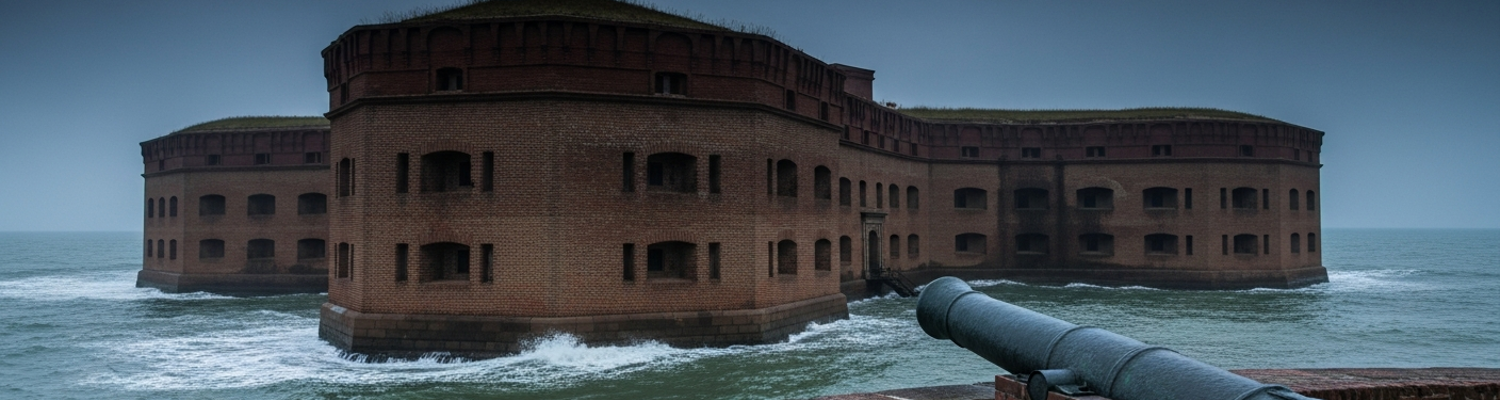

Engineering a Granite and Brick Shield
The smoke from the burning of Washington in 1814 was a stark signal of strategic failure. America’s coastline, the lifeline of its commerce and the doorstep of its cities, was dangerously exposed. The First System of fortifications, a scattered collection of earth and timber works from the 1790s, had proven utterly inadequate against a determined naval power. In response, Congress initiated a far more ambitious and permanent program of coastal defense. The Second System, constructed primarily between 1807 and the war’s end, marked a fundamental shift in U.S. military engineering, a project driven almost entirely by the U.S. Army Corps of Engineers. This new generation of forts abandoned temporary materials for robust, casemated masonry structures conceived to outlast their builders and outfight the warships of the age. The design philosophy drew heavily from French military thought, particularly the work of Marquis de Montalembert, whose advocacy for multi-tiered, geometric forts offered a model for concentrating immense firepower, a stark contrast to the sprawling, low-profile designs of the earlier Vauban school.
The defining feature of this system was the casemate, a vaulted masonry chamber built into a fort’s thick walls to protect a cannon and its crew. Forts like Castle Williams in New York Harbor, a multi-tiered circular battery, showcased this concept. The materials were brick and stone, chosen for their resilience against the elements and, more importantly, their ability to absorb the impact of solid-shot cannonballs fired from wooden frigates. The engineering objective was unambiguous: create unbreachable bastions capable of sustaining a naval bombardment while delivering a devastating, concentrated volley in return. Fort Monroe in Hampton Roads, Virginia, though technically a Third System fort, was born from this strategic mindset and represents its grandest expression. Its construction was a monumental undertaking involving massive granite and brick walls, a wide, water-filled moat, and meticulously calculated fields of fire. A young Army engineer named Robert E. Lee spent formative years of his career working on the complex drainage and counterscarp systems of Fort Monroe and its detached outwork, Fort Wool, underscoring the Corps of Engineers' central role in shaping the nation's defense infrastructure.
Fort Pulaski in Georgia provides a clear case study of the system's engineering principles and its inherent vulnerabilities. Erected on the soft, marshy ground of Cockspur Island at the mouth of the Savannah River, the fort's immense weight presented a severe structural challenge. Army engineers devised a foundation of timber pilings, some driven seventy feet deep into the mud, topped by a massive timber grillage to support the 25 million bricks of the superstructure. The fort’s defenses featured a classic scarp and counterscarp design. The scarp, the main wall of the fort, rose directly from the moat, while the counterscarp formed the outer wall of the moat. This design was intended to trap any infantry assault force in the open ditch, where they would be subjected to enfilading fire from caponiers and galleries built into the counterscarp itself. Fort Pulaski’s walls, seven and a half feet thick and constructed of Savannah grey brick, were considered by their designers to be impervious to any naval gun then in existence. They were built to defeat low-velocity, solid-shot projectiles. This confidence was a direct product of the era’s technological limits, a defense precisely calculated against a known threat that was, unknowingly, on the verge of extinction.
The Weight of Firepower
The U.S. Army artillerymen who garrisoned these coastal giants commanded the most powerful weapons in the national arsenal. The standard armament for Second and Third System forts consisted of large-caliber, smoothbore, muzzle-loading cannons. Initially, the 24-pounder and 42-pounder seacoast guns formed the backbone of the defense. These iron monsters, mounted on heavy timber carriages, could propel a solid iron shot over a mile, a respectable range for the period. The logistical apparatus required to arm the coast was a national effort. Foundries like the West Point Foundry in New York and the Watervliet Arsenal became vital centers of defense production, casting hundreds of these multi-ton gun tubes. Transporting a single 42-pounder cannon, weighing over 8,000 pounds, from a foundry to a remote fort on the Gulf Coast was a complex operation involving schooners, barges, and immense physical labor using gin poles and block-and-tackle systems. The ammunition supply chain was just as demanding, requiring the production and storage of tons of black powder, iron shot, and specialized projectiles like grape and canister for anti-personnel defense.
Deployment within the forts followed two primary methods: in casemates or on barbette mounts. Casemates provided excellent protection, shielding the gun crew from direct fire and shell fragments behind feet of brick and stone. This security, however, came with a significant tactical trade-off. The cannon’s traverse was severely limited by the narrow opening, or embrasure, cut through the wall. Barbette mounts, which placed the gun on the fort’s open-air upper tier to fire over the parapet, offered a far superior field of fire, sometimes approaching a full 360 degrees. This advantage came at the cost of exposing the gun and its crew to enemy plunging fire and sharpshooters. Army engineers and artillery officers constantly debated the optimal mix of casemate and barbette positions for each fortification, balancing the need for protection against the demand for offensive flexibility.
The mid-19th century witnessed a leap in artillery power with the development of massive new smoothbores by the Army’s Thomas J. Rodman and the Navy’s John A. Dahlgren. The rivalry between the two services extended to their ordnance bureaus. Rodman perfected a revolutionary hollow-casting method where gun barrels were cooled from the inside out, producing a much stronger weapon capable of withstanding the pressure of larger powder charges. This process yielded the formidable Rodman gun, cast in 8-inch, 10-inch, and eventually a colossal 15-inch model. Dahlgren’s guns, recognizable by their curved, “soda-bottle” shape that concentrated metal at the breech, were primarily naval weapons but were also adopted by the Army for coastal use. While a professional rivalry simmered between the two designers, their cannons represented the zenith of smoothbore technology. A 15-inch Rodman gun, weighing nearly 50,000 pounds, could fire a 440-pound projectile capable of crushing the hull of any wooden warship afloat. Manning and supplying these behemoths stretched the logistical capabilities of the era to their absolute limit, requiring purpose-built lifting cranes and reinforced concrete emplacements.
A Doctrine Set in Stone
The strategic doctrine that birthed the great coastal forts was rooted in a deep-seated American distrust of large standing armies and expensive blue-water navies. After the War of 1812, Congress chartered a Board of Engineers in 1816, led by the expatriate French general Simon Bernard, to create a permanent, unified defense plan. The board's reports advocated a strategy of harbor denial and coastal security. The Army's forts were to be a granite and brick shield, securing major ports, protecting naval shipyards, and allowing the small U.S. Navy to operate as a commerce-raiding force rather than being tethered to defensive duties. This Army-centric perspective saw fortifications as the most economical method of national defense. A fort, once constructed, was a permanent asset that could be maintained by a small caretaker garrison in peacetime.
This strategic framework was a source of persistent inter-service friction. Naval officers, who would later find their champion in Alfred Thayer Mahan, argued for an offensive strategy built around a powerful battle fleet capable of defeating an enemy far from American shores. They frequently viewed the Army’s immense expenditures on static fortifications as a drain on resources that should have been allocated to warships. The Army, in turn, pointed to the prohibitive cost of maintaining a large navy and the political reality that coastal populations demanded visible, permanent defenses. This debate played out in congressional funding battles for decades. The Army’s position was often bolstered by public panics, where political pressure would force the Navy to deploy its ships for coastal protection, a move that frustrated naval commanders but seemingly validated the Army's fixed-defense strategy.
The entire strategic argument was ultimately shattered by technological disruption. The thick masonry walls of the Second and Third Systems were designed to stop round shot from smoothbore guns. The arrival of rifled artillery changed the physics of warfare. Rifled cannons, like the 30-pounder Parrott rifle, fired conical, spin-stabilized projectiles that had vastly superior range, accuracy, and penetrating power. The decisive test came in April 1862. Union Army forces under Captain Quincy Adams Gilmore established batteries of rifled guns on Tybee Island, more than a mile from Fort Pulaski. Over 30 hours, the rifled shells did what smoothbores never could. They did not just bounce off; they acted like drills, systematically boring into the fort’s seven-and-a-half-foot-thick brick wall. When shells began to strike the wall of the main powder magazine, the fort’s commander had no choice but to surrender. The fall of a supposedly impregnable fort to artillery fire from a distance its own guns could not match sent a shockwave through the world’s military establishments. Masonry fortifications were obsolete.
The second blow came from the ironclad warship. The 1862 clash between the USS Monitor and CSS Virginia in Hampton Roads signaled the end of the wooden warship. Cannonballs that could splinter oak hulls simply clanged off iron plate. While forts still held an advantage in the weight of metal they could mount, the combination of steam-powered, armored warships and long-range rifled guns rendered the old casemated designs untenable. The Army's fixed-defense strategy, literally set in stone, was too inflexible to adapt. The age of the great sea forts was over, forcing a complete strategic and technological reset that would eventually lead to the dispersed concrete and earth batteries of the Endicott Period. The bastion coast had served its purpose, but its time had passed.