
Stephen Fuqua and the Madrid Observation Post
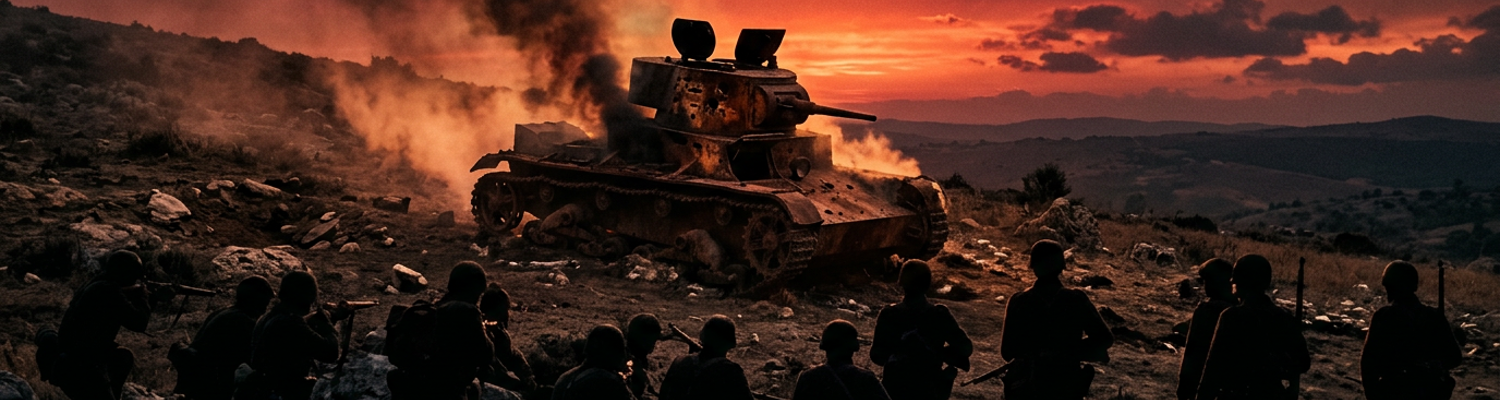
Republican tank crews slammed on their steering brakes as hidden Nationalist anti-tank batteries opened fire from concealed positions along the Casa de Campo perimeter. Solid high-explosive and armor-piercing shells tore through the thin steel plating of the leading vehicles, shattering tracks and igniting fuel tanks before the assault could gain momentum. Colonel Stephen O. Fuqua, previously Chief of Infantry from 1929 to 1933, served as the American military attaché stationed inside besieged Madrid and watched the disaster unfold through optical binoculars from an exposed urban observation post. Fuqua monitored frontline armored clashes between Soviet-supplied Republican T-26 tanks and Nationalist forces around the Casa de Campo perimeter, tracking how each machine handled the rugged park terrain and defensive obstacles. The American observer recorded how the forty-five millimeter tank cannons struck Nationalist barricades without infantry squads following close behind to clear the remaining machine gun nests. Nationalist gunners exploited this tactical separation by firing at the stranded tanks from concealed positions, leaving burning hulls scattered across the open slopes while surviving crews scrambled back into defensive gullies under heavy rifle fire.
Rifle bullets chipped concrete off the parapet around Fuqua as he stepped down from his exposed observation window to document the tactical sequence in his field notebook. The veteran infantryman filled his notebook with technical measurements of armor penetration, fuel fire vulnerability, and the mechanical failures of the Soviet running gear under combat stress. Every page described a tactical breakdown where modern armored vehicles were destroyed because commanders sent them into enemy positions without infantry coordination. Fuqua worked under harsh conditions inside the embassy compound, enduring artillery bombardments, frequent electrical blackouts, and freezing winter temperatures without reliable building heat. Food supplies dwindled to thin soup rations as Nationalist encirclement tightened around the capital, forcing the attaché to type his technical dispatches on a portable typewriter by candlelight. He sealed the typed report pages into waterproof envelopes, waiting for an authorized diplomatic courier to carry them past the battle lines toward neutral diplomatic stations.
Leather mail pouches protected Fuqua's carbon copies during a long and hazardous journey across contested Spanish roads toward those neutral diplomatic stations. Diplomatic runners navigated blocked highways, military roadblocks, and intermittent train schedules to deliver the paperwork to American consular stations outside Spain. Radio transmitters in the embassy could broadcast only brief encoded summaries due to strict security protocols, leaving detailed technical observations completely dependent on physical paper transit. Weeks passed while commercial cargo ships carried these diplomatic bags across the rough waters of the Atlantic Ocean. This transit lag kept American military intelligence weeks behind the fast moving combat developments along the Madrid front. Postal trucks eventually delivered the weathered envelopes to the War Department in Washington long after the Casa de Campo battle lines had shifted again.
Staff officers unfolded Fuqua's delayed dispatches inside the quiet hallways of the State, War, and Navy Building, operating thousands of miles removed from the physical realities of the Spanish front. These peacetime planners worked inside distant offices shaped by strict budget limits and theoretical doctrines that had not changed since the end of the World War. Planners read the accounts of destroyed T-26 tanks through their own pre-existing beliefs, concluding that light anti-tank guns had permanently eliminated the offensive power of armored vehicles. War Department committees seized upon Fuqua's descriptions of destroyed T-26 tanks to reduce financial requests for domestic tank research and mechanization programs. General staff officers stamped the Madrid reports as non-urgent reference material, locked the paperwork into steel storage cabinets, and formally halted plans to build heavy breakthrough tanks for the infantry branch.
T-26 Vulnerability to Concealed Anti-Tank Batteries
Infantry branch planners failed to comprehend the fatal tactical errors demonstrated by Republican tank assaults along the Madrid frontlines during the early months of the siege. Nationalist batteries utilizing high-velocity anti-tank guns systematically defeated Republican light tanks advancing without direct infantry coordination. German-supplied 37mm PaK 36 anti-tank guns sat camouflaged beneath olive branches, canvas tarps, and loose earth along sunken garden walls, stone farmhouses, and roadside ditches. Gun captains held their fire while Soviet-trained tank commanders drove straight across open fields and suburban vegetable plots without foot soldiers screening the hedgerows or clearing the masonry buildings ahead. Nationalist gun crews waited until the lead T-26 vehicles rumbled within three hundred yards before firing synchronized armor-piercing rounds into their exposed side plates. High-velocity solid shot punched through engine compartments and fuel reservoirs at velocities exceeding two thousand feet per second, setting multiple vehicles on fire and pinning the following units in crossfire traps.
Colonel Stephen Fuqua recorded the technical details of these crossfire traps while observing frontline engagements across the University City sector from a shattered upper floor observation post. Fuqua observed that thin armor plating on light tanks provided zero survivability against modern high-velocity 37mm anti-tank guns in urban and suburban terrain. Rolled homogeneous steel armor on the T-26 measured only fifteen millimeters at its thickest sections, providing adequate protection against rifle bullets and stray shell fragments but collapsing completely against specialized anti-tank ordnance. High-velocity German shells punched clean entry holes through the forward glacis and turret mantlet, breaking apart inside the fighting compartment and spraying jagged metal shards that killed drivers and gunners instantly. Flaming aviation gasoline from ruptured fuel lines poured over vehicle electrical cables, igniting forty-five millimeter high-explosive ammunition racks before surviving crewmen could push open their heavy turret hatches.
Crewmen who escaped through the burning hatches dropped directly onto open pavement without friendly infantry squads present to suppress the surrounding enemy positions. Nationalist snipers and machine gunners stationed in upper-story brick buildings shot these exposed tankers, leaving the immobilized vehicles stranded in the center of narrow suburban roads. Republican commanders repeated this operational blunder during successive counterattacks, deploying light tanks as independent battering rams rather than integrating them into combined arms teams with foot soldiers and close artillery support. Republican infantry platoons trailed hundreds of yards behind the charging armor, pinned to the earth by mortar barrages and entrenched machine gun nests that tank crews had driven past without neutralizing. Concealed anti-tank batteries exploited these wide gaps between armor and infantry, pivoting their guns to target the isolated vehicles from flank positions and severing track assemblies with repeated armor-piercing strikes.
Steel hulls and severed track assemblies littered the suburban roadways outside Madrid as direct physical evidence of flawed combined arms coordination. Fuqua documented every disabled vehicle in precise technical reports addressed to the War Department, explaining that tanks failed because commanders sent them forward without rifle squads to spot and eliminate concealed anti-tank positions. Peacetime staff officers inside the isolated headquarters bubble in Washington misread these detailed field observations, evaluating the high tank casualties through their own defensive doctrines and budget restrictions. War Department planners decided that modern high-velocity anti-tank guns had permanently eliminated the offensive power of all armored fighting vehicles on the battlefield. Committee members filed Fuqua's tactical warnings into steel storage cabinets, cancelled experimental contracts for heavy breakthrough armor, and forced American infantry regiments to conduct maneuvers with wooden mockups and outdated light vehicles.
Military Intelligence Division File 2041 Dispatches
Plywood mockups and obsolete six ton tanks rattled along dusty training paths in Georgia while Fuqua compiled comprehensive combat analyses and armor loss statistics transmitted under War Department General Staff file MID 2041. Fuqua cataloged every destroyed Republican T-26 hull across the central front, documenting shell entry angles, track fractures, and fuel ignition points with the precision of a seasoned combat veteran. Spanish combat zones generated dozens of specific casualty entries as Fuqua tracked armored skirmishes across the Jarama River and Guadalajara, charting how rapidly high-velocity 37mm rounds disabled light tanks. Typed tables within file MID 2041 listed the specific range of each engagement, the thickness of the perforated plating, and whether rifle platoons had advanced alongside the vehicles or lagged behind under mortar fire. Fuqua repeatedly noted that Soviet-designed hulls possessed adequate mobility across dry earth but caught fire almost instantly once armor-piercing shot struck their thin side fuel tanks. Clerks in the Madrid embassy compound glued these statistical balance sheets into thick paper dossiers and sealed them inside heavy canvas mail bags for export.
Couriers hauled these sealed canvas mail bags through military checkpoints and damaged rail corridors toward coastal shipping ports in France. Diplomatic pouch delays and maritime transit isolated Washington planners from the immediate operational velocity of the Spanish battlefield. Freight steamers spent nearly two weeks battling North Atlantic swells before docking at eastern seaboard piers, where rail workers transferred the diplomatic sacks to Washington bound express trains. Madrid frontline units launched new counteroffensives, shifted defensive sectors, and altered tactical formations long before those Atlantic vessels completed their ocean crossings. Spanish tankers welded extra steel boiler plates over their engine decks and experimented with improvised sandbag screens to defeat solid shot while the physical paperwork crawled across ocean shipping lanes. Intelligence officers in the United States received Fuqua's detailed technical assessments weeks after the fighting crews had either adapted to the threat or died in their burned out hulls.
Burned out hulls and raw casualty statistics became the sole focus of War Department planners unpacking the weathered leaves of file MID 2041 inside quiet, fan cooled offices far removed from the smoke and noise of the Spanish civil war. Peacetime staff officers focused entirely on the high vehicle casualty numbers rather than the tactical breakdowns in combined arms coordination that Fuqua carefully explained. Bureaucrats noted that dozens of Soviet-built machines burned after taking direct hits from small anti-tank batteries, viewing this as physical proof that mechanized armor could never breach prepared defensive positions. Infantry branch traditionalists seized upon the raw statistics to argue that foot soldiers armed with anti-tank guns held total dominance over modern combat vehicles. Fuqua's handwritten warnings about tanks operating without close infantry screens were dismissed as minor details beneath the terrifying totals of wrecked hulls. Army leaders ignored these operational nuances, choosing instead to interpret the file as justification for defensive spending and reduced tank budgets.
Reduced tank budgets forced ordnance officers to shelve prototype designs for medium and heavy breakthrough tanks, redirecting factory tooling toward light scout cars and towed anti-tank artillery. Engineers halted experiments on thick cast steel hulls because War Department doctrine concluded that high-velocity anti-tank guns rendered heavy armor useless on modern battlefields. American armored units remained legally subordinate to the infantry branch, restricted to cautious reconnaissance missions and direct trench support roles while European armies organized massed independent tank formations. Mechanics continued bolting spare parts onto fragile light tanks in American motor pools, completely unprepared for the speed and firepower of mechanized warfare. Staff clerks tied green cotton ribbons around the bulky file MID 2041 folders and locked the Madrid reports into basement archives alongside obsolete World War training manuals.
War Department Parochialism and Interwar Bureaucracy
Metal filing cabinets held those folders in dark basement storage rooms while officers on the War Department General Staff discounted Fuqua's frontline reports, categorizing the Spanish Civil War as a regional anomaly irrelevant to general European warfare. Bureau planners argued that irregular militia units, broken supply chains, and primitive Spanish roads produced skewed combat results that failed to reflect modern industrial battlefields. Senior staff members maintained that undisciplined partisan fighters simply misused their foreign equipment, so high vehicle losses proved nothing about the true combat power of armor in professional armies. Planners convinced themselves that genuine European armies would execute combined maneuvers with far greater skill, making Madrid's destructive ambushes completely inapplicable to American operational concepts. War Department leaders used this detached reasoning to justify their existing programs, maintaining the peacetime division of armor development between opposing branches.
Generals leading the Infantry and Cavalry branches fought bitter jurisdictional disputes that preserved fragmented doctrine, preventing the integration of dedicated anti-tank weapons and tactics. National Defense Act regulations from 1920 legally assigned all tracked combat tanks exclusively to the infantry to support walking foot soldiers during direct assaults. Cavalry officers evaded this restriction by developing fast wheeled and tracked combat cars, creating separate supply lines, different training programs, and isolated radio frequencies for their own mechanized units. Neither branch took responsibility for building specialized defense battalions equipped to hunt and destroy enemy armored vehicles, because both offices viewed dedicated anti-tank defense as an unwanted expense for their branch budgets. Infantry leaders demanded light guns that foot soldiers could pull by hand across mud, while Cavalry commanders insisted on high-speed truck mounts that could keep pace with horses and reconnaissance vehicles. Administrative disagreements between these competing headquarters blocked ordnance factories from standardizing anti-tank gun carriages, ammunition calibers, and tactical handbooks across the army.
Soldiers in field regiments felt the direct cost of this stalemate whenever they dragged obsolete World War artillery pieces onto maneuver ranges to practice emergency anti-tank defense. Infantry battalions lacked modern high-velocity guns capable of stopping the 37mm resistant armor that European factories were already building, relying instead on small fifty caliber machine guns and towed field pieces with slow traverse gears. Mechanized cavalry squadrons swept through Georgia and Texas pine forests during large scale war games, operating under peacetime rules that declared charging combat cars immune to infantry fire. Foot soldiers could not coordinate radio calls with armored vehicles because the separate branch commands purchased incompatible radio sets that operated on entirely different frequency bands. Umpires carrying white clipboards walked between the stalled formations, assessing artificial casualties and awarding points according to theoretical formulas that bore no resemblance to the high-velocity gun ambushes Fuqua witnessed in Spain.
Spanish combat realities remained entirely invisible to planners inside the State, War, and Navy Building who continued approving these artificial maneuver results. Stifling peacetime budget limits, slow overseas communications, and profound institutional isolation shielded Washington decision makers from the urgent tactical warnings crossing the Atlantic. Staff officers refused to fund a unified armored force or purchase specialized anti-tank artillery, choosing instead to distribute small batches of light tanks across separate infantry divisions. Committee members discarded proposals to create independent anti-tank battalions, insisting that existing divisional artillery could handle any mechanized threat during combat. Senior leaders signed the annual procurement schedules, stamped the branch inspection registers, and ordered factory lines to build thirty-seven light tanks designed strictly to accompany walking infantry regiments.
The 1940 Blitzkrieg and Doctrinal Vindication
Factory assembly lines were still bolting together these thirty-seven light support vehicles when German armored spearheads shattered interwar tactical doctrines in Europe. German panzer divisions forced crossings along the Meuse River and tore through French defensive positions during the Sedan offensive. The German armored breakthrough at Sedan in May 1940 confirmed Fuqua's discarded warnings regarding light armor vulnerability and massed anti-tank screens. French light tanks launched disjointed counterattacks into the German salient without accompanying infantry or artillery coordination, driving straight into camouflaged batteries of 37mm anti-tank guns and 88mm flak pieces. German gunners shattered the thin armor of these advancing vehicles at long ranges, setting French tank columns on fire in rural pastures just as Nationalist crews had destroyed Republican T-26s outside Madrid. Telegraph cables reporting the rapid destruction of French armor flooded into the State, War, and Navy Building, terrifying the War Department planners who had spent years denying that mechanized forces could break prepared fronts.
Prepared defensive lines collapsing across France forced staff officers to convene emergency conferences inside the War Department. Peacetime planners who had previously dismissed Fuqua's Spanish dispatches suddenly recognized that his technical assessments had pinpointed the exact tactical dynamics deciding the war in France. Intelligence personnel hurried into basement archives to retrieve the forgotten folders of file MID 2041, pulling the typed casualty rosters and ballistics notes out of locked metal cabinets. Bureau chiefs reread Fuqua's detailed observations of high-velocity 37mm guns penetrating thin hull plates, studying how concealed weapon batteries had slaughtered armored assaults in the Casa de Campo. General staff committees concluded that independent tank divisions would crush American forces unless the military developed dedicated weapons and specialized units designed specifically to hunt enemy armor.
Enemy armor hunting tactics developed at the hastily established United States Army Tank Destroyer Center in late 1941 relied entirely on Fuqua's 1937 field assessments. Army planners abandoned the jurisdictional disputes between the Infantry and Cavalry branches, using the Madrid data to justify an independent combat organization focused solely on defeating massed tank attacks. Doctrine writers at the newly created center in Maryland and later Texas based their tactical manuals on Fuqua's core finding that stationary, concealed anti-tank guns held an overwhelming advantage over moving vehicles. Training cadres instructed gun captains to avoid deploying anti-tank pieces in piecemeal defensive cordons, preaching instead the deployment of massed mobile batteries that could ambush hostile armored thrusts from hidden tree lines and defilades. War Department officials authorized emergency procurement orders for mobile tank destroyers, seeking fast vehicles that could carry high-powered artillery directly to threatened frontline sectors.
Engineers mounted 75mm field guns onto tracked halftracks to satisfy these urgent production directives, creating the first specialized tank destroyer vehicles in the American inventory. Artillerymen tested these open topped gun carriages on firing ranges, practicing rapid deployment drills against moving targets at extended battle ranges. Gun captains applied the Spanish combat data directly to their gunnery problems, calculating armor penetration angles and tracking speed factors derived from Fuqua's cataloged T-26 casualties. Tactical instructors warned crews that light armor plating could never protect them against direct enemy fire, repeating Fuqua's central warning that mobility and camouflage offered their only real survivability on modern battlefields. Commanders dispatched these newly formed tank destroyer battalions to large scale maneuvers across Louisiana and the Carolinas, deploying mechanized gun batteries into concealed ambush positions to engage simulated panzer thrusts.