
Post-Mortem Analysis of the Nettuno Shoreline
Hydraulic fluid atomized into a white fog across the forward machinery flat of Landing Ship Tank 197. The main ramp hoist cylinder suffered a pressure drop from twelve hundred pounds per square inch to zero. Cast-steel spur gears ground against each other inside the winch housing. They sheared their teeth into coarse metal shavings. The fifty-ton ramp jammed open at an unusable thirty-degree angle. Saltwater flooded the lower tank deck within seconds. Breaking swells drove the unmoored vessel sideways onto an outer sandbar off Nettuno. The impact twisted the heavy hinge pins. The ship primary loading portal was disabled. The manifest listed forty tons of 105-millimeter artillery shells and two hundred crates of blood plasma. None of it reached the beach.
The evacuation corridor had broken down.
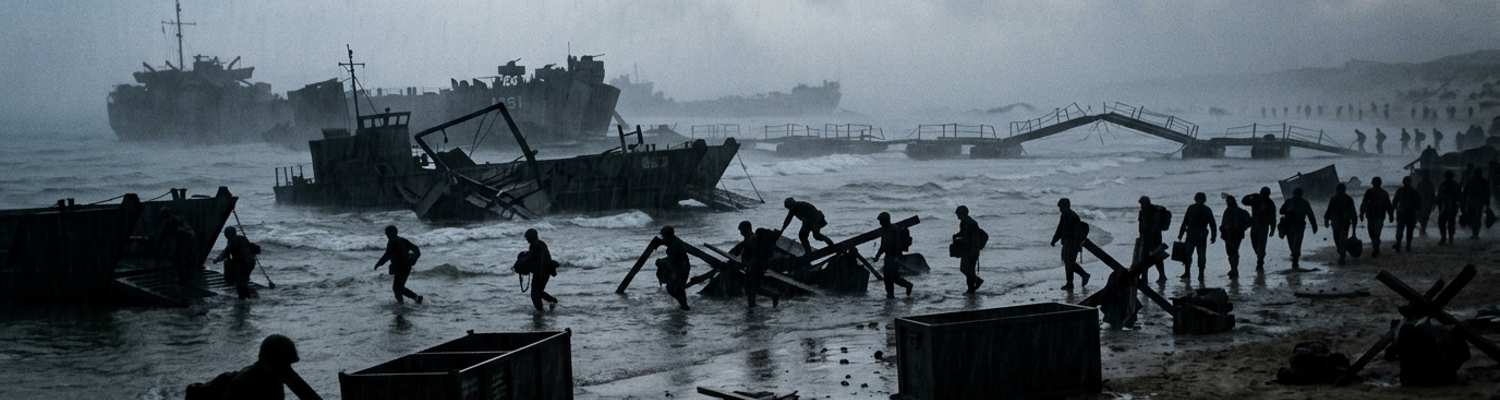
Archival evidence shows that the shoreline immediately east of the Nettuno port basin was choked with shattered equipment by the third week of March 1944. Two hundred yards of three-by-seven T-6 pontoon causeway sections lay twisted in the surf line. The 1009th Seabee Battalion constructed these temporary piers under continuous night bombardment. German 170-millimeter artillery batteries dug in near Cisterna punctured their quarter-inch steel plating with air-burst fragments. Breakers repeatedly slammed the five-ton pontoon cells into one another. Seam welds tore open. Buoyancy compartments flooded. The modular piers settled unevenly into the volcanic sand. Thousands of pounds of civilian property abandoned during night transfers lay tightly packed between these flooded steel pontoons. Discarded wooden luggage trunks littered the tideline across Yellow Beach alongside hand-stitched canvas bundles and water-soaked wool blankets. Wicker hampers and hand-pulled farm carts blocked the access ramps. Armed shore sentries ordered frightened families scrambling up rope cargo nets onto landing craft under artillery fire to drop every personal possession larger than a haversack. Ocean currents dragged these belongings into the surf. The raw-water cooling intakes of DUKW amphibious trucks attempting to churn through the shallows became fouled with submerged debris.
Beachmasters were running out of time and serviceable watercraft.
Detailed logs from the 540th Engineer Shore Regiment and attached US Navy Beach Party Team 4 expose the complete breakdown of coordinated movement schedules during the final phase of civilian departures. Operational plans originally called for eight hundred non-combatants to board three LSTs during four-hour daylight windows between artillery barrages. German forward observers stationed on the commanding heights of the Colli Laziali spotted the civilian assembly points near the Nettuno rail yard. They directed sustained concentrations of high-explosive fire directly onto the sand spits. Field telephone lines linking the beachmaster dugout to the offshore naval control vessel were severed at 1415 hours on March 18. Individual landing ship skippers weighed anchor and backed into deep water an hour ahead of published manifest deadlines to avoid bracket fire. Surviving Navy beach party reports recorded that the shore party commander unilaterally terminated all formal embarkation timetables at 1630 hours. Municipal authorities sheltering eight hundred refugees in limestone caves beneath the town received no notification of this change. Over four hundred Italian civilians were left stranded on the open sand of Red Beach under falling shrapnel. Two half-loaded landing craft waited five miles offshore for escort vessels that never arrived.
The official operation log closed at 1700 hours with forty unevacuated stretcher cases still exposed on the sand spit.
Abandonment of Standard Naval Manifest Protocols
Paper accountability collapsed completely by dusk.
Archival evidence shows that Lieutenant Commander Ralph Davies discarded Allied Military Government embarkation regulations at 1745 hours. Davies coordinated shore operations for US Navy Beach Party Team 4 from an earth-bermed cellar near the ruined Nettuno customs house. Standard Mediterranean theater naval instructions required four carbon copies of signed passenger manifests. These documents recorded full Italian civil registration names, age, sex, verified physical inspection stamps, and designated vessel serial numbers. Exploding rounds from battery-positioned German 170-millimeter guns at Cisterna shattered the field desks. The blasts splintered the wooden boarding gangways. Mimeographed roster sheets were buried beneath drifts of pulverized brick dust. Beachmaster personnel stopped checking national identity cards. Navy guards assigned to the surf line shoved groups of forty to fifty panic-stricken women, elderly men, and unmonitored orphans directly across the tidal flats toward the water. They did not log a single family name or departure ticket. Captain James Reynolds and Lieutenant Arthur Rossi operated out of a sandbagged trench. These civil affairs liaison officers abandoned their administrative tables under heavy fragmentation air-bursts. Shore teams pushed non-combatants into whatever hulls rested nearest the breaker zone. Hundreds of children were left completely undocumented and untracked.
Evacuation priority lists ceased to exist on the sand.
A close review of operational logs indicates that the task of offshore ferrying fell upon twenty-two battered GMC DUKW-353 amphibious trucks belonging to the 453rd Amphibian Truck Company. The company lost six drivers to shrapnel wounds before noon. Eleven of these six-wheel-drive vehicles had suffered hull punctures from shrapnel during the midday bombardment. Mechanics patched their quarter-inch sheet steel with cedar wedges, heavy grease, and canvas strips hammered into place. Two-inch Higgins bilge pumps inside the engine compartments ran at continuous maximum RPM. They struggled against seawater flooding through shredded rubber propeller-shaft packings. The hulls were weighed down by forty refugees per run. Salt spray combined with fine volcanic sand rapidly fouled the Zenith carburetors. Raw-water heat exchangers overheated because wool fibers from discarded blankets clogged the intake strainers. Drivers used lead mallets to repeatedly strike jammed transmission transfer cases. This forced gears into marine propeller drive as the overloaded hulls wallowed in three-foot surf fifty yards out from Yellow Beach.
Dense coastal fog rolled off the Pontine Marshes after 1930 hours. This combined with burning smoke pots to reduce visibility across the Nettuno roadstead to less than fifteen yards under strict blackout conditions. German aircraft dropped butterfly bombs across the anchorage. This prevented the use of any signal lamps, headlights, or unshielded flashlights. The DUKW drivers established an improvised daisy-chain system to guide their waterlogged vehicles toward Landing Craft Tank flotillas anchored eight hundred yards out in deep water. Crews stretched six-thread manila lead lines between the outer sandbar and the stern mooring bitts of LCT-244. Amphibious trucks traced the taut cordage by hand in total darkness. Evacuees were hoisted bodily over the low gunwales into the spray. They were tossed across two-foot gaps between swaying sponsons into the iron wells of the receiving craft. Both hulls banged violently together on rolling swells. Coxswains steered solely by the muffled drone of underwater exhaust pipes and shouted compass azimuths relayed down the line of idling vehicles.
At 2215 hours, DUKW-88 swamped four hundred yards off Red Beach with thirty-six untracked passengers aboard.
Subterranean Shelter Morale Collapse Under Bombardment
Thirty feet beneath the cobblestones of the medieval borgo, the air ran out.
Archival evidence shows that over twelve hundred Italian non-combatants, municipal laborers, and displaced farmers from the Agro Pontino were packed into the ancient volcanic tufa wine cellars beneath Piazza Mazzini. The cellars belonged to the Borghese family estate. They sheltered alongside rear-echelon personnel from the 3rd Infantry Division quartermaster section. These interconnecting subterranean vaults were hand-hewn during the sixteenth century to store oak casks. They lacked drainage, ventilation shafts, or auxiliary power. Human waste pooled in floor drainage trenches. Temperatures spiked above ninety degrees Fahrenheit from concentrated body heat. Mass hysteria erupted at 2310 hours. Rumors spread through the dark tunnels that poison gas shells had struck the upper street exits. Displaced families surged toward the narrow spiral stone stairs. They trampled elderly women and small children in pitch-black corridors. Allied Military Government officers lacked functioning radio links and could not speak the local dialect. They drew Colt M1911 service pistols to prevent armed Italian police auxiliaries and frantic rear-echelon drivers from forcing their way out through cave-ins.
Suffocation threatened long before any shell penetrated the vaulted stone.
When examining the historical record of German artillery operations, Krupp K5 280-millimeter railway guns firing from rail spurs near Ciampino sustained round-the-clock bombardment directly targeted at the Nettuno waterfront grid. Each five-hundred-fifty-pound high-explosive projectile struck the soft surface soil at supersonic velocity. They detonated with a kinetic force that sent compression shockwaves directly through the subterranean tufa strata. The concussive energy did not dissipate into the open atmosphere. The subterranean shock hammered the enclosed cellars. The pressure ruptured eardrums and triggered involuntary vomiting. It extinguished kerosene lanterns across forty interconnected storage chambers. Pulverized lime dust peeled off the ceilings in dense clouds. This reduced visibility to zero and clogged breathing passages. Twin-engine Junkers Ju 88 bombers belonging to Lehrgeschwader 1 swept in from the Tyrrhenian Sea at altitudes under eight hundred feet. They dropped SD-2 butterfly bombs across the access roads. They released strings of white-magnesium parachute flares over the port perimeter. The blinding chemical glare flashed straight down through bombed-out street vents and cellar light wells. It cast flickering, distorted shadows across the chalky dust. That rapid alternation between pitch darkness and harsh five-million-candlepower illumination systematically destroyed the depth perception of the sheltering civilians.
The cave system became an inescapable sensory trap.
A close review of operational logs from the 540th Engineer Shore Regiment indicates that subterranean shockwaves repeatedly cracked subterranean water mains running along Via Sangallo. Three feet of sewage-tainted water rushed into the lower wine cellars where stretcher patients lay on wet straw. Field telephone wires strung between the command cellar and Beach Party Team 4 snapped under falling masonry at 0140 hours on March 19. Two hundred rear-echelon service troops were assigned to carry stretchers and haul five-gallon jerrycans to the evacuation boats. They refused orders to ascend into the open blast zones on the quay. Beachmaster couriers sent into the cellars found non-commissioned officers and Italian civil authorities paralyzed by blast fatigue. They huddled against damp walls while concussions dislodged twenty-pound chunks of volcanic tufa from the overhead arches. By 0300 hours, seventy-four civilian evacuees inside the lower vaults required physical restraint to prevent self-harm. Thirty-two injured Italian refugees were pinned against timber roof-props in an unlit corridor when a 280-millimeter surface impact collapsed the cellar portal on Via Andrea Sacchi.
Severed Tactical Communications on March 14
At 0415 hours on March 14, the wire grid died.
Archival evidence shows that a seventy-minute barrage from German 150-millimeter sFH 18 howitzers and 210-millimeter Morser 18 batteries obliterated the primary communications corridor along the Nettuno-Anzio rail berm. Company C of the 36th Signal Battalion deployed twenty wiremen. They laid twelve separate circuits of four-conductor rubber-sheathed spiral-four carrier cables eighteen inches deep to link the VI Corps forward command post with beachhead cargo sectors. Delayed-fuse contact bursts cut these lines in twenty-seven places. High-frequency radio communication with Fifth Army rear headquarters in Caserta vanished. Concussive blast pressure near the Nettuno municipal cemetery shattered three 500-watt BC-610 transmitters inside mobile SCR-399 radio trucks. Shrapnel sliced through the canvas canopies of K-51 signal trucks. It pierced the cooling radiators of attached PE-95 gasoline generators and drained lubricating oil into the dirt within minutes. Copper whip antennas snapped off at their ceramic base insulators. Operators inside the vans attempted to switch to secondary 4.2-megahertz frequencies using backup horizontal dipole antennas. Near-misses from 170-millimeter guns threw mounds of earth over the field grounding rods. This broke the electrical ground current and filled receiver headsets with deafening static. Signal Corps line crews crawling across the smoking craters with splice kits and friction tape suffered eight casualties in under twenty minutes. The entire coastal enclave was left unable to transmit casualty reports, ammunition requisitions, or civil evacuation requests southward across the Tyrrhenian Sea.
Nettuno was cut off from the mainland.
A close review of operational logs indicates that this total breakdown of shore-based wiring instantly blinded the US Navy port control party stationed in a concrete bunker on the Nettuno mole. Lieutenant Commander Donald Vance was tasked with directing the incoming morning convoy from Pozzuoli. He found his headquarters completely isolated from both the army beachmaster and approaching amphibious hulls. The port party relied on SCR-608 very-high-frequency radio sets to assign designated landing slots. Incoming shrapnel tore away the mast-mounted ground-plane antennas on the pier head at 0630 hours. This silenced all tactical coordination with incoming tank landing ships. Heavy coastal squalls and dense black smoke from burning fuel dumps on Yellow Beach made optical signaling via Aldis lamps impossible beyond four hundred yards. Two miles offshore, eight incoming LSTs carrying fresh supplies for the 3rd Infantry Division began circling outside the swept channel in total confusion. LST-344 and LST-382 carried elements of the division. These vessels were assigned to clear twelve hundred civilian refugees on their return legs. The convoy commodore refused to commit his deep-draft hulls to the shallow harbor approaches without radio vectors from the port office. He feared uncharted shell craters and acoustic sea mines. Three tank landing craft attempting an unguided visual approach grounded their skegs against an outer sand spit four hundred yards west of the jetty. This exposed their troop-filled decks to direct observed counter-battery fire from German gunners on the Colli Laziali slopes.
Inside the flooded port office cellar, signalmen attempted to jury-rig an auxiliary TCS radio transceiver to a twelve-volt lead-acid truck battery. Falling plaster had cracked the radio tuning capacitor plates. This caused the transmitter to drift off frequency whenever operators keyed the microphone. Messengers sent on foot along the shell-raked quay were pinned down behind overturned cargo trailers. They were unable to cross four hundred yards of exposed concrete to deliver updated hand-written routing chits to the harbor master. By 0945 hours, the off-loading of emergency blood plasma and the reverse embarkation of wounded evacuees halted entirely. Empty landing craft drifted broadside into the coastal current. Hundreds of Italian refugees huddled without direction behind blast walls along Via del Porto, waiting for ships that could not find the beach.
Systemic Amphibious Deficits at Anzio
Waterborne transport at Nettuno was rationed down to the single gallon of marine diesel.
Archival evidence shows that Allied naval planners allocated ninety-two percent of all serviceable landing craft exclusively to offloading artillery ammunition and C-rations for the six divisions trapped in the perimeter. Non-combatant extraction was relegated to an ad-hoc pool of four battered Landing Craft Mechanized and two self-propelled pontoon barges operated by the 540th Engineer Shore Regiment. The shallow gradient across the exposed coastal shelf between the Nettuno marina and the Torre Astura headland forced deep-draft vessels to anchor twelve hundred yards seaward. Bridging that distance required continuous pontoon causeways composed of standard T-6 steel buoyancy cells. Winter gales churning across the Gulf of Gaeta had buckled the steel angle-iron connector pins on fourteen separate pontoon sections. The modular piers twisted until their three-inch tongue-and-groove decking split open under breaking surf. VI Corps quartermasters commandeered replacement pontoon sections slated for civil transport duties at gunpoint to construct emergency fuel offloading ramps at X-Ray Beach. Beach engineers lacked sheltered lighterage to shuttle families past the breaker bar. They watched six-foot swells repeatedly swamp their remaining open LCMs. Sea brine flooded the Gray Marine 6-71 diesel engines and grounded the landing craft on offshore sand ridges.
Every operational barge was bound to cargo manifests, not refugees.
When examining the historical record, only three sheltered lighters with enclosed holds were operational across the entire transport anchorage by the third week of March. These wooden-hulled utility craft were requisitioned from pre-war Italian coastal traffic. The Italian vessels were designated as Utility Boat 4 and Utility Boat 7. They lacked mechanical bilge pumps and suffered continuous drive-shaft alignment failures whenever heavy swells tossed their hulls against steel hulls. Maintenance depots at Naples sent no spare parts for non-standard craft. Shore engineers salvaged copper tubing and canvas gaskets from scuttled supply trucks to patch cracked water jackets on the auxiliary cooling systems of the lighters. Mechanics spent entire shifts draining gritty sea mud from secondary fuel filters. Fuel oil drums delivered to the Nettuno mole were contaminated with rainwater.
Two completely separate military hierarchies were fighting for the same four-hundred-yard strip of sand.
A close review of operational logs indicates that the operational friction between the US Army 540th Engineer Shore Regiment and the US Navy Port Authority under Task Force 81 stemmed from fundamentally contradictory operational doctrines. Navy port regulations dictated that all seaward approaches and berthed lighters maintain absolute priority for discharging Class V high-explosive ammunition under direct artillery fire from German batteries on the Monti Lepini. Army beachmasters attempted to push non-combatants onto outbound empty supply hulls before those vessels had cleared their incoming cargo. Thousands of panic-stricken civilians gathered around the Nettuno rail terminal. No joint doctrine existed to synchronize outbound humanitarian egress with high-tempo combat offloading under observed 170-millimeter artillery fire. Navy beachparty officers refused to authorize embarkation cycles while ammunition hoists were swinging wooden pallets of 105-millimeter shells over the quayside. They argued that an artillery airburst would ignite both the cargo and the crowding refugees. Army shore police pushed non-combatants forward anyway to clear the exposed roadsteads. This triggered armed jurisdictional confrontations on the wet concrete slips between naval beachmasters brandishing sidearms and engineer sergeants attempting to clear civilian staging zones.
At 1540 hours on March 20, an unguided Navy LCM loaded with twenty tons of mortar ammunition backed directly into a civilian boarding ramp at the Nettuno mole.
LCM-44 was operated by a crew of three enlisted sailors.
The impact sheared the mooring cables and spilled twelve Italian evacuees into the water between the crushing hulls.