
Inter-Service Friction and Coastal Defense Planning
When examining the historical record, planners inside the fortified tunnels of Corregidor operated under a strict countdown by late July 1941. Japanese forces occupied airfields across southern Indochina. Hostile bombers sat within striking distance of Luzon. The defense preparation window shrank to weeks. War Plan Orange-3 designated the entrance channels to Manila Bay as primary defensive lines requiring synchronized inter-service coordination. The strategic barrier plan rested on a single risk. Army and Navy commands had to seal these maritime gateways before sea transport links broke down. They anticipated fleet relief would take at least six months to cross the Pacific. Between Bataan and Corregidor, the North Channel stretched over two miles across. The South Channel spanned over seven miles of deep water between Caballo Island and the jagged coast of Cavite. Every week spent arguing over cable shipments brought the Asiatic Fleet closer to total isolation.
Time ran out before the concrete cured.
Inter-service execution quickly exposed structural fractures between the commands assigned to seal these channels. Major General George F. Moore directed the Harbor Defenses of Manila Bay under the US Army Coast Artillery Corps from Fort Mills. He coordinated channel control with Captain Kenneth R. Rockwell of the 16th Naval District Inshore Patrol. The joint arrangement assigned the Army responsibility for the interior minefield belts directly under coastal batteries. Naval patrols in converted yachts and steel-hulled minesweepers held outer picket lines across the mouth of the bay. Communication cables connecting the Army harbor defense switchboards at Fort Mills to naval headquarters at Cavite Navy Yard snapped repeatedly under rough monsoon swells. Army artillery plotters struggled to track swift Navy patrol launches running without lights through defensive sectors at night. Tactical friction escalated. Patrol gunboats repeatedly strayed into mapped Army firing lanes. Shore batteries had to hold their fire while tracking unknown surface contacts emerging from the South China Sea.
Neither branch trusted the other to control the trigger.
Archival evidence shows operational doctrine split open along technological lines. Coast Artillery doctrine mandated electrically controlled buoyant mines anchored to the seafloor and wired directly to shore casemates. Inside Mine Casemate 1 on Corregidor, military technicians managed multi-conductor cables hooked to submerged nineteen-mine groups. They maintained the electrical circuits that allowed operators to toggle between safe passage for friendly merchant traffic and instant detonation upon command. If a friendly freighter entered the channel, the operator disabled the contact firing switches. When a hostile target was identified, spotters in concrete observation stations on Malinta Hill used depression position finders to calculate the vessel coordinates. They ordered the casemate to close the firing circuit as the hull crossed the mine line.
The United States Navy rejected this centralized system.
Naval officers favored autonomous Mk 6 moored contact mines equipped with internal batteries and chemical horn switches. These naval weapons functioned indiscriminately once laid. They floated beneath the surface on cable tethers to destroy any hull that broke an external lead horn. Laying these divergent systems across the South Channel produced unmanageable tactical conflicts. Navy minelayers operating out of Sangley Point began dropping uncontrolled contact mines across areas the Army planned to keep open for commercial freighters. Submarine currents running at four knots ripped Army buoyant mines from their anchors. Heavy rubber-insulated nineteen-conductor cables severed on jagged coral heads off Monja Island. The Navy lacked sufficient heavy anchors to hold their deep-water contact strings against shifting tides. Unmoored ordnance drifted through designated transit corridors. Coast Artillery observers watched through spotting scopes as naval mine strings dragged out of position. This blinded the shore-directed firing system and created lethal navigational dead zones.
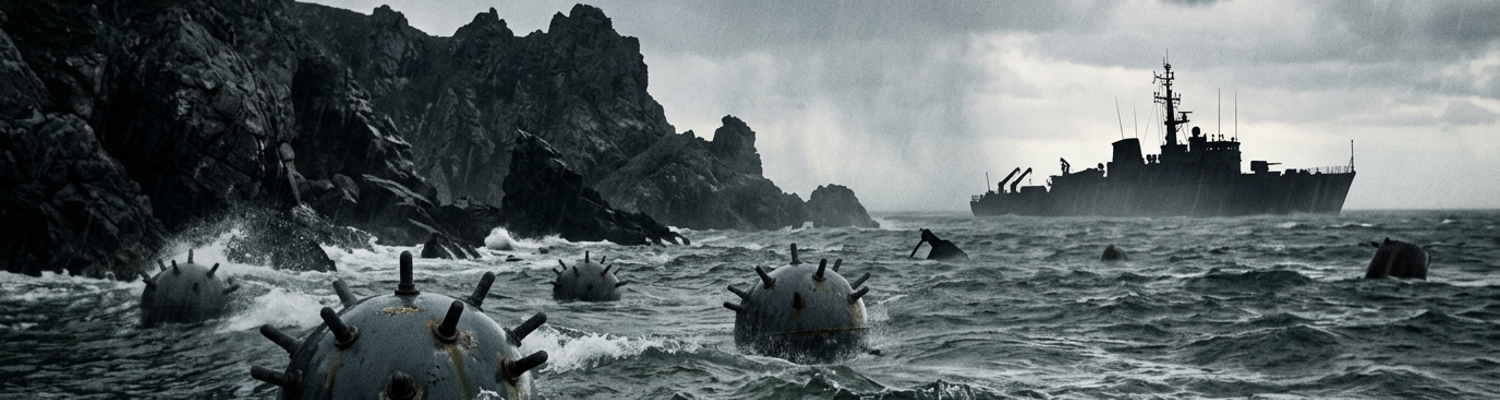
Deployment of Mark 6 Moored Contact Mines
A close review of operational logs from October and November 1941 indicates the burden of planting the South Channel fell entirely on the old steel hulls of Mine Division 9. Three converted Lapwing-class minesweepers steamed back and forth across the wind-whipped passage between the south bluffs of Corregidor and the limestone cliffs of Caballo Island. Rigged with improvised stern chutes and mechanical winches, these three vessels carried out operations under strict blackout conditions. They worked to prevent observation by Japanese merchantmen lingering outside the entrance. Working in the two-mile opening between Fort Mills and Fort Hughes, deck crews wrestled three-thousand-pound anchors across wet quarterdecks. They handled zinc-coated mooring cables and loaded spherical mine cases. Strong tidal surges ripping out toward the South China Sea regularly swung the ships off their charted bearing marks. Bridge officers relied on dead reckoning and quick compass sightings on Malinta Hill searchlight towers to maintain straight lines. The vessels dropped hundreds of anchored weapons across designated coordinate grids. Diesel engines strained against violent rip tides.
A single miscalculated drift angle threatened to detonate the entire string against the sweepers own hulls.
Archival evidence shows the Navy relied heavily on Mark 6 naval contact mines. They configured the South Channel barrier into staggered deep and shallow lines to catch incoming targets at different drafts. Technicians adjusted cable moorings so the upper tier floated fifteen feet below the low-water mark. Sixty feet deeper, a lower tier waited for submerged submarines attempting to sneak under the surface cordon. The Asiatic Fleet retrofitted these weapons with copper antenna firing mechanisms to maximize the lethal zone beyond direct hull contact. A buoyant copper wire tether extended thirty to fifty feet above the mine case. A cork float supported it.
The system operated on a simple galvanic circuit. The steel hull of an enemy ship brushed against the exposed copper antenna in salt water. The dissimilar metals formed a primary wet battery. This instantaneous galvanic voltage tripped an internal micro-relay inside the spherical casing. Current flowed to an electric detonator that ignited the three-hundred-pound trinitrotoluene charge. In heavy sea states, the mechanism misbehaved. Swift ocean currents flattened the long copper antennas horizontally. The floats pulled down and scrubbed the sensitive wiring against underwater coral formations. This triggered accidental firings that shook Caballo Island.
The machinery was blind and lethal to anyone who approached it.
The defense of the North Channel between Corregidor and the Bataan Peninsula followed a completely opposed engineering philosophy. The US Army Coast Artillery Corps rejected unmonitored contact ordnance entirely. They chose instead to place controlled buoyant mine groupings across the two-mile northern passage. Specialized Army mine planters deployed nineteen-mine groups anchored to the muddy sea floor. Each spherical casing suspended beneath the surface by calculated mooring cables. Heavy nineteen-conductor electrical cables sheathed in vulcanized rubber and lead ran from each underwater group to submerged steel distribution boxes on the ocean floor. From these junction hubs, main trunk lines snaked across the rocky bottom up into heavily armored shore firing casemates on Corregidor. Inside the casemates, Coast Artillery soldiers monitored individual galvanometer circuits on electrical switchboards. They watched needles twitch to verify electrical continuity to every submerged detonator. Spotters in camouflaged base-end stations on the slopes of Bataan tracked vessel bearings with depression position finders. They cross-plotted coordinates onto paper plotting boards. If an unidentified ship crossed the grid, casemate operators flipped a master knife switch to send high-voltage shore current into the water.
Field reports filed by harbor defense officers revealed maintaining these submerged electrical links required constant repairs. Tides churning between Mariveles Bay and Corregidor frayed the heavy lead-sheathed trunk cables against basalt ledges. Circuit paths shorted out before Army engineers could apply vulcanizing patches. By early December, several nineteen-mine clusters showed zero electrical resistance on casemate test panels.
Strategic Interdiction of the South Channel
Asiatic Fleet Commander-in-Chief Admiral Thomas C. Hart and 16th Naval District planners confronted an irreconcilable strategic trade-off in early December 1941. Japanese Vice Admiral Ibo Takahashi deployed the Third Fleet with overwhelming surface firepower. Heavy cruisers like Nachi and Haguro operated alongside multiple destroyer divisions capable of pulverizing Manila wooden supply piers within hours. Hart ordered the total interdiction of the South Channel to counter this threat. He consciously sacrificed commercial maritime access to protect the inner anchorage. Harbor defense planners understood civilian freighters and inter-island passenger steamers required continuous passage through the deep-water gap between Corregidor and Caballo Island to supply soldiers on Bataan. Laying uncontrolled Mark 6 contact mine strings directly across these standard navigation tracks turned the primary maritime thoroughfare into a lethal obstacle. Asiatic Fleet strategists accepted the heavy probability of friendly sinkings. They calculated the destruction of merchant hulls by naval ordnance was preferable to allowing a single Japanese warship to penetrate the bay.
Friendly keels were treated as expendable calculations.
Archival evidence shows the operational posture hardened into pure desperation following the complete collapse of regional air coverage. Twin-engine Mitsubishi G4M bombers from the Japanese 11th Air Fleet leveled the Cavite Navy Yard on December 10. They pulverized repair basins at Sangley Point. Companion air raids across Luzon destroyed Far East Air Force bomber strength on the ground. Patrol Wing 10 lost the majority of its Consolidated PBY-5 Catalina flying boats within seventy-two hours. Surviving aircrews withdrew southward toward Java and Australia. Deprived of aerial reconnaissance flights over the South China Sea, coastal artillery spotters on Topside could no longer track approaching enemy battle groups beyond visual range. Harbor defenses possessed no functional search radar along the coast to monitor seaward approaches after dusk. The command relied entirely on unlighted naval contact mine lines planted between Caballo Island and the Cavite shoreline to secure the maritime gateway. The South Channel minefield functioned as an unblinking barrier. It remained armed twenty-four hours a day without navigational markers or sweeping vessels to shepherd surface traffic through the darkness.
The approach to Manila Bay was now pitch-black.
A close review of operational logs indicates traversing the narrow gap required draconian maritime controls. The Inshore Patrol and the Harbor Entrance Control Post on Corregidor mandated absolute radio silence across all commercial and naval frequencies. Incoming vessels were forbidden from transmitting position reports or distress calls on 500 kilohertz. This prevented Japanese radio direction finders from pinpointing the entrance. Every ship approaching from seaward had to run completely blacked out. They doused running lights and shielded magnetic compass binnacles. Merchant masters had to time their approaches to intercept an unlit naval pilot boat near the outer western edge of the minefields off Monja Island. Recognition was managed solely by directional Aldis blinker lamps fitted with physical hoods and red-filtered lenses. They exchanged daily coded challenge letters across breaking surf. A single degree of steering drift caused by four-knot crosscurrents pushed steel hulls straight into the submerged contact horns. Any deviation from the tightly surveyed approach corridor triggered immediate counter-battery fire from Fort Mills. Gunners at Battery James and Battery Smith kept rapid-fire weapons trained continuously on the blacked-out water.
Annihilation of Cavite Navy Yard Infrastructure
Fifty-four Japanese Mitsubishi G3M2 and G4M1 bombers from the Takao and Kanoya air groups appeared over Manila Bay at twenty thousand feet at 1215 hours on December 10, 1941. They flew beyond the reach of local three-inch antiaircraft batteries. Flight formations dropped sticks of high-explosive and incendiary bombs straight across the narrow Cavite peninsula. The industrial center of the 16th Naval District was obliterated within two hours. Direct hits shattered the machine shops and the central power generating plant. The torpedo repair depot and the communications transmission towers at Sangley Point collapsed. Burning diesel fuel spread across the waterfront. The submarine USS Sealion gutted at her berth. The minesweeper USS Bittern caught fire alongside the overhaul pier. Over two hundred thousand gallons of combustible fuel oil fed flames that engulfed the naval supply storehouses. Replacement parts, brass valves, electrical wire reels, and heavy crane equipment burned. Secondary explosions tore through ammunition storage lockers. Hot shrapnel blasted through the administrative offices. The entire repair infrastructure became a smoking field of charred masonry and twisted structural steel.
The Asiatic Fleet lost its primary western Pacific repair base in a single afternoon.
When examining the historical record of the 16th Naval District Inshore Patrol, this physical annihilation forced commanding officers to invent a sea-based logistical system without dockyard support. Captain Kenneth R. Rockwell relocated his operational headquarters away from the ruined Cavite peninsula. He distributed his patrol launches and motor torpedo boats into camouflaged anchorages along the Bataan coastline. Deck officers turned to the submarine tender USS Canopus. Anchored under protective camouflage netting in Mariveles Bay, the tender functioned as a floating machine shop. Shipfitters and machinists inside the cramped workshop decks worked around the clock on twelve-hour shifts. Machinists used on-board lathes and drill presses. They manufactured replacement engine components from raw bar stock. Auxiliary engines on converted wooden-hulled district craft failed from contaminated fuel or burned-out head gaskets. Mechanics performed heavy overhauls directly on rolling open decks under canvas tarpaulins. Shipboard engineers rewired dynamos by hand. They fabricated copper piping runs with hand tools. Shrapnel punctures on hulls were patched using scrap plating cut from sunken barges.
Survival depended on what machinists could turn on a single shipboard lathe.
A close review of operational logs indicates the destruction of the naval yard ended all depot-level mine maintenance for both the Army and Navy commands. Technicians at Cavite had maintained the specialized test benches and diagnostic galvanometers required to service sensitive naval ordnance. All of these burned during the raid. Personnel assigned to the surviving Lapwing-class sweepers USS Finch and USS Quail had to maintain contact mine detonators and sweeping tackle by scavenging whatever remained unexploded along the shoreline. Crews boarded the half-sunken wreck of the Bittern before fire consumed her hull. They unscrewed wire rope clamps, salvageable paravanes, and deck winches to keep the other two sweepers functional. Ordnance men stripped sensitive micro-relays and hydrostatic firing pins from flooded Mark 6 casings recovered from shallow water. They soaked rusted electrical points in carbon tetrachloride and re-soldered broken internal wiring by hand. Sweeping gear presented equal difficulty. Salt water quickly chewed through untreated wire cables without grease supplies from shore depots. Sweeper crews spliced frayed wire runs together using salvaged marline twine. They re-bushed towing sheaves using scrap brass melted down in blacksmith forges.
Maintenance crews measured remaining wire rope by the foot.
Sinking of the Civilian Steamer SS Corregidor
Shortly before midnight on December 16, 1941, the 1,881-ton Philippine passenger steamer SS Corregidor cast off from Pier 7 along the Manila waterfront. The vessel departed without receiving official clearance from the 16th Naval District Inshore Patrol. Captain Apolinar Alvarez ordered his mooring lines dropped into the murky waters of Manila Bay. He ignored standard harbor directives that barred merchant departures after sunset. Military authorities had established a rigid gate control system through the Harbor Entrance Control Post. Outbound ships were required to wait for a naval minesweeper or an armed district craft to guide them through the surveyed gap between the defensive mine barriers. Alvarez possessed no assigned guide craft. He had no updated minefield charts showing the newly laid contact strings. He lacked authorized clearance routing from naval port directors. Port authorities had closed down harbor traffic offices at dusk to enforce regional blackout orders. The vessel attempted the twenty-five-mile transit down the bay alone. The master gambled that his personal knowledge of the bay would allow him to run the South Channel under dead reckoning before dawn.
The ship slipped into open water without an escort.
When examining the historical record of the passenger manifest, port officials could not establish an accurate head count. Frantic civilians overwhelmed dockside gangways. Over one thousand refugees, naval personnel, and Philippine government officials packed every available square foot of the merchant steamer. Displaced families fleeing anticipated Japanese air attacks crowded the open promenade decks. They sat directly on cargo crates and canvas bedrolls alongside dozens of university students trying to reach the southern Visayas. Prominent political figures mingled with enlisted sailors. This included members of the Philippine National Assembly and seven United States Navy sailors who had missed previous fleet movements. Belowdecks, passengers crammed into small staterooms and dining saloons. Civilian luggage blocked access hatches to emergency lifeboats. Blackout orders enforced across the bay forced the bridge crew to extinguish running lights and interior cabin lamps. Dark paint covered the portholes. Deckhands shielded the wheelhouse binnacle with canvas hoods. The crowded vessel plunged into near-total darkness while the reciprocating engines ran at twelve knots.
Nobody on board wore life preservers.
A close review of operational logs indicates the steamer entered the northern mouth of the South Channel shortly after 0100 hours on December 17. The ship missed the narrow safe corridor cleared by the Inshore Patrol. Tidal currents running at three knots out toward the South China Sea pushed the vessel three miles south of her intended heading. The ship drifted right into the submerged cordon laid between Corregidor Island and Caballo Island. Coast Artillery lookouts stationed at Battery Smith on Corregidor spotted the unlit silhouette through optical tracking instruments. They signaled the intruder with a hooded red blinker lamp, demanding immediate radio identification. Watchmen on the Corregidor missed the low-power red light against the jagged black terrain. At 0112 hours, the port side of the steamer struck an anchored Navy Mark 6 contact mine floating fifteen feet beneath the surface. The impact crushed an external lead horn along the casing. This shattered an internal glass vial that activated a chemical cell. Three hundred pounds of cast trinitrotoluene ignited.
Detonation shockwaves tore open the bottom hull plating. Structural bulkheads crushed inward. The primary steam dynamos failed instantly. Seawater inundated the fire rooms and ruptured high-pressure steam lines. This incapacitated the engineering crew and threw the crowded decks into complete darkness. Without auxiliary electrical power, deckhands could not operate cargo winches. A severe list to port rolled the lower lifeboats directly into the sea before crews could release the gripes. Rapid downflooding pulled the passenger liner stern-first into the depths in under ten minutes. Hundreds of trapped passengers were sucked beneath the churned surface.
Systemic Communications Failure and Inshore Rescue
The flash of the detonation at 0112 hours alerted Lieutenant John D. Bulkeley at the Sisiman Cove motor torpedo boat base on the southern tip of Bataan. Bulkeley ordered three wooden eighty-foot Elco boats of Motor Torpedo Boat Squadron 3 into the South Channel. PT-32, PT-34, and PT-35 ran on their three supercharged Packard twelve-cylinder aviation engines. The boats reached the coordinates within fifteen minutes. They throttled down to dead slow as they entered the surveyed boundaries of the minefield. Coxswains guided the light mahogany hulls through thick black bunker oil and field debris between Caballo Island and Corregidor. Crews held handheld hooded battle lamps low over the gunwales. They searched for silhouettes in the water while keeping a sharp visual lookout for the copper antennas and lead horns of unexploded Mark 6 contact mines bobbing just beneath the surface. Propeller wash threatened to pull drifting mines into the thin wooden hulls. Enginemen idled the center shafts and maneuvered strictly on outboard screws. Enlisted sailors lay flat across the forward forecastles and side decks. They manually hauled oil-slicked survivors out of the sea over the torpedo tube mountings and life rail nettings.
The wooden patrol boats maneuvered through floating explosives in total darkness.
When examining the historical record of the rescue counts, local naval authorities faced chaotic tallies on the morning of December 17. The patrol craft and the auxiliary minesweeper USS Quail fished approximately 280 living passengers out of the churned debris field. Most suffered from severe saltwater poisoning, lung damage from swallowing heavy fuel oil, and blunt trauma caused by deck machinery breaking loose as the liner settled. Between 900 and 1,200 passengers perished in the blacked-out water before rescue craft could reach them. Swimmers weighed down by heavy civilian clothing and waterlogged canvas lifejackets were swept out into the deep water of the South China Sea. Three-knot tidal currents ran west through the Caballo passage. Dozens of trapped passengers were pulled under by the suction of the stern as it plunged toward the seabed. Dead bodies washed ashore across the rocky beaches of Bataan and the fortified base of Fort Hughes for three days.
Waterlogged civilian clothing dragged hundreds down into the seabed trenches.
A close review of operational logs indicates post-disaster inquiries focused directly on the total systemic failure between civilian port authorities in Manila and naval routing officers with the 16th Naval District Inshore Patrol. Civilian harbor dispatchers at Pier 7 operated without a secure teletype line or telephone link to the Harbor Entrance Control Post on Corregidor after daytime office hours ended. The civilian port captain cleared outbound vessels through verbal arrangements without logging outbound departures with naval plotters stationed at Fort Mills. Naval port directors had neglected to distribute updated nautical charts of the South Channel minefields to civilian merchant captains. They feared Japanese espionage networks active around Manila Bay would compromise the coordinates of the secret gaps. Captain Alvarez cast off into the bay believing the southern passage remained open for routine commercial navigation. Coastal Artillery battery commanders at Fort Mills received no departure dispatch on the encrypted naval circuit. Spotters classified the fast-approaching steamer as an unidentified hostile contact until the acoustic shockwave of the mine explosion reached shore observation posts.
The Navy locked the mine charts in district safes while civilian ships sailed blind.
Submarine Egress Sweeps by Lapwing Class Minesweepers
By late December 1941, the burden of keeping the egress channel clear fell upon the twin steel hulls of the USS Finch and USS Quail. Operating out of Sisiman Bay and Mariveles, both converted Lapwing-class vessels pushed south into the surveyed safe corridor between Corregidor and Caballo Island between 2100 and 0300 hours. Sweeper crews rigged mechanical Oropesa sweeps with serrated cutter jaws alongside buoyant kite floats. They dragged steel wires at eight knots through black water. Riptides repeatedly snapped eight-hundred-pound mooring cables holding Army buoyant mines and Navy Mark 6 units. Hundreds of tethered charges transformed into untracked free-floating hazards directly inside the six-hundred-yard transit lane. Bridge lookouts used handheld binoculars without night vision equipment. They strained to identify floating chemical horns bobbing in the foam before the bow cleaved into them. When sweep wires caught mooring cables, deck hands hauled the severed cases alongside using wooden grapple poles. They detonated the floating charges with Springfield M1903 rifle fire at eighty yards distance.
Riflemen fired directly into floating explosives thirty yards off the quarterdeck.
When examining the historical record of Asiatic Fleet movements, these nightly sweeps alone kept open the deep-water escape route for fleet submarines. These submarines ran personnel, ammunition, and critical intelligence out of the besieged bay. Lieutenant Commander Charles W. Ferrall guided the damaged USS Seadragon through the cleared corridor on the night of December 16. The submarine ran on diesel engines with scorched hull plates and a jury-rigged steering mechanism following the Cavite yard bombardment. Ten days later, Lieutenant Commander Chester C. Smith brought the USS Swordfish through the same narrow lane to load personnel and military cargo bound for Surabaya. Submarine skippers were forced to make the outbound transit on the surface along a bearing of two hundred forty degrees. They maintained barely five knots through the cleared wire corridor to avoid triggering acoustic devices. Deviation of fifty yards meant striking unmoored contact arrays drifting off the Caballo shoals. Finch and Quail ran sweep passes precisely two hours ahead of every scheduled submarine transit. They cleared fresh drift ordnance before the black steel hulls reached the outer channel buoys off Monja Island.
A fifty-yard steering error meant running a fleet submarine directly onto an unmoored Mark 6 contact horn.
A close review of operational logs indicates keeping sweep gear functional forced engineering crews to salvage parts from the incinerated ruins of the Cavite Navy Yard and Corregidor dock facilities. Japanese air raids had leveled the secondary electrical repair shops on December 10. The Navy supply of replacement commutators, insulated copper wiring, and specialized contact points for magnetic sweep generators was destroyed. Mechanics on the Finch and Quail dismantled flooded dynamos from bombed storage sheds at Sangley Point. They pulled armature assemblies and carbon brushes out of the rubble to keep shipboard sweep generators firing. Technicians repaired magnetic sweep tails by wrapping frayed electrical cables in vulcanized canvas. They sealed the splices with boiling tar stripped from warehouse roofing debris. Acoustic sweep vibrators, shaken to pieces by near-miss depth charges and bomb concussions, were rebuilt aboard the submarine tender USS Canopus using copper shims cut from damaged boiler tubes. Machine shop hands worked twenty-hour shifts turning discarded automotive drive shafts into replacement hinge pins for mechanical cutting jaws.
Electricians insulated high-voltage sweep cables using roofing tar and scrap canvas.
Archival evidence demonstrates the tactical math grew more severe each week as spare parts completely vanished from inventory books. By mid-January 1942, the two sweepers possessed only five functional explosive cutters and less than two thousand feet of unbroken steel sweep wire between them. Saltwater corrosion ate into unsheathed copper leads on the magnetic cables. Electrical output dropped to forty percent. The ships had to make three redundant passes over the same lane to ensure a sterile path. Finch ran her magnetic gear at maximum amperage, risking generator fires belowdecks to detonate submerged magnetic firing units before outbound submarine hulls arrived. Each morning at 0430 hours, after finishing the final acoustic pass, the vessels tucked back into the shadow of the Bataan bluffs near Mariveles. They strung dried foliage over their 188-foot steel hulls to conceal their location from Japanese reconnaissance aircraft operating from Clark Field.
Area Denial and the Paralysis of Maritime Resupply
During the opening three weeks of December 1941, the lethal combination of anchored Mark 6 contact lines and Army controlled mine groupings held the Imperial Japanese Navy Third Fleet completely outside the mouth of Manila Bay. Vice Admiral Ibo Takahashi deployed the heavy cruisers Nachi, Haguro, and Ashigara alongside Destroyer Squadron 5 to sweep the western approaches of Luzon. His surface commanders refused to commit combatants into the South Channel. Japanese naval hydrographic charts recovered after the campaign confirmed Third Fleet intelligence identified the two-mile gap between Corregidor and Caballo Island as an impassable barrier. It was anchored by underwater ordnance and covered by the 12-inch coastal rifles of Battery Smith and Battery Hearn. Sweeping the deep channel required slow coordinated sweeps by auxiliary vessels. This operation was impossible under the direct crosshairs of Coast Artillery depression position finders mounted on Malinta Hill and Fort Hughes. Japanese destroyers like Yamakaze and Kawakaze prowled beyond the ten-fathom curve outside Monja Island. They never attempted to force an entry past the unlighted buoy line.
Takahashi kept his heavy cruisers thirty miles out in the South China Sea.
When examining the historical record of Japanese 14th Army operations, this total closure of Manila Bay dictated the geography of the entire invasion of Luzon. Japanese Imperial General Headquarters had originally analyzed a direct amphibious assault onto the Manila waterfront. This would have seized the capital city, its deep-water piers, and the rail terminals within forty-eight hours of crossing the beaches. Facing the impassable mine barriers between Bataan and Cavite Province, Lieutenant General Masaharu Homma abandoned direct entry. He diverted eighty-five transport ships carrying the 48th Division to the exposed shores of Lingayen Gulf on December 22. Two days later, another detachment of seven thousand men from the 16th Division landed at Lamon Bay on the eastern coast of Luzon. These split landing sites forced Japanese infantry into prolonged road marches across one hundred twenty miles of open highway from the north and seventy miles across the mountainous Tayabas Isthmus from the southeast. The delay provided the United States Army Forces in the Far East fourteen days to execute the retrograde movements of War Plan Orange-3. Fifty thousand regular troops and Filipino recruits channeled into defensive lines across Bataan before Japanese motorized columns could close the junction at San Fernando.
MacArthur completed the withdrawal into Bataan while Homma was still clearing road obstacles on Route 3.
A close review of operational logs indicates this barrier inflicted a catastrophic cost on the American defense by paralyzing friendly maritime movement. Sealing the two channels eliminated the waterborne supply lines needed to sustain the combined garrison of eighty thousand military personnel and twenty-six thousand civilian refugees packed into the Bataan Peninsula. Civilian merchantmen and fuel barges carrying high-octane gasoline could not move freely between the piers of Manila and the anchorages at Mariveles without risking destruction on unswept contact horns. The blockade cut off access to large stockpiles of polished rice, canned meats, and medical supplies stored in civilian warehouses in Tondo and the Port Area. When General Douglas MacArthur declared Manila an open city on December 26, thousands of tons of rations were left behind on the docks. Military authorities could not use safe maritime channels back into the bay.
Ration allowances for front-line units on Bataan dropped by fifty percent on January 5.
Harbor defense records reveal inbound blockade runners attempting to haul ammunition and quinine from the Netherlands East Indies and Australia faced equal paralysis. Vessels organized under the Southwest Pacific Command carried millions of rounds of .30-caliber ammunition and field rations toward Luzon. Naval dispatchers could not provide guaranteed clearance corridors through the minefields under continuous Japanese air observation. Both blockade runners were intercepted or diverted before reaching the entrance to Manila Bay. The garrison was completely isolated from maritime resupply. The minefield functioned as an area-denial barrier. It sealed the defenders inside an operational perimeter devoid of food, engine lubricants, and replacement components. Quartermaster officers at Fort Mills recorded warehouse stocks on Corregidor held only a thirty-day reserve of flour and canned salmon for the Harbor Defense personnel on January 23, 1942.