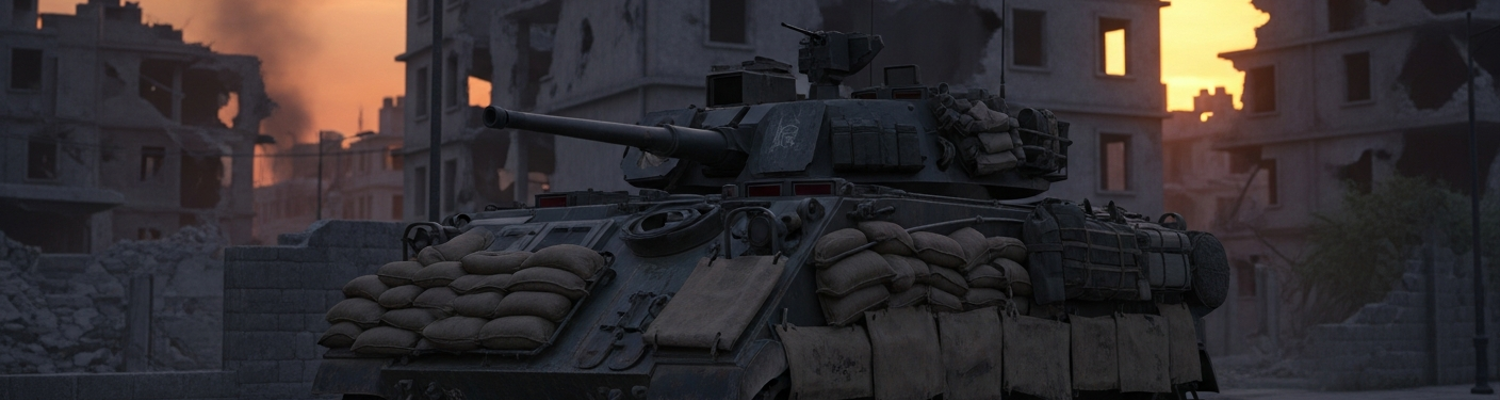

M113 Original Design Specifications
The driver’s T-bar controls went slack. A high-pitched whine replaced the steady growl of the transmission. The grinding of gears signaled catastrophic failure. Within moments, the 12-ton box of metal, a machine designed for mobility above all else, was stationary and exposed. This was the ever-present risk of the M113, a vehicle conceived not as a frontline fighter, but as a simple armored personnel carrier. An examination of its development shows the Food Machinery and Chemical Corporation (FMC) designed the M113 in the late 1950s to solve a specific problem: how to move troops to a battle under armor, have them dismount, and then have the vehicle retreat to safety. Its doctrinal function was as a battlefield transport. Entering service in 1960, its specifications were dictated by this singular purpose. It required a crew of only two, a driver and a commander, while its rear compartment could hold eleven infantrymen. By the time of its widespread use in Vietnam, early gasoline engines had been supplanted by the more reliable and less flammable Detroit Diesel 6V53, a two-stroke V6. The entire design was an exercise in utility, a direct successor to the heavier M75 and less reliable M59 carriers, intended to be mass-produced, air-transportable, and amphibious. Its role was movement, not medical care.
The vehicle was not a hospital.
Archival blueprints and production specifications from the early 1960s show a machine completely devoid of dedicated medical features. The troop compartment was a spartan, unadorned box. Two simple, inward-facing benches, made of aluminum, were folded down from the hull walls for the eleven infantry passengers. There were no litter racks for securing wounded soldiers, no power outlets for running medical equipment, and no climate control beyond a basic ventilation fan. Lighting was dim, sufficient only for troops to find their way in and out of the rear ramp, not for a medic to find a vein or assess a wound. The floor was bare, ribbed aluminum plate, offering no grip or stability for casualties, who would slide across the vibrating deck with every movement of the vehicle. Any attempt to use the M113 for medical evacuation was an act of pure improvisation. Medics were forced to lay the grievously wounded directly on the floor, often amongst ammunition cans, discarded equipment, and the mud-caked boots of the crew.
Its armor could not reliably stop a heavy machine gun round.
This vulnerability was a direct consequence of the design’s primary constraint: weight. To meet the Army's requirement for a vehicle that could be dropped from a C-130 and swim across rivers, designers at FMC and Kaiser Aluminum utilized 5083 aircraft-grade aluminum alloy for the hull. This made the M113 revolutionary, the first aluminum-hulled combat vehicle to see mass production. The protection this offered was minimal. The armor plating, ranging from 28mm on the floor to 44mm on the frontal arc, was rated only to stop 7.62mm rifle rounds and low-velocity artillery fragments. Against the weapons increasingly fielded by NVA and Viet Cong forces, this was not enough. The 12.7mm DShK heavy machine gun could perforate the M113’s thin skin. The ubiquitous RPG-2 and RPG-7 anti-tank rockets could disable the vehicle with a single, catastrophic impact. Operational records (NARA Record Group 472) frequently document M113s lost to such weapons. This level of protection was a calculated risk for a vehicle meant to dash from one covered position to another, but a deadly flaw for a machine forced to stop in the open to load wounded men.
Conventional Medevac Doctrine Limitations
Operational logs reveal that the officially designated M113 Armored Ambulance was almost a phantom on the battlefield. This variant, while based on the ubiquitous M113A1 chassis, was internally a very different machine. It was designed to carry four litter patients or a combination of walking wounded and a medic. To accommodate the stretchers, the standard troop benches were removed and replaced with folding litter racks that suspended casualties in two tiers along the hull walls. Schematics show provisions for better interior lighting and a ventilation system intended to clear the air in the cramped compartment. Yet, these vehicles were produced in insufficient numbers. They were rarely seen in the forward-most areas where they were needed most. Their allocation was prioritized for rear-echelon medical battalions, not the mechanized infantry and cavalry units in constant contact with the enemy. For a grunt bleeding out in a rice paddy, the M113 Armored Ambulance was more of a theoretical concept than an available asset.
The entire framework for American medical evacuation was built upon the lessons of World War II and Korea, envisioning large-scale conventional battles fought over relatively open ground. Doctrine called for a clear chain of evacuation. Wounded would be moved from the point of injury to a battalion aid station, then to a clearing company, and onward to larger field hospitals. This process depended on secure rear areas and established, predictable front lines. Urban combat, particularly the kind experienced during the Tet Offensive in cities like Hue, shattered this model completely. There were no front lines. A street could be secure one moment and the site of a deadly ambush the next, with fire coming from rooftops, sewers, and shattered buildings simultaneously. Setting up a static aid station in such an environment was an invitation for it to be overrun or targeted by mortars. The very act of carrying a wounded soldier on a stretcher through rubble-choked streets, which could take hours to traverse a few blocks, exposed the bearers and the casualty to constant sniper fire. Casualty rates for U.S. Marines during the house-to-house fighting in Hue were catastrophically high. The wounded rate peaked at 44.4 per 1,000 men per day. Standard operating procedures were not just ineffective; they were suicidal.
This doctrinal collapse forced a desperate reliance on two primary, and deeply flawed, alternatives: unarmored ground vehicles and helicopters. The standard field ambulance was the Dodge M43, a variant of the M37 truck, a design that had entered service in the early 1950s. These were thin-skinned vehicles with a canvas cover over the rear patient compartment. They offered absolutely no protection from rifle fire, shrapnel, or mines. Sending an M43 into a hot urban zone was a near-certain death sentence for the driver, the medic, and any patients they were attempting to rescue. The other icon of Vietnam medevac, the UH-1 helicopter, proved equally problematic in a dense urban battlespace. Helicopter evacuation missions were revolutionary in their ability to move casualties quickly over the jungle, but a city presented a different set of mechanical and tactical challenges. Finding a landing zone was nearly impossible amidst narrow streets, telephone wires, and mountains of debris. A helicopter attempting to hover or land was a slow, predictable, and highly vulnerable target for RPGs and heavy machine guns firing from surrounding rooftops. Pilots reported that even navigating the rotor wash in confined spaces could kick up clouds of debris, blinding them and potentially damaging the aircraft. Each evacuation attempt became a high-risk gamble, weighing the life of the wounded against the potential loss of a valuable aircraft and its highly trained crew.
1969 Urban Combat Environment Demands
The fighting in Hue during the 1968 Tet Offensive altered the operational environment for American forces. By 1969, the war had metastasized, sprawling from the jungle into the dense, complex terrain of South Vietnam’s cities. After-action reports from units like the 1st Marine Division show a tactical environment that neutralized many of the U.S. military’s advantages. The fighting was a three-dimensional nightmare. Engagements were not linear but vertical, with fire coming from rooftops, second-story windows, and sewer-level positions simultaneously. The architectural makeup of cities like Hue and the outskirts of Saigon meant combat was a matter of meters, not kilometers. Forces advanced by blowing holes in the walls separating adjoining buildings, fighting room-by-room through residential blocks and commercial districts. Streets became pre-sighted killing zones for machine guns and rocket-propelled grenades, forcing infantry to find alternate, slower routes through rubble and debris. This style of warfare, a contest of attrition, rendered the M113’s designed purpose as a battlefield transport almost entirely moot.
This was not a battlefield for vehicles.
The intensity of this house-to-house fighting generated combat casualties at a rate that overwhelmed established medical procedures. During the heaviest periods of fighting in Hue, U.S. Marine wounded-in-action rates reached 44.4 per 1,000 men per day. These were not simple rifle wounds. The prevalence of grenades, booby traps, and RPGs in confined spaces produced catastrophic injuries requiring immediate, advanced intervention. Amputations from explosives were significantly higher than in previous conflicts. The conventional medevac chain, which relied on moving a casualty from a point of injury to a battalion aid station, completely broke down. There were no secure front lines or safe rear areas. Carrying a wounded man on a stretcher through streets raked by sniper fire was a slow, agonizing process that exposed the casualty and the bearers to continuous danger. The sheer volume of wounded, both military and civilian, saturated every level of medical care. A single firefight in one city block could produce more critical patients than an entire company aid station was equipped to handle, creating a desperate need for a method to rapidly extract multiple casualties under fire.
This environment was further complicated by a large and unpredictable civilian population. Unlike jungle operations where the population was sparse or had been relocated, the cities were teeming with non-combatants. Archival records and civilian memoirs from the period detail streets crowded with refugees attempting to flee the fighting, complicating targeting and movement. Distinguishing between Viet Cong sympathizers and terrified civilians was a constant challenge for American troops. NVA and VC forces expertly used this to their advantage, firing from buildings occupied by families and melting back into crowds. Rules of engagement were a constant source of debate, restricting the use of heavy firepower that could have suppressed enemy positions but would have resulted in unacceptable civilian deaths. Any vehicle attempting a medical evacuation had to navigate this chaotic human landscape. It meant a slow, careful crawl through packed streets, creating a predictable, vulnerable target for ambush. The presence of civilians also meant that medical teams were often called upon to treat wounded non-combatants, placing an even greater strain on limited supplies and personnel.
Battlefield Ingenuity and Ad Hoc Solutions
The tactical equation in the rubble of South Vietnam’s cities had a brutal simplicity. A wounded soldier was a stationary target. A stationary target drew fire, and the process of evacuating that single casualty under fire often created several more. This grim cycle ground infantry platoons to a halt, pinning them in exposed positions for hours. After-action reports from 1969 reveal that the presence of wounded altered unit behavior, forcing commanders to choose between holding a position to protect the injured or risking their abandonment to save the larger force. Carrying a man on a stretcher through debris-choked streets was a slow and perilous task, making the rescue party a deliberate, predictable target for snipers and mortar teams. The doctrinal reliance on helicopter medevac, so effective in the jungle, was nullified by the urban landscape of narrow streets and wires. A hovering UH-1 was an easy kill for an RPG gunner on a rooftop. The urgent need was for a vehicle that could withstand small arms fire, navigate the debris, load multiple casualties quickly, and get them out of the kill zone.
It had to be a tracked vehicle.
It had to be the M113.
The response came not from a high-level command or a research and development office, but from the motor pools and field workshops. Combat engineers and maintenance crews, armed with little more than cutting torches, welding equipment, and scavenged materials, began to transform the M113 into an improvised armored ambulance. These modifications were entirely unauthorized, a direct violation of established procedure. Mechanics from maintenance battalions, often working with troops from armored cavalry and engineer units, were the primary innovators. They cut gun shields from the hulls of wrecked vehicles and welded them around the commander’s .50 caliber machine gun station, a modification first pioneered by ARVN troops and later standardized in the ACAV kit. They bolted or welded extra steel plates to the floor of the vehicle to provide some measure of protection against mines and booby traps, a constant threat in urban clearings. To absorb blast effects, crews would line the interior floor with sandbags, a simple but effective field expedient.
The first examples of these triage tracks were crude, functional beasts, each one unique to the crew that built it. Archival photographs and unit logs show a pattern of consistent, unofficial upgrades. Inside the spartan aluminum box, the inward-facing troop benches were often the first things to be ripped out. In their place, mechanics welded simple angle-iron brackets to the hull walls, creating crude but effective litter racks capable of holding two, sometimes four, stretchers in a tiered configuration. This was a direct echo of the official M113 ambulance design, but recreated with scrap metal and guesswork. There was no dedicated medical lighting, only whatever the crew could wire into the vehicle’s 24-volt system. The interior was often crammed with ammunition cans, C-ration crates, and the personal gear of the crew, leaving little room for a medic to work. On the exterior, alongside the added gun shields, many crews attached wire mesh screens to the sides, a technique developed to prematurely detonate RPG rounds before they could penetrate the thin aluminum hull. These were not ambulances in any doctrinal sense; they were armored extraction platforms, designed for one purpose: to get in, load the wounded, and get out, surviving the journey.
Improvised M113 Medevac Configurations
Maintenance logs from units like the 11th Armored Cavalry Regiment reveal the first and most urgent modification was the addition of external stretcher racks. The standard M113 could only accommodate a handful of wounded men lying on the cramped, vibrating floor plate, a wholly inefficient method when an entire squad was hit. The solution, implemented by maintenance crews with welding torches and scrap steel, was to treat the vehicle’s hull as a scaffold. They fabricated crude but strong frames from angle iron and welded them directly to the flat sides of the M113’s aluminum superstructure. These racks were built to the dimensions of a standard canvas litter, allowing two, and in some cases four, stretchers to be strapped to the outside of the vehicle. This innovation had a sharp tactical benefit: it drastically reduced the time spent in a kill zone. Instead of a slow, sequential loading of casualties through the rear ramp, multiple wounded soldiers could be secured to the exterior almost simultaneously, allowing the vehicle to begin moving to a secure aid station much faster.
The wounded strapped to the outside were completely exposed to continued enemy fire, shrapnel, and the elements. There was no protection. Yet, in the calculus of urban combat, the reduction in time spent stationary in a pre-sighted street often meant the difference between life and death for the entire crew and its passengers. The choice was between a high probability of taking more casualties while loading and a lower probability of the externally mounted patients being hit during the rapid extraction.
The thin aluminum skin of the M113 offered almost no real protection against the heavy machine guns and rocket-propelled grenades common in urban firefights. To counter this, crews began adding their own armor, a practice that became a hallmark of the vehicle’s service in Vietnam. The most common addition was sandbags, which were piled on the floor to provide a layer of absorption against mine blasts and laid across the top deck to dampen the effect of incoming mortars. A more significant and labor-intensive modification involved scavenging steel plate. Field maintenance units and resourceful crews would cut armor sections from destroyed vehicles, friendly and enemy alike, and weld them onto the M113’s hull. Priority was given to the front glacis plate and the side sponsons. Another key innovation, first developed by South Vietnamese forces and later adopted by American units in kits, was the Armored Cavalry Assault Vehicle (ACAV) modification. This included a circular gun shield of steel plate around the commander’s .50-caliber machine gun and often two additional M60 machine gun stations with smaller shields near the rear cargo hatch. Some units went further, attaching chain-link fencing or wire mesh screens to stand-off mounts on the hull, a technique designed to detonate RPGs before they could penetrate the main armor. These additions were not without consequence; the extra weight strained the vehicle’s engine, transmission, and suspension, but for crews facing a constant barrage of anti-tank rockets, it was a necessary burden.
Inside, the M113 was a spartan box, never intended for medical care. The first step for converting it into a triage platform was to rip out the aluminum troop benches that lined the walls. This cleared the entire rear compartment, turning the floor into a workspace for the medic. To secure casualties inside, crews often welded simple angle-iron brackets directly to the interior walls, mimicking the tiered litter rack system of the official but rare M113 ambulance variant. This allowed them to suspend two litters above the floor, freeing up space for a medic to treat another casualty below or to tend to walking wounded. Storage was a major concern, and photographs from the period show ammunition cans welded to the interior walls to serve as secure, waterproof containers for bandages, morphine, and IV bags. Lighting, barely adequate for troop transport, was wholly insufficient for medical tasks. Crews would wire in extra dome lights scavenged from wrecked trucks and jeeps, tapping them directly into the vehicle’s 24-volt electrical system. The result was a loud, cramped, and dimly lit treatment bay, but one that was under armor and mobile. It allowed a medic to begin critical life-saving interventions while the vehicle was still moving away from the battlefield.
Urban Casualty Extraction Effectiveness
After-action reports from 1969 detail the new tactical equation. When a patrol was ambushed in a dense urban grid, the difference between a successful extraction and a unit being wiped out was measured in minutes. Before the widespread adoption of improvised triage tracks, retrieving a single wounded man from a contested street could take upward of half an hour. This was a slow, agonizing process for four stretcher bearers who presented a large, slow-moving target. The arrival of a modified M113 altered this geometry of survival. Instead of waiting for a lull in the fighting that might never come, the tracked vehicle could advance directly into the kill zone, its aluminum hull deflecting rifle rounds and shrapnel that would have shredded unarmored rescuers. A driver, buttoned up and peering through his vision blocks, could push the vehicle right up to the casualty’s position. This act alone compressed the most dangerous phase of the evacuation, the exposed, stationary loading process, from a minutes-long ordeal into a frantic 30-second scramble.
Crews reported driving the vehicle’s rear ramp directly over a wounded soldier, providing a temporary shield of 12 tons of metal while he was loaded. The external stretcher racks allowed multiple casualties to be secured simultaneously rather than sequentially. A squad with three men down was no longer pinned for an hour making three separate rescue attempts; they could be loaded and moving in less than five minutes. This reduction in time spent stationary under fire had a powerful effect, saving not only the initial casualties but also the medics and riflemen tasked with their rescue.
The primary factor in increased survivability rates was the vehicle’s ability to serve as a mobile, armored treatment bay. The concept of the golden hour, the period after traumatic injury where prompt medical intervention has the highest likelihood of preventing death, was demonstrated with clarity. A soldier bleeding out from a femoral artery severed by shrapnel had no hope on a stretcher in the middle of a street. Inside the relative safety of the M113’s hull, even while the vehicle maneuvered away from the firefight, a medic could begin immediate, life-saving work. Archival medical corps records from units employing these vehicles show a direct correlation between their use and a decrease in the Died of Wounds statistic for casualties who had survivable injuries but would have previously perished from blood loss or shock during a protracted evacuation. The ability to apply tourniquets, insert IVs to administer fluids, and dress massive wounds while under armor and on the move brought the aid station directly to the patient.
This mobile capability was a direct result of the internal modifications. With troop benches ripped out, the floor became a workspace. The tiered litter racks, welded from scrap angle iron, allowed a medic to manage multiple patients at once. Ammunition cans welded to the interior walls held sterile bandages and IV bags, protected from the dirt and chaos outside. For the first time, a medic could stabilize a patient during the most violent phase of the battle, the extraction itself, delivering a casualty to a battalion aid station who was already receiving care, not one who was minutes from death.
The machine’s effectiveness was ultimately dependent on its ability to traverse the urban ruin while fighting back. A standard wheeled ambulance, like the Dodge M43, was rendered useless by a single collapsed wall or debris-filled street. An examination of the M113’s mechanical design reveals why it excelled. Its power came from the 212-horsepower Detroit Diesel 6V53 engine, providing sufficient torque through the Allison TX-200-2A transmission to push through wreckage. The vehicle’s torsion bar suspension and wide tracks distributed its weight, allowing it to climb over rubble piles and navigate cratered roads that would immobilize wheeled vehicles. Unit logs from the 11th Armored Cavalry Regiment frequently document drivers using the vehicle as a battering ram to clear paths. This mobility was paired with a newfound lethality. The ACAV gun shields provided the commander at his .50-caliber machine gun and the two rear gunners at their M60s with enough protection to lay down a sustained volume of suppressive fire. The M113 was no longer a passive box; it fought its way in and fought its way out, creating its own bubble of fire superiority that protected the loading process.
Doctrine Versus Battlefield Adaptability
Operational archives reveal a glaring disconnect between the men fighting in the streets and the established military system supposedly supporting them. There was no standardized training manual for a Medevac M113 with welded-on steel plates and jury-rigged litter racks. The vehicle’s handling characteristics were completely alien to a driver trained on a factory-model APC. Adding several tons of scavenged armor and sandbags raised the vehicle’s center of gravity and placed immense strain on the suspension and transmission, making it sluggish and prone to rollovers on uneven, rubble-strewn ground. Drivers learned through trial and error, often mentored by the very mechanic who had just finished welding a new gun shield to their commander’s cupola. This ad hoc instruction was a dangerous necessity. Medics, accustomed to working in established aid stations, had to learn to perform delicate procedures inside a vibrating, dimly lit metal box, often using medical supplies stored in repurposed ammunition cans welded to the hull walls. There was no formal instruction; it was a craft passed from one exhausted crew to the next during brief lulls in combat.
The entire logistical tail for these battlefield innovations existed outside of official channels. A quartermaster could not order a replacement gun shield cut from the hull of a destroyed T-54 tank or a set of litter brackets fabricated from scrap angle iron. Acquiring the raw materials was a constant exercise in scrounging, bartering, and outright theft. A maintenance sergeant in an armored cavalry unit might trade a case of captured enemy rifles to a Navy Seabee battalion in exchange for access to their heavy-duty welding equipment and a few lengths of steel I-beam. Welding rods, cutting torch acetylene, and even basic nuts and bolts became precious commodities. A review of unit maintenance logs shows a constant struggle to keep these unique vehicles running. When a custom-fabricated suspension component failed under the extra weight, there was no corresponding part number in the Army’s supply system. Mechanics had to manufacture a new one from scratch, often in primitive field workshops with limited tools, turning every major repair into a significant engineering challenge.
Official command structures, particularly those far from the front, initially viewed these modifications with deep suspicion. From the perspective of MACV headquarters, unsanctioned alterations to standard-issue equipment were a flagrant breach of military discipline. They invalidated vehicle warranties, created a maintenance and supply nightmare of non-standard parts, and represented a dangerous level of autonomy among front-line units. Early in the process, there are anecdotal accounts of unit commanders facing reprimands for allowing their men to alter government property. They were caught between enforcing top-down regulations and the undeniable fact that these modified vehicles were saving the lives of their soldiers. The turning point came not from a change in policy, but from the overwhelming evidence of after-action reports and casualty statistics. Units employing the improvised triage tracks demonstrated a marked increase in casualty survival rates.
This ground-level reality slowly forced a reversal in the official position. While the most extreme modifications were never formally approved, the core concepts began to be standardized. The Armored Cavalry Assault Vehicle (ACAV) kit, which included a circular steel gun shield for the commander’s .50-caliber machine gun and two additional M60 stations, was a direct result of field-expedient designs first pioneered by ARVN and U.S. troops. The Army began to procure and issue these kits, representing a rare instance where battlefield innovation flowed uphill, forcing doctrine to adapt to the brutal necessities of urban combat.
M113 Medevac Legacy and Design Evolution
The ad-hoc triage trackers of 1969 were a field-expedient proof of concept, and their influence echoed through decades of military vehicle procurement. Army development programs in the 1990s show a formal acknowledgment of the M113’s medevac deficiencies. Planners drafting requirements for the next generation of armored ambulances codified the lessons learned in the alleys of Hue. The M1133 Medical Evacuation Vehicle (MEV), a variant of the Stryker wheeled fighting vehicle, is a direct descendant of the Vietnam-era improvisations. Its design features are a point-by-point solution to the failures of the original M113. Instead of a cramped, flat-topped box, the Stryker MEV features a raised rear compartment, giving medics enough room to stand and work on patients without crouching. It can accommodate four litter patients or six ambulatory casualties, a capacity dictated by the mass casualty events common in urban warfare. The interior is not a bare metal shell, but an integrated medical suite with a hydraulic litter lift system, on-board suction, and climate control.
The M113’s thin aluminum skin, revolutionary in the 1960s for its light weight, became a fatal liability in the conflicts of the 21st century. A review of casualty reports from Operation Iraqi Freedom and Operation Enduring Freedom shows the primary threat was no longer the rifle round or RPG, but the Improvised Explosive Device (IED). These weapons, often built from massive artillery shells and hidden in roadside debris, were designed to obliterate light-skinned vehicles. The M113’s flat-bottomed aluminum hull offered almost no protection against a powerful underbody blast. Incidents in Iraq and Gaza, where M113s were destroyed with the loss of all personnel inside, became grimly known as the APC disaster. This vulnerability forced a rapid phasing out of the M113 from any frontline role, especially medevac, where the vehicle would be forced to stop or slow down. U.S. forces turned to a new class of vehicle, the Mine-Resistant Ambush Protected (MRAP), and the heavily armored Stryker and AMPV platforms to take over the medevac mission. The M113, once a savior, was now too dangerous to use for rescue.
Battlefield adaptation, while heroic, is a poor substitute for purpose-built engineering. The triage tracks of Vietnam proved the need for a highly mobile, armored ambulance, but their mechanical failures, cramped interiors, and inadequate protection demonstrated precisely how not to build one. This led directly to modern military medical doctrine, which demands dedicated evacuation and treatment vehicles as part of any armored brigade. Vehicle protection must evolve to meet the specific threat environment. An armor scheme designed for the jungles of Southeast Asia was wholly insufficient against the powerful IEDs of a new century. This forced the development of V-shaped hulls that deflect blast and advanced composite armors that became standard on the MRAP and AMPV families. Medics in Vietnam proved they could save lives while moving, but only with extreme difficulty. Modern designs like the Armored Multi-Purpose Vehicle (AMPV) M1284 Medical Evacuation Vehicle and M1285 Medical Treatment variant reflect this, with 78% more internal volume than the M113, organized storage, medical-grade lighting, and on-board power to run advanced life-support equipment.